Eugene’s advice to the Oblates in Canada to focus on doing what is right rather than trying to please the opinion of others.
Furthermore I would wish that all of you, each as much as the others, focus yourselves more on your interior relations. What a mania you all have to speak of your business to everybody! Be polite but extremely reserved. Go about your business without troubling what all and sundry think of it. You often report to me the opinion of such and such a priest. What does it matter to me what they think? Where would we end if we were ever consulting the petty views of a flock of people? What concern is it of theirs? Is it not amusing to see them worrying about the opportuneness of the voyage of the particular Father whom you have sent to the General Chapter? In one of your letters, you told me you had to explain why, how, etc. What good is it to be so obliging? Once again, let us go about our business as we please: honni soit qui mal y pense. [ed: “shame on the one who thinks evil of it”]
Letter to Fr Jean Baptiste Honorat, 7 October 1843, EO I n 27
Continuing from the previous entry, we find Eugene correcting Father Honorat for having shared on the weakness of some of his community members with the diocesan bishop.
It is the duty of the superior to uphold the worth of his members, as it is the duty of the members to uphold the worth of the superior. This concerted charity profits the entire body and facilitates the good that it is called upon to do. So put aside such worry and know how to make the best of all that is given you, always allowing for what is human without being surprised or upset.
Letter to Fr Jean Baptiste Honorat, 7 October 1843, EO I n 27
I learnt the power of these words from former Superior General, Father Marcello Zago, a successor of St Eugene. He had appointed me to a position of responsibility and during this ministry I had made a short-sighted decision on a course of action that involved others and could not be changed for a year. He called me in and made me aware in no uncertain terms of the shortcomings of the decision. After dressing me down, he added: ” You know that I do not agree with you, but outside I will support your decision and defend it.” The following academic year I was able to correct the policy. I have never forgotten that lesson on how an authority figure relates with, corrects but supports his co-workers.
Father Honorat, the superior of the Missionaries in Canada, had confided the difficulties within his community to the Bishop of Montreal. Eugene found out about it and was not happy.
I fear that in your intimate interviews with the Bishop, you may have spoken too openly about the one amongst your brothers of whom you should be most considerate and you may thus have to blame yourself for having transferred to the mind of the Bishop the prejudices which dominate you at the moment. This would be extremely annoying because prejudices disappear between brothers but they remain for ever in the mind of a stranger.
What good is that to anyone? You may well have had momentary relief by confiding in this way but the wrong that is done to an individual and which has repercussions on the family is irreparable.
Letter to Fr Jean Baptiste Honorat, 7 October 1843, EO I n 27
A pointed reminder to us today too.
The scholastics were always referred to as “the Oblates” since 1816, even before the whole Congregation received this name ten years later. In their studies and formation for the priesthood they had been moved around to various places in the 27 years of our existence: Aix en Provence, Laus, Marseilles, and then for a year to Notre Dame de L’Osier. Now the time had come to give them a more permanent home in Marseilles. Eugene noted this in his dairy.
Letter to Fr. Guigues to summon all the Oblates to Marseille so that they may do all their theological and philosophical studies there.
Eugene de Mazenod’s Diary, 1 October 1843, EO XXI
Father Guigues and the local community were upset at this decision because these young scholastics brought life and vitality to the Marian Shrine. It would remain as the novitiate.
Have a little more confidence in the Lord, my dear Father. When the Oblates shall have gone from L’Osier, new novices will be coming to replace them. You realize that it was only circumstantial that they remained at L’Osier last year; that situation could not have been a permanent one. Without any regret I call both the philosophers and the theologians to come here…
All of our Oblates will come to study both their philosophy and their theology at my seminary here in Marseilles. Everything is ready to take them in, let them come as soon as possible.
Letter to Fr. Bruno Guigues, 2 October 1843, EO X n 816
Father Henri Tempier would be their formation director. With his scholastics in his city, Eugene was able to have regular contact with them and share the spirit of his charism and his missionary zeal with them. He continues to do this today for the members of the Mazenodian family as we study his life and writings and imbibe his spirit.
Leonard Baveux was a 47 year-old Sulpician priest ordained in 1828. His meeting with the Oblates in Montreal led him to discover that he was called to missionary life and he joined them. On August 2 he had made his lifetime commitment through his perpetual oblation, and he had written to Eugene about it. Eugene noted this in his Diary:
Letter from Father Léonard the day following his profession. He proclaims, with the most touching expression, the happiness which he experienced. The bishop of Montreal addressed a very paternal discourse to him; the bishop of Kingston was also present at this wonderful ceremony. The chapel was filled with friends and parish priests. A Jesuit Father was also present. The tears of our Father Léonard made them flow from the eyes of all those present.
Eugene de Mazenod’s Diary, 19 September 1843, EO XXI
Then, in a letter to the Bishop of Montreal, Eugene referred to the Bishop’s role in the oblation ceremony.
I have just received a letter from the good Father Leonard. He wrote it to me the day after his profession. Oh, what a consolation it gave me to hear about everything that happened on that beautiful morning. It seems that the Holy Spirit poured the anointing of his generous gifts on the new Oblate. I can judge it from the letter of this fervent religious.
But, Bishop, after having testified my gratitude to the Lord, I cannot stop from expressing to you how touched I am by your fatherly concern for my dear children who are certainly yours. The words you address to them in these circumstances, proving to them how good you are to them, do them incalculable good. How happy they are to have a father like you! I am therefore not worried about them being so far away from me. It is just as if I were with them.
Letter to Bishop Bourget of Montreal, 1 October 1843, EO I n 26
Separated by the Atlantic Ocean from his Missionaries in Canada, Eugene was constantly united to them in thought and in oraison prayer. Father Dandurand had sent him a sketch of the house where the Oblate community was established.
I thank you, my dear Father Dandurand, for the sketch that you have sent. It gives me an adequate idea of the place inhabited by so dear a portion of my family. It fills this gap of time while I wait for you to prepare a picture done with care that I can have framed and hung in my study. You cannot believe how much pleasure I derive from anything that reminds me of the children that God has given me.
The Founder’s love for his children was much more than a human emotion. He loved his oblates because they were living by the charism that God had given the Congregation. He rejoiced because of the way in which they loved Jesus the Savior and made an oblation of theor lives to bring the most abandoned to the same love. He now reminded them of the conditions necessary to maintain this relationship.
Let all be intent on making our community very fervent. Fidelity to the Rules, exact discipline, charity, mutual support, goodwill in doing promptly and willingly all that obedience demands, these are the virtues to practice which makes religion a true paradise on earth. I know that you understood this from the moment you entered the Society and I rejoice about this in the Lord while blessing you with all my heart.
Letter to Father Damase Dandurand, 11 August 1843, EO I n 23
Today, through the communion of saints, Eugene continues to pray for “his children” – all the members in all the categories of his Mazenodian family who continue to love Jesus our Savior and to make him known to those who need him most.
I usually focus on the more spiritual extracts of the writings of St. Eugene. Apart from running a huge diocese, a missionary Congregation and its activities, he also gave his opinion on mundane activities!
My dear son, Father Tempier has not yet returned from a short trip he had to take. I will therefore answer the letter you have just written to him. I am perfectly in agreement that you should get rid of your horses. I do not see why you should deprive yourselves of 600 francs of income that would result from renting out your meadow for the pleasure of pasturing two nearly useless animals…
I see some difficulty in the purchase of a cow. This animal would eat up your hay, and you would be deprived of the income from your meadow. Truly your land needs enriching; but besides doing this by having a few pigs whose sale pays back for the expenses they cause. I think it would be easy to buy manure in the countryside. However, it would be a good thing to have a goat to furnish milk for those Fathers who might need it.
Letter to Father Etienne Semeria in Vico, Corsica, 24 August 1843, EO X n 813
Reminds me of the great mystic, St Teresa of Avila, who said that she found God among the pots and pans in the kitchen.
Eugene’s diary entry notes:
It is appropriate to recount here the privilege granted to our congregation by our Holy Father Pope Gregory XVI, in regard to the scapular or little habit of the Holy Virgin, decreed by the general chapter of 1837.
Eugene de Mazenod’s Diary, 20 August 1843, EO XXI
The 1837 General Chapter had asked that a cloth scapular of the Virgin Mary be given to every Oblate on the day of his perpetual oblation. This custom continues today, except that the cloth scapular has been replaced by a medal of Mary Immaculate.
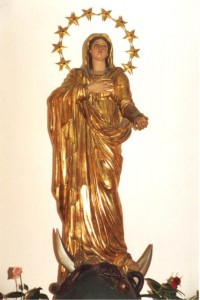 I have had a copy made of the rescript which authorizes superiors to bless the scapulars of the Immaculate Conception which the Chapter of 1837 adopted… This hidden apparel, which will be your own, must be dear to all the members of the Congregation. It will serve as the uniform which distinguishes us from the simple servants of Mary and which constitutes us exteriorly as her elite troops. On the day of oblation, it will be blessed solemnly just like the cross and placed momentarily on the soutane of the new Oblate. After the ceremony, he will hide it under the soutane, taking care to let the two pendants fall one on the chest and the other on the shoulders.
Letter to Father Jean Baptiste Honorat, 18 August 1843, EO I n 24
The meaning of the scapular continues to be expressed today:
We shall always look on her as our mother. In the joys and sorrows of our missionary life, we feel close to her who is the Mother of Mercy. Wherever our ministry takes us, we will strive to instil genuine devotion to the Immaculate Virgin who prefigures God’s final victory over all evil. CC&RR Constitution 10
Eugene continues to reflect on the meaning of the oblation of Brother Charles Baret, who has just professed his perpetual vows.
Accustom yourself, my dear son, to have confidence in the Lord, without reservation whatsoever. We must become entirely generous toward our Father who is so good and, at the same time, both so great and so powerful. There must be no reservations in the gift of ourselves to him. He knows your needs, he knows the lawful desires of your heart: that’s all that is needed. Rightfully he wants us to consider ourselves so honored, so happy to be admitted into the intimacy of his privileged disciples, that in exchange and in gratitude we give ourselves to him without reserve and without conditions… You consecrated yourself to God, to his Church, to the Congregation.
Goodbye, my dear son. In giving you my blessing for the first time, I embrace you with all my heart.
Letter to Brother Charles Baret, at Notre Dame de L’Osier, 18 August 1843