-
Recent Posts
- FOR THE REST, I DO MY BEST TO LEAVE IT TO GOD
- GOD ALONE KNOWS HOW TO REWARD WHAT WE HAVE DONE FOR HIM. SO, WE MUST DO EVERYTHING TO PLEASE HIM
- IT IS A CONSOLATION FOR ME TO BREATHE THE SAME AIR, TO OFFER THE HOLY SACRIFICE ON THE SAME ALTARS, TO BE ABLE TO PRAY AT HIS TOMB
- THERE IS NOT A CORNER OF ROME WHICH IS NOT A MONUMENT OF FAITH OR PIETY
- THE ROMAN MARTYRS ARE STILL THE OBJECT OF VENERATION OF PEOPLES
Recent Comments
- Eleanor Rabnett, Lay Oblate on FAITH-FOCUSED INVESTMENT GROUPS: A PRESENCE WHERE DECISIONS AFFECTING THE FUTURE OF THE POOR ARE BEING MADE (Rule 9a)
- Eleanor Rabnett, Lay Oblate on VIVAT: A PRESENCE WHERE DECISIONS AFFECTING THE FUTURE OF THE POOR ARE BEING MADE (Rule 9a)
- Eleanor Rabnett, Lay Oblate on WE SHOW A VERY HUMAN FACE OF JESUS TO THE WORLD, ONE FULL OF COMPASSION AND SOLIDARITY (Rule 9a)
- Eleanor Rabnett, Lay Oblate on JUSTICE, PEACE AND THE INTEGRITY OF CREATION AS AN INTEGRAL PART OF EVANGELIZATION (Rule 9a)
- Eleanor Rabnett, Lay Oblate on WALKING THE LINE BETWEEN PROPHETIC VISION AND SPIRITUAL SUSTENANCE (CONSTITUTION 9)
Archives
Meta
-
THERE ARE GLANCES WHICH HAVE A MARKED INFLUENCE ON ONE’S WHOLE EXISTENCE
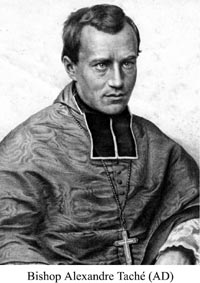
“There are glances which have a marked influence on one’s whole existence. The look which I laid upon Fathers Honorat and Telmon contributed in no small measure to the whole direction of my life.” (Alexandre Taché OMI)
Bishop Joseph Norbert Provencher of the Red River Colony (Manitoba), who needed priests to develop the works of his diocese, approached the Superior of the Canadian Oblate, Father Guigues, for help from the Oblates. Guigues hesitated because he did not have any missionaries to spare from their current commitments. Eugene acted swiftly and appointed Fr. Pierre Aubert and a young Canadian, Alexandre Taché to be the first two Oblates in Saint Boniface.
Yvon Beaudoin:
” When he had completed his classical studies he entered the major seminary in Montreal on September 1, 1841. On his way to the cathedral on December 3, the feast of Saint Francis Xavier, he saw the first six Oblates who had arrived in the city the day before. Later when he wrote about this event, he said his eyes fixed themselves with particular attention on their persons and on their Oblate crosses. “There are glances which have a marked influence on one’s whole existence. The look which I laid upon Fathers Honorat and Telmon contributed in no small measure to the whole direction of my life.”
He had hardly finished his theology when Bishop Ignace Bourget appointed him regent in Chambly College (1842-1843) and then, in January 1844, professor of mathematics in the seminary of Saint-Hyacinthe. On October 5, 1844, Alexandre began his novitiate in Longueuil. The novice master, Father Jean-François Allard, gave a very favourable judgement about him. He wrote to Bishop de Mazenod: “Brother A. Taché, from one of the most distinguished families in the country, everywhere enjoys a reputation for his talents: good memory, right minded, sound judgement, unusually sharp intellect, facility in speaking. All of these qualities are enhanced by his wisdom, an excellent education, and a refined politeness, which makes him stand out in all kinds of society. Besides, he is humble and prudent and his utterances are always to the point.” (https://www.omiworld.org/lemma/tache-bishop-alexandre/)
RAISE THE SIGN OF SALVATION, THE CROSS OF THE SAVIOUR JESUS
“Missionary zeal does not grow out of intellectual beliefs, nor out of theological arguments, but out of love. If I do not love a person I am not moved to help him by proofs that he is in need; if I do love him, I wait for no proof of a special need to urge me to help him.” (Roland Allen)
Father Pierre Aubert had been in Canada for two years. in 1846 the Superior General appointed him superior and founder of the first Oblate mission in the west in Saint-Boniface.
I have only a few moments, my dear, my very dear Father Aubert, to write to you and yet I would wish to converse with you for a whole day. …
Oh yes, my very dear friend, I love you also as a son and I consider you as an apostle, as the representative of our whole family, the vanguard of the army which must drive the demon from his last entrenchments and raise the sign of salvation, the Cross of the Saviour Jesus, in those regions where the true God never was known.
You are increasingly present to my mind and well to the fore in my heart. How would you think I could forget you whom I have chosen out of so many others for this great mission. I feel your needs, they weigh upon me also.
Letter to Father Pierre Aubert in St Boniface, Canada, 21 February 1846, EO I n 61
Gaston Carriere gives us more details:
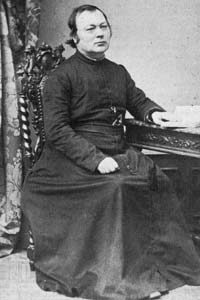 “Father Aubert was then appointed parish priest of St. Boniface Cathedral and Vicar General, positions he would hold for five years. He immediately began studying the Ojibwa language… Father Aubert left the West in 1850 and, until 1857, resided at the bishop’s house in Bytown (Ottawa), where he was Vicar General from 1851 to 1856, Superior of the bishop’s house from 1854 to 1857 and Chaplain of the Grey Nuns of the Cross (today the Sisters of Charity of Ottawa) from 1855 to 1857. It was in this last capacity that he worked on the constitution of the community. Appointed Superior of the House of St. Peter the Apostle of Montreal in 1857, Father Aubert acted as the theologian of the Most Reverend Ignace Bourget, Bishop of Montreal, at the Third Provincial Council, held in Quebec City in 1863…. He became ill and returned to France in 1865 where he became superior of the sanctuary of Notre-Dame de Lumières. Elected assistant to the Superior General two years later, he remained in Paris until his death. As an assistant, Father Aubert was a prudent advisor and intermediary between the Superior General and the Canadian authorities. No major decisions were made without consulting him. He was particularly interested in the works of the Oblates in Canada… In 1870, Father Aubert accompanied Bishop Guigues to the Vatican Council as a theologian.” (Gaston Carriere: https://www.omiworld.org/lemma/aubert-joseph-pierre-blaise/)
HE IS ANOTHER ME
“Trust has to be earned, and should come only after the passage of time.” (Arthur Ashe)
The Oblate presence in England started suddenly on an insecure foundation with the arrival of the just-ordained and inexperienced Father Daly. It was difficult for Eugene to find Oblates capable of learning and speaking English at such short notice. As the numbers grew, so was it necessary to ensure the presence of a mature Oblate to solidify the foundation. The person chosen was Father Casimir Aubert who could not be spared from his commitments in France, but who would visit England for long periods of time. Eugene wrote to Mr Phillipps:
Reverend Father Aubert, to whom I have given powers of Visitor, will have the honor of seeing you and discussing everything concerning the good of religion in your region. He is my alter-ego whose merits you already know.
Letter to M. Ambrose Lisle March Phillipps, Grâce-Dieu Manor, 2 July 1846, EO XIII n 107
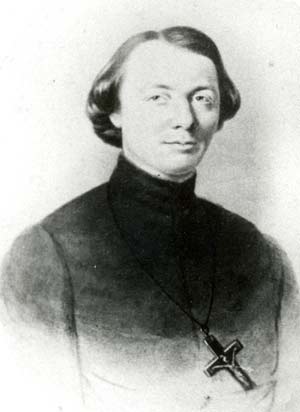 “Alter ego” is a Latin expression used by Eugene translated as “another me.” It meant that the Oblate had understood fully the spirit and way of governing of the Founder and was empowered to make decisions accordingly where Eugene was not present to be consulted. He considered all those whom he chose to be the founders of new missions, or appointed as official visitators, in countries outside of France as “alter ego.” Casimir Aubert was highly respected by Eugene.
Fr Michael Hughes fills in some details regarding this new Oblate venture in England.
“Ambrose Phillipps sought to establish himself in Grace Dieu Manor as the patron of a Mass-centre from which priests would go out to convert the locality…
On 5 September 1845 the community took possession of The Warren, a house placed at their disposal by Phillipps, some distance from the Manor House. It afforded the Fathers the privacy needed for their community life but was too far from the villages they served, and Ambrose agreed to build a new residence adjoining the Holy Cross chapel in Whitwick…
The first members of the community were Fr. Perron, superior, Fr. Naughten, Br. Bayeul, and a secular priest from Marseilles the Abbé Coussinier. Frs. Cooke and Tamburini, with John Noble not yet ordained priest, joining the community in July 1846.” (https://www.omiworld.org/lemma/grace-dieu-england-1845-1848/)
With small beginnings, the Anglo Irish province was to become one of the main providers of Oblate missionaries in all the English-speaking countries of the world.