Monday of the Second Week of Advent
And some men brought on a stretcher a man who was paralyzed; they were trying to bring him in and set him in his presence.
But not finding a way to bring him in because of the crowd, they went up on the roof and lowered him on the stretcher through the tiles into the middle in front of Jesus.
Lk 5:19-20
“We must overlook nothing, leaving nothing undared to advance, to extend the reign of Christ”
Eugene de Mazenod, Preface to the Rule, 1826
NOTE:
Thursday, December 8, is the Solemnity of the Immaculate Conception.
I invite you to look at the reflections written for this occasion in previous years:
https://www.eugenedemazenod.net/?p=4986
https://www.eugenedemazenod.net/?p=3271
https://www.eugenedemazenod.net/?p=2947
Join the ONLINE CONVERSATION “Let us walk hand in hand, with Mary”.
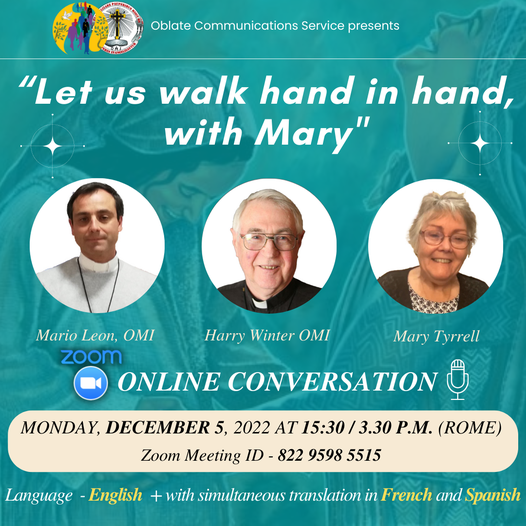
An open invitation to all the Mazenodian Family, to participate in this online conversation where Fr. Harry Winter OMI (USA), Mons. Mario Leon, OMI (Sahara) and the lay associate Mary Tyrrell (Anglo-Irish) will share their experience and expertise with us.
The discussion will be in English, with simultaneous translations in French and Spanish.
Date – Monday, 5th of December, 2022
Time – 15:30 / 3.30 P.M. (Please note that this is Rome time)
Duration – About an hour
Zoom Link –
Meeting ID – 822 9598 5515
Keep the date and time free!
Friday Advent Week 1
When he entered the house, the blind men approached him and Jesus said to them, “Do you believe that I can do this?” “Yes, Lord,” they said to him. Then he touched their eyes and said, “Let it be done for you according to your faith.” And their eyes were opened..
Matthew 9:28-30
Often the action of grace precedes the preaching of the Gospel and when hearts are touched by the first words of this marvelous preaching, they feel the need to open themselves with love to receive the divine seed sent to them from Heaven, but also to produce without delay the fruits of penance which then come to show themselves with all the characteristics of a sincere conversion
Eugene de Mazenod, Pastoral Letter on the Missions, 1844
Thursday Advent Week 1
“Everyone who listens to these words of mine and acts on them will be like a wise man who built his house on rock. The rain fell, the floods came, and the winds blew and buffeted the house. But it did not collapse; it had been set solidly on rock.”
Matthew 7: 24-25
This Holy Word resounds with the most admirable effects in our diocese; it has been heard in the villages and in the countryside as well as in the episcopal city, and it has been felt that, transmitted from Jesus Christ to his Apostles, it has lost none of its power as it has traversed the centuries; It was felt that, coming from the mouth of the One who is Himself “eternal life”, it is still “spirit and life” (Jn 6:64), it has brought life to those who have received it; it has been like a celestial light that has come to invest their souls and has made them know the truth
Eugene de Mazenod, Pastoral Letter on the Missions, 1844
Wednesday 30 November : St. Andrew
As Jesus was walking by the Sea of Galilee, he saw two brothers, Simon who is called Peter, and his brother Andrew, casting a net into the sea; they were fishermen. He said to them, “Come after me, and I will make you fishers of men.” At once they left their nets and followed him.
Matthew 4:18-19
What more beautiful ministry than that of forming in virtue, especially in the religious virtues, the chosen souls called by God to walk in the footsteps of the Apostles to spread the knowledge and the love of Jesus Christ! How much a person profits for oneself in leading others to perfection! This has turned out to be your lot. Rejoice over it, my son, and count on God’s help in this valuable ministry
Eugene de Mazenod to Father Dorey, Master of Novices, 15 October 1848, EO X n 990
Tuesday Advent Week 1
Turning to the disciples in private he said, “Blessed are the eyes that see what you see. For I say to you, many prophets and kings desired to see what you see, but did not see it, and to hear what you hear, but did not hear it.”
Luke 10: 23-24
It is then the mercies of the Lord I must proclaim… for he has quite exhausted the treasures of his grace for my sake…
Beginning with the happy moment when, regenerated in the saving waters of baptism, I was raised to the awesome dignity of child of God, filled with the gifts of my Saviour, I could more easily count the successive and rapid movements of my breathing than the number of the inestimable benefits that this adorable Master has poured out on me in generous measure.
Spiritual conference, 19 March 1809, EO XIV n 48
Monday Advent Week 1
“I say to you, many will come from the east and the west, and will recline with Abraham, Isaac, and Jacob at the banquet in the Kingdom of heaven.” Matthew 8:11
You will not find anywhere a group of wiser and more fervent youngsters. I’m going to send six to Texas, four to Red River and three to Ceylon. I am going to ordain them priests before their imminent departure as they are all deacons. We have never have had such a large number of them in the Congregation. We encompass the whole world with our apostles whose zeal and devotedness wring from me tears of joy and tenderness. They are going off happy to be chosen to announce the Good News without giving the impression that they are making the least sacrifice. How can we not admire the working of the Holy Spirit in these generous souls?
Letter to Father Charles Baret, 24 January 1852, EO XI n. 1098
[NOTE: Each year at around this time, I pause the daily chronological reflection on the writings of Saint Eugene. This year I have decided to “pause” but to do something different: a daily quote from Saint Eugene linked to the Gospel of the day of the liturgical season.]
“Let us all remember this: one cannot proclaim the Gospel of Jesus without the tangible witness of one’s life.” (Pope Francis)
As Superior General, Eugene was obliged to make decisions regarding the welfare of the Oblates outside of France, but he needed information to be able to do this. In the 19th century, letters between Canada and France took several months to arrive and Eugene found this frustrating. For this reason he insisted that all local superiors write to him every three months, and the others write once a year as a minimum. From the Superior of the whole Canadian mission, Fr Guigues, Eugene expected a more frequent and detailed communication, as he indicated in this letter:
Please greet for me affectionately Father Allard whose letter I at last received. It will give me pleasure if, in one of your first letters, you give me a personal account of all your members in the mission of America. Speak to me of the progress they are making in virtue, of the efforts they make to remove from their characters whatever may be defective, of their regularity and obedience, of their unity, of their capacity for different ministries, etc. This account should reach me at least once a year. So much for persons of whom not one is to be excepted.
You will do the same for the state of each house and each mission. Should this second report be too much for you to write, you can dictate it to Father Allard. Exactitude, precision, absence of exaggeration, confidence, simplicity, such I expect from you for my guidance.
Letter to Fr Eugene Guigues in Canada, 14 May 1846, EO I n 62.
What is of interest here is that Eugene’s main concern was not what the Oblates were doing as missionaries, but the quality of their lives: their being in order to do. He was convinced that they achieved more through witness than words.
“Challenges exist to be overcome! Let us be realists, but without losing our joy, our boldness and our hope-filled commitment. Let us not allow ourselves to be robbed of missionary vigour!” (Pope Francis)
Eugene had imagined that Fathers Aubert and the newly-ordained Taché would be living in community and ministering from there. Eugene was alarmed to learn that this would not be the case:
What Father Allard tells me about the Red River leaves me no choice but to be alarmed. Our two Fathers, he tells me, are going to be separated for a year. But it is not my intention that this be so. I cannot consent that our Fathers go alone into any kind of mission. Any kind of good (envisaged) should be dependent on that (policy). Explain this, I beg you, to their Lordships the Bishops and take this to be the rule of your own administration.
Letter to Eugene Guigues in Canada, 30 July 1846, EO I n 67
The missionary challenges of thousands of people who had not been evangelized made this impossible, as Yvon Beaudoin narrates.
Father Taché spent part of the winter in Saint-Boniface and the rest in Baie-Saint-Paul where he studied the rudiments of the Saulteaux language. On July 8, 1846, he left in the company of the diocesan priest, Father Laflèche, to found a mission at Île-à-la-Crosse. They spent the winter in the Hudson Bay Company station and studied Cree. Then Father Laflèche worked among the Indians near the trading post and Father Taché, throughout the summers of 1847, 1848, 1849 and 1850, made long journeys to Lake Caribou and Lake Athabaska. On March 25, 1847, Bishop de Mazenod wrote to Father Guigues: “I sigh to think of such a young priest, having just left novitiate and being separated by such a great distance from our confreres.” (https://www.omiworld.org/lemma/tache-bishop-alexandre/)
Eugene’s alarm was to be multiplied and constantly repeated for the rest of his life: apostolic community and missionary zeal were two essential aspects of his charism – but how to maintain a balance in these essentials when the need for evangelization of people was so pressing?
“Every Christian must be convinced of his fundamental and vital duty of bearing witness to the truth in which he believes and the grace that has transformed him.” (St. Pope John XXIII)
In France, Eugene knew all the Oblates and they had no doubt about his affection for them as the father of a missionary family. He had never met the Canadian Alexandre Taché but wished to assure him that he was a loved member of the family, even though they had never met.
Reverting to the subject of Brother Taché whom I have not yet come to know, I await from him a little letter showing me his handwriting for in lieu of the person, it is something to see some lines traced by the hand of one we cannot see, but whom we already love by virtue of the admirable union of charity which makes all of us but one heart and one soul. I enjoin you earnestly, my dear son, to express to him all the sentiments which you know me to have for the children the good God has given me.
As members of the Missionary Oblate family, Fathers Aubert and Taché, had a particular lifestyle to live.
As of now, you only form quite a small community. No matter. Conform yourselves to the Rule as much as you possibly can. Although you are only two, nothing prevents you from doing several things in common: your morning and evening meditations, your office, your examen. You will thereby accomplish a duty and those who live in the house of the Bishop will be edified. Remember that wherever you are, you must always be what you are.
Letter To Fr Pierre Aubert, St Boniface Canada, 21 February 1846, EO I n 61