-
Recent Posts
Recent Comments
- Eleanor Rabnett, Lay Oblate on THROUGH A GIFT OF THE FATHER OUR OBLATE FAMILY CHOOSES THE WAY OF THE EVANGELICAL COUNSELS (C12)
- Eleanor Rabnett, Lay Oblate on THE EVANGELICAL COUNSELS ARE INDISPENSABLE (C12)
- Eleanor Rabnett, Lay Oblate on ALL MEMBERS OF THE OBLATE CHARISMATIC FAMILY CHOOSE THE WAY OF THE EVANGELICAL COUNSELS (C12)
- Eleanor Rabnett, Lay Oblate on BEATITUDES: TO CONTINUALLY RENEW OURSELVES IN THE SPIRIT OF OUR VOCATION (C11)
- Eleanor Rabnett, Lay Oblate on LEAVEN OF THE BEATITUDES AT THE HEART OF THE WORLD (C 11)
Archives
Meta
-
WE MUST HAVE GREAT DEVOTION TO MARY (C10)
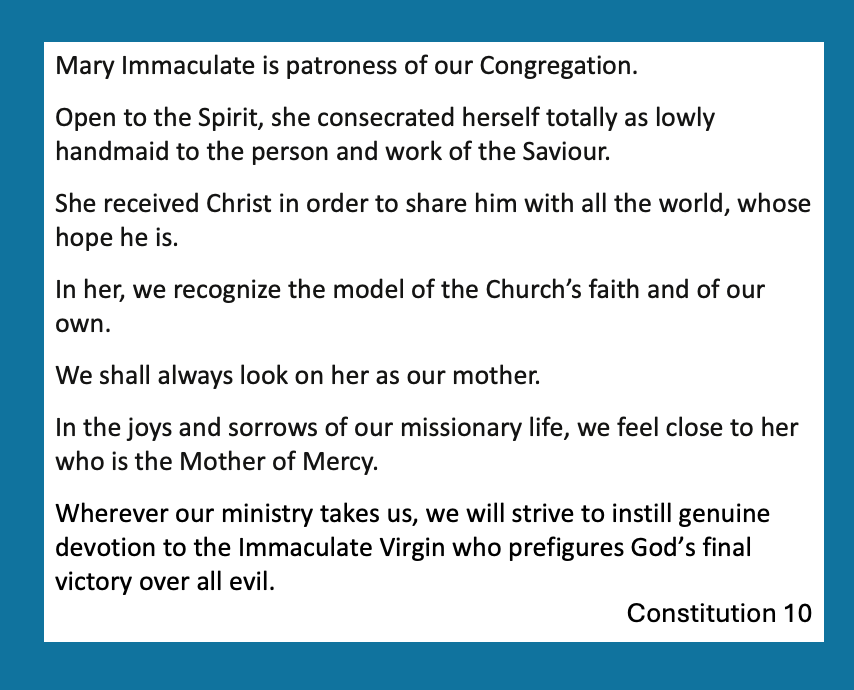
We shall always look on her as our mother.
In the joys and sorrows of our missionary life, we feel close to her who is the Mother of Mercy. (Constitution 10)
After a year as seminarian in St Sulpice in Paris, Eugene reveals in his journal on the place of Mary in his spirituality:
But devotion to the Blessed Virgin must excel all others; for the glorious Mother of God is called by the Church: our life and our hope. It is morally impossible for a soul to make any progress in the ways of perfection if it lacks this tender and sincere devotion to the most holy Mother of God.
General counsels for achieving perfection, notes taken in 1809, EO XIV n.39
Fifteen years later, he rejoiced that Mary Immaculate continued to have a special devotion in his Missionary Family, as it continues to have today.
May we really understand who and what we are! I hope the Lord will grant us this grace with the help and by the protection of our holy Mother, Mary Immaculate. In our Congregation, we must have great devotion to her.
To Fr. Tempier in Marseilles, 20 March 1826, EO VII n. 231
Posted in WRITINGS
Leave a comment
THROUGH MARY’S ROSARY WE ENTER INTO CLOSER UNION WITH JESUS CHRIST (C10)
In her, we recognize the model of the Church’s faith and of our own. (Constitution 10)
“As for Mary, she treasured all these things and pondered them in her heart” (Luke 2:19). It was the pattern of Mary’s intimate relationship with Jesus and her contemplation of his “virtues and example” that would be the model for the Oblate:
… the Blessed Virgin, to whom they will all have a special devotion and great affection. To this effect they will recite the rosary every day.
1818 Rule, Part Two, Chapter One. §5 On prayer and exercises of piety
Today:
With Mary Immaculate, the faithful handmaid of the Lord, and under the guidance of the Spirit, we enter into closer union with Jesus Christ. We will contemplate with her the mysteries of the Incarnate Word, especially in praying the rosary.
CC&RR, Constitution 36
WE MUST BE CAREFUL NOT TO VENERATE IMAGES OF MARY IF THEY OBSCURE THOSE REQUIRED BY THE PRESENCE OF JESUS CHRIST (C10)
In her, we recognize the model of the Church’s faith and of our own. (Constitution 10)
Bishop Eugene had been horrified when he went to a church on a Marian feast and had seen that the statue of Mary had been so honored that the tabernacle had been used as its pedestal. He resolved to make sure that this abuse never happened again in his diocese. These two extracts from his Pastoral Letters, written 20 years apart, are an example of his teaching:
Thus it is the Son whom we honour in the person of the Mother and this is why, in our homage to Mary, it is impossible to overstep the limit, provided we consider her a creature, because God then always remains the supreme focus of all this homage.
Bishop Eugene’s Pastoral Letter to the Diocese of Marseille, 8 July 1849.
We never give too much honour to the Blessed Virgin, provided devotion to her is understood and practised in the limited sense of what is due to a creature, however great and sublime she may be.
We must be careful however, lest we pay to ordinary images of God’s Mother a veneration whose external signs seem to obscure those required by the presence of Jesus Christ. On the contrary, the devotion which our faith and love addresses to the adorable Eucharist, must, in proportion to our humble means, be far superior to what we generally accommodate and have for Mary Immaculate.
Bishop Eugene’s Pastoral Letter to the Diocese of Marseille, 21 December 1859.
Posted in WRITINGS
Leave a comment
SHE IS SO GREATLY HONORED ONLY BECAUSE SHE IS THE MOTHER OF JESUS CHRIST (C10)
In her, we recognize the model of the Church’s faith and of our own. (Constitution 10)
As much as Eugene loved Mary, he was always aware f the importance of never giving Mary the first place: she is honored only because she helps us to have a greater dedication to her Son.
Mary’s power of intercession and maternal love are acclaimed everywhere, and in our day devotion to her has increased to a wonderful extent. It is in the highest honour as it was in times of great faith. We bless the Lord for this. This multiple homage honouring the Mother of God marks a period of renewal in faith. From Mary, it reaches her divine Son, since is so greatly honoured only because she is the Mother of Jesus Christ. Mary’s name is invoked with so much of confidence, that she may intercede for us with her divine Son, who is thereby acknowledged as the author of all grace.
Bishop Eugene’s Pastoral Letter to the Diocese of Marseille, 21 December 1859.
Posted in WRITINGS
Leave a comment
SHRINES OF MARY AS SPECIAL PLACES OF APOSTOLIC MISSION (C 10)
She received Christ in order to share him with all the world, whose hope he is. (Constitution 10)
For Eugene, Marian shrines were special places of mission for the Oblates. Together with our patroness, the Oblates were able to imitate her in making the Savior present in the lives of those they ministered to.
On our arrival at Notre-Dame de l’Osier to make a visitation of the new establishment that divine Providence has entrusted to our Congregation, our first concern was to thank the Lord for the remarkable favour he was pleased to bestow on us in calling us to this shrine to restore the devotion to the Most Holy Virgin, and to draw from the bosom of this good Mother the graces needed by the members of our Institute to accomplish worthily the apostolic ministry they are to do in these regions.
Act of Visitation of the house of N.D.de L’Osier, July 16, 1835
He expresses this sentiment even more clearly in praising the mission of our first Marian sanctuary, Notre Dame du Laus. The same sentiment remains true of all our Marian shrines today is many countries.
Surely this is an enchanting spectacle! When we consider that the Lord in this single place presents our Congregation with the means powerfully to achieve all the ends of its Institute — for also from here our missionaries go forth to evangelize all the people of the environs and even farther afield, and this family centre is definitely one of the most famous shrines of our holy Mother and Patron – we have ample reason to be swept away by consoling happiness, or, better still, ample reason to humble ourselves before God in our helplessness fully to appreciate such a gift, such evident protection.
Act of Visitation of the house of N.D. du Laus, October 18, 1835
Posted in WRITINGS
Leave a comment
MARY HAS GIVEN US HIM WHO IS THE WORLD’S LIFE AND SALVATION (C10)
She received Christ in order to share him with all the world, whose hope he is. (Constitution 10)
Mary, the first missionary! Throughout his ministry, Eugene shared his love for Mary.
Nothing is more precious for enlightened devotion than that which concerns the honour of the Blessed Virgin Mary. Here we meet all that exists in a son towards his mother. And what a Mother! She has given us him who is the world’s life and salvation, she has engendered all of us spiritually at the foot of the Cross through the sufferings of the passion and death of God Incarante, the blessed fruit of her womb; she is rightly called the new Eve and the co-re-demptrix of the human race.
Bishop Eugene’s Pastoral Letter to the Diocese of Marseille, 8 July 1849.
Mary, the first Christian missionary accompanies us to welcome her Son into our lives and mission every day
Posted in WRITINGS
Leave a comment
AN ELEMENT OF MISSION IS INVITING PEOPLE TO SHARE IN MARY’S CONSECRATION (C 10)
Open to the Spirit, she consecrated herself totally as lowly handmaid to the person and work of the Saviour. (Constitution 10)
The personal consecration of the Missionaries was something that they shared with the people in their ministry. During the parish missions they always organized a procession focused on Mary. Eugene wrote,
The consecration to the Blessed Virgin is made when the procession held in honour of the Mother of God comes back; it is obligatory. It is made from the pulpit, before the Blessed Virgin’s statue, placed on a throne, as beautiful as the locality can provide.
Letter to Fr. Bruno Guigues, 5 November 1837, EO. IX n. 652
The procession was meant to lead the people to make a personal and community act of commitment to following Mary’s Gospel example of discipleship as Christians, and of having Mary as intercessor and guide.
The recitation of the rosary and the teaching and dissemination of its use as a Gospel meditation prayer also formed part of the program of the missions.
Posted in WRITINGS
Leave a comment
CONSECRATED TO HER IN A SPECIAL MANNER AND TO BEAR HER NAME (C10)
Open to the Spirit, she consecrated herself totally as lowly handmaid to the person and work of the Saviour. (Constitution 10)
Eugene’s vision for the Oblates:
My consistent thought has always been that our little family should consecrate itself to God and to the service of the Church through the vows of religion.
Rambert, I p. 187
Mary is the model and accompanier of our consecration
May we truly understand who we are! I hope that the Lord will grant us this grace, with the assistance and protection of our holy Mother, the Immaculate Mary, to whom we must have great devotion in our Congregation. Does it not seem to you that it is a sign of predestination to bear the name of Oblates of Mary, that is, consecrated to God under the patronages of Mary, whose name the Congregation bears, like a family name shared with the most holy and Immaculate Mother of God?
To Fr. Tempier in Marseilles, 20 March 1826, EO VII n. 231
As we are guided by the charism and try to live our lives in its spirit, we are never alone.
Admit that it will be as glorious as it will be consoling for us to be consecrated to her in a special manner and to bear her name.
The Oblates of Mary!
This name satisfies the heart and the ear.
Letter to Henri Tempier, 22 December 1825, EO VI n 213
Posted in WRITINGS
Leave a comment
WE ARE MEMBERS OF A FAMILY THAT HAS MARY AS MOTHER AND PATRON (C10)
Open to the Spirit, she consecrated herself totally as lowly handmaid to the person and work of the Saviour. (Constitution 10)
The witness of the Oblates of Mary Immaculate in Canada immediately drew others to join us in our vocation. Fr. Damase Dandurand was the first Canadian to become an Oblate. Eugene wrote to him:
I could not receive, my dear Father Dandurand, a more agreeable present for the holy season of Christmas than the letter you wrote on the occasion of your approaching oblation. When it was delivered to me, your consecration to God had already taken place and you were decidedly one of us, that is, you had become member of a body which has Mary for Mother and which, under her patronage, wherever her members are to be found, wages the battles of the Lord to destroy the empire of the demon and spread with all its might the Kingdom of Jesus Christ.
Already, I know, you have put to the test your strength in this warfare and by divine grace you have reaped abundant blessings.
Letter to Fr. Dandurand, February 1843, EO I n 15b
However we express our commitment in the Oblate Family, we can be assured we have “become members of a body which has Mary for Mother and which, under her patronage” we can bring the Good News of salvation to those most in need – and be protected against the power of evil.
Posted in WRITINGS
Leave a comment