-
Recent Posts
Recent Comments
- Eleanor Rabnett, Lay Oblate on THROUGH A GIFT OF THE FATHER OUR OBLATE FAMILY CHOOSES THE WAY OF THE EVANGELICAL COUNSELS (C12)
- Eleanor Rabnett, Lay Oblate on THE EVANGELICAL COUNSELS ARE INDISPENSABLE (C12)
- Eleanor Rabnett, Lay Oblate on ALL MEMBERS OF THE OBLATE CHARISMATIC FAMILY CHOOSE THE WAY OF THE EVANGELICAL COUNSELS (C12)
- Eleanor Rabnett, Lay Oblate on BEATITUDES: TO CONTINUALLY RENEW OURSELVES IN THE SPIRIT OF OUR VOCATION (C11)
- Eleanor Rabnett, Lay Oblate on LEAVEN OF THE BEATITUDES AT THE HEART OF THE WORLD (C 11)
Archives
Meta
-
WE ARE MEMBERS OF A FAMILY THAT HAS MARY AS MOTHER AND PATRON (C10)
Posted in WRITINGS
Leave a comment
MARY’S CONSECRATION AS A RESPONSE TO THE GREAT THINGS GOD DID IN HER (C10)
Open to the Spirit, she consecrated herself totally as lowly handmaid to the person and work of the Saviour. (Constitution 10)
Each year of Eugene’s seminary formation began with a retreat.
Up to now I can only speak of the life we are leading during the retreat, which is now unfortunately coming to an end. We are finishing tomorrow with a feast which fills the seminary with its fragrance and is proper to it. It is the feast of the Interior Life of the Holy Virgin, that is to say of all the virtues and the greatest marvels of the Almighty. What a lovely feast! And how fully I am going to celebrate with the most holy Virgin all the great things God did in her!
Oh, what an advocate at God’s side! Let us be dedicated to her; she is the glory of women.
Letter to his grandmother, 18 October 1810, EO XIV n 29
Eugene’s devotion to Mary was always connected with God. She was the marvelous instrument who witnessed to the wonders God worked in her and in people through the incarnation.
With her example and intercession, she constantly focuses us on Jesus.
Posted in WRITINGS
Leave a comment
MARY SMILES AT THE OBLATE FAMILY (C10)
Mary Immaculate is patroness of our Congregation.
Constitution 10
We go back to 1822. In the midst of all his concerns for the survival of his newly-founded Missionary family, Eugene celebrated the feast of the Assumption. It was a moment which was to leave a permanent impression on our Oblate Charismatic Family.
Eugene’s letters of 1822 show the many concerns and difficulties he was experiencing. Not least among these was his worry about the survival and future of his small group of Missionaries. It was in this spirit that he blessed the new statue in the chapel, which became the opportunity for a powerful life-giving insight. He immediately wrote to Henri Tempier, who was in Laus.
I believe I owe to her also a special experience that I felt today; I will not go so far as to say more than ever, but certainly more than usual.
Eugene was usually very reticent about describing his deep spiritual experiences. His “more than usual” experience was connected with the life of the Missionaries of Provence, who were experiencing external difficulties and whose future existence was in the balance.
I cannot describe it too well because it covered several things, but all related to a single object, our dear Society.
He then described the confirmation that he received that the foundation of the Missionaries had come from God and that God assured him of a solid future for this group.
It seemed to me that what I saw, what I could put my finger on, was that within it lies hidden the seed of very great virtues, and that it can achieve infinite good; I found it worthy, everything pleased me about it, I appreciated its rules, its statutes; its ministry seemed awe-inspiring to me, as it is indeed. As I looked at the Society I found in it a sure, even infallible, means of salvation.
Letter to Henri Tempier, 15 August 1822, EO VI n 86
Here we understand why Mary is the mother and patroness of our Oblate Family. She smiled at Eugene and c0ntinues to smile today at his Oblate Family and each of us.
Posted in WRITINGS
Leave a comment
OBLATE STUDIES: AN INVITATION
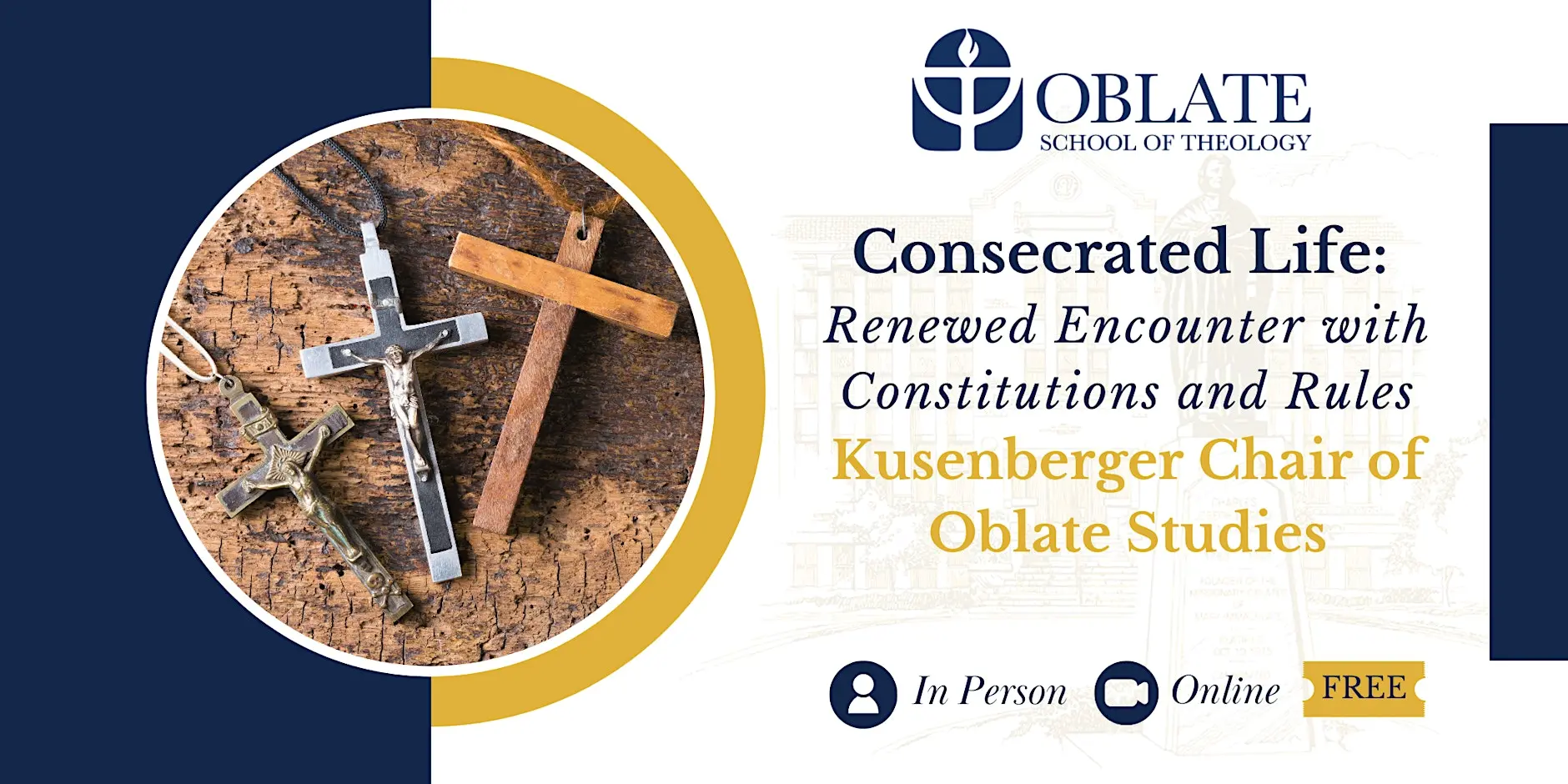
PLEASE JOIN US IN PERSON OR ONLINE ON SATURDAY 9 MAY (0900 US central time)
For further details: https://www.eventbrite.com/e/consecrated-life-renewed-encounter-with-constitutions-and-rules-tickets-1730984484189?aff=ebdsoporgprofile
Posted in WRITINGS
Leave a comment
MARY IMMACULATE AS A MODEL FOR US TO LIVE OUR OBLATE CHARISM (C10)
In concluding the first ten Constitutions, which present the key elements of our charism, we are offered the figure of Mary Immaculate as a model of how to live the charism.
Mary Immaculate is patroness of our Congregation.
Constitution 10
While in Rome in 1825, Eugene changed the name of the Missionaries and gave us a new identity with corresponding responsibilities:
Let us renew ourselves especially in devotion to the most holy Virgin and render ourselves worthy to be Oblates of the Immaculate Mary. But this is a passport to heaven!
Letter to Henri Tempier in Marseilles, 22 December 1825
Father Jetté wrote: “To be ‘patroness of our Congregation’ means that Mary Immaculate is at one and the same time the one who protects and keeps us, who intercedes for us in a special way in the presence of her Son, and who also serves us as a model and an inspiration. Article 10 particularly insists on this latter aspect: Mary is the model of our oblation, of our missionary zeal, of our faith.”
How blessed our Oblate Family is to have this special relationship with Mary!
Posted in WRITINGS
Leave a comment
THE UPHILL BATTLE TO PROPOSE JESUS AND THE APOSTLES AS THE MODEL FOR ALL CHRISTIAN GROUPS
The community of the Apostles with Jesus is the model of our life.
Our Lord grouped the Twelve around him to be his companions and to be sent out as his messengers (cf. Mk 3:14). (Constitution 3)
Apostolic community was the foundation and the reason for the success of all the Oblate ministries. Eugene was convinced of the efficacity of this Biblical model of discipleship which gave witness to the ongoing presence of the Savior – despite the human difficulties sometimes encountered.
Once he had been installed as Bishop of Marseilles, one of his first actions was to insist that the diocesan priests stop living alone, or with their families, and come to live together as a community of priests in the parish they cared for. Eugene was convinced of the importance of community life and the mutual priestly support needed for successful parish ministry. It was to be an uphill battle for the next 24 years, because the majority preferred their independence to the yoke of community life
Letter to M. Gay, parish priest of Cassis, to invite him to come to an agreement with me regarding the arrangements for the new situation that I have arranged for him. I very clearly express to him my unshakable intention of establishing community life for the pastor and the curates in all the parishes successively, while starting with his.
Eugene de Mazenod’s Diary, 11 February 1838, EO XIX
Constitution 3 can provide a model for all our groups. Today it is the foundation of the synodal process which bears abundant fruit in many situations.
Posted in WRITINGS
Leave a comment
THE PRESENCE OF JESUS CHRIST BINDS US TOGETHER IN CHARITY (C3)
The call and the presence of the Lord among us today bind us together in charity and obedience to create anew in our own lives the Apostles’ unity with him and their common mission in his Spirit.” Constitution 3
“Among yourselves, charity, charity, charity.” This death-bed wish of Eugene for his Oblate family reflected his lifetime of insistence that:
Charity is the pivot on which our whole existence turns.
Charity begins with God, and our call is to give everything to God in loving oblation.
That which we ought to have for God makes us renounce the world and has vowed us to his glory by all manner of sacrifice, were it even to be our lives.
Letter to Hippolyte Guibert, 29 July 1830, EO VII n 350
It is this charity, in oblation of self to God for others, that makes us truly members of a witnessing missionary family.
Posted in WRITINGS
Leave a comment
THE CALL AND PRESENCE OF THE LORD AMONG US TODAY (C3)
The call and the presence of the Lord among us today bind us together in charity and obedience to create anew in our own lives the Apostles’ unity with him and their common mission in his Spirit. (Constitution 3)
This is the model for our Oblate apostolic communities, and the ideal of our Oblate Family. Community exists to help us to focus together on the presence of the Savior who invites us to stay with him, and to share this experience with others.
Eugene’s mandate continues today in our Oblate Family’s wonderful mission of making Jesus Christ known and extending his kingdom as we walk in the footsteps of the Apostles
By growing in unity of heart and mind, we bear witness before the world that Jesus lives in our midst and unites us in order to send us out to proclaim God’s reign. (Constitutions and Rules, C37)
Cardinal Martini’s words sum it all up: “Essentially, what are the disciples? They are Jesus himself who continues his actions. They are not the repeaters of what they have heard, but they are the actions of Jesus that increase and continue.”
Posted in WRITINGS
Leave a comment
THE INVITATION TO ENTER INTO THE DYNAMIC OF FRIENDSHIP WITH JESUS AND THE APOSTLES (C3)
The community of the Apostles with Jesus is the model of our life.
Our Lord grouped the Twelve around him to be his companions and to be sent out as his messengers (cf. Mk 3:14). (Constitution 3)
Eugene’s understanding of the Oblate vocation was to a lifestyle and mission that was as close as possible to that of Jesus and his apostles, and in our first Rule he defined us as being:
“called to be the Saviour’s co-workers, the co-redeemers of mankind.”
Eugene was convinced of the need to go deeper than just actions – they had to imitate the virtues, the deepest bonds that existed between Jesus and his apostles. It was a call to be penetrated through and through by the profoundest aspects of this relationship:
I do not call you servants any longer, because the servant does not know what the master is doing; but I have called you friends, because I have made known to you everything that I have heard from my Father. (John 15:15)
For our Oblate Charismatic Family this is the meaning of oblation: a commitment to being friends of Jesus and living the fullness of communion and intimacy with him as apostolic missionaries.
Posted in WRITINGS
Leave a comment
THE BE-ATTITUDES: HEART AND HEAD -CHARITY AND OBEDIENCE
The call and the presence of the Lord among us today bind us together in charity and obedience to create anew in our own lives the Apostles’ unity with him and their common mission in his Spirit. (Constitution 3)
Today we use the word “holistic” to describe the totality of our commitment. Eugene’s vocabulary for this same concept in the 1818 Rule, and later, was “charity and obedience.” In other words, “heart and head.”
To “imitate in everything the example of our Lord Jesus Christ and the apostles” meant a commitment to BE with heart and head.
Charity and obedience mirrored the two portions of the life of the Missionary. A total love of the Savior and an unswerving obedience to His will, on the one hand. At the same time there was the outward direction towards others:
They will all be united by the bonds of the closest charity, and in perfect subordination to the superiors, in dependence to whom they will live the exact practice of holy obedience.
1818 Rule, Part Two, Chapter One. Regarding other principal observances
The Missionaries were to be a united body connected by the bonds of Christian love and their attentiveness to the will of God as manifested to the community.
Heart: love one another and God.
Head: listen to God’s will as it is shown in one another, and especially in the Rule and through the one responsible for the guidance and well-being of the community.
Posted in WRITINGS
Leave a comment