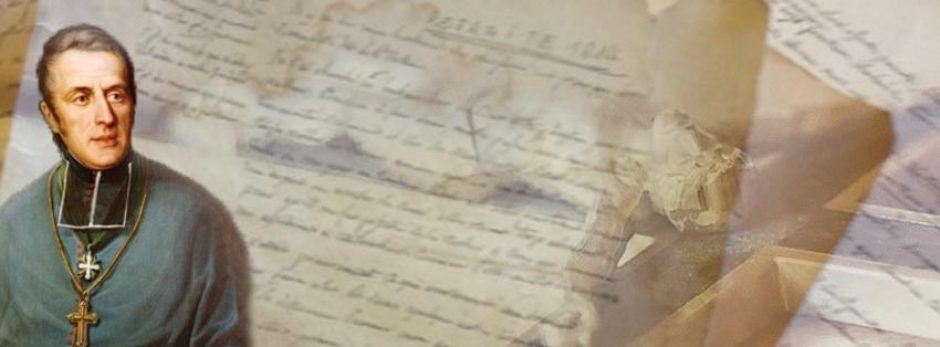
Now that the work that God has called me to has been achieved, what could be a more happy event for me than to die, especially if the sacrifice of my life were to be accepted not only as expiation for my sins, but as a holocaust to the Lord, to appease God’s anger and to turn away God’s scourge from my people and especially from our priests whose life is so precious. Up to now only one of them has died, our poor Abbé Martin; but all of you are threatened.
Letter to Fr. Henri Tempier, 12 September 1849, EO X n 1018
REFLECTION
Let us not be distracted by the theological language of two centuries ago: today we have a different understanding of natural disasters and epidemics. What is important in this extract is that Eugene did offer his life for the salvation of his people in Marseilles.
From the time of Eugene’s conversion journey, he wanted every aspect of his life to be an oblation, “all for God.” It was in the spirit of early centuries of the Church where the highest expression of oblation was martyrdom, the total gift of self to God. What is interesting about Eugene is that this martyrdom was to be achieved as a result of a gift of himself to God through serving others. For this reason we speak of the martyrdom of charity, as opposed to the martyrdom of blood.
I have all my life desired to die a victim of charity. You know that this crown was withheld from me right from the first days of my ministry. The Lord had his designs since He wanted to trust me to give a new family to His Church; but for me it would have been a greater value to have died of the blessed typhus which I had contracted while serving prisoners.
Letter to Fr. Henri Tempier, 12 September 1849, EO X n 1018
REFLECTION
From the time of his ordination to the priesthood, Eugene had desired to give his life totally in martyrdom at the service of others. It nearly happened in 1814 when he almost died of typhus while ministering to Austrian prisoners of war. But God had other plans: he was to be God’s instrument in founding the Missionary Oblates.
How many martyrs of charity have we known in our lives? Not people who shed their blood in martyrdom, but rather sacrifice themselves for the good of others in their daily lives. My life is inspired and enriched by my encounter with many each day.
We are here under the fatal influence of cholera, which takes from us some 40, or 30, 20, or 25 people each day. Those who come here are in danger. Yesterday a whole family of five people died on coming back to the city after having gone away at the beginning of the epidemic. You must know that I did not consider this danger when my duty called me back to my flock, but up to now I have felt no symptoms of the illness. None of ours has been attacked.
Letter to Fr. Ferdinand Grenier, in Nancy, 30 September 1849, EO X, n 1023
Bishop Eugene and the diocesan and Oblate clergy courageously ministered to those afflcited by the cholera epidemic.
The cholera continues with the same intensity; but sudden horrible cases are rather rare. Since I’m back, I have gone to confirm many of these poor victims on their death-bed, and I have felt no other pain than the anguish, which I cannot guard against in the sight of such disasters.
Letter to Fr Ambroise Vincens at N. D. de L’Osier, 12 October 1849, EO X n 1024
REFLECTION
“The end of life deserves as much beauty, care and respect as the beginning.” (Author unknown)
Eugene had been visiting the Oblate communities in the center of France and while in the area had also taken the opportunity to do the baptism of the child of his niece, who was about to give birth. News reached him of the outbreak of a cholera epidemic in Marseilles.
My concern is so great that I fear I will fall sick from it. The thought of what is going on in Marseilles fills my soul with bitterness. I find no happiness in finding myself among my family, my duty calls me elsewhere.
Eugene reminds Tempier that his absence is not from fear, which is something he never showed
You know me well enough to be convinced that the least thought of fear did not even enter my mind. I have all my life desired to die a victim of charity.
Letter to Fr. Henri Tempier, 12 September 1849, EO X n 1018
REFLECTION
Eugene’s love for God was so great that he wanted his whole life to be an oblation to God. This not in theory, but in loving and self-sacrificial service.
“I say to you, whatever you did for one of these least brothers and sisters of mine, you did for me.” (Matthew 25: 40)
Second of August, anniversary of my Baptism. Mass with the Capuchin Sisters. This Mass has become an institution on this day. I can think of no greater help than the prayers of these holy ladies to thank God for a benefit such as that of my regeneration.
Eugene de Mazenod’s Diary, 1 August 1849, EO XXII
REFLECTION
For Eugene the anniversary of his baptism was more important than his birthday. It was the anniversary of his being born into the life of Jesus Christ.
” The Christian community welcomes you with great joy. In the name of all of us here present and all of God’s people, I claim you for Christ by the sign of the cross.” (Rite of Baptism)
The end of my 67th year. I am entering my 68th. Thus the years add up without one being aware of it. We go forward to the tomb year by year. Nevertheless, it is possible to measure the distance travelled on the day on which our attention is fixed on celebrating the anniversary of our entry to the world. What does it matter that one has no infirmities and feels as though one were only thirty years of age. One is obliged to take account of the day which recalls that of one’s birth.
Eugene de Mazenod’s Diary, 1 August 1849, EO XXII
REFLECTION
Eugene had had some severe health complications earlier in his life which had necessitated long periods of recuperation. Once he became Bishop of Marseilles, in addition to being Superior General of the Oblates, he had a heavy schedule of commitments that seemed to have rejuvenated him – making him feel as if he were still 30 years old!
We call this the “grace of state” where God gives us the graces and strength necessary to fulfil his work. St Paul refers to this when he exclaims:
“The Lord said to me, ‘My grace is sufficient for you, for power is made perfect in weakness.’ So, I will boast all the more gladly of my weaknesses, so that the power of Christ may dwell in me.” (2 Corinthians 12:9)
Today, the anniversary of the death of our good Father Mie, I learn of that of Fr. Frederic Michel. He was one of our best men, filled with virtues, but virtues quite uncommon, talented and learned to the full, a well formed man he was. He left the seminary of Grenoble for the novitiate the very day of his ordination, not wishing even to visit his parents. He was the 200th of our Oblates and had made his profession only a few months previous; it is a great loss.
Letter to Fr. Telmon, 10 March 1849, EO I n 113
Fr. Frederic Michel died suddenly just after preaching his first parish mission, as Eugene noted in his diary:
Disturbing news of the death of Fr. Michel. He had just finished the mission in Saint Bonnet where he had given proof of his great zeal and generosity. Fr. Lavigne who gave this mission with him, wrote to tell me that he had acted like a saint. I fear that Fr. Lavigne was not able to moderate his zeal or to require that he take more care of himself personally. I am very much afraid that what Fr. Lavigne calls a cold was an irritating cough and perhaps the beginnings of a chest infection which the poor man who died was unwilling to care for. God will reward him, but the death of a good subject is a great loss for the Congregation.
Eugene’s diary, 10 March 1849, EO XXII
REFLECTION
“By dying young, a man stays young forever in people’s memory. If he burns brightly before he dies, his light shines for all time.” (Aleksandr Solzhenitsyn)
Young fathers Charles Gondrand and Charles Baret were in the Oblate community in Limoges and had written a much-appreciated letter to Eugene. Inundated with work, he had delayed in responding.
If, through the instigation of the spirit, my dear sons Gondrand and Baret, you may have judged your father badly, what regret should you not feel when you see these few lines, a witness of my remembrance and tender affection for you…
Do you not see your letter on my desk, buried under a pile of other papers? Not a day goes by that it does not several times pass through my hands when I am rummaging and re-rummaging to find out what is the most urgent matter to be taken care of. Well, each time that I touch it or that my eyes focus on it, the sight of it prompts in my soul an affectionate sentiment that I express even exteriorly with love. Dear children, I tell myself, you wait for my answer. At another time: there is that letter again! If they only knew how much I love them! Is there really need to tell them? And again: why can I not talk with them instead of writing to them and how I would hold them to my heart! What would I say to you? It is a continual monologue, or rather a dialogue, for you are always present to me, so much so are you personified in my heart.
Letter to Fathers Charles Gondrand and Baret, 25 February 1849, EO X n 998
REFLECTION
“Letter writing can be seen as a gift because someone has taken his/her time to write and think and express love.” (S. Coffelt)
The father of the Oblate family’s concern for his children:
Daylight is fading and so is time to prolong this good conversation with you. I hasten to embrace you and bless you, as well as the whole family confided to you. I have no need to recommend myself to the prayers of all my children, but tell them that every day at Holy Mass they are present in my thoughts and also in the evenings when I am before the Blessed Sacrament. That happens quite often at half past ten or eleven o’clock. I am forced to do this by my daily occupations, but it is also a consolation for me to keep watch before the Lord’s tabernacle while all my children are resting in quiet sleep.
Letter to Fr. Louis Dassy in Nancy, 13 February 1849, EO X n 997
REFLECTION
This practice of oraison, of prayer in communion before the Blessed Sacrament, is one of St Eugene’s gifts to us. As the founder and father he daily made present all the people he loved when he communed with them in the presence of Jesus. As a saint he continues to do this for us, but also encourages us to do likewise with the people we love.
From the beginning of our existence, the aim of Oblate preaching was to catechize: to teach people who the Savior is and to educate them in the contents of our faith. Fr Hippolyte Courtès had started a course of teaching catechism in Aix. Eugene encouraged him:
I see no difficulty in the course you have taken. It would have been difficult to refuse such a proposal which, besides, fits rather well into the objectives of our Congregation. In practice, you will have to oversee this teaching by laypeople which can be rather imperfect and insufficient. You will have to know how to make this catechism interesting, for it must be something more than an ordinary catechism. For that you will need to draw up a plan of instructions, which will certainly be based on what is elementary, but which will go a little more deeply into the science of religion. Our great plague is ignorance. We must do all we can to counteract it.
Letter to Fr. Hippolyte Courtès in Aix, 10 January 1849, EO X n 995.
REFLECTION
“Being a catechist is not a title; it is an attitude of abiding with him, and it lasts a lifetime! It means abiding in the Lord’s presence and letting ourselves be led by him.” (Pope Francis)