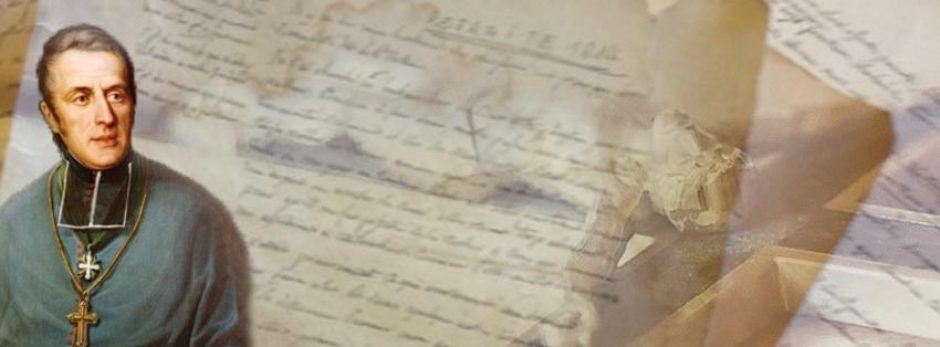
The Bishop of Ajaccio, Corsica, was unhappy that Eugene had sent 26 year-old Fr. Berne to be a professor of theology at the Major Seminary. Eugene wrote to reassure the young Oblate.
As for all the rest, don’t worry about it. There must be a beginning to everything, and when one has the solid basis of instruction that you do, the wisdom, modesty and reserve that no one will deny you, plus kindness and the other qualities that I know you have, we need not be uneasy about decisions we take, nor about assuming responsibility.
The proposal of the Bishop of Ajaccio is one of these incivilities we easily forgive a man whose education was not too brilliant. Before giving vent to his comment, it would have been better to get information about you as a person. I am obliged to tell him, even if you have to endure hearing it, that I wish he and all his equals would find men like you for directors of seminaries…
Give an answer, my dear son, to these presumptions of superficial men by being doubly faithful in your duties. Pray for me and receive my paternal blessing which I give you from a heart that overflows.
To Fr. Berne, at Ajaccio, 25 November 1849, EO X n 1027
REFLECTION
“Never despise small beginnings, and don’t belittle your own accomplishments. Remember them and use them as inspiration as you go on to the next thing.” (C. Guillebeau)
While waiting to complete your community. I have written to Father Vincens to send you Father Chaine, who is very talented and preaches very well. This young Father is excellent, but accustomed to the paternal government of Father Vincens, he could not stand being treated as a schoolboy. Watch out for that. Superiors govern brothers not subjects. They are obliged to have much regard for the men who, even though placed under their governance, belong to the family, and even more for those who must cooperate with him in the good order and administration of the community…
Kindness is an indispensable quality for making obedience easy. In a word, reread the chapter that treats of the local superior and conform yourself to everything you find there.
Letter to Fr. Toussaint Dassy, 16 October 1849, EO X n. 1025
REFLECTION
Community leaders guide equals not subjects – kindness is an indispensable quality for making religious obedience and cooperation possible. Our vocation, in community and in ministry, is to be co-operators of the Savior who humbled himself to wash feet.
Fr. Dassy, community superior in Nancy, was highly talented but very severe and demanding with the members of his community.
To tell you the truth, my dear Father Dassy. I cannot open a letter coming from Nancy without trembling. Since I last visited that town. I have not received a single one that has not disturbed me more or less. But the one that I am now answering surpasses them all. What a horrible discovery!
Fr Dassy had written to tell Eugne about the serious misbehavior of one of the members of the community.
And in telling about such horrors, instead of doing your best to console me, you turn back into yourself once again to complain that I have reproached you for being too severe… You admit, you add, that you did not scold him enough. Yes, be sorry, my dear friend; it is much better to inspire confidence than to frighten people…
Letter to Fr. Toussaint Dassy, 16 October 1849, EO X n. 1025
REFLECTION
The Founder himself had a paternal love for each of the members of his religious family. He was severe when he had to be, but it was always within the context of his love for the person. We have several accounts of his exploding in anger at a situation, and then experiencing remorse when he realized he had hurt the person by being unduly harsh. A tearful hug always followed.
I also want to tell you that Father d’Herbomez has left with the Brothers Surel and Janin for Oregon where the need is urgent. The good Father will begin his mission on board ship where there will be about sixty passengers. The boat is well built and we have every reason to hope that it will make good port at San Francisco in California from where our travellers will go toward Oregon which is only some 150 leagues more. That is the way, my dear friend; all our men work for the glory of the Master to the common good of the whole family. Let us recommend to our good Mother all these generous and devoted men who have so much to suffer in accomplishing the sacred ministry for which they long with all the ardor of a zeal that we cannot help but admire. That which edifies me even more is the eagerness and joy with which our lay brothers undertake the labors of this mission, the difficulties of which, and unavoidable sacrifices it requires, we did not hide from them.
Letter to Fr Jean Viala, at N. D. de Bon Secours, 4 December 1849, EO X n 1030
REFLECTION
One cannot but admire these courageous missionaries setting out, on a long journey of many months, filled with joy to share with the most abandoned the treasures revealed in teaching them who Jesus Christ is, and the difference He makes in people’s lives.
For us, is this not an invitation to renew our gratitude for the gift of faith and to ask for courage and joy in sharing it with the most abandoned around us?
Before going to the cathedral for the office, I ordained Fr. d’Herbomez to the priesthood in my chapel. I had invited all the Oblates present in Marseilles to be present at this very touching ordination because I was doing it to prepare an apostle who was destined to evangelize the tribes of Oregon. More than one among our Oblates was jealous of the destiny awaiting our new priest, because I know that many would be no more afraid than he is of all the privations and all the sacrifices to be made in this difficult mission.
Eugene de Mazenod’s Diary, 14 October 1849, EO XXII
REFLECTION
“Our founder is Jesus Christ, and our first fathers are the apostles,” was Eugene’s understanding of the origins of the Missionary Oblates. Each Oblate was seen as a cooperator of Christ the Savior as an apostle in way of life and mission (cf. Mk 3:14). Today, every member of the Oblate Charismatic Family can claim the same identity – each according to their particular state of life. We are all contemporary apostles.
Today then, I did the ordination to the diaconate of Brother d’Herbomez with a great sadness in my heart. I left the altar of the ordination and went to the seminary to assist at the requiem Mass which was sung in the presence of the body of our dear Fr. Mounier. Seeing him laid out in his modest coffin, I could not but reflect on the virtues which adorned his soul, his characteristic goodness, his kindness, his humility, his customary deference towards his superiors, his profound veneration for the sacred character invested in his Superior General, his zeal for the sanctification and the perfection of the brothers for whom he was responsible; these were so many qualities which entitled him to glory, and I felt confident that he was in heaven while we were here praying for him on earth.
Eugene de Mazenod’s Diary, October 1849, EO XXII
REFLECTION
How blessed we are to have our faith in the Resurrection and in the communion of saints. When someone close to us has passed, and was a person of faith, we are comforted by the assurance that the person continues to be close to us in the presence of our Risen Savior.
27 year-old Fr. Jean François Mounier had got typhoid fever and had died. He was a much-appreciated spiritual director, firstly as a deacon at the novitiate, and then as a newly-ordained priest at the seminary in Marseilles. Eugene loved and appreciated this young man and the quality of his life as is clear in his diary:
This has been a great loss for the Congregation. Independently of his religious virtues which he possessed to a very high degree, he had acquired experience in the direction of Oblates who visibly profited from his wise counsel and his example. If, at the age of twenty-seven he had won the esteem and trust of our young people what a future we might have hoped for him?
The good God planned otherwise; we must always bless his holy Name, all the more so since we had done all that we could not to release to him this dear father who was useful to us on this earth. I said numerous Masses for this intention and all our very fervent religious communities prayed fervently to God for this intention. When the Lord resists prayer in this way, we must acknowledge that his will has been proclaimed and that it is always for the good of his elect.
But what it has cost me to make this sacrifice!
Eugene de Mazenod’s Diary, October 1849, EO XXII
REFLECTION
How much the death of a young person hits us – especially if that person’s achievements were talented and promised much for the future in doing God’s work. With St. Eugene and with faith we have to have the courage to acknowledge that God’s ways are not our ways: ” The Lord gave, and the Lord has taken away; Blessed be the name of the Lord” (Job 1:21).
Within days of his priestly ordination, Fr Grenier received his first mission assignment.
My very dear Fr. Grenier, I have been wanting to write to you for several days. I have been prevented from doing so by my activities which are always increasing in number. I am longing, however, to tell you that you must come to me as soon as possible. I am giving you, to begin your apostolic work, a mission to go to Algeria, where an immense good awaits you. We are aiming at the conversion of the Arabs in continuing the way we are on at the moment. Come then as soon as possible. There will be two of you who will go and join three of our men who are already at work. Bring all the things you need with you. I shall not write any more now since I expect soon to embrace you against my heart.
Letter to Fr. Ferdinand Grenier, in Nancy, 26 October 1849, EO IV (Africa) n. 9
REFLECTION
“God, send me anywhere, only go with me. Lay any burden on me, only sustain me. And sever any tie in my heart except the tie that binds my heart to Yours.” (David Livingstone)
Eugene’s visit to the Nancy area was to have included the ordination to the priesthood of Ferdinand Grenier, but Eugene had to cut short his visit to rush back to Marseilles because of the outbreak of cholera
You would have understood that I had always wanted to impose hands on you myself… The good Lord has deprived me of that consolation; I offer it in sacrifice…
Allow my heart to have all the regret of having travelled more than 200 leagues to have the consolation of imposing my hands and then having to leave without being able to communicate to you the sublime priesthood with all the gifts of God which will make your ministry fruitful. These are some of the painful things which occur in life. I unite myself with you at least in spirit and pray the most abundant blessings of the Lord are showered upon you. Receive the first assurances from the blessing that I give you as I embrace you with all my heart.
Letter to Fr. Ferdinand Grenier, in Nancy, 13 September 1849, EO X n 1019
REFLECTION
Eugene, who always considered himself the spiritual father of each Oblate, saw this paternity doubled in the Oblate if he was able to confer the sacrament of priestly ordination on him.
“Can I recall without emotion that the first fruit of my fecundity was the precious Father Casimir Aubert, the first on whom I imposed hands. No one could guess what transpired in my soul when in profound recollection I invoked the sovereign priest Jesus Christ with all the power with which I was invested to bring about this great miracle, and lifted up my hands over the dear head of my well-beloved son and passed on to him a share of that abundance of grace and power of which I had myself received the plenitude some months before.
… it seemed to me, I say, that my own spirit communicated itself to him, that my heart expanded in the outpouring of a charity, a supernatural love that produced in its turn something more than human. It seemed to me that I could say like our divine Master that a power had gone out from me and I knew it… This miracle is worked in every ordination I perform.” (Eugene de Mazenod’s Diary, 25 March 1837, EO XVIII n 18)
The Shrine of Notre Dame de la Garde is on a hill dominating the city of Marseilles where the “Good Mother” (as Mary is referred to by the inhabitants of the city) watches over everyone. As soon as Eugene returned to the city he went to pray in gratitude for a safe journey, and then to ratify his self-offering to end the cholera epidemic.
My first thought was to go and thank our Good Mother in her shrine of the Garde. I went there today, Sunday, to celebrate the sacred mysteries and to ratify at the feet of Mary the offering of my life to the Lord for the ransom from the sickness which was ravishing my people, an offering I had made the moment I heard that cholera was mortally rampant in Marseilles. The holy mountain was covered with the faithful who came to the shrine at the same time as I did. The chapel was full when I arrived. Before beginning Mass I considered it my duty to say a few words for the edification of the assembly which, if one is to judge by the tears which I saw flowing, was perfectly in accord with the sentiments which I expressed and which came from the bottom of my heart.
Diary, 23 September 1849, EO XXII
REFLECTION
“A martyr is a man who cares so much for something outside him, that he forgets his own personal life” (G.K. Chesterton)