-
Recent Posts
Recent Comments
- Eleanor Rabnett, Lay Oblate on THROUGH A GIFT OF THE FATHER OUR OBLATE FAMILY CHOOSES THE WAY OF THE EVANGELICAL COUNSELS (C12)
- Eleanor Rabnett, Lay Oblate on THE EVANGELICAL COUNSELS ARE INDISPENSABLE (C12)
- Eleanor Rabnett, Lay Oblate on ALL MEMBERS OF THE OBLATE CHARISMATIC FAMILY CHOOSE THE WAY OF THE EVANGELICAL COUNSELS (C12)
- Eleanor Rabnett, Lay Oblate on BEATITUDES: TO CONTINUALLY RENEW OURSELVES IN THE SPIRIT OF OUR VOCATION (C11)
- Eleanor Rabnett, Lay Oblate on LEAVEN OF THE BEATITUDES AT THE HEART OF THE WORLD (C 11)
Archives
Meta
-
CLOSE TO THE PEOPLE – THEY BECAME LIKE US (Constitution 8)
I remember very well how, when I was young, on the border with Mexico in Laredo, Texas, I admired these men who had come from far away. They were from Belgium, Ireland, Spain, the Netherlands, and even the missionaries from Chicago were seen as “foreigners” come from afar. They were ordinary men and they became ordinary like us.
Gilberto Piñón Gaytán, omi
CLOSE TO THE PEOPLE BY EVERY POSSIBLE MEANS (Constitution 8)
We will always be close to the people with whom we work, taking into account their values and aspirations.
Constitution 8
The closeness of the Missionaries to the people made them favour the lowly at all times, but not to the exclusion of anyone else’s right to the benefits of salvation.
For many of the early Oblates, this was not an issue since they were incapable of preaching competently in French, not having had the broad education which Eugene himself had had or the intellectual capabilities of someone like Guibert. But in no way was this seen as being a negative quality.
The Jesuits preached a mission in Gap in 1823 with some of the Oblates, and Eugene referred to a letter he received from the Jesuit superior:
…he only says that having been forewarned that Father Mie and Father Touche would not be popular, being accustomed only to preach in Provençal, he had not made them preach; that they had the goodness to give catechetical instructions, which are much more useful to the ignorant than beautiful discourses.
Letter to Marius Suzanne, 29 November 1823, EO VI n. 121
That which some considered weakness was in fact their strength by being close to and in instructing the poor as to who God the Saviour was for them.
CLOSE TO THE PEOPLE BY SPEAKING THEIR LANGUAGE (C8)
We will always be close to the people with whom we work, taking into account their values and aspirations.
Constitution 8
The Missionaries preached in Provençal, and their use of this language brought them closer to the humble and lesser-educated people. Eugene had founded his missionary family precisely to reach out to the most abandoned people by preaching in their language. The use of the Provencal language was a principle to which he insistently clung.
The official attitude of the Government after the Revolution was that French was the only language to be used so as to unify the country. The result was that the inhabitants of the remote villages who only knew Provençal were made to be even more abandoned. The Missionaries defied this in order more effectively to lead them to God.
An example took place in 1833 when the Mayor of La Ciotat had posted strongly-worded notices in the town condemning the Missionaries and their use of Provencal. Eugene responded:
We read there that the subject of the Mayor’s inconceivable diatribe is the language which I use in my instructions. I had thought until now that it was necessary to speak to the good farmers and fishermen in the language they understand best. The Mayor’s anger does not make me change my opinion.
BOUDENS, R., “Mgr. de Mazenod et le provençal” in Études Oblates 15 (1956), p. 6-7
In 1838, Eugene wrote in his diary about a pastoral visit he had made to a parish in his diocese:
All who accompanied me and attended me were struck, as I always am, by the sustained attention of those present, including the children, in fact by noting especially the children’s attentiveness.
This is a sure sign that I follow the only good method by speaking to them in their own language.
It also shows that we must put ourselves within the reach of people, not by narrating some idle stories, nor by translating some French speeches word for word, but by explaining one’s thought well. In this way we can give good instructions on the most sublime truths and do it with great benefit to the people. Do trust my experience.
Diary, September 4, 1838, EO XIX
Posted in WRITINGS
2 Comments
CLOSE TO THE PEOPLE THROUGH BEING AVAILABLE (Constitution 8)
We will always be close to the people with whom we work, taking into account their values and aspirations…
Awareness of our own shortcomings humbles us, yet God’s power makes us confident
Constitution 8
After visiting all the people in the village, the Missionaries spent the following weeks in the church being close to the people through their availability
They will spend the whole morning in the church, and – except in case of necessity – no one will leave without permission of the one presiding
1818 Rule Part 1, Chapter 2, §2
Each morning the Missionaries were to be present in the church where the people knew that they were available for them. Once the confessions began in earnest then the Missionaries were available there in every possible moment. Their desire give themselves totally to the people was shown in that once the people began to come to confession, the Missionaries dedicated all the time necessary to helping each one.
Just as the Saviour patiently spent time with sinners to lead them to conversion, so too must His co-operator have the same patience and availability. Practically every account of the missions speaks about the endless hours the missionaries spent being available to people to listen to them in the confessional and in personal dialogue.
Posted in WRITINGS
Leave a comment
GOD’S POWER ENABLES THE MISSIONARY TO BE CLOSE TO THE PEOPLE (C8)
We will always be close to the people with whom we work, taking into account their values and aspirations…
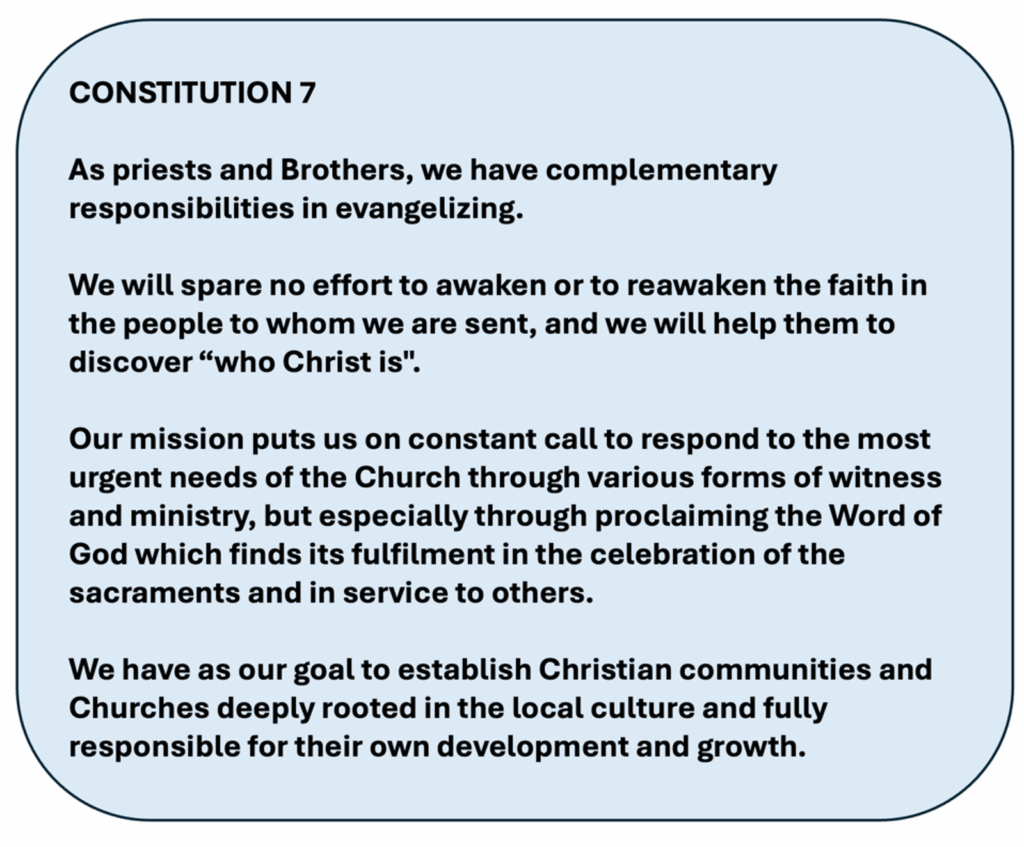
Awareness of our own shortcomings humbles us, yet God’s power makes us confident as we strive to bring all people – especially the poor – to full consciousness of their dignity as human beings and as sons and daughters of God.
Constitution 8
Through personal contact the people were invited to an encounter with the Savior, but the missionaries had to make sure that they themselves had prayed to be His cooperators and instruments to the people.
In that spirit of evangelical closeness, they visited the people of the smaller villages in their homes on the first days of the missions to establish contact with them and to ascertain whether there were any pastoral problems that needed to be dealt with.
Eugene established this principle in the first Rule of the Missionaries:
They will visit without distinction all the town’s inhabitants. The missionaries will do this with great modesty, much gentleness, affability, and consideration.
Before beginning the visit, the missionaries will go before the Blessed Sacrament to commend to our Lord Jesus Christ this important action that can greatly influence the mission’s success.
1818 Rule Part 1, Chapter 2, §2
CLOSE TO THE PEOPLE FROM THE BEGINNING OF OUR EXISTENCE (C8)
We will always be close to the people with whom we work, taking into account their values and aspirations.
Constitution 8
Eugene transmitted his methodology of being close to the people to his newly-founded group of Missionaries who were founded to preach prolonged parish missions in the small villages. In the diary of one of their earliest missions in 1816, Eugene wrote:
After breakfast, the missionaries resumed their visits until midday.
These visits are not very entertaining but they are very important, for they bring the missionaries close to the people they have come to evangelize.
They let themselves be seen in all the warmth of a charity which makes itself all things to all men, in this way they win over the most distant among them; they are able to give encouragement, to spur people on, to meet head-on some resistance, and, as they make progress, they end up discovering and to begin the process of remedying disorders that have often escaped the watchful care even of a zealous pastor.
Diary of the Marignane Mission, 18 November 1816, EO XVI
Posted in WRITINGS
2 Comments
ALWAYS BEING CLOSE TO THE PEOPLE AS THE RATIONALE OF MINISTRY (Constitution 8)
We will always be close to the people with whom we work, taking into account their values and aspirations.
Constitution 8
One of Eugene’s major ministries after his ordination was to the youth of Aix. Looking back on this ministry, Eugene described how his closeness to them was the rationale of his pastoral success with them as they reacted positively to his initiatives:
… among these youth who looked on me as their father, I only came across souls full of recognition, hearts full of affection that responded perfectly to the tender charity that I felt for them. They loved me to the point that some mothers declared that they would have been jealous had not this sentiment shown the goodness of their children, but that in truth they loved me more than they loved them, their own mothers.
Eugene’s Diary, 31 March 1839, EO XX.
He dedicated every Thursday and Sunday to being with the youth, as well as being available to them when they wanted to speak with him at other times.
If I do not watch out these young people will take all my time. It seems they cannot live without me, and I can really perceive the good that the Lord does them through my ministry.
Letter to Charles Forbin-Janson, June 1814, EO XV, n 125.
WE WILL ALWAYS BE CLOSE TO THE PEOPLE (Constitution 8)
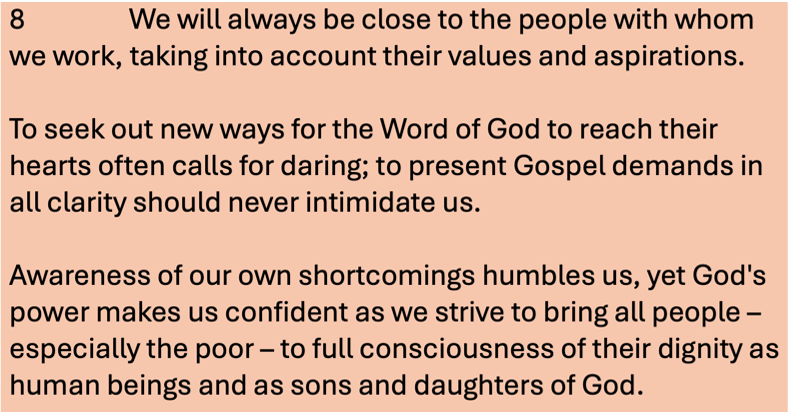
We will always be close to the people with whom we work, taking into account their values and aspirations.
Constitution 8
For the past 200 years, the expression usually associated with the Oblates is: “They are always close to the people!” It is something that we are proud of and a characteristic that was insisted on by St Eugene himself. We recognize it in his self-description at the age of 26:
A person’s rank in society does not enter as a factor at all into the feeling that brings me to love someone who of a truth loves me.
The way in which he elaborated on this is illuminating as he shows that anyone who was suffering or needed him could count on his closeness:
The proof of this is the unbelievable affection I have for the servants who are truly fond of me; I hate being separated from them, it is a wrench for me to leave them, I take an interest in their welfare, and will not overlook anything to secure it, and I do not do this out of magnanimity or greatness of soul, motivations of that kind influence me only when it is a question of people who are cold, but out of feeling, tenderness, really the only word for it is friendship. You must not think on that account that I do not feel called to do anything for anybody except those who love me. Quite the contrary, anyone who is suffering, or needs me, can count on my help.
Eugene’s self-portrait for his spiritual director, October 1808, EO XIV, n. 30
This was abundantly illustrated in all his later life choices. For example, as a seminarian he chose to teach catechism to “the poorest in the parish, children of tavern keepers, in a word, a vermin-ridden lot.”
As a newly-ordained priest he opted to ask to dedicate himself to the poor and the youth of Aix, thus setting the pattern for all his lifelong ministry of closeness to people who normally were on the fringes of society.
WE SHALL SUPPORT LAY PEOPLE IN THE DISCERNMENT AND DEVELOPMENT OF THEIR OWN TALENTS AND CHARISMS (Rule 7 f)
We shall support lay people in the discernment and development of their own talents and charisms, encouraging them to undertake ministries and apostolic commitments and thus to shoulder the responsibilities which are properly theirs in the Christian community.
Rule 7 f
From the beginning the recipients of our ministry obviously were lay people. As our communities became permanently established, so too did our bonds with the people grow. From being recipients of our ministry people developed into cooperators in our ministry doing so in a variety of ways.
Over the years the cooperation became more clearly defined. Someone described this process as a graduation from receiving the crumbs of our spirituality and mission at table, to sitting at the table to share the fullness our charism, spirituality and mission.
Today we speak of the Oblate Charismatic Family, and just as a human family has many expressions and roles, so too does the expression and life of the Oblate charism in the laity change.
In 1842 Eugene acknowledged this cooperation by incorporating a married couple as “Honorary Oblates” who received the “merits of the sacrifices, prayers, fasts and generally in all good works” of the Congregation as a sign of gratitude for the help they had given to the Oblates (Letter to M. and Mme. Olivier Berthelet at Montreal,” September 25, 1842, EO 1 n 13).
Today we understand that everyone who lives by the Oblate charism is incorporated into the Oblate Charismatic Family according to their state of life.
Posted in WRITINGS
Leave a comment