-
Recent Posts
Recent Comments
- Eleanor Rabnett, Lay Oblate on THROUGH A GIFT OF THE FATHER OUR OBLATE FAMILY CHOOSES THE WAY OF THE EVANGELICAL COUNSELS (C12)
- Eleanor Rabnett, Lay Oblate on THE EVANGELICAL COUNSELS ARE INDISPENSABLE (C12)
- Eleanor Rabnett, Lay Oblate on ALL MEMBERS OF THE OBLATE CHARISMATIC FAMILY CHOOSE THE WAY OF THE EVANGELICAL COUNSELS (C12)
- Eleanor Rabnett, Lay Oblate on BEATITUDES: TO CONTINUALLY RENEW OURSELVES IN THE SPIRIT OF OUR VOCATION (C11)
- Eleanor Rabnett, Lay Oblate on LEAVEN OF THE BEATITUDES AT THE HEART OF THE WORLD (C 11)
Archives
Meta
-
THE LIBERATING POWER OF THE WORD OF GOD (C7)
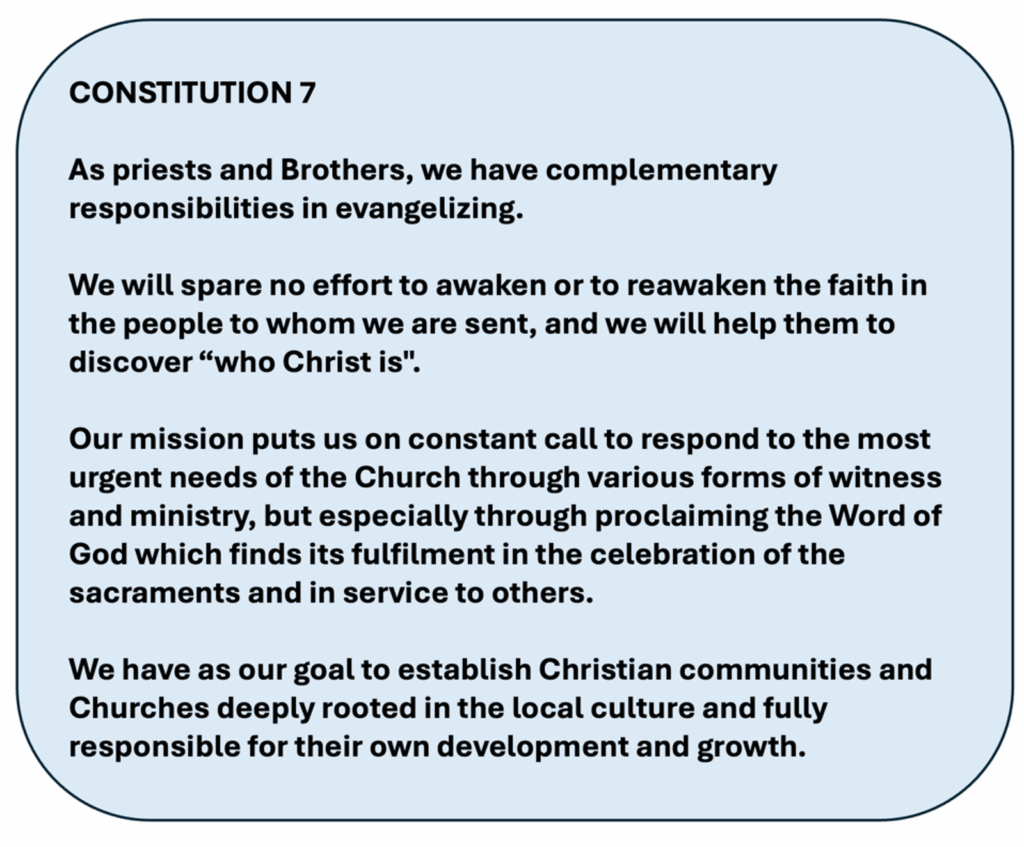
Our mission puts us on constant call to respond to the most urgent needs of the Church through various forms of witness and ministry, but especially through proclaiming the Word of God which finds its fulfilment in the celebration of the sacraments and in service to others.
Constitution 7
When we meditate on Jesus as the Way, the Truth and the Life, we invariably are led to examine the quality of our life-options, our faithfulness to the truth and to what is life-giving. It is this reflection, in the light of the Word of God, that leads us to the sacrament of reconciliation.
Eugene’s preaching and that of the early Oblate missionaries was an invitation to a prolonged intimate encounter with the Savior acting through the priest as spiritual guide and instrument of forgiveness and new life. The confessional was to be the place of transparent encounter between a person in their brokenness and the healing mercy of God. One of Eugene’s earliest sermons gives this message using the imagery of a sinner being stuck in a muddy swamp that makes release seem impossible:
In the same way the preacher of the Gospel, is saddened at the sight of sinners sinking in the dreadful swamp of their evil deeds, bogged down with no desire of getting out. They futilely try all that their gentle charity inspires them to do to have them return onto the way.
Finally seeing their obstinate determination to be lost, the preachers make the most frightening truths re-echo in their ears. They arm themselves with the whip of the holy Word, and increase their blows until at last with a huge effort these sinners get out of the mud and free themselves.
Then it is with open arms that the ministers of Jesus Christ press them close to their hearts and take delight in pouring ointment on all their wounds to ease them.
(Instruction at the Madeleine, preached in Provencal, on the fourth Sunday of Lent 1813, EO XV n 115.)
Today, as our reflection on the Word of God becomes a mirror to see ourselves, it also becomes an invitation to ask for forgiveness and to begin again with God’s strengthening sacramental grace. As a priest of many decades, I have been privileged to witness the transformative power of this sacrament in countless persons. It is a means of encounter with God that is always available and yet so easy to ignore.
OUR REFLECTION ON SCRIPTURE FINDS ITS FULLNESS IN THE SACRAMENTS (C7)
Our mission puts us on constant call to respond to the most urgent needs of the Church through various forms of witness and ministry, but especially through proclaiming the Word of God which finds its fulfilment in the celebration of the sacraments and in service to others.
Constitution 7
It was the Savior who had to speak through his co-operator and invite the listener to a deeper encounter, as Eugene wrote in his Rule:
The missionary – lest his preaching be in vain – will pray and get others to pray to the Divine Master of hearts, to deign to accompany the words of his minister with that powerful grace, which moves and converts souls, and without which all words are but as sounding brass and a tinkling cymbal.
Eugene de Mazenod’s 1826 Rule Part I, Chapter 3, §1, Art. 24.
The preaching of parish missions, for which we were originally founded, was all about preaching the Word of God and inviting people to respond by celebrating the sacraments. The goal of the Missionaries was to have every person celebrate the sacrament of reconciliation and receive the Eucharist.
A sacrament is a privileged moment of encounter with Jesus Christ. May our listening to his Word lead us to a deeper expression of communion with him and an appreciation of his sacramental presence..
COMMUNITY RETREAT
To put ourselves increasingly at the service of God in his people, we will set aside special times each month and each year for deeper personal and community prayer, for reflection and renewal. One week each year will be spent in retreat. Fraternal gatherings and an exchange on apostolic experiences could well precede or follow the retreat.
Constitution 35
This week we will be away for our community retreat and St Eugene will not speak during this period
Our website does contain 15 years of Eugene speaking which I invite you to peruse: https://www.eugenedemazenod.net
CHEW THE WORD OF GOD (C7)
Our mission puts us on constant call to respond to the most urgent needs of the Church through various forms of witness and ministry, but especially through proclaiming the Word of God…
Constitution 7
In proclaiming the Word, it is our tradition to be simple and direct and to speak a language adapted to and easily understood by our hearers.
Rule 7g
Saint Eugene’s life was dedicated to explaining the Good News of salvation to those who were most in need. He and his missionaries wanted to produce listening hearts that would transform their lives. The invitation he wrote in 1818 continues today:
Our one and only aim should be to instruct people
not only to break the bread of the Word for them but to chew it for them as well;
in a word, to ensure that when our discourses are over,
they are not tempted to heap foolish praise on what they have not understood,
but, instead, that they go back home edified, touched, instructed, able to repeat in their own family circle what they have learned from our mouth
Rule of 1818
We are so blessed today to have many commentaries and reflections available to help us to understand the Word of God and to be able to “chew” it so that it becomes an integral part of our lives.
Like Eugene, let us make Scripture reading and the Lectio divina a part of our daily lives. (Just enter “lectio divina” into the search engine of your computer and you will discover a wealth of helpful information on this practice)
A LISTENING HEART TO COME TO A DEEPER KNOWLEDGE OF THE SAVIOUR WHOM WE LOVE AND WISH TO REVEAL TO THE WORLD (C7)
Our mission puts us on constant call to respond to the most urgent needs of the Church through various forms of witness and ministry, but especially through proclaiming the Word of God…
Constitution 7
In his Diocesan Pastoral Letter on the missions, Bishop Eugene wrote in 1844:
Handed on to his Apostles by Jesus, this Word has lost none of its power in the course of the ages. We have experienced the fact that because it issued from the mouth of him who is himself eternal life, it is always spirit and life.
So convinced was Eugene of the importance of Scripture in his life that he spent time every single day studying the scriptures. For him, the Lectio Divina was the opportunity to listen to the Word of God as a personal message. He included this practice in his daily program. Scripture scholars who have studied the writings of Saint Eugene point out how steeped he was in Scripture. He often quoted directly in his letters and in his diary, and, very often, he paraphrased the texts as part of his communication.
In the first Rule he wrote that “every member of the Institute is charged to study Sacred Scripture daily.” Today in our Rule, we read:
The Word of God nourishes our spiritual life and apostolate. We will not only study it diligently but also develop a listening heart, so that we may come to a deeper knowledge of the Saviour whom we love and wish to reveal to the world. This immersion in God’s Word will enable us to understand better the events of history in the light of faith (Constitution 33)
Posted in WRITINGS
2 Comments
YOU SHOW ME THE WAY I SHOULD FOLLOW, AND GIVE ME THE DESIRE TO FOLLOW IT (C7)
Our mission puts us on constant call to respond to the most urgent needs of the Church through various forms of witness and ministry, but especially through proclaiming the Word of God…
Constitution 7
The very first two constitutions are so important because they give the sense of direction for all the Constitutions and Rules that follow. Constitutions 1 and 2 remind us very clearly that everything that we do is to be done as a cooperator of Jesus Christ. He has called us, he sends us, and it is his mission that we fulfill wherever we find ourselves and in whatever state of life.
All the Constitutions and Rules that follow build on this reality. Constitution 7 emphasizes that our main ministry is to witness to and proclaim the Word of God. To do this effectively, we are drawn “to know him more deeply, to identify with him, to let him live in us” (Constitution 2).
The way to know him is through the Scriptures, and this is why, as we preach the Word of God, we have to be soaked in it. Our message has to come through our relationship with him, because it is he who speaks to us.
Eugene was constantly aware of this role of Scripture in his life as he wrote at the age of 55:
I give you thanks, O Lord, for having made shine forth this light from the sacred deposit of your Holy Scriptures. As you show me the way I should follow, and give me the desire to follow it, you will also give me the powerful help of your grace.
Retreat preparatory to taking possession of the episcopal see of Marseilles,
May 1837, EO XV n. 185
May we have the grace to make these words our own.
ECOLOGICAL CONVERSION: THE POOR WITH THEIR MANY FACES, WE GIVE THEM OUR PREFERENCE (C5)
These are the poor with their many faces; we give them our preference (Constitution 5)
Action on behalf of justice, peace and the integrity of creation is an integral part of evangelization.
(Rule 9a)
Eugene’s life was dedicated to the poor who needed the hope that the presence of Jesus Christ could bring to their lives – in the majority of cases these were the materially poor who did not have opportunities. Two hundred years ago there was no awareness of the damage that industrialization was causing to the earth and its resources. In the Book of Genesis, God entrusted creation to our care. Today we are painfully and unavoidably aware of the damage that we have caused to the earth. The OMI Inter-Chapter is reminding us that it is the poor who suffer the most from the natural disasters of climate change:
“Marking the tenth anniversary of Laudato Si’, participants turned their prayer to the urgency of ecological conversion. The mandate of the previous Chapter was recalled with clarity: “Study Laudato Si’ and uphold its value and urgency in all our communities. Sustain and promote our positive programs and activities and connect to other groups through the Laudato Si’ Action Platform of the Church” (PHC 15.1).
Reflections emphasized that care for our common home cannot be separated from care for the poor, and that this call goes beyond ecological gestures to a deeper change of heart and community. Participants shared concrete steps already underway, such as zero-waste initiatives, renewable energy projects, community gardens, and prayers for creation. These practices showed how ecological conversion is rooted in daily life. To carry this forward, the group proposed ongoing formation, integration into pastoral and educational programs, and stronger partnerships with committed networks”.

THE MUTUAL VOCATIONAL CALL TO THE CHARISM WITHIN THE OBLATE FAMILY
Saint Eugene’s dream of the Oblate Family being the most united family in the world is seen in his description of the 1837 General Chapter of his missionary family:
The Chapter gave the image of a family, united around its head, in which all the members are making great efforts to become worthy of their mission. The most fraternal cordiality reigned throughout. The greatest zeal to attain the perfection of their vocation and attachment to my person and to the Congregation were manifested effusively. We left with the firm intention of profiting greatly from the lights that God had showered on the assembly and to work efficaciously for our own perfection and the advancement of the holy work confided to us.
Eugene de Mazenod’s Diary, August 1837, EO XVIII
At the present moment in the Inter-Chapter, Eugene’s heart must have been filled with joy:
“The second part of the day turned to the Lay Associates, who share in the Oblate charism. Inspired by 1 Cor 12,4-12, the conversation revealed that their collaboration is not a strategy but a spirituality, a way of living together in the Church by listening to the Spirit in diversity. Recalling the mandate of the last Chapter, participants prayed with the words: “The Lay Associates recognize their mutual vocational call to the charism, their profound sense of belonging together, and their commitment to mission lived out through the charism of St. Eugene” (PHC 18.2).
Listening to the Spirit through one another, the community recognized more clearly the growing role of the laity and lay associations. Their contribution touches parish ministry, solidarity, ecology, prayer, and education. Their testimonies expressed joy in service, while underlining the need for deeper recognition and structured spiritual accompaniment. The gift of the lay and the youth is undoubtedly of the Spirit. The Assembly affirmed that the Oblate charism is not exclusive to the Oblates, but to the entire Church. For this reason, there is a call to accompany, promote, and form Oblate Lay Associates and their associations.”
OUR CONSTITUTIONS AND RULES: A GOD-GIVEN PATH OF HOPE AND COMMUNION FOR THE ENTIRE OBLATE FAMILY
Sometimes there is the temptation to regard the Oblate CCRR as an unimportant dull book of legal prescriptions. How wrong we are if we fall into this trap. The Oblate delegates at the Inter-Chapter affirmed this on the fourth day of their gathering: “It was emphasized that they are not only a set of legal norms, but a living source of inspiration that propels us in mission.”
When Eugene and the founding community wrote the Rule in 1818, they attempted to put into words what the Holy Spirit had guided them to live. Through their lived experience they continued to revise what they had written and presented this text to the Pope and Cardinals for their approbation. What happened on February 17, 1826, was that the Church recognized that this Rule was inspired by God and that the Missionary Oblate Family had come into existence as part of God’s plan
Eugene now considered the Rule no longer as the work of a human author, but as the work of God who had made this work his own by inspiring the Pope to give them their character of their divine authority. Addressing the Oblates after the event Eugene referred to his role:
“He assured us, that for him, he saw nothing of the man, and that he was so persuaded that they had been inspired by Heaven, that it was impossible for him to recognise himself except as the instrument of Divine Providence.”
PIELORZ, J., Les Chapitres généraux I, p. 57-58.
May the conclusion of the inter-Chapter be that of each of us as we reflect on our Book of Life:
“The morning renewed our commitment to the charism and reminded us again that the Constitutions and Rules continue to be a path of hope and communion for the entire Oblate family.”