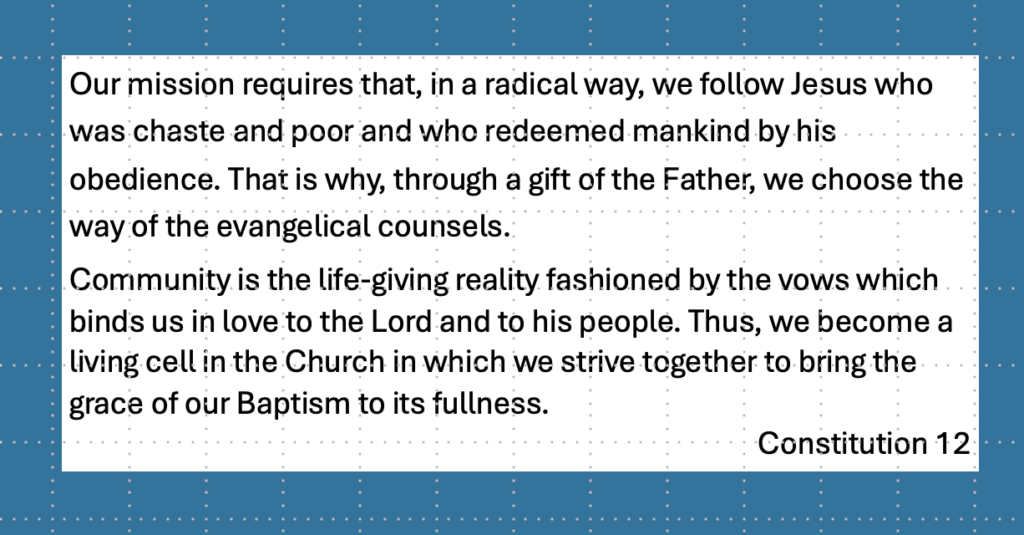
Our mission requires that, in a radical way, we follow Jesus who was chaste and poor and who redeemed mankind by his obedience. That is why, through a gift of the Father, we choose the way of the evangelical counsels.
(Constitution 12)
Eugene insisted:
My intention in dedicating myself to the ministry of the missions to work especially for the instruction and conversion of the most abandoned souls, was to follow the example of the Apostles in their life of devotedness and self-denial… Hence I considered choosing the evangelical counsels, to which they had been so faithful, as indispensable, lest our words be no more than what I have noticed about the words of those who proclaim the same truths, namely sounding brass and tinkling cymbals.
Eugene’s Memoires, quoted in Rambert, I p. 187
In this sprit, for all of us today, following the counsel of poverty aims at detachment from consumerism and materialism and develops generosity.
Following the counsel of chastity aims at purity in a world saturated with the misuse of sexuality and proposes fidelity.
Following the counsel of obedience aims at counteracting the cult of the ego, autonomy and pride and proposes following the will of God and rightful authority.
This morning I Googled “evangelical counsels” – I wanted to know the timelines for these words, these three counsels to freedom with God…
And while they might sound pious I felt called to them as a lay woman. To many who knew me before my meeting Jesus this sounds unbelievable but this was a part of an unexpected miracle that seemed absolutely normal to me. Nothing less than everything would be suffice. I suppose the intensity of this way of being and living could be described as radical.
I look at the lives of those early Oblates who came to Canada, and the ones born here and who like Albert Lacombe OMI lived so much of his time alone and so he drew people around himself and the very nature of his being. The reason he became an Oblate priest was so that he could live as he had been created to live. Like Eugene he was not perfect; yet he accepted life as he loved.
The joy of walking in the footsteps of St. Eugene has returned to me this morning as I think of Lacombe and how he lived in a community even though he was physically separated from his brothers. He too was radical.
We must walk with others to act like humans first of all, and then like Christians, and finally, we must help them to become saints. (Ref The Preface of the 1825 Manuscript)