THE SUCCESSOR OF PETER IN THE GARDEN OF GETHSEMANE (C6)

We accept loyally, with an enlightened faith, the guidance and teachings of the successors of Peter and the Apostles

(Constitution 6)

Bishop Eugene’s publication for the people of his diocese of Pope Pius IX’s letter to the universal Church asking for help for the famine in Ireland, concluded with a call to support the Pope in his suffering for the Church.

Popes, until Pope Paul VI abolished it, were crowned with a tiara. This crown had its origin in the dual role of the Pope as the spiritual head of the Church and as, still in Eugene’s lifetime, the temporal ruler (king) of the Papal States. His temporal rule was finally eliminated in 1870 but the tiara remained in use until 1963.

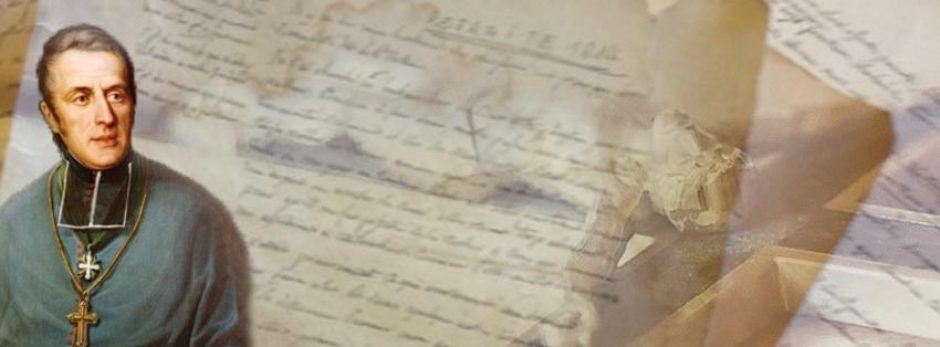
His head wears the crown of thorns of the divine Savior under the tiara of the Pontiff-King.

A firm supporter of the divinely-instituted mission of the successor of Peter, Eugene believed that the Pope had a special understanding of the destiny of the Church, despite its sufferings.

So, like Jesus Christ from the cross, his Vicar from the throne of the Prince of the Apostles cries out to the world. His spirit, illuminated by a supernatural light that penetrates the depths of what is happening today, has an insight into the dark plots of evil. He tells us that he is constantly preoccupied with them, and that he is alarmed by them. He is like the Saviour in the Garden of Olives, when his struggles, his sufferings and the unfaithfulness of humankind presented themselves to his mind, and he was seized with fear and affliction, “distressed and agitated” (ed. Mark 14:33)

Bishop Eugene’s Circular Letter to the people of Marseilles, 12 June 1847, EO III Circular n 3

Posted in WRITINGS | 1 Comment

WE ACCEPT LOYALLY, WITH AN ENLIGHTENED FAITH, THE GUIDANCE AND TEACHINGS OF THE SUCCESSORS OF PETER AND THE APOSTLES (C6)

Our love for the Church inspires us to fulfil our mission in communion with the pastors whom the Lord has given to his people; we accept loyally, with an enlightened faith, the guidance and teachings of the successors of Peter and the Apostles. (Constitution 6)

The very last pastoral letter that Bishop Eugene wrote before his death summed up his lifelong understanding and love for the Successor of Peter:

However, since the Supreme Pontiff possesses in his sacred person the fullness of apostolic power, and thus sums up in himself all the rights of the mission entrusted to Peter and the other Apostles, it is to him that we must direct our highest feelings of filial piety. He is the common Father, the Head of the great family of God’s children on earth.

Bishop Eugene’s Pastoral Letter to the Diocese of Marseilles, 16 February 1860

Posted in WRITINGS | 1 Comment

OUR LOVE FOR THE CHURCH INSPIRES US TO CONSIDER THE BISHOPS AS OUR FATHERS FROM THE MOMENT THEY ADOPT US (C6)

Our love for the Church inspires us to fulfil our mission in communion with the pastors whom the Lord has given to his people. (Constitution 6)

“We are the Bishop’s men” is a slogan that has been much used and abused throughout the history of our Congregation. Taken out of context, it has been interpreted as a reason for an Oblate to be a “jack-of-all-trades-minister” in a diocese according to the bishop’s fancies. The context in which these words were written is the key to understanding this concept.

The Vicar General of Grenoble had approached Eugene about the possibility of the Oblates coming to work in the diocese. Eugene responded by spelling out Oblate ministry clearly. Our main ministry at that moment was evangelization through parish missions, and when not doing this, it was to minister to the poor whom the Church was touching least, and whom society regarded as “dregs.”

In a town, during the interval between missions, our Missionaries, dedicated as they are to the service of abandoned souls, carry on a very useful ministry among the lowest classes of people. For example, in Marseilles, they care for the dregs of society, people who are at the age of 25 to 30, and have not yet made their first Holy Communion, and who do not know their God or about their souls; they instruct them carefully, and their labors have been crowned with the greatest success.

He then stresses that this ministry is done in closest communion with the local bishop, always ready to serve him – but within the parameters of our charism. On several occasions in the future, Eugene was to remove Oblates from a diocese or a particular ministry that he did not judge as being in accordance with his understanding of our charismatic vocation.

We consider the bishops as our fathers from the moment they adopt us; their diocese becomes our family, and I can state that these children of adoption witness to it before anyone by their affection and attachment. Besides, we have the consolation of seeing the Bishops give us constant unmistakable moving signs of preference.
We are the Bishop’s men; we are at his disposition at every moment of the day or night. We must live habitually under his influence.

Eugene’s letter  to M. Testou, Vicar General of Grenoble, 17 June 1828, EO XIII n. 68

Posted in WRITINGS | 1 Comment

IN COMMUNION WITH THE PASTORS WHOM THE LORD HAS GIVEN TO HIS PEOPLE, AS LONG AS THE SPIRIT OF OUR OBLATE VOCATION IS OBSERVED (C6)

Our love for the Church inspires us to fulfil our mission in communion with the pastors whom the Lord has given to his people. (Constitution 6)

Writing to Oblate Fr. Bellanger in Algeria, Eugene stressed:

I am delighted that you accompanied Bishop Pavy to Philippeville; by seeing you at close quarters he will understand still more readily that our missionaries are priests who are most devoted to the bishops and that their whole ambition lies in taking on their own shoulders some of the burden that lies so heavily on those of the Prelates… I am most anxious that the Bishop be fully aware of this since it is a basic principle of the Congregation… All I ask is that the bishops facilitate the means of maintaining among our members who are consecrated to their service, the spirit of their holy vocation, regularity and religious discipline.

Letter to Fr. Jean Baptiste Bellanger at Blida, Algeria, 10 November 1849, EO IV (Africa) n.10.

Oblates as “men of the Bishops” need to ensure that” the spirit of their holy vocation, regularity and religious discipline” be acknowledged and respected. The bishop in Algeria did not respect this, and so Eugene was forced to remove the Oblates from Algeria a year later.

Posted in WRITINGS | 1 Comment

OUR LOVE FOR THE CHURCH INSPIRES US TO FULFIL OUR MISSION IN A PARTICULAR  RELATIONSHIP WITH THE BISHOPS (C6)

Our love for the Church inspires us to fulfil our mission in communion with the pastors whom the Lord has given to his people; we accept loyally, with an enlightened faith, the guidance and teachings of the successors of Peter and the Apostles. (Constitution 6)

Writing to the Bishop of Quebec Eugene has one sentence in this regard:

They are essentially men of the bishops. It is with this in view that I have founded them and, thanks be to God, they are all imbued with this spirit that belongs to their Institute.

Letter to the Bishop of Quebec, 10 August 1843, EO I n 22

The phrase “they are men of the bishops” has been misused at times. It does not mean that Oblate missionaries are to be treated by the local bishop as diocesan priests. The second part of Eugene’s statement gives the key to understanding this assertion: “they are all imbued with this spirit that belongs to their Institute.” There is a specific charism and spirit that they contribute to the local diocese and with which they do their ministry. On several occasions, Eugene withdrew Oblates from a place or refused an invitation to take on a ministry because the specific aspect of being missionary preachers, in an apostolic community, to the “poor with their many faces” was absent.

Posted in WRITINGS | 1 Comment

OUR LOVE FOR THE CHURCH HAS BROUGHT US INTO THE OBLATE FAMILY (C6)

“Our love for the Church inspires us…” (Constitution 6)

Eugene’s love for the suffering Church led him to become the founder of the Oblate Family.

The Church, that glorious inheritance purchased by the Saviour at the cost of all his blood has in our days been cruelly ravaged…
The sight of these evils has so touched the hearts of certain priests, zealous for the glory of God, men with an ardent love for the Church, that they are willing to give their lives, if need be, for the salvation of souls.

Eugene de Mazenod’s Preface

In 1816 it was the hearts of “certain priests” that were touched, today it is the hearts of all of us that have been touched and have led us to respond according to Eugene’s spirit:

The call of Jesus Christ, heard within the Church through people’s need for salvation, draws us together as Missionary Oblates of Mary Immaculate. (Constitution 1)

And

Lay people recognize that they are called to share in the charism according to their state of life, and to live it in ways that vary according to milieu and cultures.(Rule 37a)

As we prayerfully reflect on these Constitutions, may we grow in love for the Church and in our efforts to love Jesus Christ as we love the Church and vice versa.

Posted in WRITINGS | 5 Comments

OUR LOVE FOR THE CHURCH – OUR SUFFERING MOTHER (C6)

“Our love for the Church inspires us…” (Constitution 6)

As Eugene’s reflection on his experience of Jesus Christ as his Savior deepened, so did his awareness of the suffering of his Body, the Church, as a result of the aftermath of the French Revolution. He was impelled to respond:

During my seminary days, I had the thought of making myself as useful as possible to the Church, our Mother, for whom the Lord had given me the grace always to have a filial love. The destitution in which I saw her had been one of the deciding motives for my embracing the priestly state.

Eugene’s Mémoires, quoted in Rambert I p 47

Writing to his mother about the impossibility of ignoring the suffering of the Church:

Do you believe that a man who had a clear vision of the needs of the Church and who, despite the attraction God gives him to work at helping her, and other signs of His will, yet opted to sit back with arms folded, sighing softly to himself about all these evils, but not raising a finger to awaken even in the least degree men’s hardened hearts, would rest in all good conscience? What an illusion… it would be enough if in the course of one’s life one could help even a single soul to work out his salvation to make all one’s labors worthwhile.

Eugene’s letter to his mother, 4 April 1809, EO XIV n 50

I devoted myself to the Church because she was suffering persecution, was abandoned…

Eugene’s letter to his father, 7 December 1814, EO XV n. 129

Today as we are painfully aware that the Church continues to be persecuted, can we sit with arms folded sighing sadly?

Posted in WRITINGS | 1 Comment

OUR LOVE FOR THE CHURCH – WHO GAVE BIRTH TO US ALL IN JESUS CHRIST (C6)

“Our love for the Church inspires us…” (Constitution 6)

 Writing to his mother who was vehemently opposed to the idea of his becoming a priest, Eugene reminded her of what happens at Baptism:

So do not grudge, dear mama, do not grudge this poor Church, so terribly abandoned, scorned, trampled underfoot – but which even so was the one who gave birth to us all in Jesus Christ – the dedication that two or three individuals out of the whole of France (a small number I count myself happy to be one of) wish to pay her of their liberty and life. And what reason could you possibly have for wanting me to delay any longer from committing myself, and devoting myself to the Spouse of Jesus Christ?”

Letter to his mother, 11 October 1809, EO XIV n.61

At our baptism these words were addressed to each of us: “ N., the Christian community welcomes you with great joy. In its name I claim you for Christ our Savior by the sign of his cross. I now trace the cross on your forehead, and invite your parents and godparents to do the same.”

This is why we are called to love the Church.

Posted in WRITINGS | 1 Comment

OUR LOVE FOR THE CHURCH – AWE AT THE COMMUNION THAT EXISTS AMONG CHILDREN OF ONE SAME FATHER (C6)

“Our love for the Church inspires us…” (Constitution 6)

As part of his search for the meaning of his life, his gradual journey of conversion, the 22 year-old Eugene read and studied and made notes:

One of the things that strikes me most in religion is “catholicity”, that communion that exists among children of one same Father who receives on high the intentions they form at the same time in lands so distant and who truly wills to give them in return a merit shared in common.

The idea that I am a member of that great family of which God himself is Head… seems to instantly make my soul surge, with an intensity that is difficult to express.

Jottings in Eugene’s notebook, May 1804, EO XIV, n 7

Today, our Oblate Charismatic Family is present in over 60 countries. What an awe-inspiring thought that we are an expression of the communion that exists because we are all children if the same God as Church.

Posted in WRITINGS | 1 Comment

OUR LOVE FOR THE CHURCH IS THE EXPRESSION OF OUR LOVE FOR JESUS CHRIST (C6)

Constitution 6 begins with the words:

Our love for the Church inspires us…

The outstanding characteristic of the life of Eugene was his passionate love for Jesus Christ as his Savior, and as his Way and his Truth and his Life. We are thus not surprised to read in his last Pastoral Letter before his death:

How is it possible to separate our love for Jesus Christ from that which we owe to his Church?” These two kinds of love merge: to love the Church is to love Jesus Christ and vice versa. We love Jesus Christ in his Church because she is his immaculate spouse who came out of his opened side on the cross

Lenten Pastoral Letter, February 1860.

The Church for Eugene was the Body of Christ, the great communion of all the baptized. As the members of his Charismatic Family, we too are urged to allow our love for Jesus Christ to lead us to recognize his living presence in the Church.

Posted in WRITINGS | 1 Comment