-
Recent Posts
Recent Comments
- Eleanor Rabnett, Lay Oblate on THROUGH A GIFT OF THE FATHER OUR OBLATE FAMILY CHOOSES THE WAY OF THE EVANGELICAL COUNSELS (C12)
- Eleanor Rabnett, Lay Oblate on THE EVANGELICAL COUNSELS ARE INDISPENSABLE (C12)
- Eleanor Rabnett, Lay Oblate on ALL MEMBERS OF THE OBLATE CHARISMATIC FAMILY CHOOSE THE WAY OF THE EVANGELICAL COUNSELS (C12)
- Eleanor Rabnett, Lay Oblate on BEATITUDES: TO CONTINUALLY RENEW OURSELVES IN THE SPIRIT OF OUR VOCATION (C11)
- Eleanor Rabnett, Lay Oblate on LEAVEN OF THE BEATITUDES AT THE HEART OF THE WORLD (C 11)
Archives
Meta
-
VIVAT: A PRESENCE WHERE DECISIONS AFFECTING THE FUTURE OF THE POOR ARE BEING MADE (Rule 9a)
Responding to the call of the Spirit, some Oblates identify themselves with the poor, sharing their life and commitment to justice; others are present where decisions affecting the future of the poor are being made. (Rule 9a)
Father Daniel LeBlanc is based at the United Nations in New York, and is involved in VIVAT, a faith-based non-governmental organization rooted in Catholic social teaching, which has grown into a global network of over 17,000 members from 12 religious congregations operating in 121 countries.
Founded in November 2000 by the Society of the Divine Word (SVD) and the Missionary Sisters Servants of the Holy Spirit (SSpS), VIVAT International takes its name from the Latin verb vivere—“to live.” This name reflects a deep commitment to promoting life in all its fullness, especially for the most vulnerable. The Missionary Oblates of Mary Immaculate (OMI) joined in 2009, bringing with them a deep-rooted presence in marginalized communities and a shared dedication to global justice.
VIVAT’s strength lies in its dual presence: deeply embedded in local realities while actively engaged on the international stage. Holding Special Consultative Status with the UN Economic and Social Council (ECOSOC) and being associated with the UN Department of Global Communications (DGC), VIVAT brings grassroots voices into global decision-making spaces. Whether advocating for human rights, environmental justice, or sustainable development, VIVAT serves as a bridge between people and the policies that shape their lives.
(https://www.vivatinternational.org/vision-mission/)
See also: https://omiusajpic.org/2025/07/10/4th-financing-for-development-ffd4-takes-place-in-sevilla-spain/
WE SHOW A VERY HUMAN FACE OF JESUS TO THE WORLD, ONE FULL OF COMPASSION AND SOLIDARITY (Rule 9a)
Action on behalf of justice, peace and the integrity of creation is an integral part of evangelization. (Rule 9a)
“As Oblates, we look at the world through the eyes of the Crucified Savior so that those who suffer will be strengthened with the hope of the power of the resurrection (C#4); this was the perspective of our Founder St. Eugene de Mazenod and the Oblate charism. As Father Louis LOUGEN, former Superior General, said about the Oblate Charism:” “We are fired by a charism that is unique and special in the Church, one that makes us very close to the poor, the rejected, the forgotten, the people that society ignores, and the people who don’t feel accepted in church…We show a very human face of Jesus to the world, one full of compassion and solidarity.”
https://www.omiworld.org/our-mission/justice-peace-and-integrity-of-creation/
Thus, many Oblates all over the world are working with, among and for the poor and are therefore exercising this ministry, even though they may not use this JPIC terminology.
SEEING TO REALLY SEE (Rule 9a)
Action on behalf of justice, peace and the integrity of creation is an integral part of evangelization. (Rule 9a)
“Justice, Peace and Integrity of Creation (JPIC) Ministry is central and at the heart of our mission as Missionary Oblates of Mary Immaculate.
… Therefore, the ministry of JPIC begins with seeing, to ‘really see’ – to have a truthful and deeper look at – to take a contemplative stance and a prophetic reading, to be able to discern in light of the values of the Gospel what is happening in our world today – our common home. JPIC ministry assists us in analyzing the current reality with a contemplative perspective to see more deeply the structures that generate poverty, devastation of the environment, conflict and violence and how we might more fully make the values of the Kingdom more visible and functional. This is the reality and the world in which we as Oblates live and minister to the people.”
(http://www.omiworld.org/en/content/news/3805/towards-a-spirituality-of-jpic-the-oblate-charism-at-the-service-of-the-poor/ )
Posted in WRITINGS
Leave a comment
JUSTICE, PEACE AND THE INTEGRITY OF CREATION AS AN INTEGRAL PART OF EVANGELIZATION (Rule 9a)
Action on behalf of justice, peace and the integrity of creation is an integral part of evangelization. (Rule 9a)
The commitment of the Oblate Family to live this is incarnated in the General Service of Justice, Peace and Integrity of Creation (OMI-JPIC) It is a ministry that is our way of life and our way of mission and forms an integral part of our process of Evangelization.
Officially, the OMI-JPIC became an Oblate pastoral and animation General Service in 2001 and there is a full-time Director in Rome: Fr. Jean-Hérick Jasmin, OMI, who was appointed in October 2020. Fr. Jasmin is originally from Haiti and served for 17 years as a missionary among the poor in and around Bogota, Colombia.
The General Service coordinates and supports the efforts of Oblates around the world as a resource for Oblates, and the people whom they minister, to help fulfill their commitment to strive for human dignity, just corporate policies, and to foster commitment to care for creation.
See: https://www.omiworld.org/our-mission/justice-peace-and-integrity-of-creation/ and https://omiusajpic.org
WALKING THE LINE BETWEEN PROPHETIC VISION AND SPIRITUAL SUSTENANCE (CONSTITUTION 9)
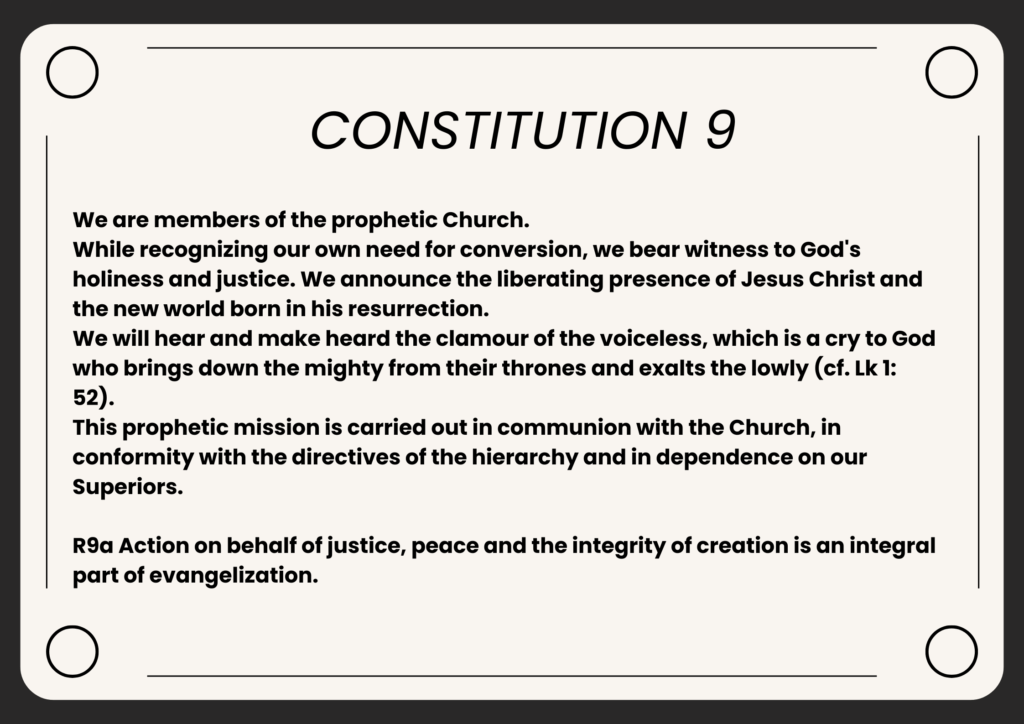
We are members of the prophetic Church. While recognizing our own need for conversion, we bear witness to God’s holiness and justice. We announce the liberating presence of Jesus Christ and the new world born in his resurrection. We will hear and make heard the clamour of the voiceless, which is a cry to God who brings down the mighty from their thrones and exalts the lowly (cf. Lk 1: 52). This prophetic mission is carried out in communion with the Church, in conformity with the directives of the hierarchy and in dependence on our Superiors. (Constitution 9)
The religious historian, Timothy B. Tyson’s words help us to live Constitution 9:
“Every minister worthy of the name has to walk the line between prophetic vision and spiritual sustenance, between telling people the comforting things they want to hear and challenging them with the difficult things they need to hear. In Oxford, my father began to feel as though all the members wanted him to do was to marry them and bury them and stay away from their souls.”
Eugene looked at the Cross and saw himself as he really was: confused and lost and lacking direction. Conversion meant that he had finally found his focus. It was seeing himself through the eyes of the Crucified Savior that gave him a focus. They led him to begin to look at the world through those same eyes and understand the purpose of his life as being a “co-operator of Christ the Savior.”
Through the eyes of the crucified Christ he became aware of a crowd of poor lost people milling at the foot of the Cross, focused on themselves and their misery . Just like Eugene, once we enter into this personal process as missionary disciples, then we find ourselves becoming even more aware of those around us who are most in need of the same change of vision.
Here is the Oblate message and mission: journey with the poor and abandoned, in their humanity, to discover the liberating presence of Jesus Christ and the new world born in his resurrection in their human struggles and joys, and then to accompany them in their growth as Christians and saints in the process.
A PARISH MINISTRY IS “OBLATE” IF IT GIVES A TANGIBLE WITNESS TO OUR CHARISM (Constitution 9)
We announce the liberating presence of Jesus Christ and the new world born in his resurrection. We will hear and make heard the clamour of the voiceless, which is a cry to God who brings down the mighty from their thrones and exalts the lowly (cf. Lk 1: 52).
(Constitution 9)
In our many parishes around the world, we need to ask ourselves the question: “What is the difference between an Oblate parish and the diocesan parishes around us?” Do people see and experience a difference?
This call is addressed in a special way to our parish ministry, in which we have a strong presence. Oblate parishes, which should have a particular missionary character, are appropriate places, for example, to offer an adequate response to the widespread indifference to the tragedy of migration and the degradation of creation. The joint work of Oblates and laity in such Christian communities can be the basis for recovering the “sense of responsibility for our fellow human be- ings on which every civil society is founded” (LS 25). (Acts of 2022 General Chapter n. 13)
On the subject of being at the service of the Catholics of Bytown, we know it is quite repugnant to our Fathers to serve in a manner too similar to the parish ministry. They have been known to say on other occasions that they were made to be missionaries, not parish priests. ne should be able to organize their service as a kind of mission…
Letter to Bp Bruno Guigues, 26 September 1848, EO I n 103
LISTEN, DIALOGUE, PROCLAIM (Constitution 9)
We announce the liberating presence of Jesus Christ and the new world born in his resurrection. We will hear and make heard the clamour of the voiceless, which is a cry to God who brings down the mighty from their thrones and exalts the lowly (cf. Lk 1: 52). (Constitution 9)
Listening to the cry of the poor demands a spirituality of listening, dialogue and proclamation.
We must not forget that the cry of the earth is the cry of the poor, to whom we are to give preference (cf. C 5). During this Chap-ter, we have heard voices proposing to take up again the centrality of the poor—especially the indigenous, migrant, young, and urban—in our missionary discernment.
In each Oblate Unit, depending on their circumstances, we should constantly discern the presence of each of the faces of the poor, to carry out our missionary work based on the spirituality of listening, dialogue and proclamation. (Acts of 2022 General Chapter n. 11.2)
Can you imagine that if every member of the Oblate Charismatic Family would take this to heart and put it into action, what a loud and powerful announcement this would be of the liberating presence of Jesus Christ and the new world born in his resurrection!
WE OFFER HOPE TO A BROKEN WORLD (Constitution 9)
We are members of the prophetic Church. While recognizing our own need for conversion, we bear witness to God’s holiness and justice. We announce the liberating presence of Jesus Christ and the new world born in his resurrection. (Constitution 9)
Taking up the invitation of the theme of the 37th General Chapter, we recognize our missionary vocation of being called to offer hope to a broken world that experiences war, poverty, and the degradation of creation. Hope in Jesus Christ calls us to “offer explicit witness to the saving love of the Lord, who despite our imperfections offers us his closeness, his word and his strength, and gives meaning to our lives” (EG 121).
(Acts of 2022 General Chapter n. 10)
The brokenness of the world touches every aspect of our lives and we feel so helpless in doing anything about it. St Eugene inspires us to have confidence in God as his cooperators:
We need to have some courage and confidence in God who shows us the road and will not abandon us when we act in his name and for his glory. Everywhere we have established ourselves we have made a feeble start.
Letter of Eugene to Fr Guigues in Canada, 5 December 1844, EO I n 50
Here he was writing to the first missionaries in Canada who were few and feeble – yet their persevering confidence in God was to bear astounding missionary fruit. His words continue to speak to us today. Healing a broken world begins with our own personal and community world.
THE NECESSITY OF RECOGNIZING OUR OWN NEED FOR CONVERSION (Constitution 9)
We are members of the prophetic Church. While recognizing our own need for conversion, we bear witness to God’s holiness and justice. We announce the liberating presence of Jesus Christ and the new world born in his resurrection.
(Constitution 9)
As members of the Oblate Charismatic Family, we share in the prophetic function of the Church: to search for, point out and promote the presence of God in the midst of evil, and to journey with people on that journey of transformation.
BUT there is one condition! We need to be constantly on a journey of personal conversion that gives witness to the presence of God that we seek to embrace daily. Unless we do this, and are energized by the Savior, we risk becoming like so many politicians and of using their same methods. It is this danger that Eugene warned against in his vision statement that we now know as the Preface. Initially aimed at Oblate priests, its scope and vocabulary can be adjusted to accommodate the whole Charismatic Family today.
They are convinced that if priests could be formed, afire with zeal for men’s salvation, priests not given to their own interests, solidly grounded in virtue – in a word, apostolic men deeply conscious of the need to reform themselves, who would labour with all the resources at their command to convert others – then there would be ample reason to believe that in a short while people who had gone astray might be brought back to their long-unrecognized responsibilities. “Take great care about what you do and what you teach,” was Paul’s charge to Timothy, “Always do this, and thus you will save both yourself and those who listen to you” (1 Tim 4: 16).
Eugene de Mazenod, Preface
Unless we constantly seek conversion, we will not be able to withstand the criticism that any prophetic ministry invites.