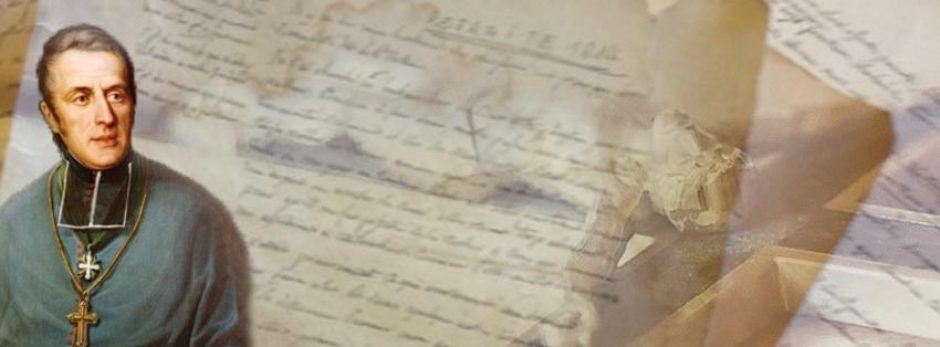
Eugene arrived in Rome during the jubilee year of 1825. This year we can appreciate his words in a deeper way as we live through a jubilee year with its invitation to encounter the mercy of God in a deeper way.
Returning to my monastery, I couldn’t resist the impulse of going into the basilica of Saint Mary Major again. I roamed through it for half an hour without dwelling on any particular object precisely. I enjoyed the beauty of this building and, as I was going about, I was greatly edified by the great number of zealous pilgrims crowded around the confessionals where the Dominican Fathers, seated in those spacious confessionals, listened charitably to them, and from time to time, extended the long cane fixed in front of them, like a pavilion standard, to touch the head or shoulders of those who knelt before them for this very purpose.
The entire sight both edified and touched me. I stopped to ponder it for some time. It was noon. All these good people had been fasting till then, since they were going to devoutly receive Holy Communion to gain the jubilee indulgence after they left the tribunal.
Eugene’s Roman Diary, 30 November 2025, EO XVII
On this 8th of December, as we prepare for the bicentenary of our approbation, we read the words of Pope Leo XII with which he concluded the written proclamation of approbation, issued a month after the verbal approval:
We firmly hope that the members of this holy family, who are employed in the ministry of the Word of God under Rules so well fitted to form hearts to piety, and who claim as their patroness the Virgin Mother of God conceived without sin, will strive with all their strength and especially by their example, to bring back to the bosom of the Mother of Mercy those persons, whom Jesus Christ on His Cross willed to give her as sons.
Given at Rome, at St. Peter’s, under the Fisherman’s Ring, on the twenty first day of March, 1826, in the third year of Our Pontificate.
(Roman Diary, EO XVII)
A blessed feast day to all the members of our Oblate Charismatic Family.
Monday November 28 was spent doing official visits to various people connected with the Diocese of Marseilles and with other projects. The following day Eugene went to visit and pray in the church of Saint Sebastian and the catacombs of Saint Calixtus.
He mentions a number of Roman ruins and churches that they passed, and continued:
At a little distance outside the gate, on your left you find the small church called Domine, quo vadis. Tradition has it that it was there that Our Lord appeared to Saint Peter, carrying his cross. Surprised, Saint Peter asked him in these words: Domine, quo vadis [ed Lord, where are you going?]! and the Saviour, who wished to make him understand, etc., replied: Eo Romam iterum crucifigi [I am going to Rome to be crucified again], and leaving the imprint of his feet on the stone, disappeared.
This stone is found in the church of Saint Sebastian which was built by Constantine above the renowned cemetery of Pope Saint Calixtus and is situated on that same Via Appia. This church was dedicated to Saint Sebastian because this saint’s body was placed there by Saint Lucina, a Roman matron… A superb statue of Saint Sebastian lying dead has been placed under the altar. It is the work of Antonio Georgetti, following Bernini’s style.
After hearing Mass …, we went down into the catacombs, seized with reverent fear at the sight of those underground caves where so many martyrs lived and were buried after their death. They estimate that there were a hundred and seventy thousand, among whom were eighteen sovereign Pontiffs. The bodies of Saints Peter and Paul were laid here for some time. You can see the altar on which the sovereign Pontiffs used to celebrate Mass and another one somewhat further on in the catacombs where Saint Philip Neri used to spend nights in prayer. We recognized the spot where Saint Cecilia’s body had been and the one which Pope Saint Maxim had occupied. When we had made several tours in these underground passages, following a guide, and all of us carrying a small candle which we were very careful not to let go out, we went out through the church, as we had entered, and regained the Via Appia to the Circus of Caracalla and the tomb of Cecilia Metella. A person can see only the remains of the Circus but can still capture somewhat its grandeur.
Roman Diary, 29 November 1825, EO XVIII
Eugene had written to Fr. Tempier that “I must be with Mgr d’Isoard before ten o’clock, who is to take me with him to St. Peter’s to assist at the great exposition of the Forty Hours.” In his diary he wrote:
Sunday, November 27: Went to Saint Peter’s. Attended the service in the chapel. All the Cardinals present, the Pope absent. The Blessed Sacrament carried in procession to the Pauline chapel for the adoration of the Forty Hours. The illumination of the chapel according to the design of…, with a huge number of candles.
One senses the excitement of the pilgrim Eugene in Rome for the first time – quite an itinerary for one afternoon:
After dinner, visited the Church of the Trinita del Monti, met the Father Abbot of the Trappists[ed. whom Eugene had hosted in Aix some years before], Saint Mary Major, Saint John Lateran, returned by way of the Coliseum and the Capitol.
Roman Diary, EO XVII
On the day of his arrival, Eugene’s first stop had been to greet Monsignor d’Isoard. We will be reading a lot about him during Eugene’s stay in Rome. Alexander d’Isoard was born in Aix en Provence, and while Eugene was a seminarian in Paris, they had visited. While in Rome, Eugene visited him very often. Because he was involved in the ceremonies at the Vatican as the Pope’s mitre-bearer, he often invited Eugene to walk behind him, thus enabling Eugene to participate fully in important ceremonies while in Rome.
On 26 November 1825. Eugene wrote to Fr. Tempier to tell him of his safe arrival in Rome after a journey of several weeks, which he had interrupted to visit various Bishops to get their opinion on the Rule he was taking to Rome. For the last part of the journey he had been been traveling in a coach with three other clerics, one of whom was a talkative Jesuit!
My very dear friend, I arrived this morning at Rome too late to have the happiness of saying holy Mass, although I had remained fasting until two o’clock, after having spent the night stretched out in the carriage hired from the inn of Monterosi, in order to have our coachman leave a little earlier. This is the first day since my departure from Genoa that I have been deprived of this consolation.
I had been so happy during my journey! The Lord had made me experience so much happiness at the altar to which I ascended every day, in spite of the beautiful discourses, the reasonings to the skies of the Jesuit Father who travelled with me, and to whom coffee at three o’clock in the morning was as indispensable as the fresh air he had to breathe. Our exercises, our conversations in a coach where we were all four invested with the priesthood, the pleasure of meeting twice a day at the inns with four others, Carmelite discalced religious, who travelled along with us and yet again, besides such company, the habit of interior recollection which gave me the facility of transporting myself in spirit either to be with you or at the bishop’s house, either in our houses and on the missions…
I am lodged at Saint Sylvester, close to the Quirinal palace. It is the novitiate and house of studies of the members of Saint Vincent de Paul. I have found it more convenient to be placed in a convent where I find altar and table within reach. … I embrace you as well as our Fathers. I rejoice that my uncle is in good health and I kiss his hands. I have you all present to me always in every place. Adieu.
Letter to Fr. Henri Tempier, in Marseilles, 26 November 1825, EO VI n. 208
Since 19 February 2025 (https://www.eugenedemazenod.net/?p=5978) I have been exploring the key elements of our Book of Life in preparation for the bicentenary of its approbation by the Church. The first ten Constitutions are fundamental because they contain the whole Oblate charism. In case you have lost the way, I refer you to the map:
THE RULE OF THE OBLATE FAMILY: A MAP https://www.eugenedemazenod.net/?p=6018
and
WHO ARE THE POOR FOR THE OBLATE FAMILY?https://www.eugenedemazenod.net/?p=6024
The next step would be to look at two models of how this is lived: the apostles (Constitution 3) and Mary immaculate (Constitution 10). I have decided to interrupt this for a few of months.
As we prepare to celebrate 17 February 2026, it is exactly now that Eugene arrived in Rome to meet the Pope and to ask for this favor. As he wrote about this journey every day, I would like to make you a part of his experience and let him speak to us about it.

Action on behalf of justice, peace and the integrity of creation is an integral part of evangelization. (Rule 9a)
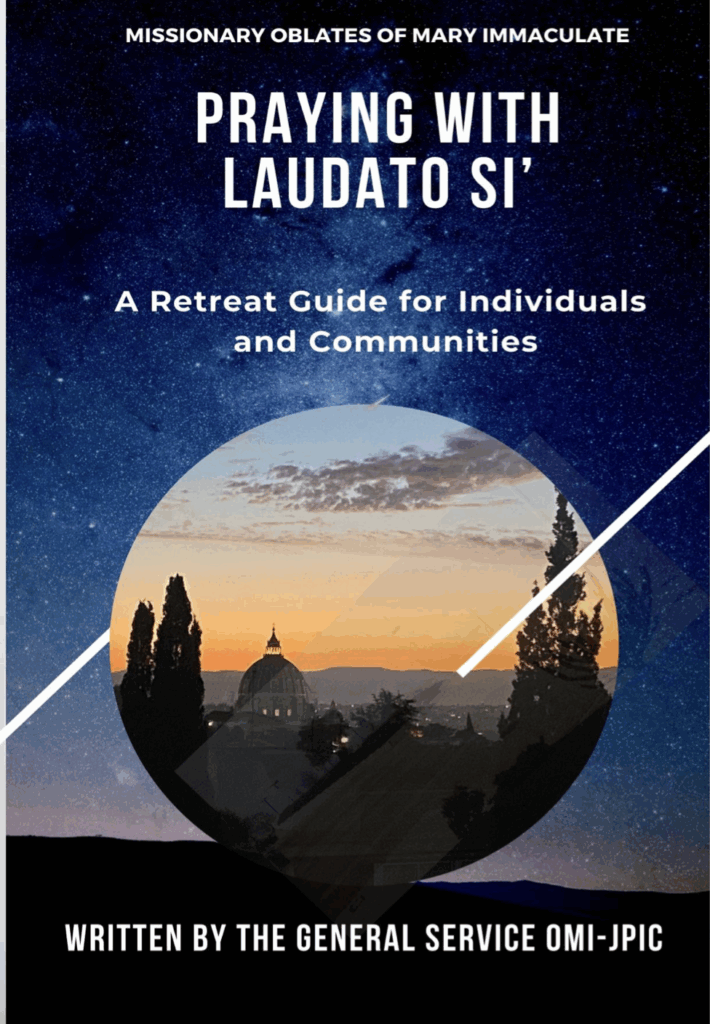
The Congregation’s General Service of Justice, Peace, and Integrity of Creation, in response to a mandate of our 37th General Chapter, has prepared a guide for individuals and communities to pray using Pope Francis’ 2015 encyclical letter, Laudato Si’.
Using insights from the encyclical letter, this guide presents Scripture passages, texts, stories and images from the Oblate tradition. Its aim is to lead to reflection, prayer, and commitment to action. The guide is not intended as a study guide to Laudato Sí’. Texts from the letter are presented for the purpose of inspiration and prayer.
The guide may be used by individuals or communities. One theme may be selected for a day of prayer, or several themes may be used over an extended time of retreat. The themes presented are suggestions; others may be developed by users. The motivation for the choice of these is that they show an aspect of the Pope’s encyclical letter as it is read through the chosen lens of GS-JPIC: Praying with Laudato Sí’ using insights drawn from listening to the cry of the earth and the cry of the poor. Some of the themes include the voices of the poor with whom the Oblates are working.
DOWNLOAD THE GUIDE AT:
https://www.omiworld.org/wp-content/uploads/1.-Praying-With-Laudato-Si.-Retreat-Guide.-OMI-JPIC.Engl_.2025.pdf
We will hear and make heard the clamour of the voiceless, which is a cry to God who brings down the mighty from their thrones and exalts the lowly (cf. Lk 1: 52).(Constitution 9)
“Let us, then, be the first to rise up to protest against anything that prevents creatures from responding to the vocation and mission for which they were created. Let us be the first defenders of life, especially human life from its gestation to its natural end, passing through all stages of its development, being creatively active in trying everything in our power to favour the human, Christian and holy development of each person, especially caring for the most vulnerable and caring for our endangered common home. Each member of our charismatic family, each institution and especially the parishes we animate (PEC n. 13) are invited to live and promote an ecological spirituality imbued with our charism.
…. The care of our common home can be a privileged place of missionary collaboration of our whole charismatic family. In particular, the Chapter speaks of the laity (PEC F. Laudato Si n.4). We have to learn together, we have to learn from each other, we have to pray together, we have to work together. Together we have to fight for the poor and make them the centre of our discernment. Could we choose one or two concrete actions that we all engage in as a sign of our family commitment to care for our common home? It would be something within everyone’s reach, but which could have a significant impact. For example, let me dream that we would commit ourselves to one of these actions: to reduce the use of plastic, to recycle our waste, to generate clean energy, to consume responsibly with an eye to justice, to facilitate access to drinking water for all, etc.
Since the youth of our societies have shown global leadership in raising our awareness in caring for our common home and ensuring a sustainable future, I ask all the young people of our charismatic family, men and women, lay and consecrated, to lead us in this field. Please, young people, help us to get down to work with concrete commitments to care for our common home. Help us to walk together.”
Action on behalf of justice, peace and the integrity of creation is an integral part of evangelization. Rule 9a
“I do not believe that cultivating an ecological spirituality is in contradiction with our charism; on the contrary, I hope it can help us to grow. As missionaries, we follow in the footsteps of Jesus Christ who chose to announce the Good News from the poor and invited us to trust in God’s Providence by speaking to us of the lilies of the field and the sparrows.
To make us understand the transforming power of the Kingdom that we proclaim, he spoke to us of the seeds that grow into great bushes and how they grow in secret and how they bear fruit according to the soil in which they are sown. Jesus invites us to discern the signs of the times as we do the winds that announce warmth or rain. Creation is shaken when Jesus dies on the cross and his rising from the tomb on the third day causes the dawn of each new day to renew our hope in the new humanity and new creation born in his resurrection. He directs history by sending his Spirit to complete his work of recapitulation so that God may be “all in all” (Eph 1:10; 1 Cor 15:24-28).
The hopeful contemplation of creation from the perspective of redemption and definitive recapitulation leads us to love God more, to identify with him, to let him live in us (Constitution 2) and to serve him as his co-workers (Constitution 1). Our relationship with Jesus, carefully cultivated, leads us to discover the Incarnate Word, through whom everything was created and in his creation we discover his presence. We praise that presence every day when we pray the Psalms as we praise him present in the poor. Authentic ecological conversion will lead us to grow in intimacy with Christ and will also lead us to action and commitment, for in communion with Christ even the simplest actions take on a transformative dimension beyond all expectations.”
Action on behalf of justice, peace and the integrity of creation is an integral part of evangelization. Rule 9a
“Some years ago, I read an article reflecting on our dehumanising pace of life. According to the author, a monk, this way of living causes a triple rupture: rupture with God, with creation and with others. The monastic life proposes a humanising rhythm of life that is marked daily by an encounter with God, with all that is created through work, with the community and with the poor. The conclusion, which we can make our own, is that in order to humanise our society we must promote the experience of reconnecting and growing in these dimensions which, besides being deeply interconnected, serve as communicating vessels.
The fact that we are used to looking at the world through the eyes of the crucified (C.4), enables us to listen with our hearts to the cries of the poor and the groaning in travail of all creation waiting to be delivered from corruption (Rom 8:18-23). We have to recognise that many of these painful cries are provoked by us, by our actions and by our omissions. This is what Patriarch Bartholomew has called the sin against creation, something we must repent of and correct. At the General Chapter, we acknowledged our inadequate efforts. Each of us could make our own examination of conscience.”