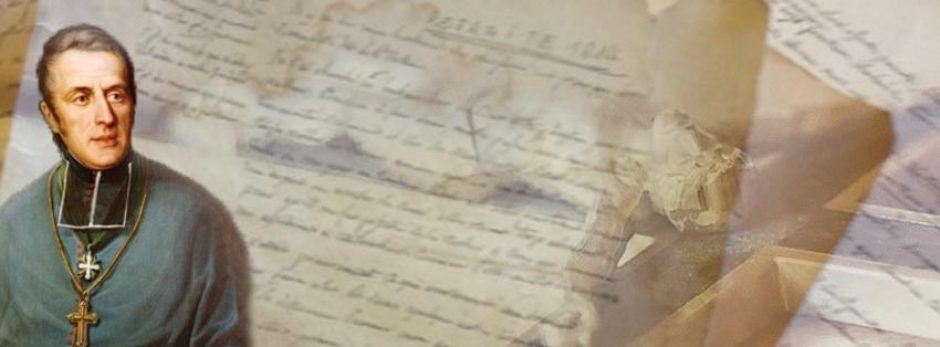
In dealing with the tensions between the young Father de Mazenod and some of the priests of Aix, I do not wish to give the impression that these priests were evil men. They were victims of their situations in a Church turned upside down by the Revolution and trying to find a sense of survival. Priests had been killed or had escaped to other countries. Those who stayed either accommodated with the system or went into hiding. Seminaries were closed and there was no opportunity for ongoing formation. Now in the post-revolutionary world many were old, tired and fixed in their traditional ways and felt threatened by the younger priests who had new ideas for regenerating the local church’s pastoral methods and goals. They were also pained by the reality that many people found the new approaches more attractive.
Writing to his mother, when he was a seminarian in St Sulpice, Eugene gives a taste of the new methods he was learning so that he could implement them in Aix after his priestly ordination:
I will not be able to write to you as much as I would like, as tomorrow I take on a new job that will involve a lot of work. At St. Sulpice we have six or seven catechism classes, which are going wonderfully well and are really admirable in the way they are set up. It is not acceptable, in these catechism classes, to teach the children just to memorize and repeat; tireless efforts are made through instructions to inculcate in them the spirit of religion, and care is taken in these instructions to prepare the children to be active participants.
This is an excellent method, in the first place for the children who are obliged to reflect and discover proper answers out of their own heads, to say nothing of the other benefits they get from it. It is also very useful for the catechists as it prepares them to give homely instructions on all aspects of religion…
Children have to be attracted in all sorts of ways. I will have in my catechism class a large number of big boys who have not yet made their first communion. Taking them on does not constitute a problem for me, as with God’s help we will not do such a bad job. Clearly they have to make their first communion, but it is still more necessary that they do it well…
I am all the more glad to be involved in this type of work, which has enjoyed every kind of success in the period of more than 150 years it has been in operation, as I want to familiarize myself thoroughly with its modes of procedure, statutes, etc., so as to set it up at Aix where the catechetical classes could not be worse and in consequence of this failure one does not see a single child persevering after first communion, while here it is quite the opposite.
Letter to his mother, 4 February 1809, O.W. XIV n.44
Come and learn who you are in the eyes of God…
Yesterday I met with a friend for lunch; a friend who is searching and looking to go deeper into his own heart and into the heart of Jesus. He and I have spoken about the Oblates and also the lay Oblate Associates. And much as I would love for him to walk with us and join Oblate family we do somehow share a space in the heart of Jesus which is where we meet. That does not end our friendship or the love we share but rather seems to deepen it. When I recognize his goodness, how God lives and works within him I am filled with delight and gratitude for God having brought us together in an ongoing way. We are more alike in the ways that matter than we are different and we recognize the love and friendship as we walk together, not stepping on the same stones, but along side of each other on the same path of life.
As I returned home from our lunch together I was energized and filled with joy in once again seeing God alive within him and how deeply beautiful he is as a friend. He loves so greatly and his journey, his pilgrimage is so similar to mine. We are each on our connecting journey as pilgrims of hope in communion…
Sometimes our world tries to demand that we each be the same and that only our [read my] way is the only right way. Eugene too experienced this but found new ways to love, to be different and to celebrate how our hearts could be within the heart of Jesus.
It is in our diversity that we find commonality. It is in recognizing God in the other that allows us to share our fruits with each other and find commonality. God is preparing all of us right now, each in our own time and space and then sending us out to do the same. Yesterday I received the gift of joy of who we are in in the eyes of God. This is what God has been preparing us for…