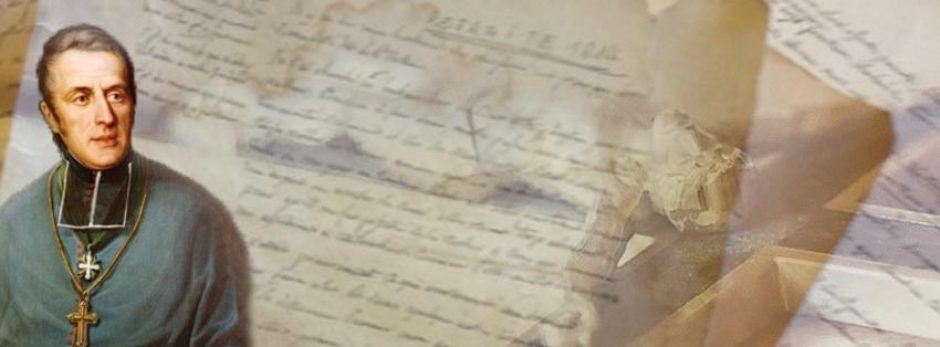
Eugene had asked each Oblate to recall and write his memories of the life of the Society. Father Suzanne had written something on the history of the Oblates in Marseille. Reading what he had written, Eugene stressed the importance of recording history
It was not just a matter of recalling events, but had a practical purpose in reminding the Oblates of various decisions and customs that had been agreed on for more successful ministry
Letter to Marius Suzanne, 23 September 1827, EO VII n 279 He repeated this to Father Courtès, superior of the Aix community.
Letter to Hippolyte Courtès, 27 November 1827, EO VII n 287 On receiving what Father Honorat had written, Eugene exclaimed:
Letter to Jean Baptiste Honorat, 12 December 1827, EO VII n 288
“Gratitude is not only the memory but the homage of the heart rendered to God for his goodness.” Nathaniel Parker Willis
|
-
Recent Posts
Recent Comments
- Eleanor Rabnett, Lay Oblate on AS WE CONTINUE TO EXPLORE THE OBLATE RULE OF LIFE, WHAT IS ST. EUGENE SAYING TO US? (C1-10)
- Eleanor Rabnett, Lay Oblate on WEDNESDAY OF HOLY WEEK: IN THE DAILY PRESSURES OF OUR ANXIETY AN INEXHAUSTIBLE TRUST IN GOD’S GOODNESS
- Mildred March on A SUMMARY OF TEN YEARS OF OBLATE MINISTRY
- Eleanor Rabnett, Lay Oblate on FAITH-FOCUSED INVESTMENT GROUPS: A PRESENCE WHERE DECISIONS AFFECTING THE FUTURE OF THE POOR ARE BEING MADE (Rule 9a)
- Eleanor Rabnett, Lay Oblate on VIVAT: A PRESENCE WHERE DECISIONS AFFECTING THE FUTURE OF THE POOR ARE BEING MADE (Rule 9a)
Archives
Meta
-
For someone who loves to write – taking notes and keeping track of what was done or not done along with the whys of that is not always onerous. But I have noticed that many do not like to take notes, keep records. By Eugene asking each man to spend at least one hour each week recording the what’s and when’s and who’s of all that occurred in their communities he (and then all of us) would have a much fuller and more rounded picture of how this growing community was living, how they were doing, what the struggles were, what worked and what didn’t. I am sure the men did not think about the possibility of people, both men and women, coming along some two hundred years later and looking at not only at who they were, what they did, but why they did what they did – at what worked and what didn’t. Eugene had a fine sense of what was needed then and what would be needed today so that we would be able to carry on, with the same basic mission, with the same spirit…
So much has changed in the last 2000 years, in the last 200 years, and yet it seems that our struggles and questions, the stones we struggle to move through on the paths of our lives, our joys and consolations – that they are not so different as those in the past. It gives cause to be able to look back and count our blessings, to give thanks for all that we have received. I love what Nathanial P Willis wrote: “…the homage of the heart rendered to God for his goodness.” How today can I live the homage of my heart rendered to God for his goodness.