-
Recent Posts
Recent Comments
- Eleanor Rabnett, Lay Oblate on THROUGH A GIFT OF THE FATHER OUR OBLATE FAMILY CHOOSES THE WAY OF THE EVANGELICAL COUNSELS (C12)
- Eleanor Rabnett, Lay Oblate on THE EVANGELICAL COUNSELS ARE INDISPENSABLE (C12)
- Eleanor Rabnett, Lay Oblate on ALL MEMBERS OF THE OBLATE CHARISMATIC FAMILY CHOOSE THE WAY OF THE EVANGELICAL COUNSELS (C12)
- Eleanor Rabnett, Lay Oblate on BEATITUDES: TO CONTINUALLY RENEW OURSELVES IN THE SPIRIT OF OUR VOCATION (C11)
- Eleanor Rabnett, Lay Oblate on LEAVEN OF THE BEATITUDES AT THE HEART OF THE WORLD (C 11)
Archives
Meta
-
NO MATTER HOW BEAUTIFUL THE WORDS OF A PREACHER SOUND, THEY ARE EMPTY IF NOT ACCOMPANIED BY INTENSE DAILY PRAYER
In the preaching of parish missions, Eugene had always insisted on the paramount importance of the witness of the lifestyle of the missionaries as the primary means of conversion of the people. A program of regular prayer is the only way to achieve an integrity of life which is then reflected in words and deeds.
No matter how beautiful the words of a preacher sound, they are empty if not accompanied by intense daily prayer.
If a man who makes a daily meditation, examines closely his conscience twice and spends half an hour in mental prayer before the Blessed Sacrament each day, does not correct his failings and makes no progress towards the perfection of his state, I would believe him much to be pitied and quite close to perdition, whatever preaching he may do in order to convert others…
Letter to Father Jean Baptiste Honorat, 1 March 1844, EO I n 32
YOUNG FABRE
Young Fabre, the best subject of the seminary, has been received as a novice.
Eugene de Mazenod’s Diary, 17 February 1844, EO XXI
This simple sentence in Eugene’s journal introduces us to the 20 year-old Joseph Fabre, who had been a diocesan seminarian in Marseilles for 2 years and had now begun his formation to become a Missionary Oblate. For the next 17 years he was in continuous contact with the Bishop Eugene and Father Tempier, both of whom esteemed him. Through this close contact he was able to imbibe their Oblate spirit. After the death of Eugene, it was the 37 year-old Joseph Fabre who succeeded him as Superior General.
When he was elected to be Eugene’s successor, he concluded the Chapter of 1861 by saying:
“I feel the assistance of our much loved Founder; he has not left us!
I was at his deathbed and said to him, “You will always be among us.” “Yes,” he replied, and he has kept his promise.
He remains among us through the Holy Rule which he had left us, and which is the expression of his love for God and the salvation of souls: it is the glorious testament of his enormous heart, and in observing it we will find all our strength.”
Father Fabre’s first circular letter to the Oblates as Superior General contains an invitation to all of us, members of the Family which is inspired by the spirit of Saint Eugene:
“Let us be united in spirit and in heart
and we will be strong for doing what is good;
let us be united in the memory of a Father
forever beloved”
For further details see: https://www.omiworld.org/lemma/fabre-joseph/
DARE TO COME CLOSER TO JESUS CHRIST WITH SAINT EUGENE – AND INVITE OTHERS TO JOIN YOU
Come and join us for these four short sessions on St Eugene. They aim to help us to dare to come closer to God through Saint Eugene accompanying us. Four short videos and some reflection questions.
They are specially prepared with the members of our Mazenodian Family in mind.
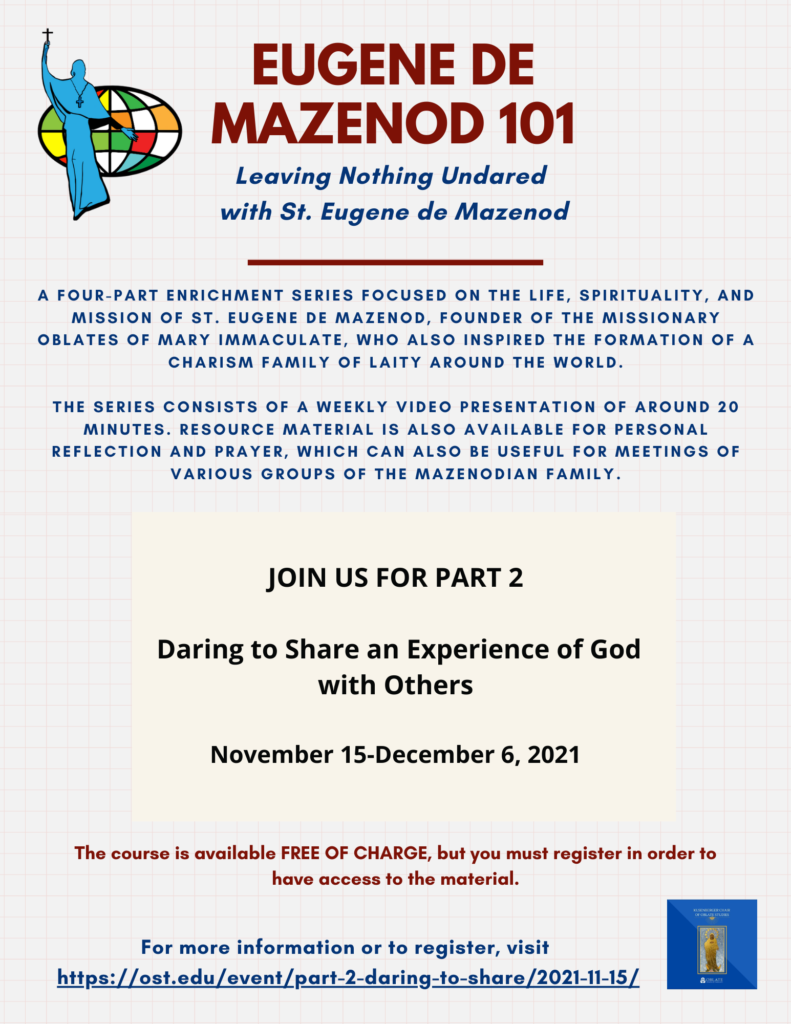
For more information or to register, visit:
https://ost.edu/event/part-2-daring-to-share/2021-11-15/
Once the session is posted, you can look at it ANYTIME during the four-week period.
Posted in WRITINGS
Leave a comment
WHAT POWER HAS BEEN ABLE TO PRODUCE SUCH ADMIRABLE RESULTS?
Reflecting on the powerful effects of the parish mission that had just concluded, Bishop Eugene marveled at the conversion of the men who usually never came near a church, and were often militantly against it..
What power has been able to produce such admirable results? It was necessary to see these men who, for a month, perhaps fifteen days, would not dare to make the sign of the cross upon entering the church, if they ever entered it; today, Sunday of Quinquagesima, that is, Sunday called Fat Sunday by the fashionable, to appear courageously as disciples of the Savior in the face of the entire city which they had more or less scandalized up to the present; not only to sing the praises of God and the hymns of their thankfulness in the whole course of the procession, but to glory in their conversion and to trample underfoot human respect, generously carrying in their buttonholes the cross, a visible sign of their reconciliation with God, and to want to not take it off even after the ceremony which, in bringing everyone together, made of them a formidable army corps, and to keep it on while returning home individually! It’s something as admirable as it is phenomenal, when a person knows in what century we are living and who are the men who surround us.
Eugene de Mazenod’s Diary, 21 January 1844, EO XXI
Writing to Father Tempier, Eugene shared the same sentimants:
Imagine, at my arrival yesterday I found in the church of St-Cannat a thousand men gathered and singing with their powerful voices hymns of gratitude. I confirmed more than 200, a thousand received Holy Communion. During the afternoon an immense procession of an even greater number of men courageously faced what people might say and filled the enclosure and the square of Le Calvaire as well as all the near-by streets, windows, balconies and roofs…
Each man in his lapel wore a cross hanging from a ribbon. and they wore this sign of grace the whole day long; and these men who, a few days previously, would have been ashamed to make the Sign of the Cross on entering a church, dared to wear this pious decoration in all the streets of the city and down to the port where many were seen walking. Isn’t this admirable? And what if it had been the women? We know what they can do in similar circumstances.
Letter to Father Henri Tempier, 19 February 1844, EO X n 834
How beautiful to be able to share these sentiments of Eugene’s enormous pastoral heart, from which was born the Mazenodian family.
Posted in WRITINGS
2 Comments
WHAT NEED IS THERE FOR TONGUES OF FIRE TO SEE, IN SOME WAY, THE PRESENCE OF THE HOLY SPIRIT?
Bishop Eugene continues to describe the awe-filled experience of the power of God at work to convert people at the conclusion of the parish mission.
Yes, a thousand men made the vaults of this church resound with hymns most touching and most appropriate to the happy location in which the overabundant grace of the Lord had placed them all. Not being able to address this immense assembly, I requested Fr. Loewenbruck to make up for the incapacity to which I was reduced by the loss of voice that was the result of my illness. Father said what was necessary, then the Veni Creatorwas sung, and more than two hundred men and one hundred women broke away in order to come to receive the sacrament of Confirmation. It was necessary to see the contemplation of all these Confirmands, all adults, of every age and of every condition. Young men shining with youth, from twenty to thirty years; men of an age mature in years, and old men in great number also presenting themselves in the most respectful attitude, majesty on their brows and fervor depicted on their faces.
What need is there for tongues of fire to see, in some way, the presence of the Holy Spirit? On these occasions, his presence is perceptible to me and I am penetrated with it to the point of not being able to contain my emotion. I need to force myself to not cry with joy, and, in spite of my efforts, very often involuntary tears betray the feeling with which I am animated and which is overabundant in every depth of the term!
I then offered the Holy Sacrifice and secluded myself after my thanksgiving, leaving to the parish priest the sweet consolation of distributing Holy Communion to this fervent assembly of Christians, my sickly condition not permitting me to obtain for myself this happiness which I appreciate so much!
Eugene de Mazenod’s Diary, 21 January 1844, EO XXI
I NO LONGER KNEW IF I WAS IN HEAVEN OR ON EARTH, AND I HAD TO SHED TEARS OF JOY AND APPRECIATION
The closure of the parish missions in Marseilles was one of the greatest consolations for Bishop Eugene as this journal entry testifies.
It’s not for nothing that I did not want to permit a physician to be called; the doctor would have believed himself obliged to keep me in bed and I needed to arise in order to do the will of the heavenly Father. Today must take place the general Communion of the men in the parish of Saint-Cannat, fruit of the mission which Fr. Loewenbruck has been giving for five weeks. A certain number among them, and many women also, were waiting for me in order to receive the sacrament of Confirmation which they had neglected to receive. I would have needed to be in my death throes to stay away. What more consoling duty to fulfill! Who could have replaced me for this ministry? How, besides, to consent to depriving myself of the truly ineffable happiness experienced by a bishop to whom God gives the grace of sensing what is characteristic of the true pastor in regard to his flock in such a situation?
Without thinking I was doing a heroic deed, I then wrapped myself in my ceremonial fur and got out of bed to go to the church, where so many renewed Christians found themselves gathered at the foot of the holy altar, in the expectation of the remainder of the graces which had been reserved for them after their reconciliation with God. What a delightful sight! I was counting on a great number of attendants, but when, placing my foot on the doorstep of the main door, I saw the nave filled with gathered men, all of whom knelt to receive my blessing, when, having arrived in the sanctuary, I prostrated myself to adore our Savior, to give him thanks for having arranged such a harvest in my ministry, and while a thousand men’s voices were raised at the same time to sing the mercies of the Lord, to exalt the power of his arm and to witness to the happiness with which they were filled, I no longer knew if I was in heaven or on earth, and I had to shed tears of joy and appreciation.
Eugene de Mazenod’s Diary, 21 January 1844, EO XXI
IT IS AT SUCH ASSEMBLIES THAT ONE UNDERSTANDS WHAT IS THE COMMUNICATION OF THE HOLY SPIRIT BETWEEN THE FATHER AND THE SPIRITUAL CHILDREN THAT GRACE HAS JUST REGENERATED
The main evangelizing activity of the Oblates in their early years of existence was the preaching of parish missions. It is not surprising then to see how important these were for Bishop de Mazenod in his diocese. It was a conviction that the like-minded Bishop Bourget shared in Montreal. Eugene wrote to him on this topic:
I have read with great interest the pastoral letter that you addressed on the occasion of a mission to each parish favoured by this great grace. I know that you are not without consolation in this respect and I bless God for it. It is a just recompense earned by your zeal for the salvation of your flock.
Eugene then describes his custom to attend the closing ceremonies of every preached parish mission in his diocese to bless the spiritual renewal that had taken place.
I also gather consolation of this kind when I go to preside over the closing of all the missions which are annually given in my diocese. It is at such assemblies that one understands what is the communication of the Holy Spirit between the father and the spiritual children that grace has just regenerated. I cannot conceive why all bishops do not procure this happiness for themselves.
Letter to Bishop Bourget, Bishop of Montreal, 15 February 1844, EO I n 31
ONLY GOD WORKS SUCH MARVELS.
Bishop de Mazenod’s care for the poor of his diocese knew no limits and he relentlessly established groups to respond to the many spiritual and material needs of every category of people. Here is one example from his Diary.
It’s a year yesterday, day for day, that I had established the Sisters of Saint Vincent de Paul in the service of the poor of our parishes. Who would have told me that, one year later, on the very day, they would be installed to render the “service de la Misericorde” [of Mercy] after the great anger of the administrators and the opposition of all these gentlemen?
Yvon Beaudoin explains the background to Eugene’s happiness: “In 1758, seven charitable men of Marseille formed a brotherhood to give a regular association to the distribution of alms. This brotherhood was established first in the church des Accoules (Le Calvaire), under the title of N.-D. de la Miséricorde [Our Lady of Mercy]. This work received numerous donations, acquired several establishments and distributed many alms… In 1843, some administrators wanted to appeal to some recognised religious. One among them, Pélissier, opposed it. An accord was, nevertheless, concluded on September 13, 1843 with the Filles de la Charité [Daughters of Charity] who set themselves up in two houses on the street Fonderie-Vieille.”
The Lord, who is the master of hearts, has turned theirs in such a way that they could become the most powerful promoters of a good to which no one could have dared lay claim. The Sisters were adopted by the administration and soon much good will be done by them, and the enormous abuses which existed will be destroyed. Only God works such marvels.
Eugene de Mazenod’s Diary, 21 January 1844, EO XXI
The “enormous abuses” refers to the way in which help for the poor provided by the government sometimes never reached the poor but ended up in the wrong pockets. Now that the Sisters were to be in charge of all the almsgiving, the poor would be assured of receiving help.
IS IT NOT A FORETASTE OF PARADISE TO FIND ONESELF IN THE PRESENCE OF JESUS CHRIST
In this beautiful reflection in his private journal, Eugene describes how he was caught up in the wonder of the presence of Jesus during his time of prayer before the Eucharist. He writes about his desire to be united with Jesus at all times and to prepare himself for the permanent encounter at the moment of his death. His death was to occur 17 years later, but the fact that the Church was to canonize him was proof that he did indeed live these words for the rest of his life.
During my adoration before the Blessed Sacrament exposed, I was preoccupied with the thought that it was impossible to be better. Is it not a foretaste of paradise to find oneself in the presence of Jesus Christ, prostrate at his feet to adore him, to love him and to expect from his goodness the graces which are needed.
Going further into this thought, I came to a conclusion from it that had never presented itself to my spirit. It’s that, if in my last illness, I maintain my reasoning, I ought to obtain for myself the happiness of suffering the anguishes of death and of rendering my last breath in the presence of our divine Savior. It seems to me that this would be an infallible means of being absorbed only with him and that my heart would not cease for a single instant in being united to him who would embrace it by his presence and fortify it in the formidable moment of this passage from time to eternity.
It also seems to me that it would be impossible that this same Jesus Christ continuously invoked, gripped lovingly with a complete trust and in whose bosom, in a way, I would render my last breath, could send me away from his face at the very instant that I would have just left him on earth. I feel these things better than I express them.
Eugene de Mazenod’s Diary, 6 January 1844, EO XXI
Posted in WRITINGS
2 Comments