

-
Recent Posts
Recent Comments
- Eleanor Rabnett, Lay Oblate on THROUGH A GIFT OF THE FATHER OUR OBLATE FAMILY CHOOSES THE WAY OF THE EVANGELICAL COUNSELS (C12)
- Eleanor Rabnett, Lay Oblate on THE EVANGELICAL COUNSELS ARE INDISPENSABLE (C12)
- Eleanor Rabnett, Lay Oblate on ALL MEMBERS OF THE OBLATE CHARISMATIC FAMILY CHOOSE THE WAY OF THE EVANGELICAL COUNSELS (C12)
- Eleanor Rabnett, Lay Oblate on BEATITUDES: TO CONTINUALLY RENEW OURSELVES IN THE SPIRIT OF OUR VOCATION (C11)
- Eleanor Rabnett, Lay Oblate on LEAVEN OF THE BEATITUDES AT THE HEART OF THE WORLD (C 11)
Archives
Meta
-
CELEBRATING 206 YEARS OF COURAGE TO WALK IN THE FOOTSTEPS OF THE APOSTLES
If, as I hope, you wish to be one of us, you will not find yourself in unfamiliar territory; you will have four companions.
If presently we are not more numerous, it means we wish to choose men who have the will and the courage to walk in the footsteps of the apostles. It is important to lay solid foundations.
Letter to Henri Tempier, 9 October 1815 O.W. VI n 4
In bringing the missionary group into existence, Eugene used the model of Jesus and the apostles.
The missionary vocation was to be apostolic. From the first Rule of Life that he wrote, he expressed it this way:
What did Our Lord Jesus Christ do?
He chose a certain number of apostles and disciples whom He formed in piety and filled with His spirit;
and after having trained them in his school and the practice of all virtues, He sent them forth to conquer the world which they soon brought under the rule of his holy laws.
1818 Rule
Like Henri Tempier, the members of the Mazenodian family must follow the model of the apostles, and have the courage to do so whatever the consequences.
Henri Tempier’s reply to Eugene’s invitation was a source of great joy for Eugene. It shows the apostolic “one heart and one soul” that marked his relationship with Eugene:
“May the good God be blessed for having inspired you to prepare for the poor, for the inhabitants of our countryside, those who have the most need of instruction in our religion, a house of missionaries who will go and announce to them the truths of salvation.
I share your views completely, my dear brother… What you want most in those you choose as your collaborators is priests who will not get into a rut of routine and daily hum-drum, and, as Father Charles’ predecessor used to say, plod along day after day without accomplishing anything; you want priests who will be ready to follow in the footsteps of the Apostles and work for the salvation of souls with no other reward here on earth but hardship and fatigue. I think that God’s grace has given me this desire. If not, then I wish with all my heart that I will have it, and working with you will make it all the easier to attain. You can, therefore, count entirely on me.”
27 October, 1815 Cf. REY I, p. 183
Eugene described his apostolic ideal in the original version of our Preface:
What more sublime purpose than that of their Institute?
Their founder is Jesus Christ, the very Son of God;
their first fathers are the Apostles.
They are called to be the Savior’s co-workers, the co-redeemers of mankind;
and even though, because of their present small number and the more urgent needs of the people around them, they have to limit the scope of their zeal, for the time being to the poor of our countryside and others,
their ambition should, in its holy aspirations, embrace the vast expanse of the whole earth.
The Church, that glorious inheritance purchased by Christ the Savior at the cost of his own blood, has in our days been cruelly ravaged…
Nota Bene (1818 Rule)
Posted in WRITINGS
2 Comments
CELEBRATING THE INVITATION TO COME AND “BE” IN ORDER TO “DO”
From the very beginning, Eugene insisted that whatever missionary work was done, its success depended on the quality of life of those doing it. It was the example of the lifestyle of the missionary that was to speak louder than any words. This is why for Eugene, community and a commonly accepted Rule of Life was a non-negotiable element of our vocation.
In our 206 year history, many lay persons have joined the Oblates in living a vocation to be missionaries, expressed in many ways according to their state of life.
The Mazenodian Family at prayer in the Oblate Chapel in Aix en Provence
Each of the members of the Mazenodian family has a vocation to BE (to have an exemplary quality of life) – in order to DO (to evangelize people and help them to find a Christ-focused meaning in their lives).
Eugene highlighted the core ideal to Tempier:
… an establishment which will steadily furnish our countryside with fervent missionaries.
These will ceaselessly engage in destroying the empire of the demon, at the same time as providing the example of a life worthy of the Church in the community which they will form.
Indeed, we will live together in one house, that which I have bought, under a Rule we shall adopt with common accord
To form “one heart and one soul” is a concept dear to the heart of the Founder. As the size of the Congregation grew, so did he become increasingly insistent on this unity. For Eugene, his missionary family was the most beautiful family in the whole world and he wanted it to be the most united. The one heart and one soul was formed by an equilibrium in lifestyle and Eugene’s constant call was for a greater balance – BE in order to DO:
Happiness awaits us in this holy Society which will have but one heart and soul. One part of the year will be devoted to the conversion of souls, the other to seclusion, study and our individual sanctification.
I say no more for the moment; it suffices to give some intimation of the spiritual delights we will taste together…
… All depends on how we begin. We need perfect unanimity of sentiments, the same goodwill, the same disinterestedness, the same devotedness – that sums it up.
Letter to Henri Tempier, 9 October 1815, EO VI n 4
CELEBRATING OUR VOCATION TO LISTEN TO WHAT GOD IS ASKING AT THE FOOT OF THE CROSS
Eugene’s letter to the 27 year-old diocesan priest, Henri Tempier, is an essential foundation document for us. It contains the seeds of what is essential in our vocation.
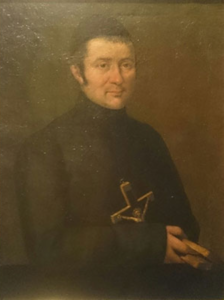 The letter shows the fundamental starting point of the vocation of any member of the Mazenodian family: it has to flow from an experience of the love of God on the Cross. “Read this letter at the foot of your crucifix” is not a pious thought – but it is a necessary attitude: Eugene experienced God’s love for him and understood his vocation at the foot of the Crucifix. Anyone who feels called to journey with Eugene needs to have as a starting point and as a point of focus the fact of God’s love expressed on the Cross.
In his desire to live “all for God” Tempier must listen to where the voice of God is calling him to move for the glory of God and for the salvation of the abandoned people of Provence.
My dear friend, read this letter at the foot of your crucifix
with the desire to listen only to God
regarding what the good of his glory
and the salvation of souls
demand from a priest like yourself.
Henri Tempier is invited to look at the religious situation of the poorer people in Provence through the eyes of the Crucified Savior. It is an invitation to feel from the depth of his heart their experience of not having a sense of direction in their lives because God is absent.
At the foot of the Cross, symbol of the Savior who sacrificed all for others, he is invited to make a sacrifice of his own comfort so that others may have life.
This is the meaning of oblation: to look at the most abandoned with the eyes and heart of the Savior, and to respond by imitating the Savior’s self-giving so that they may have the fullness of life.
Dismiss the attraction of possessions, the love of comfort and convenience;
allow yourself to be fully penetrated by the situation of the people who live in the countryside, by the state of religion among them, by the apostasy that daily spreads wider with dreadfully ravaging effects.
Look at the feebleness of the means employed to date to oppose this flood of evil; ask your heart what it would like to do to remedy these disasters and then reply to my letter.
Letter to Henri Tempier, 9 October 1815 EO VI n 4
This invitation has continued to be repeated and echo throughout our 206-year history. Many have responded as religious, priests and laity, and their missionary generosity has made a difference to the lives of countless people around the world. As we celebrate, we give thanks and we respond with the desire to let Eugene’s call continue to echo and to make a difference.
CELEBRATING A DREAM THAT BECAME A SOURCE OF LIFE TO MANY
We prepare to celebrate the 206th anniversary of our foundation. The time had come for Eugene to begin to invite others to join him in his missionary dream. As members of the Mazenodian family, lay and religious, we are invited to see in these vocational texts something about our own calling to live out our baptism according to the spirit of Eugene.
In this letter Eugene invites Hilaire Aubert, director of the seminary in Limoges, to join him and gives the main reasons for the existence of the new group: the tragic religious situation of the poor and the scarcity of missionaries to help them through preaching and through their efforts to destroy the power of evil. The situation today still calls out with the same invitation.
The good we intend to do must remedy the greatest evils that face us. Those who deal with them dwindle; there is nothing more urgent.
… Oh, dear friend, if you would be one of us! We would begin in your part of the country where religion is practically extinct as in so many other places. I almost dare to say that you would be necessary.
Continuing to reflect on Eugene’s letter of invitation to Hilaire Aubert, we come across a central concept of Eugene’s thought and action: that of forming a group that would be a life-giving cell in the world. He uses the word noyau, which refers to a group that is a source of life to others, like a nucleus in a group of cells, or the seed in a fruit, or the core of something that has life. When he started his youth congregation in Aix, it was for them to be yeast in the society of Aix. Similarly, the Missionaries were meant to be the same: an select group of persons who would be a source of life for others.
In order to be a life-giving force in France, the Missionaries would have to have a quality of life that would be a life-giving to others. They needed to aim at becoming saints by living the commandment of love, according to a Rule and with a transparent lifestyle like the apostles. In order to be a life-giving force in the world of today, we as members of the Mazenodian family, lay and religious, are called to a particular quality of life so as to be a nucleus in society.
Ah! if we could form a nucleus, there would soon cluster round it the most zealous elements in the diocese.
Think a while about that before the good God. You know that we must have, in order to do any good in our regions, people of the country who know the language.
Oh! do not doubt that we will become saints in our Congregation, free but united by bonds of the most tender charity, by exact submission to the Rule we would adopt, etc. We would live poorly, apostolically, etc.
Letter to Hilaire Aubert, 1815, EO VI n 3
(Note: After being presented with this founding vision, Hilaire Aubert discerned not to join the Missionaries of Provence)
PREPARING TO CELEBRATE 206 YEARS OF EXISTENCE AS A MAZENODIAN FAMILY
In 2016 I published a series of reflections in preparation for our bicentenary on 25 January. Six years later, I think it useful to revisit a few of them to prepare us to live this event in a deeper way.
“Just as the child is father to the man, so the impressions of one’s youth remain the most vivid in manhood” (Gustav Stresemann). As I reflect on how God prepared Eugene to bring a missionary group into existence, I recognize a patchwork of events and impressions in his life that remained vivid and gave a specific color and quality to the Mazenodian Family that was born on 25 January 1816.
 Eugene was born into a noble family and did not lack anything: loving parents, a large house filled with servants, a good primary school, and all the material possessions he needed. The French Revolution took all that away and he experienced exile away from his country of birth, moments of insecurity and fear and even poverty when they had to rely on the charity of others. These impressions were later to make him aware of and sensitive to others who were suffering as immigrants, or in poverty or in fear – the very people he founded the Oblates to serve.
 Eugene’s father was a judge who wrote and spoke well. From him, Eugene inherited the ability to be an outstanding and persuasive preacher. He learnt to treat everyone with justice and to relate easily with all classes of society. He learnt to understand and respect the law, and was able to use these skills to draw up several Rules of Life for the youth congregation and for the Missionaries.
 His mother came from a very wealthy middle class family. From her he learnt business and financial skills that would serve the organization of the Oblates and the Diocese of Marseille with efficiency – not to forget the considerable financial aid that she gave to the mission of the Oblates in providing the money necessary for various projects.
He had had good teachers and mentors – especially Don Bartolo Zinelli in Venice. From them he learnt the importance of spiritual guidance in human and faith development. As a priest, missionary and bishop, he spent his life ministering as a guide to people who were in need – and founded a missionary group to dedicate itself to evangelization and faith development among the most abandoned.
His warm, sensitive heart led him to a sensitivity to the needs of others and a search for the most loving response possible. He had a passionate, fiery character and was a born leader. When he did explode in anger, he would go out of his way to make amends when he realized that he had hurt others. (https://www.eugenedemazenod.net/?p=27 – begins some revealing reflections which he wrote on his personality)
God used all these characteristics, weak and strong, to mold his instrument into a missionary priest and religious and founder of the Missionary Oblates and the larger Mazenodian Family. God was preparing this “jar of clay” to receive a treasure:
“But we have this treasure in jars of clay to show that this all-surpassing power is from God and not from us.” 2 Corinthians 4:7
As we journey with Eugene towards January 25, let’s pause to reflect on how God has molded us into jars of clay containing a treasure. When we have done this at a personal level, let’s think of how the large Mazenodian Family has been a huge container for the Savior’s love and mercy for 206 years.
The child is indeed the “father of the man” – all that God has done in our lives, in good times and in bad, has molded our Mazenodian Family in generosity – to be fruitful and bring the love of the Savior to birth in situations of abandonment.
WITH MARY IMMACULATE DURING OUR PAUSE
As these reflections will pause until mid-January, I wish each of you a fruitful Advent and all the blessings of Christmas.