

-
Recent Posts
- FOR THE REST, I DO MY BEST TO LEAVE IT TO GOD
- GOD ALONE KNOWS HOW TO REWARD WHAT WE HAVE DONE FOR HIM. SO, WE MUST DO EVERYTHING TO PLEASE HIM
- IT IS A CONSOLATION FOR ME TO BREATHE THE SAME AIR, TO OFFER THE HOLY SACRIFICE ON THE SAME ALTARS, TO BE ABLE TO PRAY AT HIS TOMB
- THERE IS NOT A CORNER OF ROME WHICH IS NOT A MONUMENT OF FAITH OR PIETY
- THE ROMAN MARTYRS ARE STILL THE OBJECT OF VENERATION OF PEOPLES
Recent Comments
- Eleanor Rabnett, Lay Oblate on FAITH-FOCUSED INVESTMENT GROUPS: A PRESENCE WHERE DECISIONS AFFECTING THE FUTURE OF THE POOR ARE BEING MADE (Rule 9a)
- Eleanor Rabnett, Lay Oblate on VIVAT: A PRESENCE WHERE DECISIONS AFFECTING THE FUTURE OF THE POOR ARE BEING MADE (Rule 9a)
- Eleanor Rabnett, Lay Oblate on WE SHOW A VERY HUMAN FACE OF JESUS TO THE WORLD, ONE FULL OF COMPASSION AND SOLIDARITY (Rule 9a)
- Eleanor Rabnett, Lay Oblate on JUSTICE, PEACE AND THE INTEGRITY OF CREATION AS AN INTEGRAL PART OF EVANGELIZATION (Rule 9a)
- Eleanor Rabnett, Lay Oblate on WALKING THE LINE BETWEEN PROPHETIC VISION AND SPIRITUAL SUSTENANCE (CONSTITUTION 9)
Archives
Meta
-
I HAD LONG BEEN PRAYING TO OUR LORD THAT HE CAUSE TO SHINE A RAY OF HIS LIGHT ON HIS INTELLIGENCE SO THAT HE WOULD UNDERSTAND HOW EVIL WAS THE WAY HE WAS FOLLOWING
Father Jean Baudrand was 30 years old when he was sent to Canada in 1841 as part of the first group of Oblates. He was a good preacher, but had a hyper-critical spirit.
In a September 20, 1842 entry in his Diary, Bishop de Mazenod expressed his displeasure:“Things would improve in America if Father Baudrand was not fostering this internal division. Father Baudrand is a man of no education, without tact and endowed with very little virtue. He… uses his knowledge only to grumble, to sow discord, to complain even outside of the community, emphasizing the faults of his confreres according to what his imagination and his ill-natured heart portrays them. He is really doing the devil’s work in Canada and the damage he has done us is incalculable”
In April of 1843, Bishop de Mazenod decided to recall him to France… In response to the insistence of Bishop Bourget, the Founder left Father Baudrand in Canada, but on August 10, 1843, he wrote the bishop: “You wanted to give Father Baudrand a respite. […] Let’s exercise a bit more patience, then, even if he does not show more sincerity in his obedience. And if he does not break himself of the mania he has of wanting to judge everything and everyone, we will have to deal with it.” Did Bishop Bourget share this letter with Father Baudrand? On May 10 1844, Father Honorat announced that Father Baudrand had made a retreat, asked pardon for his actions and promised to change. In closing, he stated: “I consider this change of heart as being one of the greatest graces that God has granted us since we are in Canada.” (https://www.omiworld.org/lemma/baudrand-jean-fleury/)
When Eugene received this news he responded:
First nothing could console me more than the holy dispositions which you assure me are to be found in Father Baudrand. I had long been praying to Our Lord that He cause to shine a ray of His light on his intelligence so that he would understand how evil was the way he was following and that He would also touch his heart so that he would repent and repair the scandal of his obstinacy.
I do not yet have before me the proof of his amendment. It would be impossible to believe him converted as long as he does not take the initiative in my regard that his whole duty demands. I am certainly disposed to pardon him but I cannot exempt him from making a sincere act of reparation which should not have taken so long to come.
Letter to Jean Baptiste Honorat, 18 July 1844, EO I n 43
THIS MORNING, I WENT TO SAY MY LAST ADIEUX TO MY OLD FRIEND CHARLES
Before our Christmas break. we had seen how Eugene’s lifelong friend, Charles Forbin de Janson, had died.
Eugene had presided at his funeral and wrote in his diary:
This morning, I went to say my last adieux to my old friend Charles, bishop of Nancy…
I offered the Holy Sacrifice in the presence of the coffin which enclosed his body. The Marquis de Janson and his son, alerted about my arrival, came to join with me in this last religious duty which I came to render to their brother and uncle. Fr. Magnam, who was accompanying me celebrated the Holy Mysteries after me. When his Mass was said, I put on the cape and we changed the concluding funeral prayer. After which I withdrew to no longer see again this friend, this school fellow, this confrere, this colleague, except at last in blessed eternity where I hope his prayers will contribute to making me arrive.
Eugene then reflects on the meaning of the heavy crosses in his life:
Before parting, Mr. de Janson implored me to accept the reliquary cross which his brother wore, I accepted it as a souvenir and as a relic, because I did not lack crosses, those of a bishop as others. I already had five of the first. It would not be so easy for me to count the others, they are as numerous as heavy, but the all-good God indeed knows how to lighten their burden. There are only those of the heart whose wounds always remain bloody. They who make me bear them are very cruel.
Eugene de Mazenod’s Diary, 16 July 1844, EO XXI
REJOICE WITH ME AND CONGRATULATE YOURSELVES, FOR IT HAS PLEASED THE LORD TO GRANT US GREAT FAVORS
The full impact and importance of the foundation we are celebrating can only be appreciated if we look at the bigger picture. Eugene was convinced that the 6 men coming together in the foundation room were doing so in response to a call from God. But, how sure of this was he?
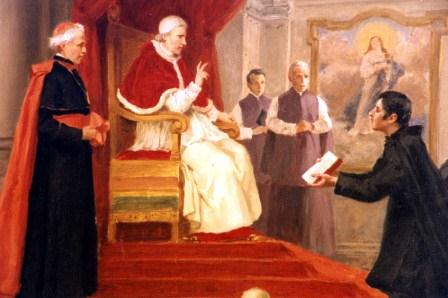
Exactly 10 years later, Eugene was in Rome seeking the Church’s recognition that the foundation event of 25 January was indeed the will of God. With the papal approbation, the Oblate charism was recognized as having its inspiration in the Holy Spirit:
Rejoice with me and congratulate yourselves, my beloved, for it has pleased the Lord to grant us great favors;
Our Holy Father the Pope, Leo XII, gloriously reigning from the chair of St. Peter, has sanctioned with his apostolic approbation, on March 21 of this current year, our Institute, our Constitutions and our Rules.
See then our little flock, to whom the Father of the family has kindly wished to open wide the field of the holy Church, given a place in the hierarchic order, associated with the venerable Congregations which have spread throughout the Church so many great benefits and enlightened the entire world with so bright a light;
see her, right from her birth, enriched with the same privileges of those illustrious Societies, in the footsteps of which, with all her strength and all her means, she will certainly strive to walk steadily forward.
Letter to all the Missionary Oblates of Mary Immaculate, 1826, EO VII n.232
Papal approbation of the Missionary Oblates of Mary Immaculate, ten years after our foundation
Fr. Fernand Jetté OMI, successor of St. Eugene from 1974 -1986, shows the necessity for a “divine guarantee” regarding our foundation:
It is essential for a religious family to be recognized by the Church, for it is the Church who “constitutes” us, as the Founder put it; it is the Church who gives us our “mission”, who sends us as an apostolic corps to evangelize the world…
For a religious family the issues at stake are substantial; it invites men to leave everything, to give up establishing themselves in this world in order to commit themselves in a radical way and within a group to the following of Christ. In such a project, each one stakes his own life. Who will guarantee the Gospel authenticity of the way that is proposed?
…Before one can offer people a particular way of evangelical life, it is necessary that there be signs from God, discernment and the Church’s official confirmation…. It is the Church therefore that “constitutes” us what we are. She vouches to the faithful for the Gospel authenticity of the life-project we offer them.
F. Jetté, THE OFFICIAL APPROBATION OF OUR NEW CONSTITUTIONS, Letter – Rome 27/06/1982 http://www.omiworld.org/superior-general-writings.asp?v=W&sID=4
206 YEARS AGO: CELEBRATING OUR FOUNDING FIGURES
Not all approached by Eugene to join him on 25 January 2016 had the same sentiments as Henri Tempier. In this letter to his friend, Forbin Janson, Eugene gives vent to his feelings in a frank, and rather humorous, description of the reactions of some of his future companions.
Despite all this, they did get together and begin, and we are here today because in spite of their human frailties, they did manage to put the founding dream into reality. God certainly does work miracles despite the imperfect vessels we are!
The house was bought a long time ago; the church leased and partly repaired. All is ready on the material side but my men dither, the few that they are.
He on whom I was counting the most is letting himself be deterred by the cackling of the pious hens of his parish. He is convinced there is much good he can do his backyard. He hesitates to leave and I am dismayed by his indecision.
Another who excels constantly in proclaiming the Word of God to the people is only partially attached to our mission, being persuaded that he does enough good by himself on his travels to and fro.
A third, who is too incensed and vexed with the slowness of the others, threatens to take off by himself if they do not promptly make up their minds.
A fourth, who is an angel, and who seems destined to be the joy of a community, cannot obtain permission to leave his vicariate, although he protests that he cannot bear to stay and wants to work only in the mission field, etc.
I myself, overwhelmed with worries and cares, wage war listlessly, supported in the midst of this bother only by the supernatural outlook which inspires me, but which does not prevent me feeling the whole weight of my situation and all the more woefully in that I am helped neither by my taste or inclination which indeed are quite contrary to the kind of life which I am leading. All this God sends my way for my embarking on such a difficult venture.
How can I put up with a priest who pledges himself with words of absolute devotion and then comes to retract them for the reason that his mother, who has lived separately from him for ten years, cannot live without him – he would regard it as homicide were he not to give her the consolation of eating with her – and more twaddle of this sort?
The one who should have rendered us the greatest service went back on his word; he remains in his parish wherein he stirred up such a commotion with his ridiculous farewells and got the people so worked up that they opposed his departure.
Letter to Forbin Janson, 19 December 1815, EO. VI n. 8
The Carmelite convent Henri Tempier
Eventually, the first five responded! Our “founding fathers” are:
Eugene de Mazenod who was 33 years old, and was the one whose vision sparked the new missionary adventure.
The first three of his companions had been seminarians in Aix at the time when Eugene was a part-time spiritual director and confessor there from 1812 onwards:
Auguste Icard was 25-years old, ordained two years before for the Diocese of Aix, and had been assistant priest in the parish of Lambesc, near Aix.
Henri Tempier was 27, and had been a priest for two years, working as assistant priest in Arles.
Sébastien Deblieu was 27, and had had three years of priestly ministry, working as assistant in the parish of St. Jean outside the Walls in Aix, and then for a year as parish priest of Peynier. He came to live in the Carmelite convent a few days after the others.
Emmanuel Maunier was 46, and was a widower who was ordained a priest for 18 years and worked in Marseille. Although he was a founding member and signed the 25 January document, he was only able to move into the community in March.
Pierre Mie was 47, and had been a priest for 18 years, working in various parish situations and also preaching retreats and missions. It appears that he was a part of the Missionaries in their life and activities from the beginning but only definitively went to live in Aix much later.
The older priests, Maunier and Mie, had both experienced being persecuted as priests during the Revolution and, at danger to themselves, had ministered clandestinely to people. Their experiences would have made them very open to Eugene’s understanding of the damage caused to the Church by the Revolution – especially as expressed in the Preface.
RECALLING OUR FOUNDING STORY 206 YEARS LATER
The all-important first day of community life for the Missionaries was obviously a story often repeated in all its details over the past 206 years. In his Memoires, Father Tempier, described it as: “This memorable day that I will never forget for as long as I live.”
Here Eugene is writing to the novices and scholastics who were in Billens, Switzerland, to escape the dangers of the anti-religious persecution by the government of Louis Philippe. He narrates the story of the beginning of their religious family, and draws a conclusion linked with the vow of poverty and the call to simplicity.
… I celebrate the anniversary of the day, sixteen years ago, I left my mother’s house to go and set up house at the Mission. Father Tempier had taken possession of it some days before. Our lodging had none of the splendour of the mansion at Billens, and whatever deprivations you may be subject to, ours were greater still. My camp-bed was placed in the small passageway which leads to the library: it was then a large room used as a bedroom for Father Tempier and for one other whose name we no longer mention amongst us. It was also our community room. One lamp was all our lighting and, when it was time for bed, it was placed in the doorway to give light to all three of us.
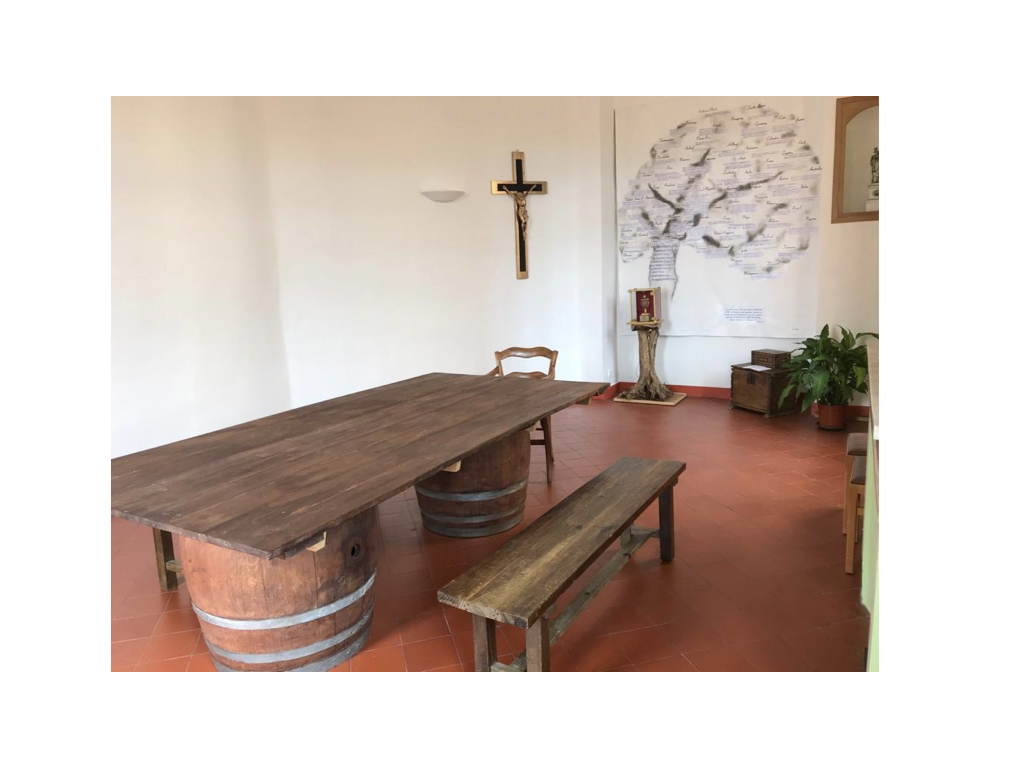
The Foundation Room today
The table that adorned our refectory was one plank laid alongside another, on top of two old barrels. We have never enjoyed the blessing of such poverty since the time we took the vow. Without question, it was a foreshadowing of the state of perfection that we now live so imperfectly. I highlight this wholly voluntary deprivation deliberately (it would have been easy to put a stop to it and to have everything that was needed brought from my mother’s house) so as to draw the lesson that God in his goodness was directing us even then, and really without us having yet given it a thought, towards the evangelical counsels which we were to profess later on. It is through experiencing them that we learnt their value.
I assure you we lost none of our merriment; on the contrary, as this new way of life was in quite striking contrast with that we had just left, we often found ourselves having a hearty laugh over it. I owed this tribute to the memory of our first day of common life. How happy I would be to live it now with you!
Letter to Jean-Baptiste Mille and the novices and scholastics,
24 January 1831, EO VIII n.383
206 YEARS AGO TODAY: CELEBRATING THE FIRST DAY OF MAZENODIAN COMMUNITY LIFE
25 January 1816 marked the first day of community life for the Missionaries, with the arrival of the first three members. What we refer to today as the Mazenodian Family was born!
Eugene had bought some of the Carmelite Convent, with an arrangement that the seller, Madame Gontier, could continue using the greater part of the building for her boarding school for girls. In his Memoires, Eugene tells us that she had
… left us narrowly confined to the rooms she had conceded to us. To reach the top-floor apartment, which now serves as a library, we had to use the small staircase leading from the outside of the house; we had great difficulty squeezing into these quarters. Thus, two of our group slept in the room that has now become the library, while I myself slept in the narrow passageway leading to it.
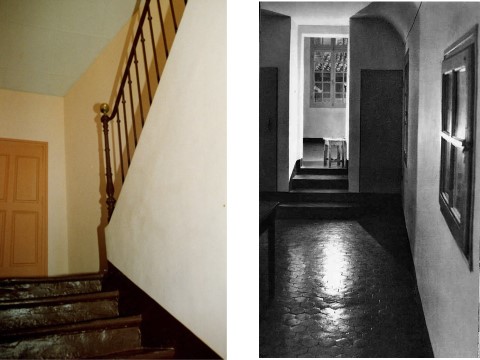
As we had very little furniture in those first days, we set a lamp on the threshold of the connecting door and it served the three of us at bedtime.
The refectory, supposedly temporary, remained poorly furnished for a long time. Our improvised table was merely a plank placed over two barrels which served as legs. The fireplace, where we did our cooking, smoked so badly that it blotted the daylight out of the fox-hole where we ate with great relish the meager portions set before us. This suited the dispositions God had put into our hearts far more than the leisurely meals my mother would have been glad to serve us at her home. We had lost none of our gaiety; on the contrary, since this way of life was such a striking contrast to the one we had just given up, it often provided us with many a hearty laugh.
Memoires, cited by Rambert, La vie de Monseigneur Charles-Joseph-Eugène de Mazenod, Tome I, p. 177
206 YEARS LATER: WITHOUT DIVINE PROVIDENCE AND BENEFACTORS WE COULD NEVER HAVE BEEN FOUNDED
Eugene needed a large house and property to accommodate the nearly 300 energetic youth who met every Thursday and Sunday for prayer, instruction and games. At the same time he needed a big house to accommodate the future members of the missionary group he was planning to start to share in the ministry he was engaged in.
He then turned his attention to the centrally-placed former Carmelite Convent. Here Eugene’s charismatic vision was to become a reality.
My approaches were unexpectedly successful. In a single interview the affair was settled and I found myself proprietor of the major part of the old Carmelite convent situated at the top of the Cours with a charming church attached, somewhat the worse for wear, to tell the truth, but which we could restore to use for less than a hundred gold sovereigns.
We come across the practical point that every dream has to have a down-to-earth foundation of the means with which to put it into practice. Eugene was fortunate to have the possibility of borrowing money from his family, but it was not enough, and it would have to be paid back within a year.
So much for my story. But the amusing thing is that all that was done without my being held back by the thought that I had not a single cent (ed. sol). To prove I was not mistaken, Providence immediately sent me twelve thousand francs, loaned to me without interest for this year. Now tell me how to reimburse them. I have made a golden deal since the whole establishment, including repairs to the church, will cost me only 20 000 francs. But where shall I find this sum? I have no idea.
In the meantime the missionaries are on my back. They want to begin tomorrow. In vain I tell them we need time to fix the rooms and make the house habitable. They cannot wait that long. And then, what about means of livelihood when we set up the community?
Letter to Forbin Janson, 23 October 1815, EO VI n.5
Eugene’s father was still in Palermo, and his son writes to inform him of his missionary project. Eugene firmly believed in divine providence to make his foundation possible – but that did not mean sitting around waiting for something to fall from the clouds. He had to work hard to find the means to finance the missionaries, but with the conviction that God would indeed provide through others.
… What is good about it is that I am forming it without a penny. We must trust fully in divine Providence. If your rich people of Palermo would want to contribute to it, that would be the most wonderful work they have ever done. One has no idea of the peoples’ need.
Letter to Charles Antoine de Mazenod, 8 November 1815, EO XIII n.1
In Aix a Prospectus for the Missions was produced in which an appeal was made for benefactors to participate financially in the evangelizing activities of the Missionaries by subscribing towards the expenses of setting up the house of the Missionaries of Provence.
But an establishment, which should produce such great fruit as an institution that can be described as being so necessary, cannot be formed without the contribution of the faithful by their charity. We have no doubt that those who have in their hearts a sincere love for religion, will agree to the pleasing duty of sowing some temporal goods in order to reap eternal ones.
Is it possible that they would wish to deprive themselves of the graces that God does not fail to give to those who cooperate in such a holy work?
We sense that this is not the most favorable of times; but the danger is too urgent for us to put off being associated with this good work. In order for the contribution not to be too much of a burden, we propose a subscription or a participation as a means to contribute in a very inexpensive way, for several years, depending on the possibilities of each one.”
We will have daily prayers in the church of the mission in Aix for the benefactors and during the course of the missions we will urge the people to do the same.”
Formula of subscription:
” I promise to pay each year for (_____) insofar as my possibilities allow, the sum of ___, as a contribution to the expense of the establishment of the house of the Missions of Provence, founded in Aix in the former convent of the Carmelites.”
OMI General Archives, Rome, DM-IX-1
Our foundation in Aix would not have been possible, without the material contribution of benefactors. Our 200-year missionary history would not have been possible without the generosity of our benefactors. Let us pause for a moment to recall these lay partners in our mission – let us give thanks for them, and let us pray for them.
Gautama Buddha gives us a good missionary perspective: “Good people and bad people differ radically. Bad people never appreciate kindness shown them, but wise people appreciate and are grateful. Wise people try to express their appreciation and gratitude by some return of kindness, not only to their benefactor, but to everyone else.”
CELEBRATING 206 YEARS OF COURAGE TO WALK IN THE FOOTSTEPS OF THE APOSTLES
If, as I hope, you wish to be one of us, you will not find yourself in unfamiliar territory; you will have four companions.
If presently we are not more numerous, it means we wish to choose men who have the will and the courage to walk in the footsteps of the apostles. It is important to lay solid foundations.
Letter to Henri Tempier, 9 October 1815 O.W. VI n 4
In bringing the missionary group into existence, Eugene used the model of Jesus and the apostles.
The missionary vocation was to be apostolic. From the first Rule of Life that he wrote, he expressed it this way:
What did Our Lord Jesus Christ do?
He chose a certain number of apostles and disciples whom He formed in piety and filled with His spirit;
and after having trained them in his school and the practice of all virtues, He sent them forth to conquer the world which they soon brought under the rule of his holy laws.
1818 Rule
Like Henri Tempier, the members of the Mazenodian family must follow the model of the apostles, and have the courage to do so whatever the consequences.
Henri Tempier’s reply to Eugene’s invitation was a source of great joy for Eugene. It shows the apostolic “one heart and one soul” that marked his relationship with Eugene:
“May the good God be blessed for having inspired you to prepare for the poor, for the inhabitants of our countryside, those who have the most need of instruction in our religion, a house of missionaries who will go and announce to them the truths of salvation.
I share your views completely, my dear brother… What you want most in those you choose as your collaborators is priests who will not get into a rut of routine and daily hum-drum, and, as Father Charles’ predecessor used to say, plod along day after day without accomplishing anything; you want priests who will be ready to follow in the footsteps of the Apostles and work for the salvation of souls with no other reward here on earth but hardship and fatigue. I think that God’s grace has given me this desire. If not, then I wish with all my heart that I will have it, and working with you will make it all the easier to attain. You can, therefore, count entirely on me.”
27 October, 1815 Cf. REY I, p. 183
Eugene described his apostolic ideal in the original version of our Preface:
What more sublime purpose than that of their Institute?
Their founder is Jesus Christ, the very Son of God;
their first fathers are the Apostles.
They are called to be the Savior’s co-workers, the co-redeemers of mankind;
and even though, because of their present small number and the more urgent needs of the people around them, they have to limit the scope of their zeal, for the time being to the poor of our countryside and others,
their ambition should, in its holy aspirations, embrace the vast expanse of the whole earth.
The Church, that glorious inheritance purchased by Christ the Savior at the cost of his own blood, has in our days been cruelly ravaged…
Nota Bene (1818 Rule)
Posted in WRITINGS
2 Comments