
-
Recent Posts
- FOR THE REST, I DO MY BEST TO LEAVE IT TO GOD
- GOD ALONE KNOWS HOW TO REWARD WHAT WE HAVE DONE FOR HIM. SO, WE MUST DO EVERYTHING TO PLEASE HIM
- IT IS A CONSOLATION FOR ME TO BREATHE THE SAME AIR, TO OFFER THE HOLY SACRIFICE ON THE SAME ALTARS, TO BE ABLE TO PRAY AT HIS TOMB
- THERE IS NOT A CORNER OF ROME WHICH IS NOT A MONUMENT OF FAITH OR PIETY
- THE ROMAN MARTYRS ARE STILL THE OBJECT OF VENERATION OF PEOPLES
Recent Comments
- Eleanor Rabnett, Lay Oblate on FAITH-FOCUSED INVESTMENT GROUPS: A PRESENCE WHERE DECISIONS AFFECTING THE FUTURE OF THE POOR ARE BEING MADE (Rule 9a)
- Eleanor Rabnett, Lay Oblate on VIVAT: A PRESENCE WHERE DECISIONS AFFECTING THE FUTURE OF THE POOR ARE BEING MADE (Rule 9a)
- Eleanor Rabnett, Lay Oblate on WE SHOW A VERY HUMAN FACE OF JESUS TO THE WORLD, ONE FULL OF COMPASSION AND SOLIDARITY (Rule 9a)
- Eleanor Rabnett, Lay Oblate on JUSTICE, PEACE AND THE INTEGRITY OF CREATION AS AN INTEGRAL PART OF EVANGELIZATION (Rule 9a)
- Eleanor Rabnett, Lay Oblate on WALKING THE LINE BETWEEN PROPHETIC VISION AND SPIRITUAL SUSTENANCE (CONSTITUTION 9)
Archives
Meta
-
THE DIOCESAN PRIESTS NEED COMMUNITY
As a Missionary Oblate, community life was an essential aspect of Bishop Eugene’s life. He understood the difficulty of living and working alone without fraternal encouragement. Without a link to a supportive community the priest could succumb to problems. His diary entry shows that this had happened to one of the priests in his diocese.
Is it a warning, is it a reproach that the Lord is giving me today? I have just learned that a priest of my diocese is behaving badly, from which I conclude that I must, more than ever, insist that the priests live in community. This one arrived at this excess only gradually.
Eugene’s solution was to insist that all the diocesan priests serving in the same parish would live together. His appeal led to major opposition among the clergy.
Do I not have to blame myself for having stopped myself in front of almost insurmountable obstacles, I must admit that from every corner there is opposition to the resolution that I had taken to oblige my priests to live in community? This example will provide me a further argument, when finally I shall smash all the obstacles which each has not ceased to place before the execution of a plan which was conceived only in a supernatural perspective for the honor of the Church and the preservation of the clergy.
He had been so discouraged by their reaction and had not pushed strongly enough.
If I had been helped a little, I would have obtained more results than those which I have been able to obtain. Has it not been said that I was the only one to insist on this measure, and that I would be obliged to give it up.
Eugene de Mazenod’s Diary, 3 October 1844, EO XXI
Eugene insisted on this until the day of his death, but it was a losing battle that dissolved on the day after his death.
THE IMPORTANCE OF RECITING PRAYERS
Each one must know by heart the prayers in use in the Congregation. Begin at once to require it of scholastics and have them recited as soon as they are known.
Letter to Father Charles Bellon, 30 August 1844, EO X n 853
“Recited prayer is a vital way of connecting to God through the community of believers-by saying prayers that have been prayed for generations, you are participating in a worldwide, centuries-long relationship between God and his people. Of course, it’s important that these recited prayers do not substitute for an authentic, spontaneous relationship with God. Like saying “how are you?” to friends, these prayers need to be deliberate and intended. It’s not necessarily about the words-people often use the rosary to meditate, not to think about the content of the “Hail Mary,”-but it is about your intention. These prayers shouldn’t be a duty or a magical way to get God to do what you want. They’re a way to grow closer through reciting what has already been said-like saying “good night” before you go to bed. “(https://bustedhalo.com/googling-god/how-to-pray/recited-prayers )
St. Paul of the Cross writes: “When you are dry as dust in prayer, don’t quit, but keep going. Use little short prayers.”
DYING TO ONESELF
Some religious congregations, during the time of Eugene, stressed religious commitment as “dying to oneself” by dramatically having a funeral pall for the candidates to lie on when they professed their vows. Eugene did not tolerate this spectacle, but referred to the necessity of its spirit.
Teach them well that by the religious profession one dies to the world. There is no need for us to lie under the funeral pall, as is done at Visitation and other places, to know and to practice that; we just have to remind those who may forget it.
I have not yet come to a definite solution regarding Brother N. I would have wished that this young religious show more detachment and had overcome nature. One is not good for very much when one cannot imitate the detachment recommended by Jesus Christ and practised by the saints. Oh! How lax we are! We arrive only by much reasoning, when we should fly as though by supernatural instinct!
Letter to Father Charles Bellon, 30 August 1844, EO X n 853
All discipleship means dying to ourselves so as to achieve the ideal preached by John the Baptist: “He must increase and I must decrease” (John 3:30)
IT IS A QUESTION OF FORMING PERSONS WHO ARE TO BE IMBUED WITH THE SPIRIT OF JESUS CHRIST CAPABLE OF FIGHTING THE ENORMOUS POWER OF THE DEVIL
Helping people to become “Human, Christian, Saints” was the Oblate ideal. Eugene thus stressed the human foundations necessary to achieve this.
But I see that in everything we have to start again from the beginning with the very first principles of spiritual life. I implore you to demand also that they be polite, honest and kind. Do not permit any rudeness. Let them get used to bearing up with one another. Deal severely with any kind of murmur, and let charity reign among us to such an extent that it isn’t even possible for anyone to fail in it in the slightest manner.
Applying this to the scholastics in training to be missionaries:
In a word, let our training be manly, serious and totally saintly. It is a question of forming persons who are to be imbued with the spirit of Jesus Christ capable of fighting the enormous power of the devil, of destroying his reign among people, of building up the world so as to bring it to the truth and of serving the Church in the most lofty and difficult apostolate.
Is it possible to achieve these results with those who are not generous, who have no courage, are lacking in love and have fallen into a rut? When does a person entertain such sentiments if he does not have them during the period of fervour?
Letter to Father Charles Bellon, 30 August 1844, EO X n 853
An invitation to all of us to renew our efforts to be imbued with the Spirit of Jesus in our daily lives and activities.
SCHOLASTICS ARE RELIGIOUS WHO, IN CONSCIENCE, ARE BOUND TO WALK IN THE WAY OF PERFECTION; AND YOUR DUTY IS TO BE FIRM IN REQUIRING THAT THEY FULFIL THEIR OBLIGATIONS
One of Eugene’s guiding principles when he founded the Missionaries was to bring the most abandoned to know Jesus Christ as their Savior. In order to achieve this goal it was necessary that the minsiters of the Gsopel be holy persons who knew and loved the Savior. For this reason, he insisted that those in the formation process be aware of their call to being as perfect as possible in their discipleship.
Keep telling them in my name that they are neither students nor ordinary Christians, nor even seminarians, but religious who, in conscience, are bound to walk in the way of perfection; and your duty is to be firm in requiring that they fulfil their obligations.
You may read my letter to them. I will be glad if they know what I think and how dissatisfied I am with the little progress they have made in their spiritual life and with their many imperfections in which they stagnate.
I was going to ask you to instil into them self-denial, renouncement to their own will, obedience as it is understood by our Rules and observed in all good Congregations and Orders, zeal for their own perfection so as to deserve to work for the sanctification of others.
Letter to Father Charles Bellon, 30 August 1844, EO X n 853
Unless each member of the Mazenodian Family constantly works to come to a deeper relationship with Jesus as Savior, what do we have to offer to those around us?
I CANNOT TOLERATE THIS HABIT OF IMPERFECTION IN YOUNG RELIGIOUS WHO SHOULD BE MODELS OF PIETY.
We do not know the background to this admonition regarding the scholastics in Marseilles, but Eugene writes to one of the formators, Father Bellon, that the situation must be remedied because future Oblate priests are primarily religious and need to be models of piety as they live the vows they make as Oblates.
I admit that this picture did not reassure me; I must even tell you that I was not able to contain my indignation at the sight of such obstinacy in a state of voluntary imperfection so contradictory to their duties. This must absolutely be remedied. If kindness does not suffice, you must use strictness.
I cannot tolerate this habit of imperfection in young religious who should be models of piety.
Notify them in my name that I will not admit to Holy Orders those who do not give me the guarantee of solid piety and regularity above every test.
I do not understand that people can bargain with the good Lord. I will not go into detail, but I remind you, who are their director, that it is not a question of being satisfied with anything you can achieve, but that they are to put themselves heart and soul into acquiring the virtues that are proper to the state of perfection they have vowed.
Letter to Father Charles Bellon, 30 August 1844, EO X n 853
Eugene is referring specifically to scholastics but his admonition applies to every member of the Mazenodian Family who follows the spirit of Eugene’s charism in her or his discipleship. He warns us: “I do not understand that people can bargain with the good Lord.”
Posted in WRITINGS
2 Comments
THE RESPONSIBILITIES OF A MEMBER OF A FORMATION TEAM
The scholastics (whom Eugene always referred to as “the Oblates”) were studying at the Marseilles Major Seminary, together with the diocesan seminarians. Father Tempier had been the Superior and Formation Director since 1827. At the same time he was also very busy as a Vicar General of the diocese and of the Oblate Congregation. He thus had to rely heavily on the members of his formation team in the seminary. Eugene had close contact with all the students and expressed his concern at some examples of insufficent piety. He wrote to Father Charlses Bellon, one of the formators:
I remind you, who are their director, that it is not a question of being satisfied with anything you can achieve, but that they are to put themselves heart and soul into acquiring the virtues that are proper to the state of perfection they have vowed
Letter to Father Charles Bellon, 30 August 1844, EO X n 853
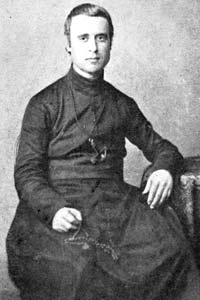 Father Bellon was 30 years old, and as we will be encountering him frequently in Eugene’s correspondence, it is good to introduce him. (He was going to be Eugene’s first choice to be Vicar Apostolic of Natal in 1852)
“Father Bellon was called to the major seminary of Marseilles in the fall of 1843 to teach dogma there and be spiritual director for the scholastic brothers whose number was growing year by year. In this regard, Father Fabre wrote: “For their direction, it was necessary to choose a priest who possessed solid and profound learning along with a gentle, enlightened piety, a priest who could teach by his words as well as by his example. Among everyone else, Reverend Father Bellon was worthy of the choice our superiors made of him. During the five years this very difficult and important work was confided to him, he always showed himself equal to his sensitive task.
Never demanding of others what he would not do himself, his life was for the seminarians and for the Oblates a continuous teaching. In class, a conscientious and well-read professor, in chapel and the prayer room, a model of piety, fervour and regularity, in his room he was a good, prudent, enlightened director, without being too weak and without being too rigid, exteriorly of great equanimity, his face inspired confidence, while his words inspired a love of piety. Since he knew how to use his time wisely and having a pious appetite for study, he was able to acquire that depth of learning that would later make him sought after and held in high regard at the provincial council of Agen [in 1859] by the learned and pious clerics, while at the same time he was educating himself and perfecting his knowledge of Hebrew, Italian, German, English and Spanish. His day was marvellously well organized. He had found the means to do a lot of work and do it well, to blend a profound learning with a gentle, kindly piety…” (See https://www.omiworld.org/lemma/bellon-charles-barthelemy/)
He obviosuly taught by example, but Eugene felt that he needed to be more pro-active.
Posted in WRITINGS
2 Comments