This reflection was prepared a while ago. As I reread it today, in the context of our current world situation, the question comes to mind: “How can I proclaim this to those most in need today?”
Firstly, by spending time meditating on this reality myself and making it more alive in me as a life-giving focus in these times of fear and uncertainty.
Then it will overflow to those I reach out to wherever I can.
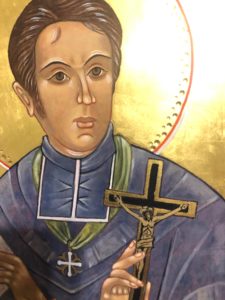
Detail of an icon written by Lauretta Agolli
St Eugene’s Good Friday experience of the Savior brought light and focus into his life:
What more glorious occupation than to act in everything and for everything only for God, to love him above all else, to love him all the more as one who has loved him too late
Eugene de Mazenod, Retreat Journal, December 1814, EO XV n.130
“The word ‘Oblates’ means people ready to give themselves for the love of God. God’s Spirit has granted St. Eugene and his sons and daughters the zeal to get caught up by the mystery of the saving cross and to proclaim it to those most in need. Our spirituality is therefore centered on the salvation given us by Christ; it can be called ‘salvatorian’. With such a spiritual orientation our Congregation was approved in 1826.
Our recognition by the Church, which we celebrate each February 17th calls us to delve deeper into the mystery of salvation, to make it even more the center of our lives, as it was the center around which Eugene’s life revolved.”
Steckling OMI, OMI Information n 462, Rome, February 2007.
Goodness always tends to spread. Every authentic experience of truth and goodness seeks by its very nature to grow within us, and any person who has experienced a profound liberation becomes more sensitive to the needs of others. As it expands, goodness takes root and develops. If we wish to lead a dignified and fulfilling life, we have to reach out to others and seek their good. In this regard, several sayings of Saint Paul will not surprise us: “The love of Christ urges us on” (2 Cor 5:14); “Woe to me if I do not proclaim the Gospel” (1 Cor 9:16). Pope Francis, The Joy of the Gospel, 9.
(These reflections have been adapted from those published in 2021)
Former Superior General, Wilhelm Steckling OMI, wrote in 2007:
“It was probably in 1807, on Good Friday of that year, that Saint Eugene had a special encounter with the Crucified One that changed his life. It essentially made him an Oblate. What we can celebrate in 2007 is not an anniversary of the Congregation, but rather an anniversary of our charism, the spiritual gift that makes us live – an anniversary of our Oblate spirituality.
It was the cross displayed on Good Friday that made young Eugene – 24 at that time – aware of his life- style apart from God.
 “I had looked for happiness outside of God and outside him I found but affliction and chagrin”, he writes a few years later (1814) during a retreat. In his emptiness he encounters someone who loves him without measure. His sins melt away amidst tears in the embrace of Christ, and this experience marks him for the rest of his life. “Can I forget the bitter tears that the sight of the cross brought streaming from my eyes one Good Friday?” “Blessed, a thousand times blessed, that he, this good Father, notwithstanding my unworthiness, lavished on me all the richness of his mercy.” The experience did not stay just inside of him. “Let me at least make up for lost time by redoubling my love for him.”
After a short time, St. Eugene wanted to share the mercy he experienced with others. Such zeal for souls finally led to the birth of the Oblates. The word “Oblates” means people ready to give themselves for the love of God.”
W. Steckling OMI, OMI Information n 462, Rome, February 2007
“Jesus on the cross feels the whole weight of the evil, and with the force of God’s love he conquers it; he defeats it with his resurrection. This is the good that Jesus does for us on the throne of the cross. Christ’s cross, embraced with love, never leads to sadness, but to joy, to the joy of having been saved and of doing a little of what he did on the day of his death.” Pope Francis
Two years later, Bishop Eugene wrote a Pastoral Letter to his diocese about the works of mercy that were active in his diocese. It shows an amazing grasp of the human needs of the second largest city of France, and of this Missionary Oblate’s response:
Marvel at how these good works are multiplying. So many new institutions with a previously unknown objectives! Childhood, old age, sickness, poverty, the worker who toils all day long, innocence in danger, the repugnant vice that inspires remorse, the imprisoned youth already initiated in the habits that make criminals, the great culprit seasoned in crime, even the rich man often so destitute before God on his deathbed.
Charity embraces everything; and for new needs, it invents, when necessary, new means: spiritual help, bodily help, bread for the soul, bread for the body; instruction for ignorance; advice, guidance, support for weakness; asylum for virtue or for penance; pious sentiments, sweet consolations, supernatural strength for the dying;
All kinds of good works are being generated in the name of Jesus Christ
Without speaking of the zeal and generosity of those pious associations of ladies who support our charitable establishments in our city of Marseilles, where they are distinguished by such a perfect spirit and by all the virtues of the Christian woman…
Bishop Eugene de Mazenod, Pastoral Letter of 7 February 1847, Marseille
To respond to the needs of the poor domestic servants, Bishop Eugene had been instrumental in the founding of the Sisters of Compassion in collaboration with Fr. Jean François Barthès, S.J.
I visited the establishment of the new Dames de la Compassion [Sisters of Compassion]. Evidently, the good God is helping this good Father Barthès to make him succeed in some undertakings where the most skilful would fail.
In his diocese he wanted the laity to be fully involved in the various works of mercy, and tried to provide religious to support them, where possible. The founding of the Sisters of Compassion aimed at supporting the ministry to domestics.
Even so, I recommended to him that l’Oeuvre des Domestiques [the Work of the Domestics] be not neglected. It is essentially for this work that I have adopted this new Order or, to say it better, that I have let it develop under my auspices and my authority.
Eugene de Mazenod’s Diary, 29 June 1845, EO XXI
“Arriving in Marseilles in 1843, Jean-François Barthès encountered a community of Sisters of the Holy Family from Bordeaux who had been called to the city by Eugene de Mazenod, Bishop of Marseilles, to care for the sick in their homes and to open a house for young women who had left the country to work as domestic servants. Bishop de Mazenod then thought of creating an autonomous congregation, entirely dedicated to the work of domestic servants, and entrusted the task to Barthès. Barthès created the congregation on June 25, 1843 in Marseilles; it was erected as an institute of diocesan right on June 16, 1845, the same day the first twelve postulants received the religious habit from the bishop.” https://fr.wikipedia.org/wiki/Sœurs_de_Notre-Dame_de_la_Compassion_de_Marseille
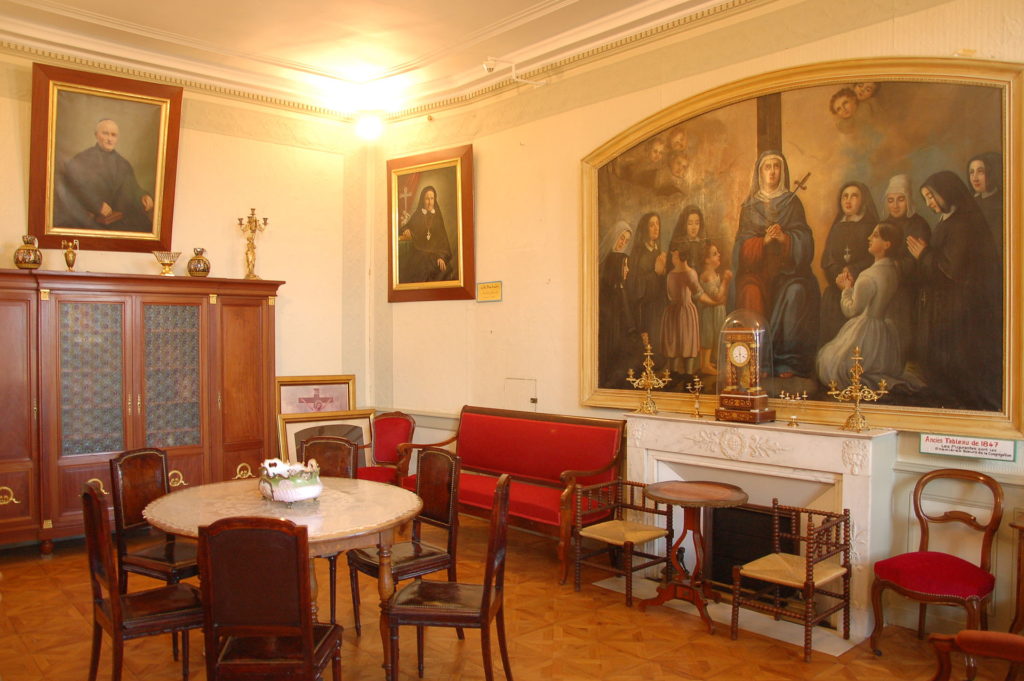
A picture of Fr. Barthès on the left, and of the first Sisters on the right
“Seeing the world through the eyes of the Crucified Christ” as a Missionary Oblate, Eugene was always close to the people of his diocese and aware of their needs. He responded by establishing various Works of Charity to meet the material and spiritual needs of the various groups of people.
In explaining what this work of charity was, I am not afraid of proclaiming, in order to reply to those who could be surprised that someone was proposing a new work to them, that this would not be the last.
Eugene de Mazenod’s Diary, 31 January 1845, EO XXI
This short sentence is significant because it presents three distinguishing marks of Eugene’s episcopal reaching out to the needs of his people.
1/ Firstly, his practical response to the needs of specific groups of people was always to create a work of charity. In this case it was the “Oeuvre des Domestiques” – the Work of the Domestic Servants. He makes it clear that he would continue this process of reaching out for the rest of his life.
2/ Secondly, on the day of this diary entry, he had been to the Chapel of the Mission of France, which he had turned into a meeting center for all the works of charity that did not have a special place to gather. He thus provided for the structure and administration of all the groups he established and involved as many people as possible to be the ones to care for that particular need.
3/Thirdly, he was creative in his responses and wanted as many people involved as possible. To support the work of the laity, he aimed to bring to the diocese religious congregations who focused on specific groups of needy people. When none were available, he became instrumental in the foundation of new religious congregations in his diocese. It was to this that today’s diary entry refers.
I fell from the clouds, my dear Father Martin, on receiving your letter. I was hundreds of miles removed from suspecting your dislike for the position I have placed you in.
Eugene had given Father Martin a change of community to Aix en Provence, and was surprised to receive a response that was not positive about the move. Seemingly Father Martin and Father Courtès had had a misunderstanding when he had previously worked in Aix.
It wasn’t too long ago that you showed feelings to the contrary and, as I remember, I was edified that I even made some comment about it. I therefore had every reason to be certain that what had happened such a long time ago had been entirely forgotten, as in effect it should have been.
As Superior General, Eugene had experience of some of the Oblates having difficulties with one another. His attitude was to urge them all to work for the common good.
Where would we all be if such grudges were perpetual? Soon we would all have to live alone, for the grievances you believe you hold against Father Courtès, others claim to hold against you, and there would be no end to it. Let holy charity consume all our disagreements in the melting-pot of religion.
For my part, I am quite determined not to suppose that we can be otherwise than duty requires. I urge you, for love of God, not to manifest either at Aix or elsewhere, any aversion to what I am obliged to prescribe for you. Peace and the common good depend on it. You have too deep a sense of your state in life not to understand this.
Letter to Fr. Joseph A. Martin, 10 January 1845, EO X n 865
“Peace and the common good” are good pointers for us to remember in times of interpersonal challenges.
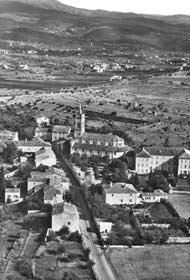 “When Bishop Hippolyte Guibert arrived in the diocese of Viviers in 1842, the Abbé Deschanels, chaplain at the shrine, was asking for help. Furthermore, the Jesuits of the house of Lalouvesc were no longer able to respond to all the requests for parish missions. Bishop Guibert was very attached to his own religious family and thus he decided to ask the Oblates to serve the shrine and to preach missions in a sector of his diocese. The General Council readily acceded to this request, for it corresponded so well with the ends of the Congregation. In the minutes of the January 14, 1845 Council meeting we read: ‘This is a shrine to Mary, our holy Mother and Patroness, which needs to be developed and our Congregation is called to do the same in other pilgrimage places that have been entrusted to us… By its location on the borders of the dioceses of Viviers, Nïmes and Mende, this house presents us with a vast field that is worthy of the zeal of those among us who will be its personnel’…” (https://www.omiworld.org/lemma/notre-dame-de-bon-secours-1845-1994)
Not only would this shrine further the aspects of the Oblate charism concerning the preaching of parish missions and permanent mission center of a Marian shrine, but it would also provide new vocations to the Oblates to send to Canada as missionaries. Writing to the Bishop of Montreal, Eugene narrated:
Believe me, dear Monseigneur, I have made sacrifices to further the plans of God for the sanctification of our dear Canadians and of the Indigenous who dwell in these northern lands. I must not deprive myself in Europe of the means to build up the family with good members.
To obtain vocations we must become known in dioceses other than those which have supplied us up to now and which are emptied. It is now several years that the service has been proposed to me of a shrine of the Holy Virgin from where the missionaries could spread in the diocese by organizing the preaching of missions as they already do in the dioceses of Aix, Marseilles, Fréjus, Avignon, Valence, Grenoble, Digne and Ajaccio.
I have just accepted this undertaking as much to renew devotion to the Holy Virgin as to recruit if possible some good members. But I need personnel for this establishment. I hope to invest for the future this sum of confidence in Mary.
Letter to Bishop Bourget of Montreal, 6 February 1845, EO I n 51
The Founder, as Superior General, regularly held decision-making Oblate council meetings. The minutes of January 1845 start off with a long statement on the poverty of the Congregation, which had hardly any funds but spent large amounts to feed and clothe “some sixty young men.” These were the juniors at Lumières, the novices at L’Osier, and the scholastics at Marseilles. In spite of this enormous expense, it was decided to accept the ministry and administration of the shrine of Notre-Dame de Bon Secours in the Diocese of Viviers.
Eugene described this move to Father Courtès in Aix:
Things have gotten to such a point that yesterday in Council, we were just about to give up the valuable foundation at La Blachère. Especially Tempier argued strongly in favour of abandoning that project, not only because we lacked the men, but also because we do not have the money, and it is impossible for us to incur the expenses of a very costly construction.
I fought against his position which not only would prevent the Congregation from doing a good work that is in line with its Institute, but which would also deprive us at the same time of a valuable source from which we could hope for an increase in our members.
Experience has proven that wherever we have established ourselves, we have in a first period brought to our ranks a goodly number of excellent recruits; but soon these sources become exhausted and produce no more. Look at Aix, how many good candidates came from there? But for how many years now have there been no more? At Gap, the same situation occurred. Marseilles has given its share; but if we still get a few more there, it is the seminary that is bringing them to us. And so it suits us to spread out so as not to die out quickly.
Letter to Fr. Hippolyte Courtès in Aix en Provence, 4 January 1845, EO X n 864
Yvon Beaudoin comments in the footnote to this letter: ” It is interesting to note how Father Tempier, the procurator general, is concerned about bringing the Congregation into debt and consequently insists that we should not over-reach ourselves by accepting a place where housing needs to be built immediately. The Founder however shows that he has a wider view, more audacity and more zeal in allowing his sons to practise their ministry in a new region, despite the Congregation’s few resources in men and money.”
In France it is customary to exchange greetings at New Year. Eugene wrote to Father Courtès to express his good wishes.
So that things won’t happen to me today as they do every day, my dear Courtès, that I don’t have the time to take pen in hand, I am writing to you by the lamp light much before dawn. If I had not wished you a happy festive season, I would be even more put out for being late in wishing you a happy New Year; but you know that Mass on New Year’s Day is offered as a prayer – a wish for all those whom the Lord has given me.
Eugene then shares with him the good news of the growth of his Oblate family.
This year, I had the consolation of receiving the profession of one of our Irish lads, in the midst of twenty-two confrères. During the ceremony, the regimental band was playing beautiful tunes in my courtyard, which contributed to giving the celebration an unusual but very imposing solemnity. I think that at the same time at L’Osier they received the profession of Brother Coste; Brother Fabre’s profession will be held on February 17.
Thus the family is growing little by little, and that is good, for the needs are so great and so pressing from all sides.
Letter to Fr. Hippolyte Courtès in Aix en Provence, 4 January 1845, EO X n 864
The “Irish lad” was Louis Marie Keating, who would be one of the founders of the Oblate mission in Ceylon, in which he served as a missionary for 35 years.
In the previous entry we saw how Eugene had described the new missions in Canada to the Council of the Propagation of the Faith. His letter continues:
I feel, gentlemen, that I have sufficiently illustrated for you the needs of the Bytown foundation and its importance in the light of the various ministries carried out by the missionaries there, an importance which increases every day considering the position of this city at the very center of communications between Upper and Lower Canada, the United States, and the North of this part of America.
The renowned zeal which inspires you and associates you to any enterprise whose object is the propagation of the faith and the good of religion, the generosity with which you have granted abundant alms to various foundations opened in the United States and elsewhere by other missionary societies, and the goodness with which you have accepted our requests in favor of the Cornwall mission entrusted to the Oblates of Mary Immaculate in England, leads me to hope and assures me that you will be so kind as to take our new foundations in America under your protection and include them among the missions supported by the admirable Missionary Society you administer with such wisdom and devotion.
Letter to the Council of the Propagation of the Faith, 23 December 1844, EO V n 90
From the very beginning, without financial support, the Oblate missions to the most abandoned would be impossible. Today we recall with gratitude the countless benefactors who support and make possible our mission of evangelization