-
Recent Posts
- FOR THE REST, I DO MY BEST TO LEAVE IT TO GOD
- GOD ALONE KNOWS HOW TO REWARD WHAT WE HAVE DONE FOR HIM. SO, WE MUST DO EVERYTHING TO PLEASE HIM
- IT IS A CONSOLATION FOR ME TO BREATHE THE SAME AIR, TO OFFER THE HOLY SACRIFICE ON THE SAME ALTARS, TO BE ABLE TO PRAY AT HIS TOMB
- THERE IS NOT A CORNER OF ROME WHICH IS NOT A MONUMENT OF FAITH OR PIETY
- THE ROMAN MARTYRS ARE STILL THE OBJECT OF VENERATION OF PEOPLES
Recent Comments
- Eleanor Rabnett, Lay Oblate on FAITH-FOCUSED INVESTMENT GROUPS: A PRESENCE WHERE DECISIONS AFFECTING THE FUTURE OF THE POOR ARE BEING MADE (Rule 9a)
- Eleanor Rabnett, Lay Oblate on VIVAT: A PRESENCE WHERE DECISIONS AFFECTING THE FUTURE OF THE POOR ARE BEING MADE (Rule 9a)
- Eleanor Rabnett, Lay Oblate on WE SHOW A VERY HUMAN FACE OF JESUS TO THE WORLD, ONE FULL OF COMPASSION AND SOLIDARITY (Rule 9a)
- Eleanor Rabnett, Lay Oblate on JUSTICE, PEACE AND THE INTEGRITY OF CREATION AS AN INTEGRAL PART OF EVANGELIZATION (Rule 9a)
- Eleanor Rabnett, Lay Oblate on WALKING THE LINE BETWEEN PROPHETIC VISION AND SPIRITUAL SUSTENANCE (CONSTITUTION 9)
Archives
Meta
-
EASTER WITH THE WORD OF GOD – MAY OUR HEARTS BURN WITHIN US
Did not our hearts burn within us as he talked to us on the road and explained the scriptures to us? (Luke 24,32)
The downcast disciples returning to Emmaus had lost all sense of purpose. The one they had pinned their hopes on had been put to death, and all that he stood for had disappeared. No more dreams or inspiring ideals… it was time to return home and shut themselves in.
Luke 24:13-35 narrates how they became aware that a “stranger” was walking with them and entered into their experience and opened their eyes.
Here we understand the meaning of Easter: the realization that Jesus Christ is alive and enters into the reality of our lives. Easter is the opening of our eyes and hearts and lives to his presence.
During Easter we are invited to spend time with Scripture. Like the disciples let us let him explain his Word to us and set our hearts on fire in our everyday existence.
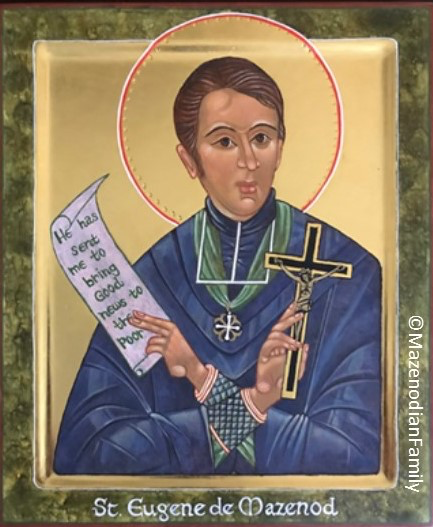
Saint Eugene’s life was dedicated to explaining the Good News of salvation to those who were most in need. He and his missionaries wanted the hearts of all those who listened to burn within them. The invitation he wrote in the Rule of 1818 continues today:
Our one and only aim should be to instruct people…
not only to break the bread of the Word for them but to chew it for them as well;
in a word, to ensure that when our discourses are over,
they are not tempted to heap foolish praise on what they have not understood,
but, instead, that they go back home edified, touched, instructed, able to repeat in their own family circle what they have learned from our mouth.
At times we feel like those disciples who wanted to shut themselves into their own isolation in Emmaus. Let’s open our eyes to recognize the presence of the Risen Jesus alongside us. Let us spend some time with his Gospel. As we break the bread of the Word, he helps us to chew it – and our hearts will burn within us.
LET US MAKE IT POSSIBLE TO PROCLAIM “I HAVE SEEN THE RISEN LORD”
“Mary Magdalene went to the disciples with the news: ‘I have seen the Lord!’ And she told them that he had said these things to her.” John 20,18
Mary Magdalene was the first to recognize that Jesus was risen and she rushed to tell the disciples who were fearfully isolated in the upper room. “I have seen the Lord!” she proclaimed. Initially incredulous, they too began to experience that Jesus was alive.
As a result of the French Revolution the people of the countryside of France were locked in their ignorance of their faith. Eugene de Mazenod had recognized the presence of the Risen Jesus in his life, and he dedicated his life to proclaiming “I have seen the Lord!” to those who were the most needy of coming to know the Risen Lord.
Inviting others to enter into his life of proclamation, he founded the Missionary Oblates, and insisted that their time be divided between “seeing the Lord” in prayer, reading and reflection and the proclamation, “I have seen the Lord!” whom they had encountered in this way:
The Missionaries will divide their group in such a way that while some strive in community to acquire the virtues and knowledge proper to a good missionary, others are travelling in the rural areas proclaiming the Word of God.
When their apostolic journeys are over, they will return to the community to rest from their labours by exercising a ministry that is less demanding, and to prepare themselves through meditation and study for a more fruitful ministry when next called upon to undertake new work.
Request to the Capitular Vicars of Aix, 25 January 1816, EO XIII n.2
In these days, let us use this time in a similar way so that each day we too can proclaim “I have seen the Lord! He is risen and alive for me!”
OUR RISEN LORD INVITES US TO A SPIRIT OF RECOLLECTION
“Do not be afraid; go and tell my brothers that they must leave for Galilee; they will see me there.” (Matthew 28, 10)

Photo by Sammy Chandio on Unsplash
The Risen Jesus tells the disciples to go back to Galilee: “They will see me there.” Galilee is where it all began for the disciples, it was the place where they met Jesus, and he entered into their lives.
Today, the Risen Lord tells each of us: “Go back to Galilee – go back to that time when you realized that I was present in your life.”
The Risen Jesus is inviting us to enter into the Galilee of our hearts and lives.
Saint Eugene frequently did this, and he called it recollection. He wanted all those who followed his way of discipleship to do the same, as he wrote in his Rule of 1818:
The whole life of the members of our Society ought to be a life of continual recollection (Art. 1).
To attain this, they will first of all make every effort to walk always in the presence of God, and frequently try to utter short but fervent spontaneous prayers. (Art.2,)
Eugene and Jesus shared a deep bond of friendship – and a friend always wants to be in the presence of a loved one. His days are filled with moments of recollection – of short bursts of prayer and expressions of love.
During this Easter season, this is what Eugene invites us to do in a special way i n our troubled world.
EASTER: TO RECOGNIZE AND ANNOUNCE THE POWER OF HIS RESURRECTION
Through the eyes of our crucified Saviour we see the world which he redeemed with his blood, desiring that those in whom he continues to suffer will know also the power of his resurrection (cf. Phil 3: 10).
OMI Constitutions and Rules, Constitution 4
After journeying with him through the sad event of his Passion, after weeping over the torments that our sins made him endure, how consoling it is to see him rise triumphant over death and hell, and what gratitude must fill our hearts at the thought that this good Master has really willed to make us sharers in his resurrection, destroying the sin that is in us and giving us a new life.
Eugene de Mazenod to his mother, 4 April 1809, EO XIV n 50

Icon by Oblate Partner, Lauretta Agolli
“We announce the liberating presence of Jesus Christ and the new world born in his resurrection”
OMI Constitutions and Rules, Constitution 4
HOLY SATURDAY: WE FEEL CLOSE TO HER WHO IS THE MOTHER OF MERCY
In her, we recognize the model of the Church’s faith and of our own.
GOOD FRIDAY: “MY GOD, MY GOD, WHY HAVE YOU FORSAKEN ME?”
What was the moment when Jesus suffered the most and when he showed his greatest love for us?
It was when, hanging on the cross, he cried out: “My God, my God, why have you forsaken me?”
In the incarnation, Jesus became fully human and became one with us in all our experiences. On the cross, he entered into the extreme experience of human hopelessness: the sense of having been abandoned by God.
He became one with us in all those situations where we cry out in darkness and despair: “Where are you God, why are you absent?”
As we embrace Jesus Forsaken on this Good Friday, let us embrace the door that he opened through his suffering and death: his resurrection and ours.
As I read St. Eugene’s writings, I constantly hear echoes of his Good Friday experience of his fragility and his awareness of God’s healing love. It was a conviction that never left him and that was at the basis of all his ministry: to lead others to his same experience. St Eugene knew darkness and seeming-hopelessness many times in his life. Yet he recognized that in these dark moments, his Savior was present, and he attests to this in constantly in his writings. Just one example:
In the end, though with sadness, I go my way, placing my trust in God alone. Let us love him always more.
Letter to Father Forbin Janson, 12 September 1814
He encouraged others to do the same. In particular today I recall his words to Father Jacques Jourdan, aged 25, and the first Oblate to die. He was suffering from deep depression and darkness:
Courage, my dear friend. Very great saints have been tried like you, but they became saints in spite of these circumstances because they did not cease to obey; courage, once more, my dear friend, we are all down on the floor praying for you so that you will bear this hard trial like a valiant soldier of Jesus Christ. This so amiable Master, our model, did not yield to despair in the garden of Olives; into what an agony he was plunged nevertheless! Hold on to him and fear nothing, drink the cup of his bitterness since he allows to let you share in his passion, but do not doubt that he will soon fill you with his sweetest joys. Until then you must keep your peace and obey…
At the moment of communion, tell him lovingly about all your sorrows: “O Lord I am oppressed be my security!” [Is. 38, 14].Embrace his feet in spirit, protest that you will never separate yourself from him, that you wish to love him for ever, then take him into your heart and be not troubled about anything.
Letter to Jacques Antoine Jourdan, 30 March 1823
Victor Frankl, a survivor of the second world war concentration camps attests to this when he wrote:
“We who lived in concentration camps can remember the men who walked through the huts comforting others, giving away their last piece of bread. They may have been few in number, but they offer sufficient proof that everything can be taken from a man but one thing: the last of the human freedoms — to choose one’s attitude in any given set of circumstances, to choose one’s own way.”
St. Eugene teaches us the choice of the attitude of recognizing Jesus in his forsakenness on the Cross in every moment of the darkness we experience in this present time of difficulty.

HOLY THURSDAY: SAYING “YES” IN THE GARDEN OF GETHSEMANE
For Saint Eugene, Holy Thursday marked two important events: his first communion and his private vow of saying “yes” to God on this night when Christians keep watch with Jesus in the garden of Gethsemane and Jesus said “yes”.
I invite you to spend some quiet time with Jesus in his agony in the garden. With all that is happening around us, we too need to be strengthened.
This is how Eugene and his closest Oblate companion, Henri Tempier, spent that night in 1816:
Briefly put. Father Tempier and I felt that we should not delay any longer, and on Holy Thursday (April 11, 1816), when both of us had taken our place under the structure of the beautiful repository we had erected over the main altar of the Mission church, in the night of that holy day, we pronounced our vows with an indescribable joy. We enjoyed our happiness throughout this beautiful night, in the presence of Our Lord.
Rambert I, p. 187
This time of reflection recalled the time Jesus spent in the Garden of Gethsemane at prayer while struggling to live the events taking place at that moment. The “not what I want, but what you want” (Mark 14:36) of Jesus to the Father became the commitment to the “not what I want, but what you want” of Eugene and Henri Tempier to the Father – and consequently the key to understanding the meaning of self-giving – which we know as “oblation.
”As we meet in the Garden of Gethsemane today, let us be united with one another, in the spirit of “oraison,” in giving each other strength as we struggle with so much darkness in our world.
The altar referred to today was originally in Aix, but is now in Rome.