THE PROCLAMATION OF THE DOGMA OF THE IMMACULATE CONCEPTION

“In view of this motherhood, Mary was preserved from original sin, from that fracture in communion with God, with others and with creation, which deeply wounds every human being. But this fracture was healed in advance in the Mother of the One who came to free us from the slavery of sin. The Immaculata was written in God’s design; she is the fruit of God’s love that saves the world.” (Pope Francis)

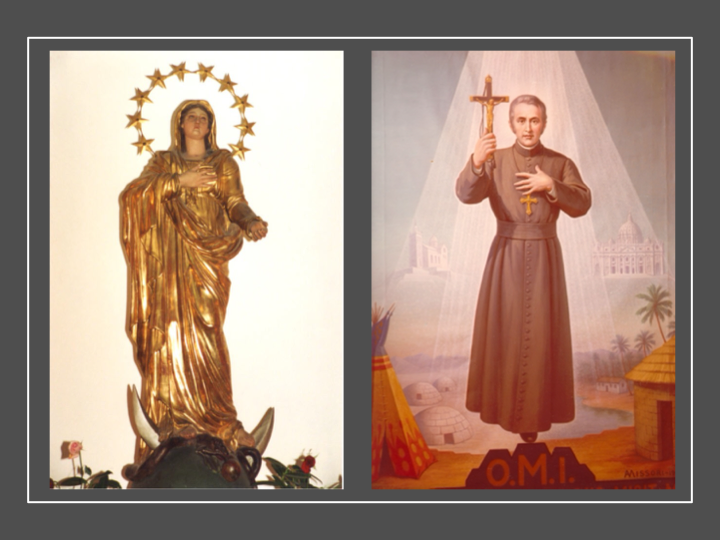
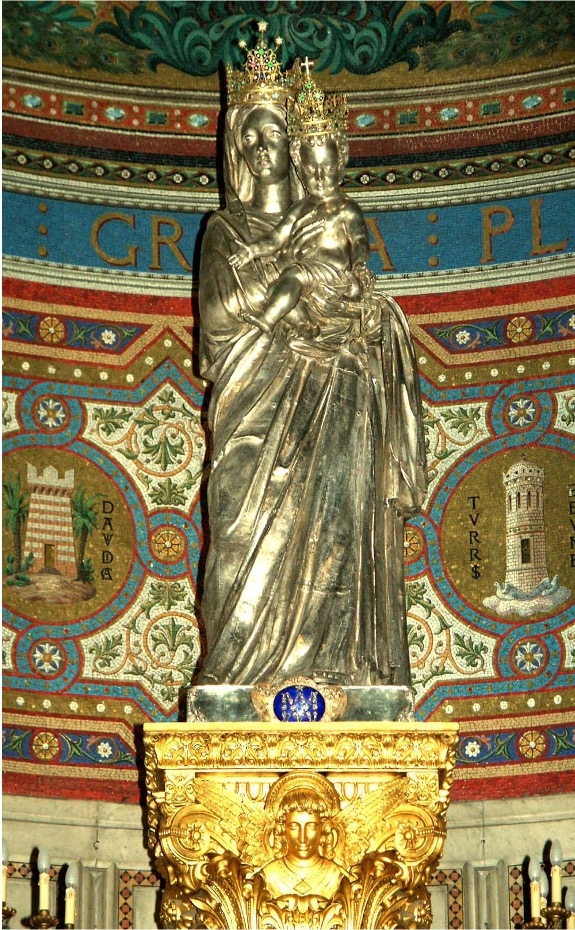
The “Golden Madonna. “

Such was the name given by the people of Marseilles to the monument erected by Bishop de Mazenod in honour of Mary Immaculate in order to keep fresh in the minds of people the definition of the dogma of the Immaculate Conception proclaimed by Pope Pius IX on December 8, 1854.

This definition was a great event in the life of saint Eugene. He felt himself carried away into the joy of heaven as he notes in his diary:

“In that moment, I seemed to see the heavens opening over our heads and showing us totally revealed the joy of the entire Church triumphant… I seemed to see Jesus Christ our Lord congratulating his divine Mother… and Saint Joseph rejoicing at the happiness of his spouse to whom he is so closely united in heaven.” (Quoted in REY II, p. 528)

Bishop de Mazenod was not able to contain his joy when he learned how much the diocese of Marseilles was united to the joy of the whole Church as Bishop Jeancard tells us in his Mélanges historiques: “

On the first anniversary of the definition of the dogma, Bishop de Mazenod’s diary records this:

“We wanted to conserve the memory of this event by laying the cornerstone of a monument which will always bring to the mind of future ages both the declaration of truth in honour of the Mother of God and the piety with which we have responded to the voice from heaven.” (see REY II, p. 555)
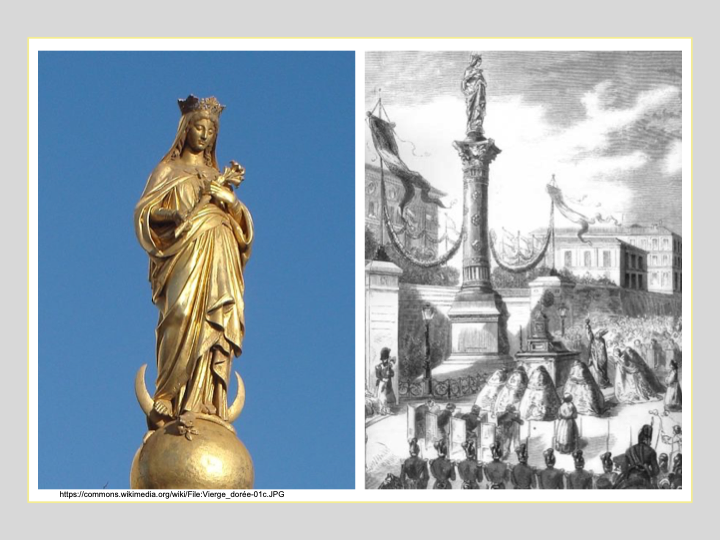
The monument was unveiled on December 8, 1857. In his enthusiasm, Bishop de Mazenod wrote personally to Pius IX to tell him how the ceremony took place. He began by describing the monument:

It is made of Carrara marble; it consists of a Byzantine column of rather large dimensions placed upon a fine pedestal which is equally of marble and which bears on his summit the statue of Mary Immaculate.”

To start things off, there was a procession which took two hours; then the bishop celebrated Mass at the foot of the statue. The people of Marseilles were not satisfied with merely a morning celebration. Bishop de Mazenod continued in his letter to Pius IX:

“In the evening, the whole city was illuminated, even the most humble dwellings were lit up, charity drew the poor into the common joy.”

René Motte OMI in https://www.omiworld.org/lemma/golden-madonna-marseilles/
 

Posted in WRITINGS | 1 Comment

THE CHOLERA EPIDEMIC: I WENT TO PLACE ALL UNDER THE PROTECTION OF THE BLESSED VIRGIN

“If we acknowledge and honor the sacrifices of human beings for reasons of love, from the Mother Teresas, to heroes of war, from the first responders of 9/11, to the suffering parents of dying children, how can we fail to acknowledge the sufferings of Mary at the foot of the Cross for the salvation of the world?.” (Mark Miravalle)

While assisting those who were suffering so greatly from the cholera epidemic in Marseilles, Bishop Eugene and his uncle, Bishop Fortuné, arranged to focus the attention of the people of the city on concentrated prayer. The population had a special devotion to the small sanctuary of Notre Dame de la Garde on the hill dominating the city. The statue of the “Good Mother” which represented Mary’s “keeping guard” over the city and over the sea, was particularly loved by the people. Eugene wrote:

We are going to offer solemn prayers. Tomorrow we are bringing down the statue of Notre Dame de la Garde for exposition in the cathedral for three days. Afterwards we will have a procession of the Blessed Sacrament for all who wish to take part…

Letter to Casimir Aubert, 10 March 1835, EO VIII n 508

Writing to his mother some days later he describes this event:

We are now confronted by a quite ravishing spectacle. It is a holy explosion of devotion to the Blessed Virgin, which was displayed not only in the course of the journey down from the Mount to the cathedral, but is still going on with a sustained trust. …

Letter to his mother, March 1835, EO XV  n. 176

Two years later there was another outbreak of the epidemic:

On the feast of the Assumption, I officiated pontifically at the cathedral both in the morning and in the evening. I took part in the general procession and gave Benediction in the evening. On Sunday in the octave, I went to say Holy Mass at Notre-Dame de la Garde to place myself, all of our men, and the whole diocese, under the protection of the Blessed Virgin.

Eugene de Mazenod’s Diary, undated entry August 1837, EO XVIII

The same devotion was repeated in the epidemic of 1854 in Marseilles.

Posted in WRITINGS | 1 Comment

MAY THE MOST HOLY AND IMMACULATE VIRGIN MARY, OUR LOVING MOTHER, KEEP YOU ALWAYS UNDER HER PROTECTION.

“As sailors are guided into port by the shining of a star, so Christians are guided to heaven by Mary” (Saint Thomas Aquinas)

As Superior General, whenever Eugene sent Oblates to the missions outside of France, he entrusted them to Mary Immaculate’s care. Here are just two examples.

When he sent Father Semeria and the first community to Ceylon:

Now go forward, beloved Son, to the work that is entrusted to you together with those whom we have chosen to be your companions in those distant parts of Asia, for the greater glory of God, which we must further there and everywhere.

May the Most Holy and Immaculate Virgin Mary, our loving Mother, keep you always under her protection. May the angels of God assist you. And as for Us, beloved son in Christ, we will not cease to implore for you an abundant rain of divine grace from heaven.

Act of Appointment of Fr. Etienne Semeria to Ceylon, 24 October 1847, EO IV n 1 (Ceylon)

In 1851 Eugene sent Henri Tempier on an important and delicate mission to visit the Oblates and assess their religious and missionary life in Canada. It is with this wish that he missioned him:

Go then in the name of the Lord, well-beloved son, towards that part of our family which is separated from us by so great a distance, which we have always present and intimately united to us, following it as we do with all the affection of our heart. Accomplish faithfully for its good the ministry that has been entrusted to you. May the Most Holy and Immaculate Virgin Mary, our most loving Mother, keep you continually under her protection; may the Angel of God also be propitious to you in your going and in your coming back; during this time, we shall not cease to implore from heaven an abundant shower of graces for you.

Letter to Henri Tempier en route to Canada, 1 May 1851, EO II n 145

Posted in WRITINGS | 1 Comment

WE ASK YOUR HOLINESS TO GIVE US THE NAME OF OBLATES OF MARY IMMACULATE

“But what took place most singularly in the Virgin Mary also takes place within us, spiritually, when we receive the word of God with a good and sincere heart and put it into practice. It is as if God takes flesh within us; he comes to dwell in us, for he dwells in all who love him and keep his word. It is not easy to understand this, but really, it is easy to feel it in our heart.” (Pope Francis)

Having decided to change the name of our Congregation, Eugene now asked the Pope to give us this name officially. When this request was eventually granted, Eugene was able to proclaim everywhere that it was “the name that the Pope has given us.”

At the same time, we ask Your Holiness that, in the Brief of Approval which the Missionaries request, you give them the name of Oblates of the Most Holy and Immaculate Virgin Mary

“As Father Fernand Jetté stated, the title of a religious family usually expresses its nature, essence and function. It really seems that the choice of the title Missionary Oblates of the Most Holy and Immaculate Virgin Mary must have been the culmination of a new and deeper insight into the mission of the Congregation on the part of Father de Mazenod. He discovered Mary as the person who was the most committed to the service of Christ, the poor and the Church and saw her as the most comprehensive model of apostolic life as required by his Congregation.”   Casimir Lubowicki, “Mary” in the Dictionary of Oblate Values, https://www.omiworld.org/lemma/mary/

“Today the Church gives thanks to God for Saint Eugene de Mazenod, an apostle of his time, who, clothed with the Lord Jesus Christ, spent his life in service to the Gospel of God. We give thanks to God for the great transformation accomplished through the work of this bishop. His influence is not limited to the era in which he lived, but continues to act on our time as well. For the good accomplished by virtue of the Holy Spirit does not perish, but endures in every ‘hour’ of history.” Pope John Paul II at the canonization of St Eugene

Posted in WRITINGS | 1 Comment

THE APPROBATION OF THE OBLATES: OBLATES OF MARY – PROUD OF OUR DIGNITY AND OF THE RIGHTS THAT IT GIVES US  

“What a joy to remember that Mary is our Mother! Since she loves us and knows our weakness, what have we to fear?” (Saint Therese of Lisieux)

On February 17, 1826, the Missionary Oblates were given approbation by the Church authorities. Responding to the euphoria of the Oblates at this important recognition, Eugene reflected on our family name.

May we understand well what we are! I hope that the Lord will give us this grace, with the assistance and by the protection of our holy Mother, the Immaculate Mary, for whom we must have a great devotion in our Congregation. Does it not seem to you that it is a sign of predestination to bear the name of Oblates of Mary, that is, consecrated to God under the patronage of Mary, a name the Congregation bears as a family name held in common with the most holy and immaculate Mother of God?
It is enough to make others jealous; but it is the Church who has given us this beautiful name, 

“Consecrated to God under the patronage of Mary”

In fact, it was Eugene himself who had changed the name from “Missionaries of Provence” to “Oblates of Mary Immaculate” and then asked the Pope to approve the change. (cf. https://www.eugenedemazenod.net/?p=2298). It is in this sense that the Church “gave” us the name. The Church ratified the inspiration that Eugene had received regarding our name and the identity it gives us. In this sense, our name and our identity belong to the Church, and therefore:

we receive it with respect, love and gratitude, proud of our dignity and of the rights that it gives us to the protection of her who is All Powerful in God’s presence.

Letter to Henri Tempier, 20 March 1826, EO VII n 231

Today these sentiments continue as our Rule of Life shows:

“Mary Immaculate is patroness of our Congregation. Open to the Spirit, she consecrated herself totally as lowly handmaid to the person and work of the Savior. She received Christ in order to share him with all the world, whose hope he is. In her, we recognize the model of the Church’s faith and of our own.” CC&RR Constitution 10

Posted in WRITINGS | 2 Comments

OBLATES OF MARY IMMACULATE – WHY DID WE NOT THINK OF THIS SOONER?

“The Son of God became man for our salvation but only in Mary and through Mary.” (Saint Louis Marie de Montfort)

In 1825 Eugene went to Rome to seek official Church recognition for the Missionaries and their Rule from the Pope. It was there that he was inspired to change our name to Oblates of Mary Immaculate.

Once the decision had been made, and Eugene had officially requested this new name, he was filled with joy at having done the right thing.

Oblates of the Immaculate Mary. But this is a passport to heaven! How have we not thought of it sooner?

Letter to Henri Tempier, 22 December 1825, EO VI n 213

Why had he not thought of it before?

Eugene “seems to become aware of the fact that, even if he had always loved Mary, he had not yet understood the essential role she played in the plan of Redemption. In searching for the patron who best expressed the goal of his Congregation – that is a person walking in the footsteps of Christ, committed to the apostolate of service and to the instruction of the poor – he had not thought of Mary. While in Rome, he understood who Mary really was. The title of the Congregation was thus born from a discovery that, in order to respond in an authentic way to the urgent needs of the Church, its members should identify with Mary Immaculate “to offer themselves” to the service of God’s plan of salvation like she did.”   Casimir Lubowicki, “Mary” in the Dictionary of Oblate Values, https://www.omiworld.org/lemma/mary/

Posted in WRITINGS | 2 Comments

THE DISCOVERY OF THE PLACE OF MARY IN OUR MISSION

“The attitude of Mary of Nazareth shows us that BEING comes before DOING, and to leave the DOING to God in order to BE truly as he wants us.” (Pope Francis)

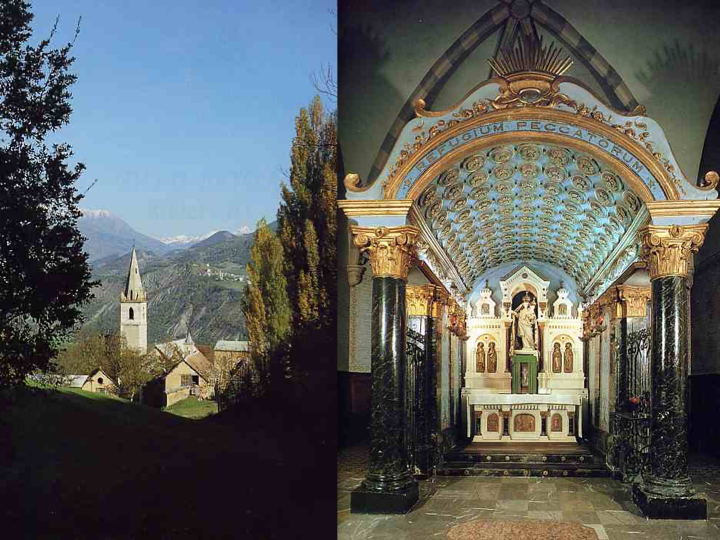
Two years after the foundation of the Missionaries, we were invited to take over the mission of the Marian shrine of Notre Dame du Laus

After visiting there, Eugene wrote this description of the place and of the evangelization that the Missionaries would undertake from there:

We have formed an establishment at Notre Dame du Laus thus bringing ourselves into direct relations with the dioceses of Gap, Digne, Embrun and Sisteron.
We have become the guardians of one of the most celebrated shrines of the Blessed Virgin where the good God is pleased to manifest the power that he has granted to this dear Mother of the Mission.

Letter to Pierre Mie, October 1818, EO VI n.31

Notre Dame du Laus

At this moment the Missionaries of Provence did not have a specifically Marian identity. Being missionaries at the Laus sanctuary, this identity started to be expressed as they came to understand that Marian shrines did form a part of their missionary outreach.

Seventeen years later Eugene wrote about this mission:

They all rightfully attribute it to the care the Congregation has always taken to fulfill its mission in this place of blessing. Hence the ever-increasing number of the faithful who flock to the feet of our good Mother, assured that they will meet on the steps of the earthly throne of the Queen of Heaven zealous ministers of her divine Son, especially charged with reconciling sinners upon whom this Mother of mercy is calling to forgiveness and peace through her powerful protection. Hence so many conversions. Thus a renewal of fervor for so many pious souls attracted daily to the shrine by the good odor of Mary’s perfumes, by the brilliance of the marvels she never ceases to work, and, it must be said, by the edification produced at the sight of a regular community

E. MAZENOD, Act of visitation of the house of Notre-Dame de Laus, October 18, 1835


Posted in WRITINGS | 1 Comment

A HAPPY AND BLESSED FEAST DAY TO ALL THE MEMBERS OF OUR MAZENODIAN FAMILY

“Mary treasured all these words and pondered them in her heart.” (Luke 2:19)

On this 200th anniversary of the blessing of the statue of the Oblate Madonna and all the blessings which this event has brought to us, I invite you to reflect on an Icon based on the Oblate Madonna. The icon-writer, Lauretta Agolli, gives us an explanation:

“This is a Byzantine Holy Icon of Mary, inspired by the statue of the Oblate Madonna and its importance in the life of St Eugene and of the Mazenodian Family. 

The “Mary, Heart of Oblate Studies” icon was created for the Oblates of Mary Immaculate to honor the international Oblate Studies program established by the Kusenberger Chair of Oblate Studies. 

It is a sacred image that represents a reality beyond our worldly senses and provides us an invisible world made visible. It is two dimensional (without depth) calling all who view it to pass through to the other side. 

Mary appears with 12 stars around her head representing the crown of immortality. She is clothed in a golden gown, symbolizing the presence of God enfolding her life. In this icon the gold is glimmering and reflecting the infinite nuances and aspects of God, as Mary’s discipleship did. 

Mary is looking toward God with love and attention. It is this love and God’s message that fills Mary’s heart (one hand is on her heart) and as she receives she extends her hand toward us to share all that God is giving her. It is an elliptical exchange between God and the viewer through the Heart of Mary. 

The background blue color is that of divinity and also representing the infiniteness of the sky and the everlasting world; it is the color of the Mother of God who is transcendent. Mary is standing on a crescent moon. The full shape of the moon is partly visible to the world and is partly in the invisible world. The moon too is inviting us through to the other side.

The green color of the serpent is the color of nature and earth. Mary standing on the serpent’s head refers to the first Biblical promise of salvation (Genesis 3:15). It suggests that she is asking the viewer to focus less on the temptations of our earthly surroundings and more on God’s assurance of salvation, which St. Eugene proclaimed throughout his life. 

In the process of writing this icon I was drawn in by the listening and sharing heart of Mary Immaculate. It is surely this same listening and communicating heart that spoke with St. Eugene. It is Mary’s heart through this icon that expresses St. Eugene’s mission of experiencing and proclaiming God’s love – which is the mission of the Kusenberger Chair of Oblate Studies.”


Posted in WRITINGS | 1 Comment

AN INVITATION TO LEAVE NOTHING UNDARED WITH EUGENE DE MAZENOD

A free sixteen-part video series focused on the life, spirituality, and mission of St. Eugene de Mazenod, founder of the Missionary Oblates of Mary Immaculate, who also inspired the formation of a charism family of laity and religious around the world

Aims:

      1. To help you to gain a deeper knowledge of the life of St. Eugene de Mazenod.
      2. To assist you to understand the charism, mission, and spirituality of St. Eugene de Mazenod.
      3. To see in him and his Mazenodian spirituality a model of holiness that can enrich your life
      4. For members of the Mazenodian Family to be inspired to discover their individual vocation within their specific branch of the Mazenodian Family.


This series is offered by the Kusenberger Chair of Oblate Studies as a free service to the Mazenodian Family and other interested parties and can be found at:

https://sites.google.com/site/oblatestudies/eugene-de-mazenod-101

Posted in WRITINGS | Leave a comment

200 YEARS AGO ON AUGUST 15, 1822

 “To succeed in your intentions, entrust yourselves to the Blessed Virgin Mary always, but especially in moments of difficulty and darkness. ‘From Mary we learn to surrender to God’s will in things. From Mary we learn to trust even when all hope seems gone. From Mary we learn to love Christ, her Son and the Son of God…Learn from her to be always faithful, to trust that God’s Word to you will be fulfilled, and that nothing is impossible with God.’” (St. John Paul II)

We go back to 1822. In the midst of all his concerns for the survival of his newly-founded Missionary family, Eugene celebrated the feast of the Assumption. It was a day which was to leave a permanent impression on our Mazenodian family.

Eugene’s letters of 1822 have shown the many concerns and difficulties he was experiencing. Not least among these was his worry about the survival and future of his small group of Missionaries. It was in this spirit that he blessed the new statue in the chapel, which became the opportunity for a powerful life-giving insight. He immediately wrote to Henri Tempier, who was in Laus.

I believe I owe to her also a special experience that I felt today; I will not go so far as to say more than ever, but certainly more than usual.
Eugene was usually very reticent about describing his deep spiritual experiences. His “more than usual” experience was connected with the life of the Missionaries of Provence, who were experiencing external difficulties and whose future existence was in the balance.
I cannot describe it too well because it covered several things, but all related to a single object, our dear Society.

He then described the confirmation that he received that the foundation of the Missionaries had come from God and that God assured him of a solid future for this group.

It seemed to me that what I saw, what I could put my finger on, was 
that within it lies hidden the seed of very great virtues,
and that it can achieve infinite good;
I found it worthy,
everything pleased me about it,
I appreciated its rules, its statutes;
its ministry seemed awe-inspiring to me, as it is indeed.
As I looked at the Society I found in it a sure, even infallible, means of salvation.

Letter to Henri Tempier, 15 August 1822, EO VI n 86

This was the grace that the Oblate Madonna had obtained for Eugene: a God-given assurance that he was on the right track and that he needed to persevere despite all the external storms raging around him that seemed to threaten the existence of the Missionaries.

Two hundred years later we continue to reap the harvest of this boost of confidence which our Oblate Madonna “smiled” on us.

Posted in WRITINGS | 2 Comments