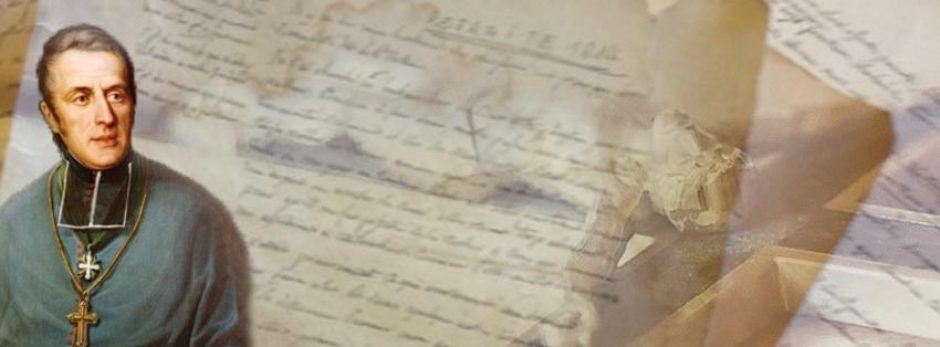
HIS CONVERSION LED HIM TO DEDICATE HIMSELF TO THE WELFARE OF THE WORKERS

“The apostle Paul never seemed to exhaust the topic of grace – what makes us think we can? He just kept coming at it and coming at it from another angle. That’s the thing about grace. It’s like springtime. You can’t put it in a single sentence definition, and you can’t exhaust it.”  (Max Lucado)

Babeau’s conversion was likened to that of the Samaritan woman in the Gospel. She converted her common-law husband and married him. Hopefully she did not have to beat him up to achieve this!

Just as her conversion had made her into a driving force to bring her fellow-market workers to the sacraments, so too his conversion led him to dedicate himself to the welfare of the workers.

Joseph, the coachman, who had lived with the new Samaritan woman before becoming her husband, was for the Conference of Saint Joseph what Babeau had become for the Congregation of Saint Anne. He dedicated himself to doing good and became a zealous apostle. In this way the labourers had their work of charity, which soon became very flourishing.

Rey page 204

How concerned are we for the spiritual welfare of those around us?
Posted in WRITINGS | 1 Comment

BABEAU’S CONVERSION AS THE STIMULUS TO BRING OTHERS TO THE SACRAMENTS

It is the chief joy of all holy beings to witness the joy and happiness of those around them. (Ellen G. White)

So powerful had Babeau’s conversion been, that she now wielded all her authority on the women of the market to lead them to conversion themselves.

Eugene, who administered the sacrament of confirmation every Monday morning in his chapel, noted in amazement in his diary:

I would have believed that on this Monday no one would be presented, having administered the sacrament of Confirmation on Saturday. But, no, it must be said that, since I have been bishop, not a single Monday has passed without my confirming any adult in my chapel. Today, besides a woman from Africa, there were, I do not know how many, women of the market who are returning in great numbers to the practice of religion.

The association formed by Fr. Barrelle under the patronage of Saint Anne already counts nine hundred of these good women, who are like so many apostles for bringing back their companions. I would never have believed that there were so many women among the people who lived without the sacraments.

Eugene de Mazenod’s Diary, 17 March 1845, EO XXI

How do I live out my faith each day? Am I like an apostle who inspires others through the witness of the quality of my life?

Posted in WRITINGS | 1 Comment

BABEAU: THE QUEEN OF THE MARKET

Choose to focus your time, energy and conversation around people who inspire you, support you and help you to grow you into your happiest, strongest, wisest self. (Karen Salmansohn)

One of the more colorful cooperators of Bishop Eugene, in reaching out to the poor, was the fish-seller known as Babeau. The biographer Rey gives the details:

In 1843, Father Barrelle preached the Lenten sermons at the Church of the Trinity. He had the consolation of converting a woman from the market, known in Marseille under the name of Babeau or Elisabeth. Nothing was done in the market without her approval; she was the queen of the market. “To bring a woman to her senses,” she said, “for me it is less than nothing, but to flatten a man under my blows and when he is down to give him more at my pleasure, that is “my business”. Such feats, accompanied by cries and frightful swearing, were a daily occurrence for her”

When she returned to God, she devoted herself entirely to the apostolate inspired by Father. Every day she regularly brought five or six new conquests to the confessional, sometimes many more. It was a matter of ensuring the perseverance of these converts, hence the foundation of the Congregation of Saint Anne. In less than two years, the association grew prodigiously.

Rey page 204

She remained close to Bishop Eugene and would often stop his carriage to talk with him when he drove past the market.

Where do I focus my energy each day? What does Babeau teach me?

Posted in WRITINGS | 1 Comment

RESPONDING TO THE NEW FACES OF THE POOR IN MARSEILLES

What does love look like? It has the hands to help others. It has the feet to hasten to the poor and needy. It has eyes to see misery and want. It has the ears to hear the sighs and sorrows of men. That is what love looks like. (Saint Augustine)

Before the summer break we had begun to see some of the responses of Bishop Eugene to the new faces of the poor in his Marseilles diocese. Ten years after his appointment he looked back in a Pastoral Letter to his diocese about the works of mercy that were active in his diocese. It shows an amazing grasp of the human needs of the second largest city of France, and of this Missionary Oblate’s response:

Marvel at how these good works are multiplying. So many new institutions with a previously unknown objectives! Childhood, old age, sickness, poverty, the worker who toils all day long, innocence in danger, the repugnant vice that inspires remorse, the imprisoned youth already initiated in the habits that make criminals, the great culprit seasoned in crime, even the rich man often so destitute before God on his deathbed.

Charity embraces everything; and for new needs, it invents, when necessary, new means: spiritual help, bodily help, bread for the soul, bread for the body; instruction for ignorance; advice, guidance, support for weakness; asylum for virtue or for penance; pious sentiments, sweet consolations, supernatural strength for the dying; All kinds of good works are being generated in the name of Jesus Christ.

Without speaking of the zeal and generosity of those pious associations of ladies who support our charitable establishments in our city of Marseilles, where they are distinguished by such a perfect spirit and by all the virtues of the Christian woman…

Bishop Eugene de Mazenod, Pastoral Letter of 7 February 1847, Marseilles

Do I recognize the face of Jesus Christ crying out in the many faces of the poor I encounter?

Posted in WRITINGS | 1 Comment

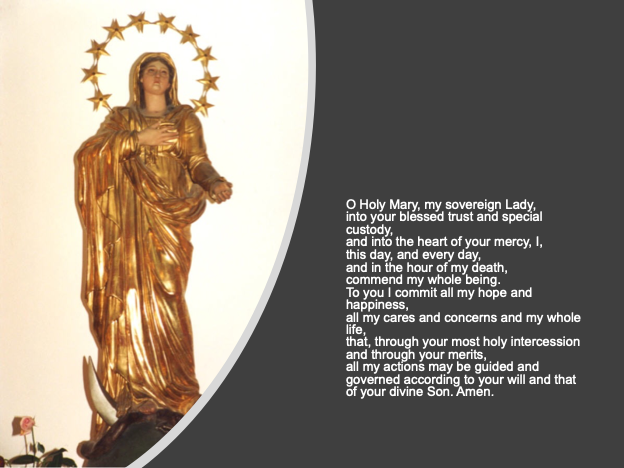
O HOLY MARY, MY SOVEREIGN LADY

“Mary is not only the bridge joining us to God; she is more. She is the road that God travelled to reach us, and the road that we must travel in order to reach him. (Pope Francis)

With this beautiful prayer from our Oblate tradition, I conclude our bicentenary focus on Mary Immaculate.

O Holy Mary, my sovereign Lady,
into your blessed trust and special custody,
and into the heart of your mercy, I,
this day, and every day,
and in the hour of my death,
commend my whole being.
To you I commit all my hope and happiness,
all my cares and concerns and my whole life,
that, through your most holy intercession
and through your merits,
all my actions may be guided and governed according to your will and that of your divine Son. Amen.

As from tomorrow, we will return to the chronological reflections on the writings of Saint Eugene and pick up from where we left off with those of 1845.

Posted in WRITINGS | 1 Comment

THE VISION OF THE MAZENODIAN FAMILY TODAY: MISSIONARIES TO THE NEW FACES OF THE POOR ACCORDING TO THE EXAMPLE OF MARY, WHO WAS FULLY ATTENTIVE TO THE NEEDS OF THE POOR

“What for Mary was honor to birth was also good news for a people. They could anticipate one who would save or restore. What for Mary was a personal longing, she was able to personify for the poor ones. Her personal happiness, or being blessed, was transformed into vindicating or asserting rights for a whole people. In spite of suffering and oppression, she claimed that justice will come, that injustice will be righted.”(Dorothy Yoder Nyce)

We are members of the prophetic Church. While recognizing our own need for conversion, we bear witness to God’s holiness and justice. We announce the liberating presence of Jesus Christ and the new world born in his resurrection. We will hear and make heard the clamour of the voiceless, which is a cry to God who brings down the mighty from their thrones and exalts the lowly (cf. Lk 1: 52).

CC&RR, Constitution 9

The wording of this Constitution startled some when the time came for its ecclesiastical approval. Father Jetté, who was the Superior General, responded in the name of the Oblates:

“The allusion to Mary’s canticle is to be read in the biblical perspective of salvation. As Oblates of Mary Immaculate we love to live our vocation of missionaries to the poor according to the example of her who was fully attentive to the needs of the little ones and the poor among God’s People. On January 30, 1979, in his homily at the shrine of Zapopan (Mexico), Pope John Paul II did not hesitate to quote this same passage when he was speaking of the Christian commitment to serving the poorest of the poor” (Réponse aux Observations de la S.C.R.I.S., April 16, 1982)” F. Jetté, The Apostolic Man, p. 103

Posted in WRITINGS | 1 Comment

THE VISION OF THE MAZENODIAN FAMILY TODAY: MARY IMMACULATE IS OUR PATRONESS, MODEL OF FAITH, AND MOTHER

“Mother Mary in her Magnificat sings the praises of the Lord. She challenges us and confronts us to be that advocate, that voice for those who are considered the least by society but looked upon as favored by God.” (Valerie D. Lewis-Mosley)

During this bicentenary month, I have been reflecting with you on the figure of Mary in the life and charism of St Eugene, and how that vision continues to be expressed today by the Mazenodian Family.

In our Constitutions and Rules we recall how Mary Immaculate is a part of our vision, charism and spirituality today:

Mary Immaculate is patroness of our Congregation. Open to the Spirit, she consecrated herself totally as lowly handmaid to the person and work of the Savior.

She received Christ in order to share him with all the world, whose hope he is. In her, we recognize the model of the Church’s faith and of our own.

We shall always look on her as our mother.
In the joys and sorrows of our missionary life, we feel close to her who is the Mother of Mercy.
Wherever our ministry takes us, we will strive to instil genuine devotion to the Immaculate Virgin who prefigures God’s final victory over all evil.

OMI Rule of Life,
CC&RR Constitution 10

Mary Immaculate is the Mother of the whole Mazenodian Family!


Posted in WRITINGS | 3 Comments

THE ATTITUDE OF THE MAZENODIAN FAMILY: CONTEMPLATING THE MYSTERY WITH MARY

“The Rosary is the book of the blind, where souls see and there enact the greatest drama of love the world has ever known; it is the book of the simple, which initiates them into mysteries and knowledge more satisfying than the education of other men; it is the book of the aged, whose eyes close upon the shadow of this world, and open on the substance of the next. The power of the Rosary is beyond description.” (Fulton Sheen).

“As for Mary, she treasured all these things and pondered them in her heart.” Luke 2:19

It was the pattern of Mary’s warm relationship with Jesus and her contemplation of his “virtues and example” that would be the model for the Missionary:

… the Blessed Virgin, to whom they will all have a special devotion and great affection. 
To this effect they will recite the rosary every day.

1818 Rule, Part Two, Chapter One. §5 On prayer and exercises of piety 

 Today:

 With Mary Immaculate, the faithful handmaid of the Lord, and under the guidance of the Spirit, we enter into closer union with Jesus Christ. We will contemplate with her the mysteries of the Incarnate Word, especially in praying the rosary.

CC&RR, Constitution 36

“When we have spiritual reading at meals, when we have the rosary at night, when we have study groups, forums, when we go out to distribute literature at meetings, or sell it on the street corners, Christ is there with us.”    Dorothy Day

Posted in WRITINGS | 1 Comment

THE ATTITUDE OF THE MAZENODIAN FAMILY: LIKE MARY

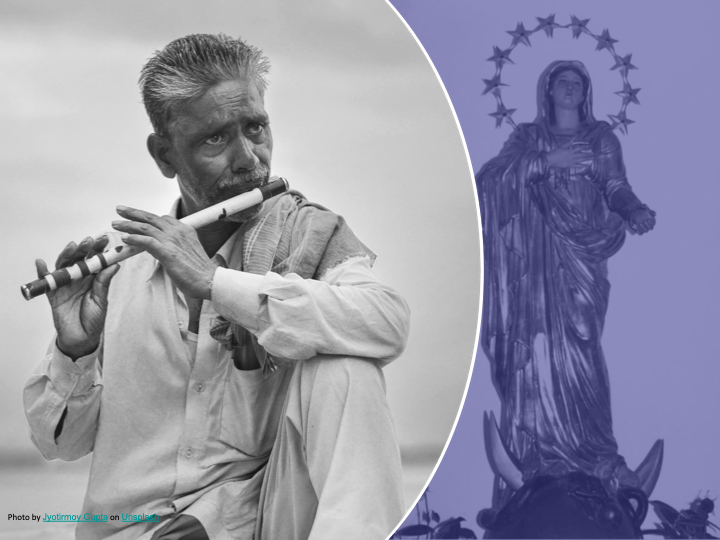
“It is the emptiness like the hollow in the reed…which can only have one destiny; to receive the piper’s breath and to utter the song that is in his heart.” (Caryl Houselander)

Caryll Houselander captured this spirit when she referred to Mary as the “Reed of God” through which the music of the Incarnation took flesh.

Mary’s encounter with the plan of God’s love for her had changed her life – just as Eugene’s encounter with God’s love had done. The Gospel of Luke narrates the response of Mary to the actions and words of her son: “His mother treasured all these things in her heart” Luke 2:51.

Similarly Eugene, treasured the “virtues and examples of Jesus Christ” and pondered them in his heart and in this way his “inner vision” would be a source of meaning and of transformation for himself and for others. He wrote in the first Rule of the Missionaries:

During the day we will also make … a visit … to the Blessed Virgin, to whom we will all have a special devotion and great affection.

1818 Rule, Part Two, Chapter One. §5 On prayer and exercises of piety 

Today, Mary continues to be this missionary model :

We shall always look on her as our mother. In the joys and sorrows of our missionary life, we feel close to her who is the Mother of Mercy.

CC&RR, Constitution 10

Posted in WRITINGS | 1 Comment

AT HIS LAST BREATH, MARY ACCOMPANIED EUGENE TO THE FRUIT OF HER WOMB

” So your strength is failing you? Why don’t you tell your mother about it?…Mother! Call her with a loud voice. She is listening to you; she sees you in danger, perhaps, and she–your holy mother Mary–offers you, along with the grace of her son, the refuge of her arms, the tenderness of her embrace…and you will find yourself with added strength for the new battle.” (Saint Josemaria Escriva)

“They will always regard her as mother” Eugene had written when we officially became Missionary Oblates of Mary Immaculate after our papal approbation in 1826. He asked us to have a “tender and filial devotion.” Throughout his whole life he was accompanied by Mary – because of this Rule that he quotes in his retreat notes:

Devotion to Mary must also characterize us: At least once a day they will pay a visit to the Blessed Sacrament and a visit to the Blessed Virgin, towards whom all the missionaries will cultivate a special devotion, and to whom they will always look up as to their Mother
They will recite the rosary every day, and will leave nothing undone to make the faithful most fervently and trustfully devout to this Immaculate Virgin and the most holy Mother of God. 

Retreat notes, October 1831, EO XV n. 163

Eugene died during the praying of the Salve Regina, at these words: “Turn then, most gracious Advocate, your eyes of mercy toward us, and after this our exile, show unto us the blessed fruit of your womb, Jesus, O merciful, O loving, O sweet Virgin Mary!”

Father Fabre describes the scene:

We recited the entire Salve Regina, which our well-loved Father understood and followed fully. At the words: Nobis post hoc exilium ostende, he opened his eyes slightly; at each invocations: O clémens, o Pia, he made a slight movement; at the third: O Dulcis Virgo Maria, he breathed his last. His beautiful soul was in the presence of God.

Circular Letter to the Congregation 26 May 1861

Because of his life-long closeness to Mary, she did indeed accompany him to the fruit of her womb: Jesus. May we learn to look on her as mother and as our faithful faith-companion on our Christian journey to be shown the fruit of her womb at its fulfilment in our own death.

Posted in WRITINGS | 2 Comments