-
Recent Posts
- THE PETITION TO PRESENT TO THE POPE ON THE DAY HE GRANTS ME AN AUDIENCE
- FOR THE REST, I DO MY BEST TO LEAVE IT TO GOD
- GOD ALONE KNOWS HOW TO REWARD WHAT WE HAVE DONE FOR HIM. SO, WE MUST DO EVERYTHING TO PLEASE HIM
- IT IS A CONSOLATION FOR ME TO BREATHE THE SAME AIR, TO OFFER THE HOLY SACRIFICE ON THE SAME ALTARS, TO BE ABLE TO PRAY AT HIS TOMB
- THERE IS NOT A CORNER OF ROME WHICH IS NOT A MONUMENT OF FAITH OR PIETY
Recent Comments
- Eleanor Rabnett, Lay Oblate on FAITH-FOCUSED INVESTMENT GROUPS: A PRESENCE WHERE DECISIONS AFFECTING THE FUTURE OF THE POOR ARE BEING MADE (Rule 9a)
- Eleanor Rabnett, Lay Oblate on VIVAT: A PRESENCE WHERE DECISIONS AFFECTING THE FUTURE OF THE POOR ARE BEING MADE (Rule 9a)
- Eleanor Rabnett, Lay Oblate on WE SHOW A VERY HUMAN FACE OF JESUS TO THE WORLD, ONE FULL OF COMPASSION AND SOLIDARITY (Rule 9a)
- Eleanor Rabnett, Lay Oblate on JUSTICE, PEACE AND THE INTEGRITY OF CREATION AS AN INTEGRAL PART OF EVANGELIZATION (Rule 9a)
- Eleanor Rabnett, Lay Oblate on WALKING THE LINE BETWEEN PROPHETIC VISION AND SPIRITUAL SUSTENANCE (CONSTITUTION 9)
Archives
Meta
-
A DAY IN THE LIFE OF BISHOP EUGENE DE MAZENOD
“O my God, teach me to be generous,
teach me to serve you as I should,
to give without counting the cost,
to fight without fear of being wounded,
to work without seeking rest,
to labour without expecting any reward,
but the knowledge that I am doing your most holy will.”
Feast of Saint Peter. General ordination, the largest number that I have ever done. I gave the tonsure to [thirteen], minor orders to [twenty-four], I ordained [nine] sub-deacons, eight deacons and three priests. It is true that four Capuchins and one Oblate have since received tonsure inclusively to the diaconate. The ceremony began at 6 o’clock and finished at 10:30 o’clock, enough time so that the Chapter was able to say its office and to sing Solemn Mass.
As if there was nothing, I was obliged to set off again at 3 o’clock for St.-Barnabe where I had to first give the sacrament of confirmation to the children of the parish, then bless the foundation stone of the new church, and finally bless two clocks on the site, all with a dreadful wind which did not prevent the crowd from keeping its footing, but which was very uncomfortable.
I do not know until when I will be made to do these feats of strength to which I give myself as long as I can manage. In fact, I am not fatigued at all, but watch out in several years! I am enjoying my rest.
His last act of the day was to visit the Sisters of Compassion , who had been founded in Marseilles to look after the spiritual needs of domestic workers in a particular way (see https://www.eugenedemazenod.net/?p=5105)
Before departing, I visited the establishment of the new Sisters of Compassion… It’s essentially for this work that I have adopted this new Order or, to say it better, that I have let it develop under my auspices and my authority.
Eugene de Mazenod’s Diary, 29 June 1845, EO XXI
What do my busy days look like? Where do I get the strength to manage?
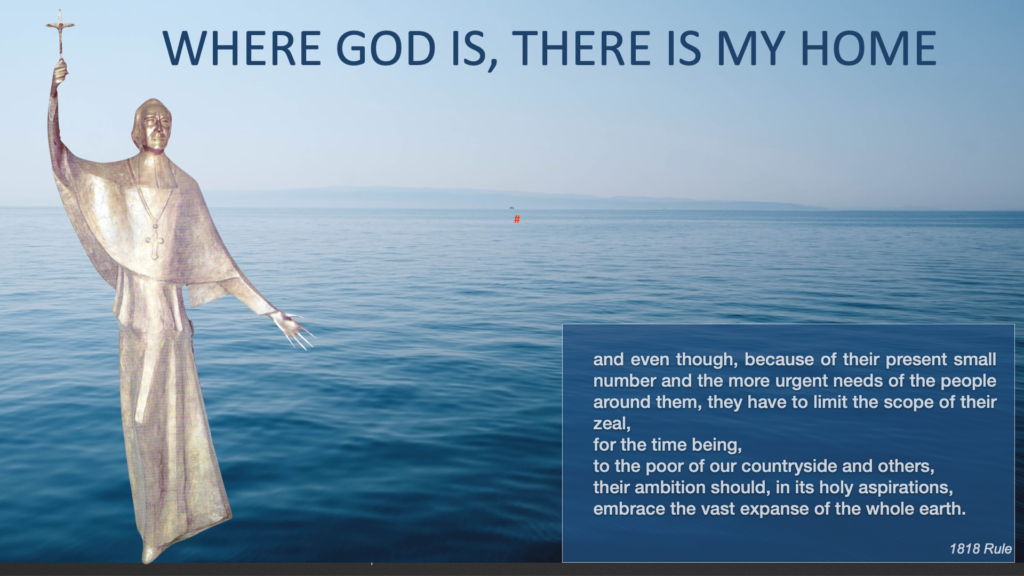
WHERE GOD IS, THERE IS MY HOME
Where is home for me? Home is where the heart is – what is God’s place in my heart?
As Superior General, Eugene needed to move Oblates to different places when the need arose. Approaching Father Jean Joseph Magnan about a possible move, Eugene was edified by his response.
Letter from Fr. Magnan. He expresses the sentiments of a perfect religious: Ubi Deus, ibi patria [ed Where God is, there is my country], he says to me, so as to put his will into my hands.
Eugene de Mazenod’s Diary, 24 May 1845, EO XXI
Putting these words into practice, Eugene gives him a new mission:
I am obliged to call you to the Major Seminary of Marseilles to be professor of moral theology. I am telling you this under secret. When I get to Lumières, I will spell out for you which treatises you will have to teach at the outset. You will also be responsible for the formation of the seminarians in piety and the knowledge of their duties, that is to say, to assist at the spiritual lectures and to comment during the last eight or ten minutes. Those are the functions of what is called the spiritual director. You may begin your groundwork and to prepare your materials.
Letter to Fr Jean Joseph Magnan, 13 June 1845, EO X n 874
Where there is God, there is my country – the sentiment of a true missionary. In other words, wherever God is present, that is my home.
FOR ME IT WAS MORE HOLY THAN THE CATACOMBS
Do we consider some of our deceased loved ones as being saints? Are they present to us in the communion of saints?
The bodies of some of the first Oblates to have died, as well as of some of Eugene’s family members, had been buried in the grounds of the “Enclos”, Madame de Mazenod’s property in Aix en Provence. A burial chapel was now constructed in the Aix cemetery and Eugene participated in the exhumation of the remains, which had lain in the earth for some 25 years.
Journey to Aix. I had the bodies exhumed which are still found at l’Enclos. They are those of Fr. Suzanne, of Fr. Arnoux, of Bro. Morandini and of Nathalie de Boisgelin. For me this was a very painful journey, but I acquitted myself of this duty with the meditation inspired in me by the sight of the precious remains of all these predestined saints whose relics I was collecting, penetrated by a religious respect, but also with a type of heartbreak difficult to express. … I will not describe it. It’s too horrible to report. As long as not the least fragment of the holy bones which I came to collect have been able to escape our search.
Eugene knew each of them well and was convinced that each one had lived a holy life and was a saint.
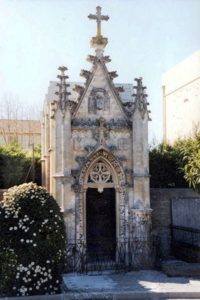 … for me it was more holy than the catacombs, so much did I know the virtues of the blessed souls who had enlivened these bodies reduced to such a deformity. They have been placed, the three missionaries in a three-compartmented box of walnut wood, and my niece in another separate small box. In several days, they will be transported to a tomb which I have had prepared in the grand cemetery, with the other holy bodies of my father, of my grandmother, of Caroline and of Fr. Marcou.
Will we not be able to truthfully inscribe on the tomb containing these holy remains: corpora sanctorum [ed. the bodies of saints]?
Eugene de Mazenod’s Diary, 21 April 1845, EO XXI
THE CONSOLATION OF CELEBRATING THE SACRAMENT OF CONFIRMATION
“The Holy Spirit can be with you always and guide you back to Him, but in order to enjoy the benefits of this holy gift, you must truly receive it, and then you must use it in your life. How sad it would be to be given such a precious gift and then set it aside and never use it.” (Margaret D. Nadauld)
During Eugene’s lifetime, the only person who could give the sacrament of confirmation was the bishop. Bishop Eugene thus went on a regular basis to celebrate this sacrament in the parishes, usually for large numbers of children. Every Monday, however, he celebrated the sacrament in his chapel at his residence, usually for adults. This diary entry gives an idea of his ministry and the consolations it brought him.
It is hard to believe. I am coming again to administer the sacrament of Confirmation to some twenty adults, and it is like this every Monday since I have been bishop. Oh, the fine thought that was inspired in me there!
All the bishops of the large cities ought to do as much of this, they would experience the same consolation as I. Because it is to be taken for granted that this great number of persons of every age and of every condition who present themselves willingly in my private chapel would never have the courage to mix with children in the general Confirmations of children. What astonishes me is that there is such a great number of them every week.
Today, among others I confirmed a father and his son, the son was a good 25 years of age; I confirmed a cripple who has no legs and walks with his hands, dragging himself on his knees, he’s a man of about 35 years of age, very well dressed, in the association of artisans; several other men, and among the women some ladies from the market, etc. This source has been providing a surprise for some time. I confirmed up to a dozen of them at a time.
Eugene de Mazenod’s Diary, 14 April 1845, EO XXI
The regular flow of ladies from the market was due to the influence of Babeau’s determination to bring her fellow-workers back to the practice of their faith.
What does the sacrament of confirmation mean to me today?
I TOOK THE OPPORTUNITY TO BOOST THE COURAGE OF THESE POOR YOUNG PRISONERS
“The message of Jesus is summed up partly in the Sermon on the Mount, and partly when he begins his ministry and quotes the passage from Isaiah: ‘I have come to set free the prisoners and restore sight to the blind.’ And certainly, his mission is also to bring hope. It was to heal people, to befriend the outcast.” (Dan Wakefield)
A priest of the Diocese of Marseilles, Father Fissiaux. had focused his ministry on the youth of the city. With Bishop Eugene’s blessing and encouragement, he had founded the Society of St Peter in Chains for Brothers who dedicated themselves to serving delinquent youth (see https://www.eugenedemazenod.net/?p=4554). Among their works was the industrial penitentiary where young prisoners were spared the corrupting element of the adult prisons and were trained in industry and agriculture so as to return to the world with skills useful to society.
Bishop Eugene describes one of his visits to this penitentiary.
Visit to the prison. I was customarily received there to the sound of fanfare and by the whole community. I celebrated Holy Mass there at which I distributed Communion to about fifty prisoners and to all the brothers.
After Mass, I administered the sacrament of confirmation to the prisoners who had received Communion, among whom was the son of a Moslem. I took the opportunity of the occasion to boost the courage of these poor young people by remarking to them that divine justice was less rigorous than human justice and that, if they had obtained from God a sentence of absolution, they owe it to the religion which had descended with them into their prisons, etc.
I then went to the infirmary where I again confirmed 13 young men, among them two converted Moslems, one of them a Black man. On the whole, the morning was very consoling and well filled.
Eugene de Mazenod’s Diary, 10 April 1845, EO XXI
WE MUST NOT TEMPT GOD BY ASKING TOO MUCH FROM HUMAN WEAKNESS
“It is dangerous to make everybody go forward by the same road: and worse to measure others by oneself.” (
Eugene had just appointed Fr. Jacques Santoni as Novice Master in France and shared some advice about discernment regarding the suitability of his novices.
We cannot test our candidates enough lest we risk the unpleasantness of discovering when it is too late that we have been mistaken in their regard. All the same we must not tempt God by asking too much from human weakness. What I want to say is that not all are fit to be put through extraordinary tests.
Eugene then qualifies that it is the understanding and living of Gospel values as Oblates that must pass the test in the lives of the novices.
However, all must pass those tests designed to ground them in the virtues which they must practise. namely, obedience, poverty, self-denial, holy indifference towards everything that could be required of them in terms of work, place, persons. etc.
Letter to Father Jacques Santoni, 18 March 1845, EO X n 867
In our idealism in every day life, we are reminded not to push our family members, work companions, parishioners etc, beyond their human limits
LET US BE WORTHY OF OUR GREAT VOCATION AND GO FORTH IN THE NAME OF THE LORD WHO WILL SEE TO OUR RECOMPENSE
At baptism I was “claimed for Christ the Savior”- how am I living that challenge today?
Despite Father Bermond’s reaction, his presence was needed in Canada, and Eugene informed him of his imminent departure.
I do not share, my dear Father Bermond, the misgivings you have manifested to me. So do not be afraid, my dear friend, to respond to the appeal of our Fathers in Canada. Your departure is fixed for the 9th or 10th of July.
Come to Marseilles as soon as possible. We will have time to converse with each other… I abjure you, my dear friend, to put aside at this juncture any human consideration and especially to repulse anything in your memory which may trouble you. In the name of God, let your heart soften and be at rest, assured as you are of the esteem and affection that have never been wanting in mine, whatever you may have believed.
Let us be worthy of our great vocation and go forth in the name of the Lord who will see to our recompense… On your voyage you will have for companions Father Mulloy and another Oblate and angels will preserve you, the while they gladden you along the way with (the song): Evangelizantium bona…
Letter to Fr Bermond, 14 June 1845, EO I n 55
Writing to Father Guigues, the Oblate Superior in Canada, Eugene gave a positive picture.
Father Bermond has excellent qualities. Father Vincens was very pleased with him at Osier and gave me a testimony of him that is most consoling. Show him confidence and friendship and I am sure that you will be satisfied…
Letter to Fr. Eugene Guigues, 6 July 1845, EO I n 57
Indeed Father Bermond did do good work during the 14 years that he remained in Canada. He did cause certain difficulties in his relationship with some Oblates, but we will see this later.
IT IS IMPOSSIBLE TO ANSWER THIS UNWORTHY LETTER EXCEPT WITH REPROACH AND I PREFER TO KEEP SILENCE
“It is not because things are difficult that we do not dare, it is because we do not dare that they are difficult.” (Lucius Annaeus Seneca)
Father Bermond’s reply to being sent to Canada astounded Eugene!
I was thinking of sending Father Bermond to America. I wrote him on the subject, a letter full of kindness, which earned me an answer that is filled with insolence from one end to the other. I can overlook the impertinence in this letter, but what is more deplorable is a stupid ignorance of one’s most sacred duties. He builds up a thesis that the vows do not oblige him to obey me in this instance, and from that point he takes off to miserable rationalizations through which one can perceive that his self-conceit has been injured. It is impossible to answer this unworthy letter except with reproach and I prefer to keep silence.
Letter to Father Ambroise Vincens at N.-D. de L’Osier, 11 May 1845. EO X n 872
Honoring our commitments costs sometimes.
THERE IS SO MUCH HAPPENING THERE TO MOVE A TRUE MISSIONARY TO THE DEPTHS OF HIS BEING
Am I moved to the depths of my being when I hear about others coming to know about Jesus Christ and commiting themselves to a relationship with him?