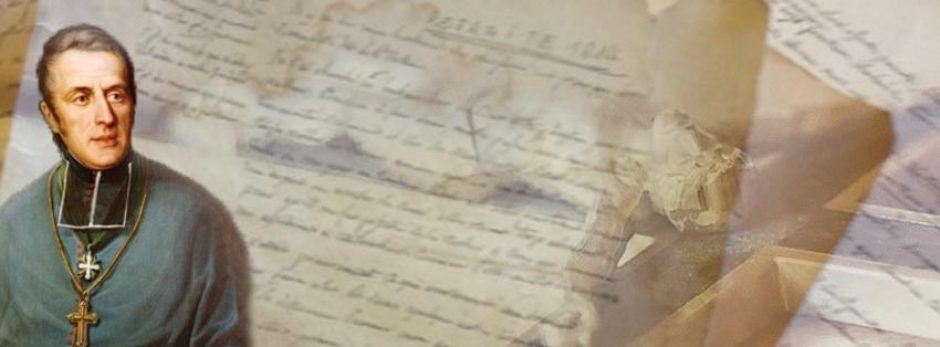
Continuing his reflection on the hardships inflicted on the Church by her enemies, Bishop Eugene points out that despite persecution, it is the example of its members that stands out.
But while people are still following the path in which misguided enemies have led them, Grace is already pleased to overturn all the calculations and hopes of their godless minds. This Faith, which was considered to be dead or dying, is awakening more alive, more active, more fruitful than in the days that preceded so many violent attacks
He then points out how alive the faith is through the many works of charity in his diocese:
Faith had been renewed in persecution, and now it is taking its place in the world through charity… This faith, with the powerful energy which is proper to it, goes forth to create everywhere, under the life-giving breath of God, these admirable works. In its presence the astonished world is obliged to admit the sterility of its false doctrines, and the need it has of the Church to obtain a true commitment regarding social miseries.
Pastoral letter of Bishop de Mazenod to the Diocese of Marseilles for Lent 1847
REFLECTION
“Love conquers all. I do not mean the exhilarating, spell-bound sort of love that temporarily intoxicates us. I mean the profound, unconditional, Christ-like sort of charitable love that endures forever. That love conquers all.”
― Richelle E. Goodrich, Being Bold: Quotes, Poetry, & Motivations for Every Day of the Year
The Church, mother of all Christians, is called to carry in her womb all the peoples of the earth blessed in Jesus Christ… Her divine Founder predicted that “the gates of hell shall never prevail against her” (Mt 16:18) and for eighteen centuries this prediction has never ceased to be fulfilled with unwavering faithfulness.
… How many furious storms has the ship of the Church been battered by, as it moves forward on the stormy waves? It often seems as if it is going to be submerged, and suddenly calm is restored and those who were perishing are saved each time to be saved a thousand times more
Pastoral letter of Bishop de Mazenod to the Diocese of Marseilles for Lent 1847
REFLECTION
“The world has always shown hostility to the message of God – a truth which ought to give some concern to the contemporary church existing for the most part rather comfortably in a world of increasing wickedness.” (Robert Mounce)
{Revelation, Eerdmans, www.eerdmans.com, 1977, p. 227)
As Bishop of Marseilles, Eugene wrote many pastoral letters to those entrusted to his care in the diocese. His Lenten letter of 1847 dealt with the death of the Pope and the election of his successor in the midst of turbulent times. Christianity was being persecuted and attacked on many fronts at this time, and during these stormy times that the Church was going through, Eugene assures people that God never abandoned it
When the death of Pope Gregory XVI, of happy memory, threw the Church into mourning, we invited you to offer prayers to the Lord for the father we had lost and to beg Heaven “to give us, among so many men in good relationship with God, the Pontiff most suitable to govern his people in the present times. We are living – we said – in such stormy times, when the “empire of darkness” (Lk 22:53) has become so powerful on earth, that it seems that we need the Lord, in his mercy, to grant us one of those extraordinary men whom he has raised up on other occasions to bring back the most beautiful days of the faith…
Referring to the Conclave of cardinals gathered to elect a new Pope, Eugene continued:
the operations of the distinguished gathering were suddenly brought to a close by an unexpected effect of the assistance of him who said to his Church: “I am with you always, to the end of the age” (Mt 28:20). He had also said “that he would not leave us orphans” (Jn 14:18). And so, as soon as he had been invoked, the consoling spirit, the Paraclete he had promised us, came to make his choice, giving us a father in the person of the vicar of Jesus Christ, and the name of Pius IX, greeted by universal acclamations, became the known name of the Pontiff whom God had elected “to direct our steps in the ways of peace” (Lk 1:79).
Pastoral letter of Bishop de Mazenod to the Diocese of Marseilles for Lent 1847
Throughout his long letter the Bishop continually stressed that God never abandons the Church, the Body of Christ – a message still relevant for today.
“Christ’s followers cannot expect better treatment in the world than their Master had.” Matthew Henry
Two years after or foundation in Aix en Provence, Eugene had described his dream for his missionary family:
and even though, because of their present small number and the more urgent needs of the people around them, they have to limit the scope of their zeal, for the time being, to the poor of our countryside and others,
their ambition should, in its holy aspirations, embrace the vast expanse of the whole earth
1818 Rule, Part One, Chapter One. The ends of the Institute, §3. Nota Bene. Missions, 78 (1951) p. 15
Now, 30 years later, with the departure of the Missionaries for the United States, he exclaims as the fulfilment of his dream unfolds:
After they will have arrived at their destination, our family will be announcing Jesus Christ from one sea to the other in immense territories which have never yet known him. What an apostolate!
Letter to Fr Jean Baudrand in Bytown, Canada, 21 January 1847, EO I n 77
“I dream of painting and then I paint my dream.” (Vincent Van Gogh)
Writing to Fr Baudrand, who had been part of the first group of missionaries to be sent to Canada, Eugene rejoices in God’s blessings outside and in France.
I must also thank the Lord for keeping all of you well in the midst of the laborious work of your ministry – this is a tangible protection from the goodness of God upon our family…
It is ever with growing admiration that I consider all the good done by our little Congregation through the zeal and devotedness of her members. Everywhere they are to be seen, God blesses their ministry. You have before your eyes what He does through you. we have the same consolation everywhere else. I do not speak to you of the marvels of the missions in our country which we are familiar with and which continue admirably.
Letter to Fr Jean Baudrand in Bytown, Canada, 21 January 1847, EO I n 77
“This is the heart of Jesus’ teaching to the disciples regarding their mission in the world. The disciples are to be witnesses of Jesus, in every place and situation, thanks to the grace of the Holy Spirit that they will receive… In a similar way, every Christian is called to be a missionary and witness to Christ. The Church’s only mission, as the community of Christ’s disciples, is to bring the Gospel to the entire world by bearing witness to Christ.” (Pope Francis)
As Superior General of the Missionary Oblates, Eugene aimed to be in constant contact with the activities of the Oblates in France and in the missions outside. In France the main focus continued to be on the preaching parish missions. At the conclusion of a successful mission in St Maximin, where the relics of Mary Magdalene were believed to be, Eugene wrote:
The Saint-Maximin mission has had truly great results… I had brought the Bishop [ed. of Fréjus] with me to witness the delightful spectacle that is the closing of a mission; he was truly astonished, it was something entirely new to him. Everything went as I had wished it for the honor of the Congregation.
Eugene added:
unfortunately the quality of the priests who remain there will prevent them from doing anything to sustain the marvellous work that grace accomplished.
Letter to Fr Hippolyte Courtès in Aix en Provence, 11 January 1847, EO X n 920
The mission approach of the Oblates was to spend some weeks in a parish to undertake a thorough renewal. The ongoing success however, depended on the local clergy to continue the renewal. It was the poor quality of some of the clergy that led Eugene to undertake the running of seminaries as one of the facets of our charism. (Just for the story: 12 years later St Maximin was entrusted to the Dominicans who brought new life to the center)
“The People of God need to be guided by pastors whose lives are spent in service to the Gospel. I ask parish communities, associations and the many prayer groups present in the Church, not to yield to discouragement but to continue praying that the Lord will send workers to his harvest. May he give us priests enamoured of the Gospel, close to all their brothers and sisters, living signs of God’s merciful love.”
Pope Francis (w2.vatican.va/content/francesco/en.html)
After our Lenten and Easter journey with the daily Scripture and Saint Eugene, we will resume our chronological journey through the writings of Saint Eugene de Mazenod.
My aim in these daily reflections is to make the story and rich personality and missionary spirituality of St Eugene known.
“A father’s communication with his many children… that is one of the most agreeable occupations of my life”
Letter to all the Oblates, February 2, 1857, EO XII
I hope that you do find some daily inspiration from Eugene’s communication with you.
Jesus said to them, “Come, have breakfast.”
And none of the disciples dared to ask him, “Who are you?”
because they realized it was the Lord.
Jesus came over and took the bread and gave it to them,
and in like manner the fish.
John 21: 12-13
In John 21:1-14, the disciples had returned to their normal occupation of fishing and the Risen Jesus appeared to them in the midst their everyday activity. They did not recognize him at first, but it was love that opened their eyes.
St Eugene had always loved the Risen Jesus present in his Word. In 1837, before becoming Bishop of Marseilles, he looked back on 55 years of lovingly listening to the Word of God:
I give you thanks, O Lord, for having made shine forth this light from the sacred deposit of your Holy Scriptures. As you show me the way I should follow, and give me the desire to follow it, you will also give me the powerful help of your grace.
He said to them,
“These are my words that I spoke to you while I was still with you
that everything written about me in the law of Moses
and in the prophets and psalms must be fulfilled.”
Luke 24:44
“Handed on to his Apostles by Jesus, this word has lost none of its power in the course of the ages. We have experienced the fact that because it issued from the mouth of him who is himself eternal life, it is always spirit and life.”
Eugene de Mazenod, Pastoral Letter 1844
Today we can understand in a deeper way the experience of the disciples locked in the upper room because they were afraid. The risen Jesus appeared to them and opened their minds to his presence in the Scriptures. Let us invite the Risen Jesus to penetrate the walls of our “upper room” today and give him time to open our minds to understand how present he is whenever we read the Word of God.
Then they said to each other,
“Were not our hearts burning within us
while he spoke to us on the way and opened the Scriptures to us?”
Luke 24: 32
During Easter we are invited to spend time with Scripture. Like the disciples let us let him explain his Word to us and set our hearts on fire in our everyday existence.
Saint Eugene’s life was dedicated to explaining the Good News of salvation to those who were most in need. He and his missionaries wanted the hearts of all those who listened to burn within them. The invitation he wrote in the Rule of 1818 continues today:
Our one and only aim should be to instruct people…
not only to break the bread of the Word for them but to chew it for them as well;
in a word, to ensure that when our discourses are over,
they are not tempted to heap foolish praise on what they have not understood,
but, instead, that they go back home edified, touched, instructed, able to repeat in their own family circle what they have learned from our mouth.
At times we feel like those disciples who wanted to shut themselves into their own isolation in Emmaus. Let’s open our eyes to recognize the presence of the Risen Jesus alongside us. Let us spend some time with his Gospel. As we break the bread of the Word, he helps us to chew it – and our hearts will burn within us.