-
Recent Posts
- WEDNESDAY OF HOLY WEEK: IN THE DAILY PRESSURES OF OUR ANXIETY AN INEXHAUSTIBLE TRUST IN GOD’S GOODNESS
- TUESDAY OF HOLY WEEK: ARE YOU READY TO MEET UP TO THE REQUIREMENTS OF DISCIPLESHIP?
- PAPAL APPROBATION: RECOGNIZING THE COMMITMENT TO SPREAD MARIAN DEVOTION
- PAPAL APPROBATION: RECOGNIZING THAT THE CHURCH HAS SPOKEN
- PAPAL APPROBATION: RECOGNIZING OUR SUPERIOR GENERAL AS OUR SPECIAL STRENGTH AND SUPPORT
Recent Comments
- Mildred March on A SUMMARY OF TEN YEARS OF OBLATE MINISTRY
- Eleanor Rabnett, Lay Oblate on FAITH-FOCUSED INVESTMENT GROUPS: A PRESENCE WHERE DECISIONS AFFECTING THE FUTURE OF THE POOR ARE BEING MADE (Rule 9a)
- Eleanor Rabnett, Lay Oblate on VIVAT: A PRESENCE WHERE DECISIONS AFFECTING THE FUTURE OF THE POOR ARE BEING MADE (Rule 9a)
- Eleanor Rabnett, Lay Oblate on WE SHOW A VERY HUMAN FACE OF JESUS TO THE WORLD, ONE FULL OF COMPASSION AND SOLIDARITY (Rule 9a)
- Eleanor Rabnett, Lay Oblate on JUSTICE, PEACE AND THE INTEGRITY OF CREATION AS AN INTEGRAL PART OF EVANGELIZATION (Rule 9a)
Archives
Meta
-
ACT OF APPOINTMENT AS SUPERIOR OF THE CEYLON MISSION.
Charles Joseph Eugene de Mazenod
A FAMILY WHICH IS SOLDIERING IN THE CHURCH UNDER THE BANNER OF MARY
Eugene’s letter to the young Oblates who had just made their lifetime oblation can apply to all of us, members of the Mazenodian Family, as we celebrate our patronal feast.
My dear sons, you are quite right to congratulate yourselves for the happiness you have experienced in consecrating yourselves to God in the Congregation which has Mary Immaculate as its Mother. This is a grace of predilection, a true guarantee of your predestination to eternal bliss. The saintly death of all those whom the Lord has harvested from our midst has proved this to date. But before going to Heaven, what good things you are called to do here on earth!
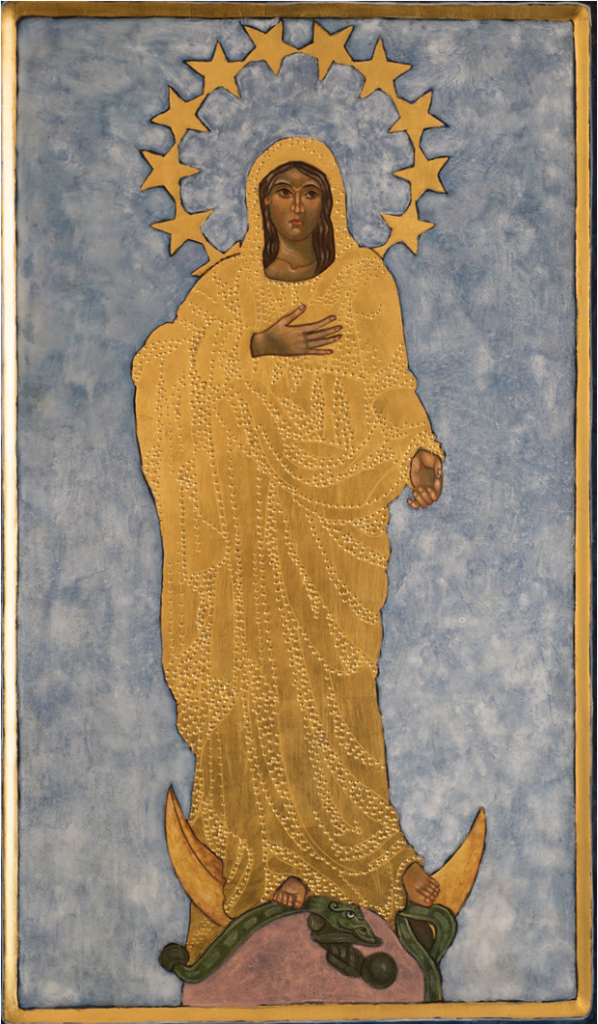
“Mary, Heart of Oblate Studies” by Lauretta Agolli
And so with great pleasure to rejoice at your vocation, convinced as I am of your constant fidelity to respond to this special grace of God’s mercy in your regard. My dear children, I leave you to consider how happy I am to be able to count you among the number of those whom the Lord has given me as sons in a family which is soldiering in the Church under the banner of Mary. In advance I calculate, so to speak, all the good that you will be able to do in the course of your life.
You will be enriched not only by these merits of your own, but, because of the solidarity within our family, you will be enriched by all that is meritorious accomplished in the works of your brothers in all parts of the world.
Goodbye, my dear sons, I bless you from the abundance of my father’s heart.
+ C. J. Eugene, Bishop of Marseilles, sup. gen.
REFLECTION
Through our response to live by the charism given to us through St Eugene, we become members of a world-wide family under the patronage of Mary Immaculate. Because of this solidarity each of us is enriched by all the other members of the family in all parts of the world.
A Blessed and Happy Feastday to all – with gratitude for our calling.
A MISSIONARY’S PRAYER TO MARY IMMACULATE
Bishop Vital Grandin OMI had been a missionary bishop in Canada for 47 years. Not long before his death in 1902 he composed this prayer to Mary Immaculate. As we prepare for our patronal feast tomorrow, I share it with you.
Prayer to Mary Immaculate
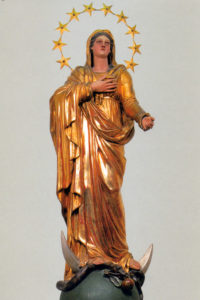 O good and most loving Immaculate Mother, in my fears and my concern for the eternal salvation of the dear souls of this Mission, seeing so much misery and so many needs, I entrust them to you today. I commend everyone: children and adults. I consecrate them. I give them to you. Since you are the Mother of the Good Shepherd, defend them against the enemies of their salvation…
I myself a poor sinner, place myself under your protection. My end is near; the Good Lord is going to call me. Very soon I will say: “Jesus, Mary, Joseph, I give you my heart, my soul and my life.” Obtain for me from the Most Sacred Heart of our good Master the ultimate grace of perseverance.
Ah, Lord, cast your eyes on the Divine Mother, who is also my Mother. It is she who presents to you this oblation; It is her immaculate heart that I give you. Ah, take me from the arms of my dear Mother. O Holy Virgin, what happiness. I am your privileged son, your Oblate! O my Mother, I come to consecrate myself entirely to your service! Yes, Mother, I promise not to neglect anything to make you loved and respected by all. O my Mother, receive me in the bosom of your merciful goodness. All my life, I swear to love, respect, and trust you like my mother. Oh! Do not abandon me in trouble, in pain, and especially at the hour of death. You know my nothingness, my sinfulness, so, pray incessantly for me, a poor sinner.
Bishop Vital Grandin OMI
I HAVE SELECTED THE BEST FROM AMONG THESE GOOD MEN
Vatican approval was necessary for this new mission, which Cardinal Fransoni granted. In responding to him, Eugene described the qualities of Fr. Semeria.
In keeping with the views of the Sacred Congregation, it has been my concern to select three very good men. This was not a very difficult task since our Oblates of the Most Holy Mary Immaculate, by the grace of God, are all good and all ready to sacrifice their lives for the glory of God to and work for the conversion and sanctification of souls. That is the precise goal of their vocation.
I have selected the best from among these good men: Fr. Etienne Semeria. He is still rather young, only 34 years old, but does possess the required maturity as far as virtues and all religious qualities are concerned. He has been the superior of the Corsican missions for a number of years. It is unbelievable with what success, with what blessings of God, even bandits have come to prostrate themselves before him; and marvelous indeed are the cases of reconciliation in this land we all know due to his zeal and goodness.
When the bishop learns of this theft I am about to perpetrate, I don’t know if he will forgive me. The Congregation, however, loans its members, it does not donate them. It is of utmost importance that there be a religious such as Fr. Semeria at the head of this first small community.
Letter to Cardinal Fransoni, Prefect of the S. Cong, of Propaganda Fide, 25 September 1847. EO 5 n 6
REFLECTION
Etienne Semeria was a good choice and was eventually to become Bishop of Jaffna. (See: https://www.omiworld.org/lemma/semeria-bishop-etienne/)
“A true leader has the confidence to stand alone, the courage to make tough decisions, and the compassion to listen to the needs of others. He does not set out to be a leader, but becomes one by the equality of his actions and the integrity of his intent.” (Douglas MacArthur)
IT IS AN INFINITELY DIFFICULT MISSION FOR SEVERAL REASONS
Leflon writes, ‘‘There can be no doubt that once again, and with very sure insight, Bishop de Mazenod had looked far beyond the feasibility of the present to envision the realizations of the future. It does not seem so certain, however, that he had a clear appreciation of the odd and complicated situation which existed in what the first Oblate superior would soon call a ‘strange country’ and which would discourage his sons as well as himself…” (Volume 4 p 167)
In view of the expected difficulties, Fr. Semeria was chosen as the superior of the four Oblates destined for Ceylon. He was the highly-respected rector of the major seminary in Ajaccio, and his departure was a blow to the Bishop. Eugene wrote to him to justify his choice:
“It is an infinitely difficult mission for several reasons, and I needed a proven man like Fr. Semeria to entrust it to for my own peace of mind. This is the sacrifice that God has asked of us, and I had to make it with joy in firm confidence regarding the great good that will result from it; the Sacred Congregation of Propaganda calls the help that it has asked from us “opportunissimo et necessario”. I have every reason to think that Fr. Rolleri, who will replace him at Vico, will do good work.
Letter to Bishop Casanelli d’lstria of Ajaccio, 7 October 1847, EO IV page XXIV
REFLECTION
“If Jesus Christ be God and died for me, then no sacrifice can be too great for me to make for Him.” (C.T. Studd)
NO MONEY, NO MISSION
Sending Oblates to the foreign missions and maintaining them, especially in the poorest rural regions, required funds. Each year Bishop Eugene had to write to Rome and to the French Propagation of the Faith asking for grants.
Dear Sirs,
Since some of our missionaries are about to leave for the missions which our Congregation of the Oblates of Mary Immaculate has founded in North America … That same period will also mark the departure of a group of four of our missionaries I have placed at the disposal of Bishop Bettachini, the coadjutor of the Apostolic Vicar of Ceylon. During the few days he spent in Marseilles, when I had a number of conversations with him, this prelate painted such a picture of the deplorable state of the religion in that island that I was unable to refuse coming to his aid despite the needs of the other foreign missions entrusted to our Congregation. …
I recognize the fact that we cannot claim a large grant in light of the requests already advanced this year by our Congregation for its missions in America and England. Therefore we will restrict ourselves to what is strictly necessary for our mission in Ceylon; the travelling expenses of the four missionaries and the initial settlement and support costs. That will require at least 12000 francs.
To the Members of the Central Council of Southern France for the Missionary Society of the Propagation of the Faith, Lyon, 14 August 1847, EO V, n106
When they delayed in responding, Eugene feared that he would not have the money to be able to send the 4 missionaries to Ceylon and would have to cancel the project. Two months later he wrote again:
Dear Sirs,
I awaited your response to my letter of September 15 last with a sort of anxiety. In effect, I saw the day arrive when it would be necessary to decide on the departure of our missionaries for Ceylon and I still had no assurance of finding the means to send them to their destination…
Gentlemen, this gives you an idea of the distressing state from which I was rescued by the reception of your letter of October 4th and the draft for 3 000 francs it contained.
Letter to the Members of the Central Council for Southern France, of the Missionary Society of the Propagation of the Faith, Lyon, 14 October 1847, EO V n 109
REFLECTION
“I’ve heard people say, “I want more of a heart for missions.” I always respond, “Jesus tells you exactly how to get it. Put your money in missions – and in your church and the poor – and your heart will follow.” (Randy Alcorn)
ADVENT WITH THE MAZENODIAN FAMILY 2023
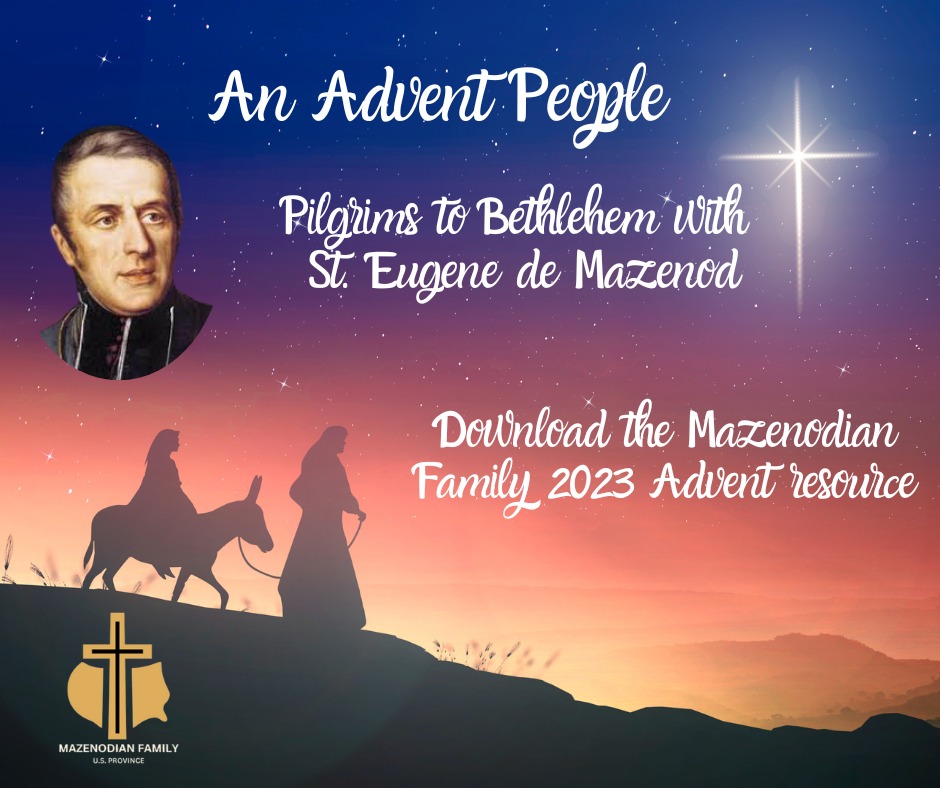
Father David Muñoz OMI has prepared this beautiful series of daily meditations to help us on our Advent journey.
As we make use of them, let us consciously unite ourselves with all the members of the Mazenodian Family throughout the world who are pilgrims of hope in our suffering world.
LET’S HAVE COURAGE THEN AND PUT OUR CONFIDENCE IN THE LORD
Father Vincens was the Novice Master, preparing future Oblate missionaries. In the previous entry we saw Eugene’s letter to him announcing the acceptance of our first mission in Asia, which concludes with:
Bishop Bettachini left with his heart full of joy; and unless the Propagation presents obstacles, which I hope will not happen, next month our first missionaries will leave with the Bishop to lay the first foundations of this great endeavor.
This departure will not prevent four missionaries from leaving for America, who will soon be followed by several others. You see that we need a lot of people to satisfy all these needs.
Let’s have courage then and put our confidence in the Lord. The important point will always be to form good men; neglect nothing to that purpose.
Letter to Father Ambroise Vincens, 12 August 1847, EO X n 936
REFLECTION
“I have but one candle of life to burn, and I would rather burn it out in a land filled with darkness than in a land flooded with light.” (John Keith Falconer)
NOVENA IN PREPARATION FOR THE IMMACULATE CONCEPTION