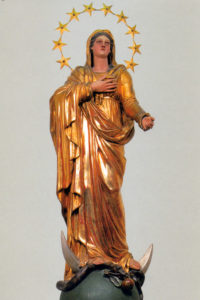
 O good and most loving Immaculate Mother, in my fears and my concern for the eternal salvation of the dear souls of this Mission, seeing so much misery and so many needs, I entrust them to you today. I commend everyone: children and adults. I consecrate them. I give them to you. Since you are the Mother of the Good Shepherd, defend them against the enemies of their salvation…
-
Recent Posts
- PAPAL APPROBATION: RECOGNIZING THAT THE CHURCH HAS SPOKEN
- PAPAL APPROBATION: RECOGNIZING OUR SUPERIOR GENERAL AS OUR SPECIAL STRENGTH AND SUPPORT
- PAPAL APPROBATION: RECOGNIZING OUR NAME AS THE EXPRESSION OF OUR IDENTITY
- PAPAL APPROBATION: TO CONTINUE CARRYING OUT OUR DUTY WORTHILY, FAITHFULLY FULFILLING OUR SPLENDID VOCATION
- PAPAL APPROBATION: THE OBLATE COMMITMENT TO BEING COOPERATORS OF THE SAVIOR IS RECOGNIZED AND GIVEN A LEGAL STANDING IN THE CHURCH, THE BODY OF CHRIST
Recent Comments
- Mildred March on A SUMMARY OF TEN YEARS OF OBLATE MINISTRY
- Eleanor Rabnett, Lay Oblate on FAITH-FOCUSED INVESTMENT GROUPS: A PRESENCE WHERE DECISIONS AFFECTING THE FUTURE OF THE POOR ARE BEING MADE (Rule 9a)
- Eleanor Rabnett, Lay Oblate on VIVAT: A PRESENCE WHERE DECISIONS AFFECTING THE FUTURE OF THE POOR ARE BEING MADE (Rule 9a)
- Eleanor Rabnett, Lay Oblate on WE SHOW A VERY HUMAN FACE OF JESUS TO THE WORLD, ONE FULL OF COMPASSION AND SOLIDARITY (Rule 9a)
- Eleanor Rabnett, Lay Oblate on JUSTICE, PEACE AND THE INTEGRITY OF CREATION AS AN INTEGRAL PART OF EVANGELIZATION (Rule 9a)
Archives
Meta
-
Oraison December 17, 2023

CLICK THE IMAGE BELOW FOR THIS MONTH’S ORAISON REFLECTION

Posted in WRITINGS
Leave a comment
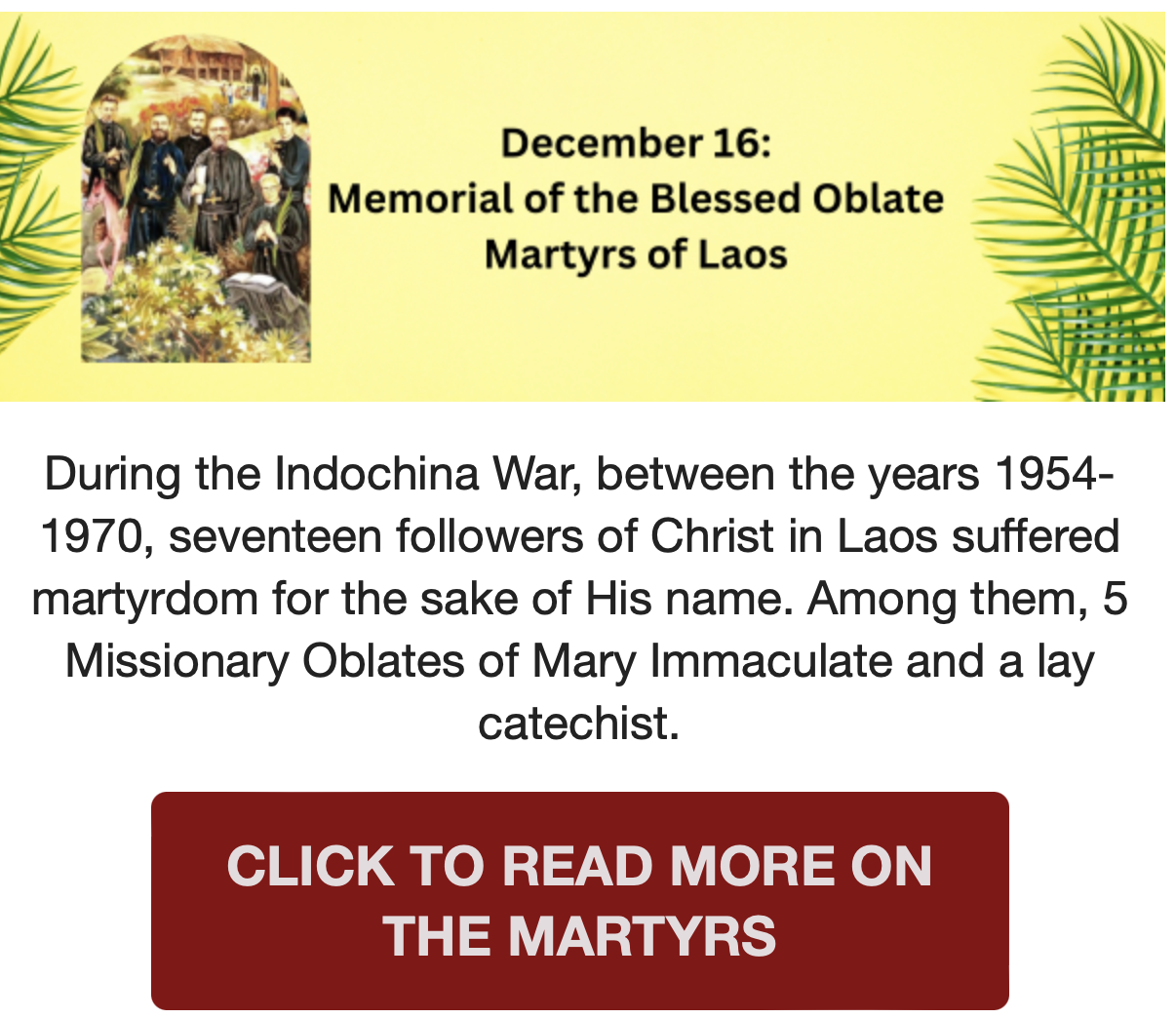
DECEMBER 16: MEMORIAL OF THE BLESSED OBLATE MARTYRS OF LAOS
Posted in WRITINGS
Leave a comment
CHRISTMAS BLESSINGS
A BLESSED CHRISTMAS TO YOU AND YOUR LOVED ONES
There will be a pause in these reflections until January 8.
Thirteen years of reflections continue to be available on the website https://www.eugenedemazenod.net – a treasure-chest of material to invite us to encounter Saint Eugene in the often-flawed humanity that God used to make him a saint, his charism, his mission and spirituality. This is the reason why I produce the daily reflection.
-
-
- You can consult these through the “Archives” section on the main page.
- Better still, put in a word or concept in the “Search” label at the top of the main page, and all the published texts with that word or theme will appear.
- Through the search engine you can also find that over the years I have explored themes (e.g. our foundation, the bicentenary, the Youth Association, the 1818 Rule to mention just a few)
-
Posted in WRITINGS
Leave a comment
PREPARING FOR CHRISTMAS WITH SAINT EUGENE
One of the privileged moments of prayer for Eugene was to be able to unite himself with those he loved in the presence of God. In our Oblate tradition we have come to know this exercise as “oraison.” As a seminarian in Paris he wrote to his mother one Christmas morning describing how united he had been with her during Midnight Mass, despite the distance that separated them.
Dearest Mother, do you really think that I was not beside you last night? How could I fail, meditating as I was on the holy Mother of God, who had just been filled with consolation on giving the world its Saviour, and at the same time had to experience so vividly the poverty, weakness and misery to which she saw her Divine Master reduced for love of men, how could these tender sentiments fail to draw me close to you?
Indeed yes, darling mother, we spent the night together at the foot of the altar, which for me represented the crib in Bethlehem; together we offered our gifts to our Savior and asked him to come to birth in our hearts and strengthen us in all that is weak, etc.
You know my heart all too well, since it was formed from your own, so you will have a very clear understanding that it is as active and goes through the same feelings as your own.
Letter to his mother, 25 December 1809, EO XIV n 37
REFLECTION
Who are the people I want to unite myself with in oraison prayer before the crib in Bethlehem this year?
I AM OVERWHELMED WITH JOY TO BE ABLE TO SEE WHAT GOD’S GRACE HAS MADE OF THEM.
Departure of Fathers Lempfrit and Bernard and Father Arnaud for America. They will be joined in Lyon by Father Gaudet and the two lay brothers Triolle and Tisserand. Nothing could be more admirable or more lovable than these generous misssionaries. How kind they were in expressing their affection for me! They are worthy of all my love. I can say that I am overwhelmed with joy to be able to see what God’s grace has made of them.
Eugene de Mazenod’s Diary, 24 September 1847, EO XXI
REFLECTION
Each Oblate had to undergo many years of formation in order to imbibe and become a missionary disciple of Jesus the Savior according to the charism given to Eugene de Mazenod. Here we see the satisfaction of the father of the family as he contemplates God’s handiwork in the generosity of the new missionaries.
“Being a father has been, without a doubt, my greatest source of achievement, pride and inspiration. Fatherhood has taught me about unconditional love, reinforced the importance of giving back and taught me how to be a better person.” (N. Jain)
TRULY, IT’S ENOUGH TO WEEP WITH JOY TO HAVE MEN OF THIS CALIBRE IN OUR CONGREGATION
Eugene had always regarded himself as the father of his missionary family. He was the Founder, and Superior General whose role was more than administrative. It was to maintain the family bonds and spirit. Eugene was the father who loved every one of his missionary sons and who rejoiced in their mutual relationship. This evident in his diary entry:
September 24: Ordination of our three deacons: Bernard, Gaudet, Keating . I ordained them deacons on Saturday 18th, and made them priests today. Oh, how worthy of this privilege these three religious have shown themselves, one ready to leave for the island of Ceylon, the other two for Canada, with sentiments truly worthy of their vocation. I don’t know which of the three to admire most.
Father Keating is colder and more timid, but Fathers Bernard and Gaudet expressed to me the deepest feelings of their hearts with a truly filial affection and commitment, and I certainly did not remain insensitive to these touching testimonies of their affection. Never has a son, parting from his father, shown him more love. Father Gaudet is leaving tomorrow. He wanted to leave me a written record of his feelings… He had already written me a perfect letter to express his desire not to be forgotten in the choice I was to make of subjects for Canada, for this country infested by typhus which, with everyone’s knowledge, has already taken more than twelve priests and affected four of our own. Today it’s to thank me for answering his prayer.
Truly, it’s enough to weep with joy to have men of this calibre in our congregation.
Eugene de Mazenod’s Diary, 24 September 1847, EO XXI
REFLECTION
“God’s love for all. I am saying that it is this sentiment, which I know comes from Him who is the source of all charity, which has evoked in the hearts of my children this reciprocity of love which forms the distinctive character of our beloved family.” (Eugene de Mazenod to Fr. Mouchette, 2 December 1854, EO XI n 1256)
ACT OF APPOINTMENT AS SUPERIOR OF THE CEYLON MISSION.
Charles Joseph Eugene de Mazenod
by divine mercy and favour of the Apostolic See
Bishop of Marseilles,
Commander of the Holy Religious and Military Order of Saints Maurice and Lazarus,
Superior General
of the Congregation of Oblates of the Most Holy and Immaculate Virgin Mary,
to our beloved Brother in Christ Étienne Semeria
Priest of the same Congregation,
Greetings and blessings in the Lord
Monsignor Bettachini, coadjutor of the Vicar Apostolic in the island of Ceylon, having most earnestly asked us to assign some of our missionaries to him as travelling companions and associates in his work. We, to whom is entrusted the government of the whole Congregation, considering less our shortage of subjects than the will of God, the members of our Congregation being called to work in this part of the vineyard of the Father of Family, have decided to send evangelical laborers to work there. Under the jurisdiction of the Most Reverend Coadjutor, these laborers will therefore work diligently, for the greater glory of God and the salvation of souls, to stimulate the piety of Catholics, to restore the faith among heretics, and above all to rescue unfortunate infidels from the darkness and shadow of death.
Granted the great distance that will separate us and the great difficulties that could result from it, we have chosen from among the members of our Congregation and appointed with extraordinary faculties as head of this great undertaking and guide of this excellent mission, the said Étienne Semeria, a man matured by prudence and many years as an Oblate, notable for his zeal and piety, and unshakeable in his attachment to Ourself and the Family.
The document continues with a listing of the administrative powers given to him in this new Oblate mission, where he was to be the Founder’s “alter-ego.” He concludes
Now go forward, beloved Son, to the work that is entrusted to you together with those whom we have chosen to be your companions in those distant parts of Asia, for the greater glory of God, which we must further there and everywhere.
May the Most Holy and Immaculate Virgin Mary, our loving Mother, keep you always under her protection. May the angels of God assist you. And as for Us, beloved son in Christ, we will not cease to implore for you an abundant outpouring of divine grace from heaven.
Given at Marseilles… October 21, 1847.
+ C. J. Eugene, Bishop of Marseilles, Superior General.
Father Semeria received his obedience and then embarked on a 37-day voyage, where he reached Ceylon in the company of Fathers Louis Marie Keating from Ireland, Joseph Alexandre Ciamin from Nice and Brother Gaspard De Stefanis from Genoa.
A FAMILY WHICH IS SOLDIERING IN THE CHURCH UNDER THE BANNER OF MARY
Eugene’s letter to the young Oblates who had just made their lifetime oblation can apply to all of us, members of the Mazenodian Family, as we celebrate our patronal feast.
My dear sons, you are quite right to congratulate yourselves for the happiness you have experienced in consecrating yourselves to God in the Congregation which has Mary Immaculate as its Mother. This is a grace of predilection, a true guarantee of your predestination to eternal bliss. The saintly death of all those whom the Lord has harvested from our midst has proved this to date. But before going to Heaven, what good things you are called to do here on earth!
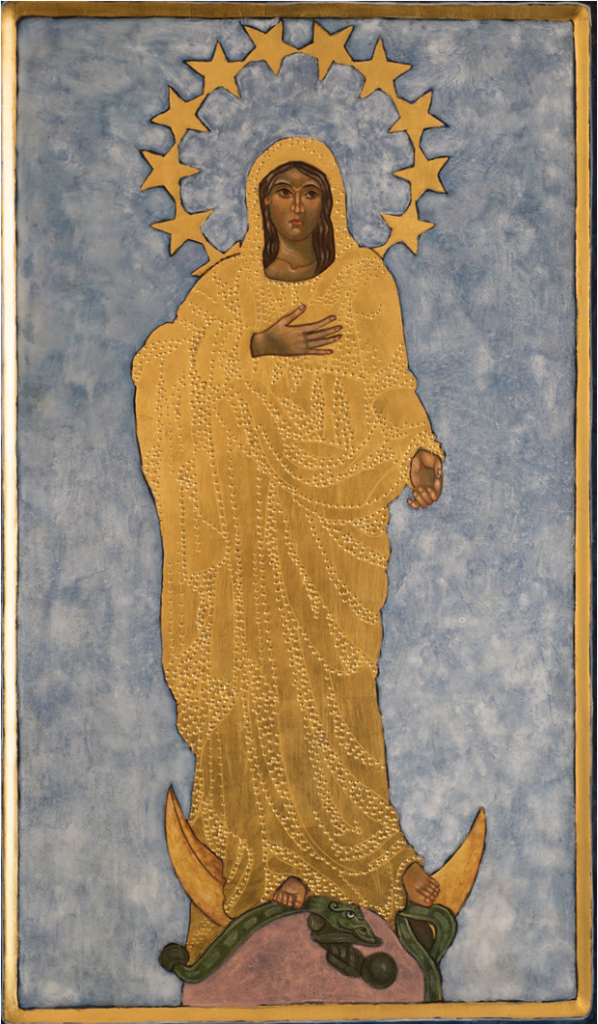
“Mary, Heart of Oblate Studies” by Lauretta Agolli
And so with great pleasure to rejoice at your vocation, convinced as I am of your constant fidelity to respond to this special grace of God’s mercy in your regard. My dear children, I leave you to consider how happy I am to be able to count you among the number of those whom the Lord has given me as sons in a family which is soldiering in the Church under the banner of Mary. In advance I calculate, so to speak, all the good that you will be able to do in the course of your life.
You will be enriched not only by these merits of your own, but, because of the solidarity within our family, you will be enriched by all that is meritorious accomplished in the works of your brothers in all parts of the world.
Goodbye, my dear sons, I bless you from the abundance of my father’s heart.
+ C. J. Eugene, Bishop of Marseilles, sup. gen.
REFLECTION
Through our response to live by the charism given to us through St Eugene, we become members of a world-wide family under the patronage of Mary Immaculate. Because of this solidarity each of us is enriched by all the other members of the family in all parts of the world.
A Blessed and Happy Feastday to all – with gratitude for our calling.
A MISSIONARY’S PRAYER TO MARY IMMACULATE
Bishop Vital Grandin OMI had been a missionary bishop in Canada for 47 years. Not long before his death in 1902 he composed this prayer to Mary Immaculate. As we prepare for our patronal feast tomorrow, I share it with you.
Prayer to Mary Immaculate