MAY GOD GRANT THAT I MAY REAWAKEN SO MANY FOOLISH PEOPLE FROM THE FATAL CARELESSNESS THAT BRINGS THEM TO THEIR DOOM

When Eugene returned to Aix en Provence as a young priest he preached a series of Lenten sermons aimed at those who were the most abandoned as a result of the French Revolution. For Eugene the “poor” were those who had been deprived of knowing God as savior as a result of the historical and social circumstances.

In the first sermon he presented the indifference of the people to God, and invited “you poor of Jesus Christ” to come to the instructions where they would be enlightened. Just over two hundred years later, our circumstances are different but the message remains equally powerful.

Question the milling crowd that jostles in the public squares, ask anyone what he is doing, where he is going, what is he engaged in doing, etc.

  • The one will answer that a process on the issue of which depends his entire fortune summons him to the bench to solicit, etc.
  • Another will say that he is going to negotiate an important matter, etc.
  • Another will say that he is going to negotiate his presence on the farm to which he is heading with all speed.
  • Another again will say that he is going over in his mind some plans concerning fortune, interests or ambition that will assure, etc.
  • Perhaps you will discover some who will be compelled to say that they are hastening their steps towards the object of their less than noble passions.

So come, whoever you are, come tirelessly to some instructions that must correct you in many fatal errors, enlighten you on what should be your only true interests. Not a single one, no, not one will be able to reply that his mind is filled with the eternal truths, that these are the subject of his meditations and searches. “It has been made a desolation” etc. (Jer. 12:11). O blindness! O folly! However, the days pass, the years roll by, death has its day!

Then illusion vanishes, but there is no longer time to make good the loss of a life entirely devoted in the tiring search for passing vanities that must be left behind. It is too late to collect an incorruptible treasure of glory and happiness for eternity.

Come especially you poor of Jesus Christ and may God grant that I may make my voice heard in the four quarters of the world to reawaken so many foolish people from the fatal carelessness that brings them to their doom.
Notes for the first instruction in the Church of the Madeleine EO XV n. 114

These were Eugene’s preaching notes and thus when we see the “etc.” in the text, it means that he would spontaneously expand on that point.

Posted in WRITINGS | 1 Comment

PRAYER IS THE ONLY COURSE OPEN TO ME

During the cholera epidemic of 1835, Eugene was away from Marseilles, because he had been ordered to as a result of the ongoing hostility with the government

In this letter Eugene confides his sense of impotence, and his anxiety for the people he cared for, to his friend and confidante, Father Tempier, and gives the only response possible for him.

My dear Friend, normal life is impossible at this unhappy juncture. My heart and mind are in an emotional state that breeds anxiety  that makes it impossible to rest in peace. Prayer is the only course open to me, any other activity is impossible. Apart from that, my imagination plagues me with unhappy and gloomy thoughts; as a result I sometimes even have nervous spasms. I mean I start involuntarily at the thought of the evil that I fear may befall the people who are dear to me, or of their death. For two days I had no letters from you. It was all that was needed to torture me with the idea that perhaps you were dead.

At the time of the first epidemic, when I was there on the spot, sharing the same dangers, I experienced hardly any anxiety for others any more than myself. It seemed as if we were all invulnerable; now that for my sins I am in a place of safety, the most acute suffering is never absent from me..

Letter to Henri Tempier, 7 August 1835, EO VIII n 531

Posted in WRITINGS | 3 Comments

TODAY: FOCUS ON SEEING WHAT IS ESSENTIAL

Through the eyes of our crucified Saviour we see the world which he redeemed with his blood, desiring that those in whom he continues to suffer will know also the power of his resurrection (cf. Phil 3: 10).

CC&RR, Constitution 4

Fr. Jetté reflects: “we are invited to contemplate the cross, Christ’s suffering not only within ourselves but also in others. Our desire is ‘that those in whom he continues to suffer will know also the power of his resurrection’.” (F. Jetté, The Apostolic Man, p. 59)

Eugene’s first recorded homily, in the Madeleine Church, put this view into practice:

Lift yourselves towards heaven where your minds should be set, our citizenship is in heaven (Phil. 3:20), let your eyes see for once beneath the rags that cover you, there is within you an immortal soul made in the image of God whom it is destined to possess one day, a soul ransomed at the price of the blood of Jesus Christ, more precious in the eyes of God than all earth’s riches, than all the kingdoms of the earth, a soul of which he is more jealous than of the government of the entire universe.

Christians, know then your dignity, with St. Leo I will call you sharers in the divine nature.

Notes for the first instruction in the Church of the Madeleine, 1813,  EO XV n. 114

Posted in WRITINGS | 1 Comment

TODAY: LIVING JESUS THE CRUCIFIED SAVIOR IN SUPERNATURAL JOY

I originally published what follows in May 2016 and believe it has something to say to us today. It was written by Enzo Teodori, who died five months afterwards. He refers to the reflection of Fr Jetté that I used in Friday’s entry of “St Eugene Speaks.” (https://www.eugenedemazenod.net/?p=4255)

This is what I wrote then.

I received this reflection today from one of the Oblate lay associates who is very very seriously ill in Italy. In this powerful and moving reflection, he shares his lived understanding of the Good Friday vision of St Eugene, that is our inheritance as members of the Mazenodian Family – this is the meaning of oblation:

“A little echo to the masterful reflections of Fr.  Jetté you reported in ‘Eugene speaks to us’ today on May 6.

Unity with the Crucified Jesus and Savior gives one a supernatural joy that inspires in one a strong desire to make others happy and to put oneself in their service.

Because of my illness, I am compelled to remain in the house for many hours. So I thought of sending to my closer acquaintances, via whatsapp,  the Word of the day with a little comment, to give busy people a little time of daily “recreation.” Well, I started with the “group” of siblings and in-laws, and now, about 80 people receive it, with very edifying reactions. Another simple experience: although I am incapable of eating, I try to cook nice things for my wife and my children.

These are two simple experiences, two expressions of the supernatural joy that I experience in unity with Jesus the Crucified Savior. Paradoxically, it is a joy that is nourished by the pain: the stronger the physical pain, but above all the moral, the more intense is the joy and stronger the desire to make others happy.

What is the key to unity with the Crucified Savior? The illness has brought down my world, my desires, my plans; everything is lost and the vision of Providence that followed them has given way to the image of abandonment. Contemplating and meditating on Jesus Crucified, I realized that his act led him to the resurrection: he unconditionally entrusted his spirit to the Father. With this act, even humanly, He took on the Father’s will. His great desire to be recognized as the Savior, which was the reason for his incarnation, desire agreed to with the Father, collapsed on the cross. In the human perspective it collapsed, in the human understanding of the will of God. Trusting in the collapse, in the perception of abandonment (but as to my mission … had we not agreed, I and You, my Father ?!), Jesus humanly has embraced fully the outlook of God, and that’s the resurrection, and here is the full joy, and here is the overcoming of the limits of human desires, even the most holy, like taking care of one’s family effectively.

Illness is to live the abandonment, the collapse, on an ongoing basis, unraveled over time. The reliance must be renewed every day and several times a day. The grace that comes from relying unconditionally makes sense, even if you do not understand, as Providence in action. It makes you understand, even if you do not see how, that the Father is implementing a plan of love in your soul, in your body and in your story.

The more intense the pain is, the more the Spirit convinces you that God is building, drawing a masterpiece. If the pain is relatively little, it makes you think that God is working on a sketch, a draft; when the pain is very strong it makes you think that God is drawing the Sistine Chapel in your life. And masterpieces, you know, take years and years of hard work ….

So, I think Fr. Jetté has expressed very skillfully that unity with Jesus the Crucified Savior that gives one supernatural joy that inspires a strong desire to make others happy, to put oneself at their service.”

What a gift to read this and be able to share it again! May every reader of this reflection join in prayerful gratitude for this son of St Eugene and his young family. May he rest in peace and intercede for us in our time of need.

Posted in WRITINGS | 1 Comment

LEARN ABOUT ST. EUGENE DE MAZENOD FROM YOUR HOME!

Class 3 of the online course “Eugene de Mazenod 101” is available from today.


All uploaded classes will remain available until the end of the year: https://moodle.ost.edu/course/index.php?categoryid=28

(Please note that the first part of this page refers to the course in Spanish – and that you have to scroll below the Spanish to reach the English section)


Conditions permitting, we hope to launch this online course in French in June.

Posted in WRITINGS | Leave a comment

THE TRANSFORMATION THAT OUR OUTLOOK UNDERGOES WHEN IT IS IN CONTACT WITH THE MYSTERY OF THE CROSS

Reflecting on this pivotal constitution of our Mazenodian spirituality, former Oblate Superior General, Fernand Jetté wrote that it : “expresses the purification and transformation that our outlook undergoes when it is in contact with the mystery of the cross:

Through the eyes of our crucified Saviour we see the world which he redeemed with his blood, desiring that those in whom he continues to suffer will know also the power of his resurrection (cf. Phil 3: 10).

CC&RR, Constitution 4


“Our outlook on the world becomes that of Jesus the Savior crucified. It was the Founder’s outlook after his ‘conversion’, how he saw himself and the world in terms of Christ’s blood. The expressions: ‘souls at the price of Christ’s blood’, ‘who have cost him his blood’, recur again and again in his writings. 

Farther on, in Rule 12, we will find the complementary expression: ‘to love others as Jesus loves them’. Indeed, the Oblate’s apostolic spirit consists in contemplating the world with the eyes of Christ, loving it with the heart of Christ, and working wholeheartedly with Christ in the work of its redemption.” (F. Jetté, The Apostolic Man, p.58-59)

When this was written in 1992, the concept and profile of the Mazenodian family had not emerged clearly. Today we would say “Indeed, the Mazenodian Family’s apostolic spirit consists in contemplating the world with the eyes of Christ, loving it with the heart of Christ, and working wholeheartedly with Christ in the work of its redemption”

Posted in WRITINGS | 1 Comment

TODAY LET US HELP  ONE ANOTHER TO SEE EVENTS THROUGH THE EYES OF THE CRUCIFIED AND RISEN SAVIOR

The cross of Jesus Christ is central to our mission. Like the apostle Paul, we “preach Christ and him crucified” (1 Cor 2: 2). If we bear in our body the death of Jesus, it is with the hope that the life of Jesus, too, may be seen in our body (cf. 2 Cor 4:10). Through the eyes of our crucified Saviour we see the world which he redeemed with his blood, desiring that those in whom he continues to suffer will know also the power of his resurrection (cf. Phil 3: 10).        OMI Constitutions and Rules, Constitution 4

Eugene’s conversion happened when he became aware that his past attitude and behavior was leading him to death, to mortal sin. He changed when his eyes were opened to recognize that he was bearing the death of Jesus in his life. He changed radically and in embracing new life, it was “with the hope that the life of Jesus, too” would be seen in his body. It requires consistent effort to maintain the effects of this new life, or else we are in danger of the “cheap grace” made famous by Bonhoeffer.

“Cheap grace is the grace we bestow on ourselves. Cheap grace is the preaching of forgiveness without requiring repentance, baptism without church discipline, Communion without confession…. Cheap grace is grace without discipleship, grace without the cross, grace without Jesus Christ, living and incarnate.”   Dietrich Bonhoeffer

We have the Cross – but it is the door that opens to resurrection!

Posted in WRITINGS | 1 Comment

I WENT TO PLACE ALL UNDER THE PROTECTION OF THE BLESSED VIRGIN

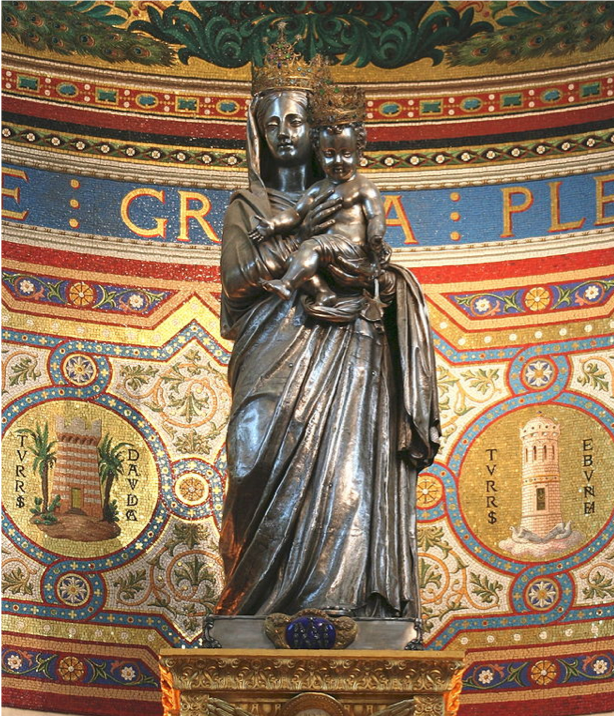
While assisting those who were suffering so greatly from the cholera epidemic, Eugene and his uncle, Bishop Fortuné, arranged to focus the attention of the people of Marseilles on concentrated prayer. The population had a special devotion to the small sanctuary of Notre Dame de la Garde on the hill dominating the city. The statue of the “Good Mother” which represented Mary’s “keeping guard” over the city and over the sea, was particularly loved by the people. Eugene wrote:

We are going to offer solemn prayers. Tomorrow we are bringing down the statue of Our Lady de la Garde for exposition in the cathedral for three days. Afterwards we will have a procession of the Blessed Sacrament for all who wish to take part…

Letter to Casimir Aubert, 10 March 1835, EO VIII n 508

Writing to his mother some days later he describes this event:

We are now confronted by a quite ravishing spectacle. It is a holy explosion of devotion to the Blessed Virgin, which was displayed not only in the course of the journey down from the Mount to the cathedral, but is still going on with a sustained trust. …

Letter to his mother, March 1835, EO XV  n. 176

Two years later there was another outbreak of the epidemic:

On the feast of the Assumption, I officiated pontifically at the cathedral both in the morning and in the evening. I took part in the general procession and gave Benediction in the evening. On Sunday in the octave, I went to say Holy Mass at Notre-Dame de la Garde to place myself, all of our men, and the whole diocese, under the protection of the Blessed Virgin.

Eugene de Mazenod’s Diary, undated entry August 1837, EO XVIII

The same devotion was repeated in the epidemic of 1854 in Marseilles.

Posted in WRITINGS | 1 Comment

TODAY LET US HELP ONE ANOTHER TO FOCUS ON THE CROSS AND RESURRECTION

The cross of Jesus Christ is central to our mission. Like the apostle Paul, we “preach Christ and him crucified” (1 Cor 2: 2). If we bear in our body the death of Jesus, it is with the hope that the life of Jesus, too, may be seen in our body (cf. 2 Cor 4:10). Through the eyes of our crucified Saviour we see the world which he redeemed with his blood, desiring that those in whom he continues to suffer will know also the power of his resurrection (cf. Phil 3: 10).

OMI Constitutions and Rules, Constitution 4

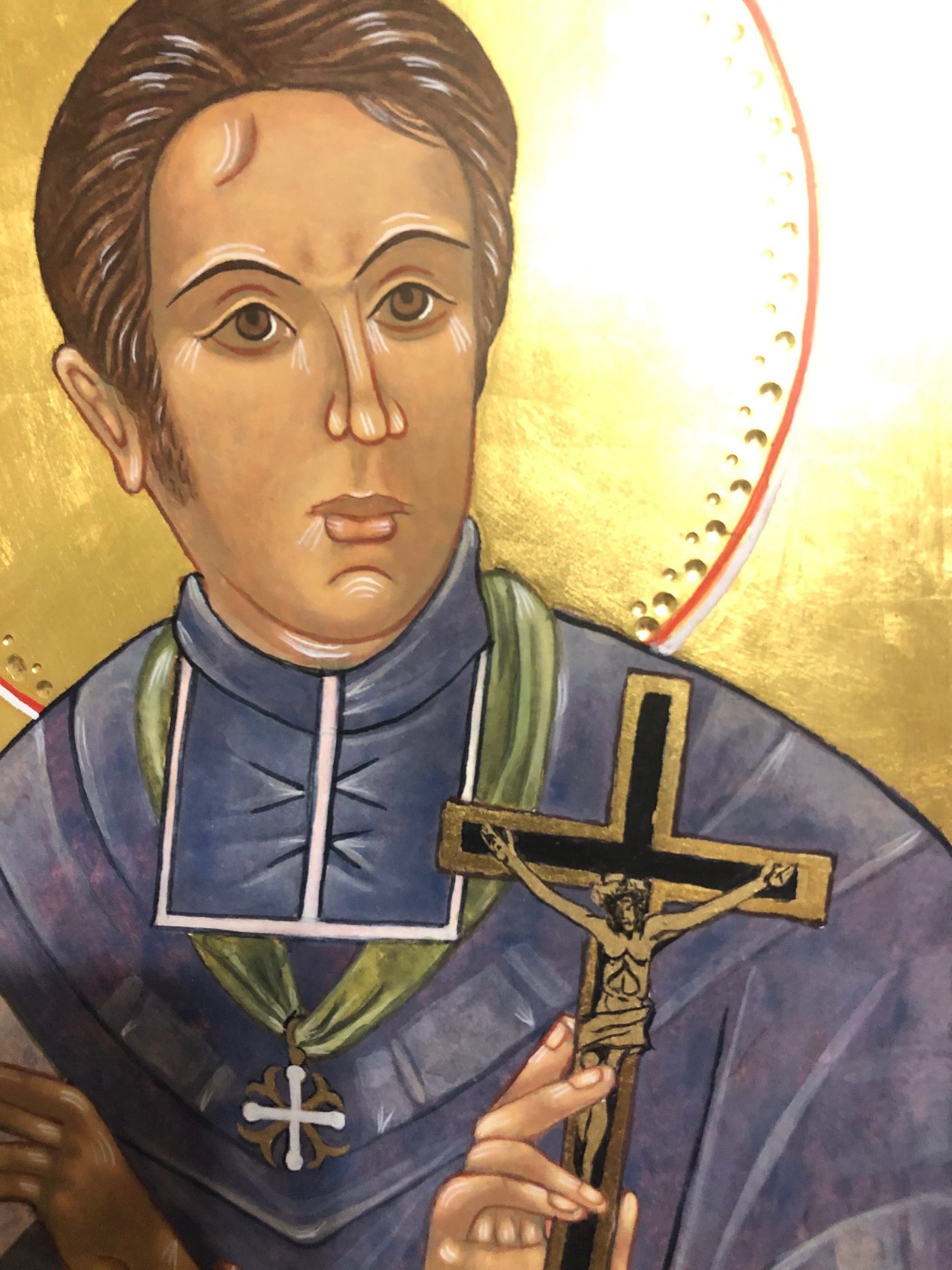
Detail of an icon written by Lauretta Agolli

For the young Eugene de Mazenod, his encounter with the Cross was a stepping stone to new life – to resurrection. Some of us were brought up to keep our gaze at the foot of the Cross, reflecting on our misery and on how much Jesus suffered because of us.

It is true that we can never meditate sufficiently on the price paid by Jesus to rescue us from our misery. He did, however, die to remove us from our misery and bring us to the fullness of life in the resurrection. “If we bear in our body the death of Jesus, it is with the hope that the life of Jesus, too, may be seen in our body.”

Posted in WRITINGS | 1 Comment

IN THE UNCERTAINTY AND PAIN OF THESE DAYS, SAINT EUGENE DE MAZENOD HELPS US TO FOCUS.

In the darkness and insecurity we are living through, we recall a 25 year-old in Aix en Provence whose life was insecure because he had no clear sense of direction.

I looked for happiness outside of God and for too long with resulting unhappiness.

As he struggled to find meaning in what was going on he understood the presence of God in a new way one Good Friday, looking at the Cross, and realized the only focus that could made enduring sense for the rest of his life. As he looked at the Cross he learnt to focus from darkness to light

Detail of an icon written by Lauretta Agolli

Never was my soul more satisfied, never did it feel such happiness; for in the midst of this flood of tears, despite my grief, or rather because of my grief, my soul took wings towards its final end, towards God its only good whose loss it felt so keenly.

 Just the memory of it fills my heart with a sweet consolation. Thus I had looked for happiness outside of God, and outside of God I found only disorder and anxiety.

Let me at least make up for lost time by redoubling my love for God. May all my actions, thoughts, etc., be directed towards that end. What more glorious occupation than to act in everything and for everything only for God, to love God above all else, to love God all the more as one who has loved God too late.

Eugene de Mazenod’s Retreat Journal, December 1814, EO XV n.130

“Just the memory of it fills my heart with a sweet consolation” – an invitation to recall the “God-moments” in our lives and to allow them to help us to refocus on what counts.

Posted in WRITINGS | 1 Comment