DURING OUR ISOLATION, OUR RISEN LORD INVITES US TO A SPIRIT OF RECOLLECTION

“Do not be afraid; go and tell my brothers that they must leave for Galilee; they will see me there.” (Matthew 28, 10)

Photo by Sammy Chandio on Unsplash

The Risen Jesus tells the disciples to go back to Galilee: “They will see me there.” Galilee is where it all began for the disciples, it was the place where they met Jesus, and he entered into their lives.

Today, the Risen Lord tells each of us: “Go back to Galilee – go back to that time when you realized that I was present in your life.”

During this time of isolation, the Risen Jesus is inviting us to enter into the Galilee of our hearts and lives.

Saint Eugene frequently did this, and he called it recollection. He wanted all those who followed his way of discipleship to do the same, as he wrote in his Rule of 1818:

The whole life of the members of our Society ought to be a life of continual recollection (Art. 1).

To attain this, they will first of all make every effort to walk always in the presence of God, and frequently try to utter short but fervent  spontaneous prayers. (Art.2,)

Eugene and Jesus shared a deep bond of friendship – and a friend always wants to be in the presence of a loved one. His days are filled with moments of recollection – of short bursts of prayer and expressions of love.

During this Easter spent isolation and this is what Eugene invites us to do in a special way during these difficult days.
 

Posted in WRITINGS | 1 Comment

EASTER: TO RECOGNIZE AND ANNOUNCE THE POWER OF HIS RESURRECTION

Through the eyes of our crucified Saviour we see the world which he redeemed with his blood, desiring that those in whom he continues to suffer will know also the power of his resurrection (cf. Phil 3: 10).

OMI Constitutions and Rules, Constitution 4

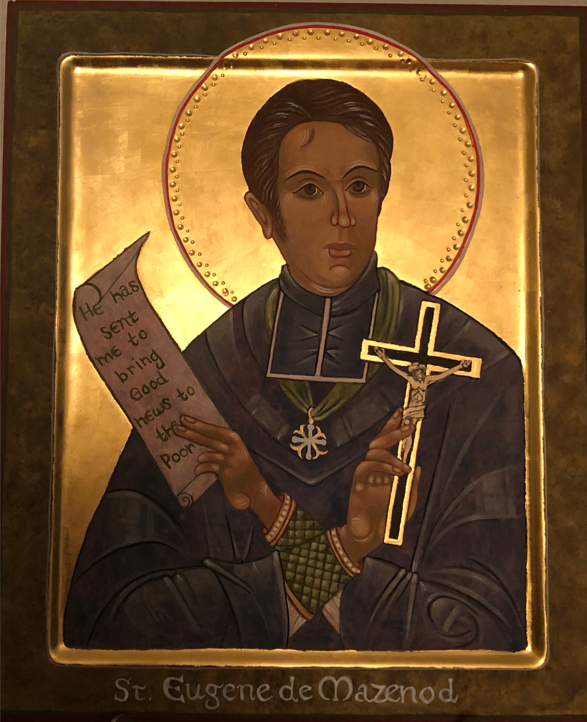
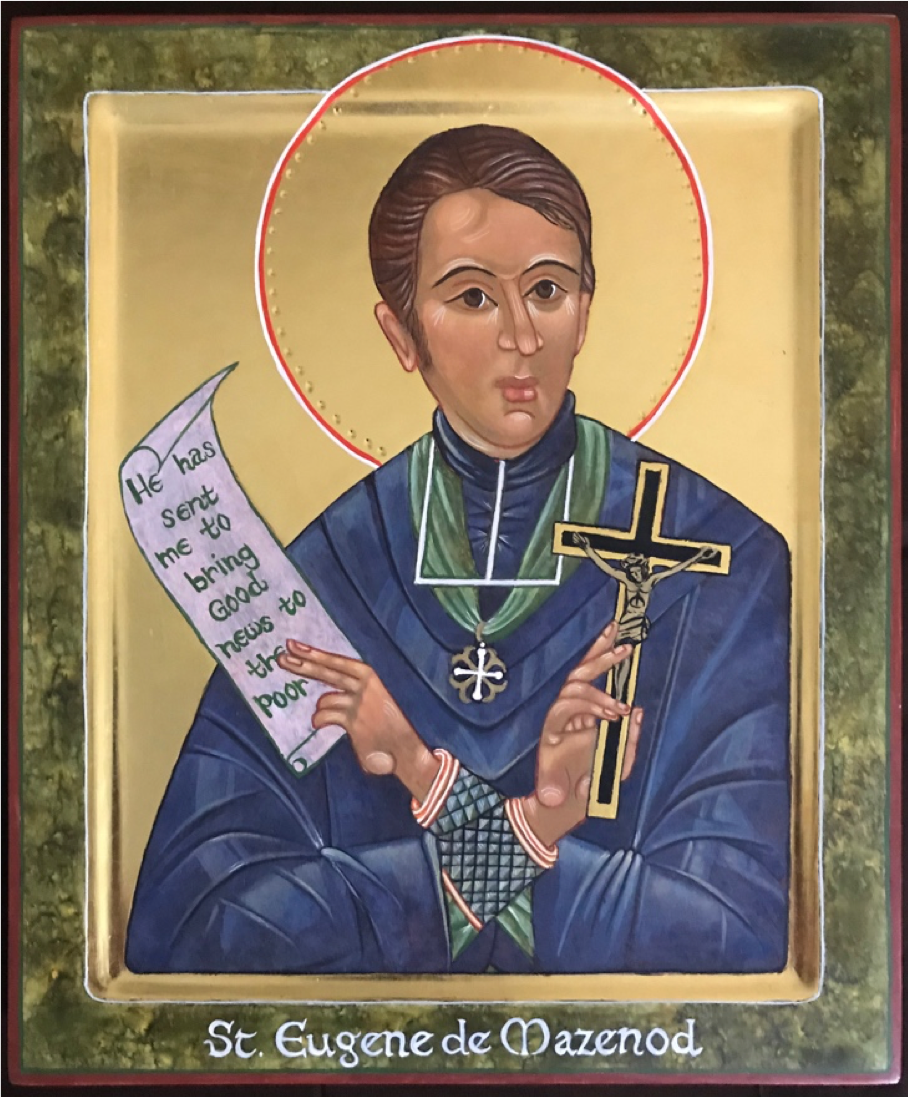
Icon written by Lauretta Agolli for the US Mazenodian Family

After journeying with him through the sad event of his Passion, after weeping over the torments that our sins made him endure, how consoling it is to see him rise triumphant over death and hell, and what gratitude must fill our hearts at the thought that this good Master has really willed to make us sharers in his resurrection, destroying the sin that is in us and giving us a new life.

Eugene de Mazenod  to his mother, 4 April 1809, EO XIV n 50

“We announce the liberating presence of Jesus Christ and the new world born in his resurrection”

OMI Constitutions and Rules, Constitution 4

Posted in WRITINGS | 1 Comment

HOLY SATURDAY: WE FEEL CLOSE TO HER WHO IS THE MOTHER OF MERCY

In her, we recognize the model of the Church’s faith and of our own.

We shall always look on her as our mother.

In the joys and sorrows of our missionary life, we feel close to her who is the Mother of Mercy.

OMI Rule of Life,  CC&RR Constitution 10

Posted in WRITINGS | 1 Comment

GOOD FRIDAY: “MY GOD, MY GOD, WHY HAVE YOU FORSAKEN ME?”

What was the moment when Jesus suffered the most and when he showed his greatest love for us?

It was when, hanging on the cross, he cried out: “My God, my God, why have you forsaken me?”

In the incarnation, Jesus became fully human and became one with us in all our experiences. On the cross, he entered into the extreme experience of human hopelessness: the sense of having been abandoned by God.

He became one with us in all those situations where we cry out in darkness and despair: “Where are you God, why are you absent?”

As we embrace Jesus Forsaken on this Good Friday, let us embrace the door that he opened through his suffering and death: his resurrection and ours.

As I read St. Eugene’s writings, I constantly hear echoes of his Good Friday experience of his fragility and his awareness of God’s healing love. It was a conviction that never left him and that was at the basis of all his ministry: to lead others to his same experience. St Eugene knew darkness and seeming-hopelessness many times in his life. Yet he recognized that in these dark moments, his Savior was present, and he attests to this in constantly in his writings. Just one example:

In the end, though with sadness, I go my way, placing my trust in God alone. Let us love him always more.

Letter to Father Forbin Janson, 12 September 1814

He encouraged others to do the same. In particular today I recall his words to Father Jacques Jourdan, aged 25, and the first Oblate to die. He was suffering from deep depression and darkness:

Courage, my dear friend. Very great saints have been tried like you, but they became saints in spite of these circumstances because they did not cease to obey; courage, once more, my dear friend, we are all down on the floor praying for you so that you will bear this hard trial like a valiant soldier of Jesus Christ. This so amiable Master, our model, did not yield to despair in the garden of Olives; into what an agony he was plunged nevertheless! Hold on to him and fear nothing, drink the cup of his bitterness since he allows to let you share in his passion, but do not doubt that he will soon fill you with his sweetest joys. Until then you must keep your peace and obey…
At the moment of communion, tell him lovingly about all your sorrows: “O Lord I am oppressed be my security!” [Is. 38, 14].Embrace his feet in spirit, protest that you will never separate yourself from him, that you wish to love him for ever, then take him into your heart and be not troubled about anything.

Letter to Jacques Antoine Jourdan, 30 March 1823

Victor Frankl, a survivor of the second world war concentration camps attests to this when he wrote:

“We who lived in concentration camps can remember the men who walked through the huts comforting others, giving away their last piece of bread. They may have been few in number, but they offer sufficient proof that everything can be taken from a man but one thing: the last of the human freedoms — to choose one’s attitude in any given set of circumstances, to choose one’s own way.”

St. Eugene teaches us the choice of the attitude of recognizing Jesus in his forsakenness on the Cross in every moment of the darkness we experience in this present crisis.

Posted in WRITINGS | 1 Comment

HOLY THURSDAY: LOCKDOWN IN THE GARDEN OF GETHSEMANE

For Saint Eugene, Holy Thursday marked two important events: his first communion and his private vow of saying “yes” to God on this night when Christians keep watch with Jesus in the garden of Gethsemane and Jesus said “yes”. This year, being unable to celebrate the liturgy in our churches, I invite the members of the Mazenodian Family to spend time with Jesus in his agony in the garden. This year we can appreciate more deeply that lonely agony of Jesus as he grappled with what was happening.

This is how Eugene and his closest Oblate companion, Henri Tempier, spent that night in 1816.

Briefly put. Father Tempier and I felt that we should not delay any longer, and on Holy Thursday (April 11, 1816), when both of us had taken our place under the structure of the beautiful repository we had erected over the main altar of the Mission church, in the night of that holy day, we pronounced our vows with an indescribable joy. We enjoyed our happiness throughout this beautiful night, in the presence of Our Lord.

Rambert I, p. 187

This time of reflection recalled the time Jesus spent in the Garden of Gethsemane at prayer while struggling to live the events taking place at that moment. The “not what I want, but what you want” (Mark 14:36) of Jesus to the Father became the commitment to the “not what I want, but what you want” of Eugene and Henri Tempier to the Father – and consequently the key to understanding the meaning of self-giving – which we know as “oblation.”

As we meet in the Garden of Gethsemane today, let us be united with one another in giving each other strength as we struggle in our aloneness. (“Oraison”)

Let us also be conscious of the courageous oblation of those who are caring for the sick and the dying, and of those providing us with “essential services” that make our daily lives possible. As we keep watch with Jesus and St Eugene in Gethsemane, let us pray for these ministering angels and let us become ministering angels to one another.

The altar referred to today was originally in Aix, but is now in Rome.

“If we are to share our lives with others and generously give of ourselves, we also have to realize that every person is worthy of our giving. Not for their physical appearance, their abilities, their language, their way of thinking, or for any satisfaction that we might receive, but rather because they are God’s handiwork, his creation. God created that person in his image, and he or she reflects something of God’s glory. Every human being is the object of God’s infinite tenderness, and he himself is present in their lives. Jesus offered his precious blood on the cross for that person. Appearances notwithstanding, every person is immensely holy and deserves our love. Consequently, if I can help at least one person to have a better life, that already justifies the offering of my life. It is a wonderful thing to be God’s faithful people. We achieve fulfilment when we break down walls and our heart is filled with faces and names!”

Pope Francis, The Joy of the Gospel, 274

Posted in WRITINGS | 1 Comment

HOLY WEEK: SOCIAL DISTANCING DOES NOT DISTANCE US FROM THE CROSS

The pandemic does not make it possible for us to participate physically in the Holy Week liturgies and the sacraments. What an experience of the Cross it is, and what an invitation to see things in a new light!

From the Cross, our Savior reminds us that he is present every time we read the Scriptures, and every time we consciously live this promise with someone else: “Where two or three are gathered in my name, I am present among them” (Matthew 18,20). The persons taking this promise seriously, DO have the presence of Jesus among them – even if separated by many miles and even continents. Jesus has promised always to be present in this way if we remember to allow him to. This is one way of living the Cross with those who suffer today.

Saint Eugene recalled:

Can I forget the bitter tears that the sight of the cross brought streaming from my eyes one Good Friday?

Eugene de Mazenod, Retreat Journal, December 1814, EO XV n.130

“How could we get deeper into this salvatorian spirituality of ours? Let me mention three ways.   First.  Someone inspired by St. Eugene will not be afraid of the cross. As true Oblates we will look openly into the face of the suffering and crucified Christ. This is done not so much by pictures and movies as by reading the Scriptures, experiencing Christ’s presence in the sacraments and looking into the face of the poorest of our brothers and sisters.

W. Steckling OMI, OMI Information n 462, Rome, February 2007.


“Sometimes we are tempted to be that kind of Christian who keeps the Lord’s wounds at arm’s length. Yet Jesus wants us to touch human misery, to touch the suffering flesh of others. He hopes that we will stop looking for those personal or communal niches which shelter us from the maelstrom of human misfortune and instead enter into the reality of other people’s lives and know the power of tenderness. Whenever we do so, our lives become wonderfully complicated and we experience intensely what it is to be a people, to be part of a people.”

Pope Francis, The Joy of the Gospel, 270.

Posted in WRITINGS | 1 Comment

HOLY WEEK: THE ZEAL TO GET CAUGHT UP BY THE MYSTERY OF THE SAVING CROSS AND TO PROCLAIM IT TO THOSE MOST IN NEED

This reflection was prepared a while ago. As I reread it today, in the context of our current lockdown, the question comes to mind: “How can I proclaim this to those most in need today?”

Firstly, by spending time meditating on this reality myself and making it more alive in me as a life-giving focus in these times of fear and uncertainty.

Then it will overflow to those I reach out to, in my home, and through my use of social media to reach out to others.

St Eugene’s Good Friday experience of the Savior brought light and focus into his life:

What more glorious occupation than to act in everything and for everything only for God, to love him above all else, to love him all the more as one who has loved him too late

Eugene de Mazenod, Retreat Journal, December 1814, EO XV n.130

“The word ‘Oblates’ means people ready to give themselves for the love of God. God’s Spirit has granted St. Eugene and his sons and daughters the zeal to get caught up by the mystery of the saving cross and to proclaim it to those most in need. Our spirituality is therefore centered on the salvation given us by Christ; it can be called ‘salvatorian’. With such a spiritual orientation our Congregation was approved in 1826.

Our recognition by the Church, which we celebrate each February 17th calls us to delve deeper into the mystery of salvation, to make it even more the center of our lives, as it was the center around which Eugene’s life revolved.”

Steckling OMI, OMI Information n 462, Rome, February 2007.

Goodness always tends to spread. Every authentic experience of truth and goodness seeks by its very nature to grow within us, and any person who has experienced a profound liberation becomes more sensitive to the needs of others. As it expands, goodness takes root and develops. If we wish to lead a dignified and fulfilling life, we have to reach out to others and seek their good. In this regard, several sayings of Saint Paul will not surprise us: “The love of Christ urges us on” (2 Cor 5:14); “Woe to me if I do not proclaim the Gospel” (1 Cor 9:16).   Pope Francis, The Joy of the Gospel, 9.

Posted in WRITINGS | 1 Comment

HOLY WEEK: PEOPLE READY TO GIVE OURSELVES FOR THE LOVE OF GOD

Former Superior General, Wilhelm Steckling OMI, wrote in 2007:

“It was probably in 1807, on Good Friday of that year, that Saint Eugene had a special encounter with the Crucified One that changed his life. It essentially made him an Oblate. What we can celebrate in 2007 is not an anniversary of the Congregation, but rather an anniversary of our charism, the spiritual gift that makes us live – an anniversary of our Oblate spirituality.

It was the cross displayed on Good Friday that made young Eugene – 24 at that time – aware of his life- style apart from God.

“I had looked for happiness outside of God and outside him I found but affliction and chagrin”, he writes a few years later (1814) during a retreat. In his emptiness he encounters someone who loves him without measure. His sins melt away amidst tears in the embrace of Christ, and this experience marks him for the rest of his life. “Can I forget the bitter tears that the sight of the cross brought streaming from my eyes one Good Friday?” “Blessed, a thousand times blessed, that he, this good Father, notwithstanding my unworthiness, lavished on me all the richness of his mercy.” The experience did not stay just inside of him. “Let me at least make up for lost time by redoubling my love for him.”

After a short time, St. Eugene wanted to share the mercy he experienced with others. Such zeal for souls finally led to the birth of the Oblates. The word “Oblates” means people ready to give themselves for the love of God.”

W. Steckling OMI, OMI Information n 462, Rome, February 2007

“Jesus on the cross feels the whole weight of the evil, and with the force of God’s love he conquers it; he defeats it with his resurrection. This is the good that Jesus does for us on the throne of the cross. Christ’s cross, embraced with love, never leads to sadness, but to joy, to the joy of having been saved and of doing a little of what he did on the day of his death.”   Pope Francis

Posted in WRITINGS | 1 Comment

CHECKING THE COMPASS IN THE MIDST OF THE STORM

Every year Eugene spent some time on retreat, away from his busy schedule, aiming at refocusing his priorities. One example from his writings speaks today as we are invited to refocus on our priorities and the direction of our lives.

The year 1817 had been a seesaw of events and emotions. The successful ministry of parish missions in the villages, the ministry of the community in Aix itself, and the ministry with the Youth Congregation was counterbalanced by the destructive criticism and difficulties caused by of some of the city pastors and their followers. Eugene carried the burden of all this .

While all this was happening Eugene took a time of retreat to get things into perspective. With all the busy-ness and the storms he needed to get his bearings on the map of his life so as to ensure that he was still moving in the direction that God wanted for him.

If I want to achieve some good, I must see myself as one sent by God on earth to do there all the good it is in my power to do during the time allotted me, and then death will summon me to him who sent me and who will judge me severely on my works. Woe is me if I am found not to have fulfilled my task!
With this thought in mind, I must make haste and get to work, having always God alone in view, and disdaining any notice of human contradictions which, far from discouraging me, should on the contrary stimulate me all the more to pursue my path, since these contradictions were foretold and are the hall-mark of God’s works.

Retreat Notes, August 1817, O.W. XV n. 144

The focal point was always oblation – living “all for God.” He needed to constantly come back to that compass point so as to keep things in perspective. It was the “home address” on his GPS. What is yours today?

Posted in WRITINGS | 1 Comment

MAY GOD GRANT THAT I MAY REAWAKEN SO MANY FOOLISH PEOPLE FROM THE FATAL CARELESSNESS THAT BRINGS THEM TO THEIR DOOM

When Eugene returned to Aix en Provence as a young priest he preached a series of Lenten sermons aimed at those who were the most abandoned as a result of the French Revolution. For Eugene the “poor” were those who had been deprived of knowing God as savior as a result of the historical and social circumstances.

In the first sermon he presented the indifference of the people to God, and invited “you poor of Jesus Christ” to come to the instructions where they would be enlightened. Just over two hundred years later, our circumstances are different but the message remains equally powerful.

Question the milling crowd that jostles in the public squares, ask anyone what he is doing, where he is going, what is he engaged in doing, etc.

  • The one will answer that a process on the issue of which depends his entire fortune summons him to the bench to solicit, etc.
  • Another will say that he is going to negotiate an important matter, etc.
  • Another will say that he is going to negotiate his presence on the farm to which he is heading with all speed.
  • Another again will say that he is going over in his mind some plans concerning fortune, interests or ambition that will assure, etc.
  • Perhaps you will discover some who will be compelled to say that they are hastening their steps towards the object of their less than noble passions.

So come, whoever you are, come tirelessly to some instructions that must correct you in many fatal errors, enlighten you on what should be your only true interests. Not a single one, no, not one will be able to reply that his mind is filled with the eternal truths, that these are the subject of his meditations and searches. “It has been made a desolation” etc. (Jer. 12:11). O blindness! O folly! However, the days pass, the years roll by, death has its day!

Then illusion vanishes, but there is no longer time to make good the loss of a life entirely devoted in the tiring search for passing vanities that must be left behind. It is too late to collect an incorruptible treasure of glory and happiness for eternity.

Come especially you poor of Jesus Christ and may God grant that I may make my voice heard in the four quarters of the world to reawaken so many foolish people from the fatal carelessness that brings them to their doom.

Notes for the first instruction in the Church of the Madeleine EO XV n. 114

These were Eugene’s preaching notes and thus when we see the “etc.” in the text, it means that he would spontaneously expand on that point.

Posted in WRITINGS | 1 Comment