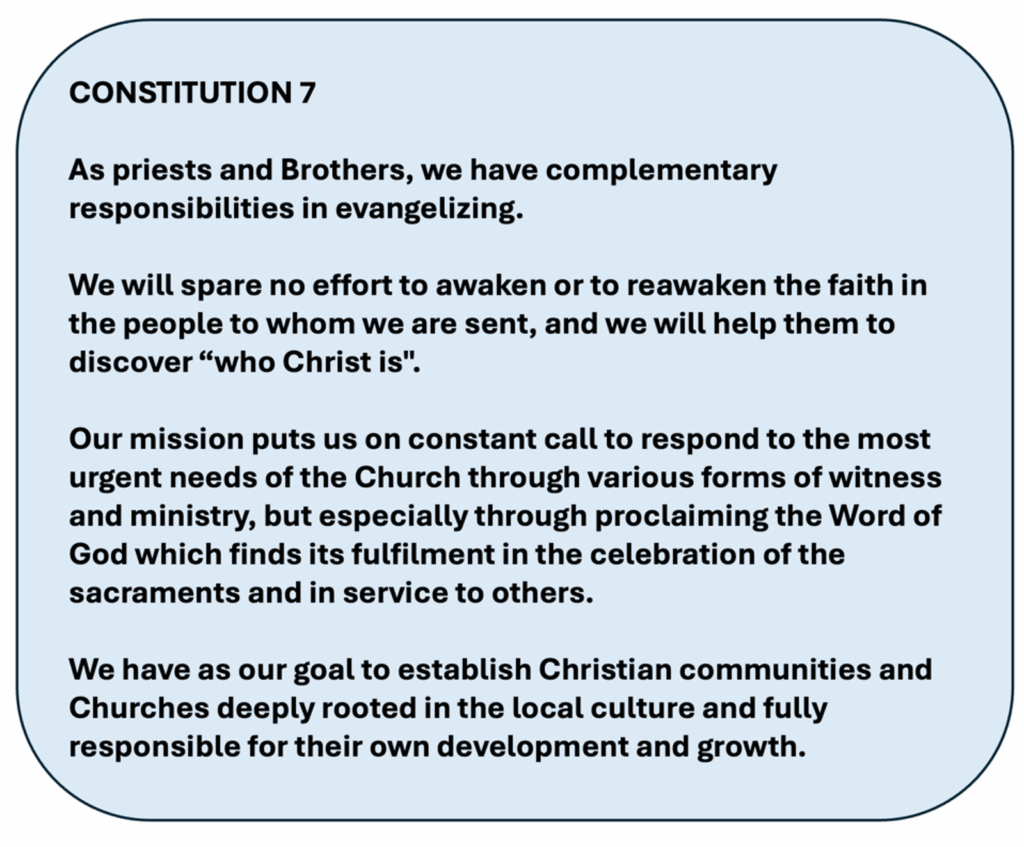
As priests and Brothers, we have complementary responsibilities in evangelizing.
Constitution 7
From the beginning, Oblates had one mission, and all participated in it according to their talents. Initially the Brothers supported the mission through common prayer and ensuring the functioning of the community structures so that the priests could dedicate themselves fully to the preaching and sacramental ministry. Later they were to participate in evangelization in more direct ways.
The problem arose that some of the priests treated them as domestic workers. Eugene went to great lengths to correct this situation, as he wrote in his Diary:
Letter from Father Vincens about his novitiate and what he must grant to the Coadjutor Brothers who no longer must be considered like salaried domestics. They are entitled to everything that may be done by religious men. In addition, their work must be moderated by pious exercises and everything that the Rule prescribes.
Eugene de Mazenod’s Diary, 8 December 1842, EO XXI
Father Jetté comments:
A brief historical review can help us to understand better this distinction in the Oblate life. In the beginning, Eugene de Mazenod wanted to establish a Society of priests who would dedicate their lives to evangelizing the poor, especially by the preaching of missions and the celebration of the sacraments (Reconciliation and the Eucharist). These men were called “missionaries” or “apostolic men”. Lay persons soon came to join them: they wanted to consecrate themselves to God in the Oblate religious life and to cooperate, according to their preparation and talents, with the missionary activity of these “apostolic men”….
Since then until today our terminology has changed: the terms “missionary” and “apostolic men” are now equally applied to the Brothers and to the priests.
“The Apostolic Man” p 47 -48
Over the years, so many of our lay associates have also felt called to move on from being the helpers of the Oblates to being missionaries with us.
From the perspective of a Lay Oblate Associate I find my heart opening to Constitution 7 not because I feel attracted to becoming one of the men, but because I want to be able to become a sacrament like religious and married couples with their vows.
I offer two examples. The first is of a little girl who might be anywhere in the world and who is given a special doll and expresses her joy because finally she is seeing a doll who looks like her. It is not just a condition of skin colour but also of the gifts we might wish to share with others.
The second is that of Fr. Albert Lacombe OMI who was one of God’s missionaries born in Canada. He was sent to minister to some of the Indigenous peoples with whom he deeply identified. After experiencing hunts he discovered that his identity was very much a part of him. Returning to Montreal because he needed to be apart of a community which offered a Rule or way-of-being if he was to remain a priest. He joined the Oblates after hearing one of their missionaries “who looked like him”.
Some of us lay people respond with our lives. “Come and learn who you are in the eyes of Jesus, our crucified Saviour.”
We discover our hearts’ finding a home and we make our small oblation according to how we hear God calling our names and the Spirit who leads us let go of our former lives and share in the beautiful Oblate Rule of Life according to our role of life. It is with our lives that we have “complementary responsibilities” in evangelizing and helping others (as well as ourselves) to learn who we are in the eyes of God.
I dare to quote Fr. Luis Ignacio Rois Alonso, OMI as he paraphrased Karl Rahner: “…the Oblate of the 21st century will be a missionary mystic, or will not be. The missionary mystic is capable of seeing God in everything and allows himself to be transformed by his presence. Thus, he become his sacrament, collaborating with his oblation in the same Mission of Christ: that “God be all in all (1 Cor 15:28).
I have a dream…