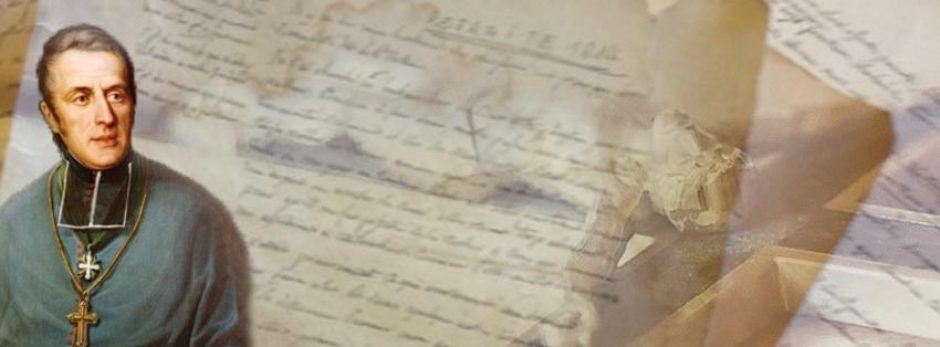
In the face of the ingratitude and criticism that Eugene was experiencing from some of the people of Marseilles, he reflects on the motivating force of his life as he recalls the steps of his vocation. The direction of his life was the result of his realization of the overwhelming love of the Savior for him.
There you have the explanation for the dedication of my life to the service and wellbeing of my neighbor. I renounced the comforts of a private life and I violently tore myself loose from the embraces of maternal tenderness, personified above all in the person of my grandmother for whom I was an idol; and after beginning with some works of charity among the sick and the prisoners, I became a priest because it was only in this state that I could realize that which my heart inspired me to do for the salvation and consequently for the true happiness of people.
Eugene then recalls his days at Saint Sulpice as a seminarian preparing himself for priesthood.
Until then nothing could free me of my illusion. I have met only upright hearts, who were even sensitive to the initiatives of my charity. It is thus that at the seminary, directors and students, teachers and fellow students, gave me unmistakable proofs of gratitude for the affection that let me anticipate them at each encounter and let me prove to them that I loved them. This explains the sort of supervision that they allowed me to exercise over the health of all my fathers and brothers even though I had never had the title nor, strictly speaking, the functions of infirmarian.
He singles out the superior of the seminary, Fr Emery, who had a major influence in Eugene’s formation:
Fr. Emery himself, who had never wanted to listen to anyone on the subject of his health, accepted without repugnance – I would say rather, with deference and gratitude – that I take care of him; and one knows that from the first signs of his last illness that took him from us, I took advantage of the influence that he allowed my heart to take over him. I can say that during the five years I was at St. Sulpice I sailed at full sail in this sea of charity without having ever encountered a single reef.
Eugene de Mazenod’s Diary, 31 March 1839, EO XX
All this because of the love of the Savior for Eugene, which overflowed in love for others.
So when he had washed their feet [and] put his garments back on and reclined at table again, he said to them, “Do you realize what I have done for you? You call me ‘teacher’ and ‘master,’ and rightly so, for indeed I am. If I, therefore, the master and teacher, have washed your feet, you ought to wash one another’s feet. I have given you a model to follow, so that as I have done for you, you should also do. (John 13: 12-15)
I usually come here fresh from waking but I am late this morning – my normal rhythm has been shaken up and I struggle to settle in with Eugene and Frank.
Gradually I find myself looking at the power of love. It is love that gives us life, that gives us the life which has been ordained for each of us.
“I became a priest because it was only in this state that I could realize that which my heart inspired me to do for the salvation and consequently for the true happiness of people.” And “All this because of the love of the Saviour for Eugene, which overflowed in love for others.” Eugene and all who come after him are our models – we are sent for each other even as our own boundaries stretch and we move out. Not just Eugene and not just priests – but all of us.
Reading the words of John. I find myself singing the “Song of the Lord’s Command” by David Haas – for it takes both Eugene’s and Franks words and carries us into depths of what that shared love looks like. It is both our call and our response.
Song of the Lord’s Command by David Haas
Do You know what I have done for you,
You who call Me Up your Teacher and your Lord.
If I have washed your feet so you must do as I have done for you.
Do You know what I have done for you,
You who call Me your Teacher and your Lord?
If I have washed your feet so you must do as I have done for you.
1.
What I am doing now you do not know
But after a time has gone by you will understand.
Do You know what I have done for you,
You who call Me your Teacher and your Lord?
If I have washed your feet so you must do as I have done for you.
2.
Don’t you understand what I must do?
If you would be mine then I must bend to wash your feet.
Do You know what I have done for you,
You who call Me your Teacher and your Lord?
If I have washed your feet so you must do as I have done for you.
3.
I have given to you an example.
What I have done for you, you must do for one another.
Do You know what I have done for you,
You who call Me your Teacher and your Lord?
If I have washed your feet so you must do as I have done for you.
It is for this reason that I am a very ordinary lay woman, who sits at the feet of Jesus as we sing together this morning. I have never seen it this full light this morning – perhaps another blessing of starting late.