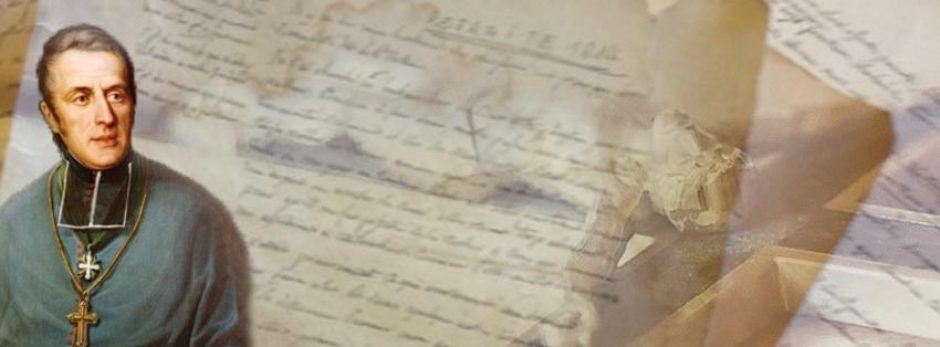
My dear Son, my intention is to ordain Brother Kotterer at the first ordination in Lent… I am sending him to Aix, my intention being that he enter the novitiate and spend the whole time there in profound retreat under the special direction of the master of novices. Please place this dear ordination candidate in his care as I have placed him in yours so that he may become a good priest of the kind the Church needs.
Affectionate greetings and my blessing to all.
Letter to Hippolyte Courtès, 1 March 1835, EO VIII n 507
The future priest is entrusted to the director of novices, Father Casimir Aubert, for his retreat.
Please take special care of Brother Kotterer. Take advantage of his retreat to instil in him the great principles of religious life: detachment especially, death to self, cheerful obedience, total dedication to the Church and to the (Oblate) family, support of his brothers, etc.
Letter to Casimir Aubert, 10 March 1835, EO VIII n 508
The vision that Calixte Kotterer had been formed into, and which he is to be reminded of during his retreat is found in Eugene’s document we today know as the “Preface”:
“What did Our Lord Jesus Christ do? He chose a certain number of apostles and disciples whom He formed in piety and filled with His spirit; and after having trained them in his school and the practice of all virtues, He sent them forth to conquer the world which they soon brought under the rule of his holy laws.
What must we, in turn, do to succeed in winning back for Jesus Christ so many souls who have cast off his yoke? We must work seriously to become saints, walk courageously in the footsteps of so many apostles who have left us such fine examples of virtue in the exercise of a ministry to which, like them, we are called; renounce ourselves totally, maintain in view exclusively the glory of God, the building of the Church, the salvation of souls; renew ourselves constantly in the spirit of our vocation; live in a habitual state of self-denial and in an unremitting determination to achieve perfection, working unstintingly to become humble, gentle, obedient, lovers of poverty, repentant, mortified, detached from the world and our families, brimming with zeal, ready to sacrifice our goods, our talents, our rest, our persons and our lives for the love of Jesus Christ, the service of the Church and the sanctification of our neighbour. Then, filled with confidence in God, we must enter the lists and fight unto death for the greater glory of God.”
from the Nota bene (1818 Rule)
See also: https://www.eugenedemazenod.net/?p=66
Thanks Frank for sharing the core thought process of why Eugene and the Oblates have been so effective over the years! Following the core principles associated with following in the footsteps of Christ and his Apostles.
A wee suggestion: the worlds like ‘mortified’, ‘repentant’ are a little bit archaic… for those who are on the margins of faith & church.. some simpler words might help to get the listener.
Many thanks for your good work!
Kirk – Charism worker – Anglo-Irish Oblates
I doubt that the first apostles and disciples questioned and studied why Jesus called their names. What a colossal waste of time that would have been, just as it would be for me today. Rather they and us today follow and respond to no small amount of love given and shared with us; we experience this as we go deeper and deeper within ourselves, within our hearts moving outward even as we are entering more deeply inwards within the heart of Jesus. It is never just one but always the both – the personal and the communal at the same time.
“We must work seriously to become saints, walk courageously in the footsteps… […] filled with confidence in God, we must enter the lists and fight unto death for the greater glory of God.” I do that! Not perfectly, not in a way that it is noticeable to any save God. Not as a way of getting ‘what I want’ or in order to have ‘an easy life’. No – I am compelled, driven, by my heart, by the love that God has poured within me.
When I first met my Beloved and heard him say my name my response, after simply sitting in that love, was to say that the only way I would ever be able to love as I was being loved was to give my all to God, to empty my heart so that God could fill it – with God’s love then I would be able to love everyone else. I barely knew what I was saying. This is how I am able to try and live as prescribed by Eugene de Mazenod in the Preface. I am carried and nourished and it becomes a part of my breathing.
Every day I end my morning prayers by saying: “Our life in all its dimensions is a prayer that, in us and through us, God’s kingdom come.” (C 32) Not just another memorized prayer but rather what I hope and pray and breathe for.