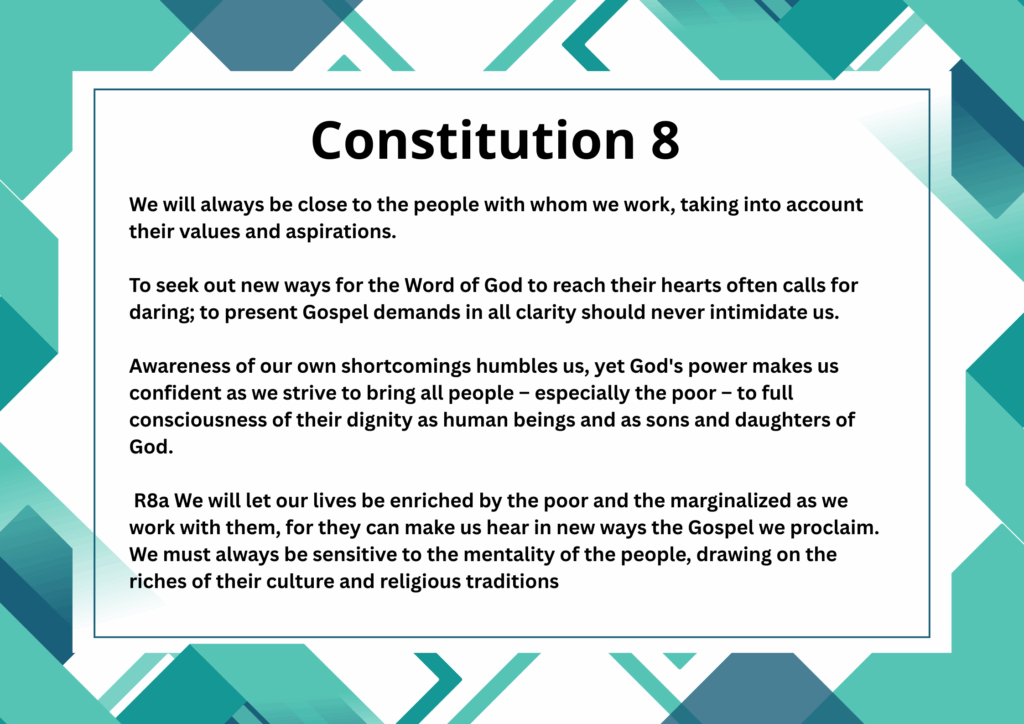
We will let our lives be enriched by the poor and the marginalized as we work with them, for they can make us hear in new ways the Gospel we proclaim. We must always be sensitive to the mentality of the people, drawing on the riches of their culture and religious traditions
(Rule 8a)
“Being missionaries of hope means knowing how to read the signs of its hidden presence in the daily life of the people. Learning to recognize hope among the poor to whom you have been sent, who often succeed in finding it amid the most difficult situations.
Letting yourselves be evangelized by the poor you evangelize: they teach you the way of hope, for the Church and for the world.”
Pope Francis to the OMI General Chapter 2022
We will always be close to the people with whom we work, taking into account their values and aspirations.
Constitution 8
Eugene’s diary is filled with descriptions that show his closeness to his flock. Some examples:
Confirmation for a poor woman who was in great pain as she lay on her mattress on the fourth floor. How it pains my heart to see people suffer in that way, but also, what a consolation to be able to bring them relief by my words and by the graces of my holy ministry!
Diary, 28 December 1838, EO XIX
At that time, the bishop was the only one allowed to minister the sacrament of confirmation:
Confirmation in my chapel of two soldiers who are about to leave for the Crimea.
It would be interesting to make a list of the [special] Confirmations that I have the occasion to do in the course of the year (independently of the general Confirmations), either in my chapel, or in the hospitals, or in the homes of the sick to whose bedside I am continually being called. There would be good reason to give glory to God for inspiring me to perform this duty assiduously, to the great benefit of so many souls.
I admit that, as far as I am concerned, this truly pastoral ministry fills my soul with a holy joy and is a consolation to me, the real recompense for the accomplishment of this duty. That is especially true when I am called to the bedside of the poor as has happened once again today. Nothing can be so touching as the visible signs traced on the faces of all those who rush to the sick person’s dwelling to be present for the bishop’s visit. Sometimes it is necessary to climb to the attic by stairways that are all but impracticable. However, these stairways, which are normally quite dark, are lighted by numerous lamps placed at a short distance from one another on the steps of these ladders which at times must be mounted by hoisting one’s self with the help of the rope which serves as a railing.
But when once he arrives at the bedside of the sick person, what a feeling overwhelms the pastor who has come to visit his suffering sheep and bestow religious assistance by addressing words of encouragement, or resignation etc. The almsgiving which ordinarily follows the prayer which I say aloud while the sick person is interiorly united with me, is accepted with emotion. It is a day of consolation for the afflicted family and of happiness for the visiting pastor.
Diary, January 13 1856, EO XXII
We will always be close to the people with whom we work, taking into account their values and aspirations.
Constitution 8
In the midst of a war with Austria which France had won, the old Bishop Eugene ministered to the injured of both sides of the conflict. In moving words, he wrote:
I officiated pontifically. It was at the end of the High Mass that we sang, sadly, the Te Deum as requested. How is it possible to rejoice over a heap of dead bodies, over so much blood shed for such a bad cause!
Therefore, after the Te Deum, I added prayers for peace and I recited in a loud voice the Fidelium animae per misericordiam Dei requiescant in pace. I had, beforehand, had the intention of offering the indulgence of the Mass just celebrated for the poor souls of the French and Austrians who were sacrificed on the battlefield.
My heart was so weighed down at the thought of so many victims, that I sought some relief by fulfilling a paternal duty of charity and by going to visit the wounded from both nations who have been brought to our military hospital. The inspiration proved to be good.
All those interesting young men were singularly touched by my visit. I approached the bed of each one and showed a lively interest in them. The Austrians, whose faith is more demonstrative, took my hand to kiss it. I could have willingly kissed their faces so strongly did I feel their catholicity which made them so dear to me.
The sight of one of these wounded men whom I had before me filled my heart with compassion and sadness; and these men, with one exception, had only lesser wounds, or least not life threatening. What must be, I thought, the sight of those thousands of men terribly mutilated piled up in heaps of corpses? What an awful sight! Is it not sufficient to make one curse all wars and even more so those undertaken as this one of today, under such vain pretexts and for such a detestable cause!
Diary, 12 June 1859, EO XXII