
-
Recent Posts
- PAPAL APPROBATION: RECOGNIZING THAT THE CHURCH HAS SPOKEN
- PAPAL APPROBATION: RECOGNIZING OUR SUPERIOR GENERAL AS OUR SPECIAL STRENGTH AND SUPPORT
- PAPAL APPROBATION: RECOGNIZING OUR NAME AS THE EXPRESSION OF OUR IDENTITY
- PAPAL APPROBATION: TO CONTINUE CARRYING OUT OUR DUTY WORTHILY, FAITHFULLY FULFILLING OUR SPLENDID VOCATION
- PAPAL APPROBATION: THE OBLATE COMMITMENT TO BEING COOPERATORS OF THE SAVIOR IS RECOGNIZED AND GIVEN A LEGAL STANDING IN THE CHURCH, THE BODY OF CHRIST
Recent Comments
- Mildred March on A SUMMARY OF TEN YEARS OF OBLATE MINISTRY
- Eleanor Rabnett, Lay Oblate on FAITH-FOCUSED INVESTMENT GROUPS: A PRESENCE WHERE DECISIONS AFFECTING THE FUTURE OF THE POOR ARE BEING MADE (Rule 9a)
- Eleanor Rabnett, Lay Oblate on VIVAT: A PRESENCE WHERE DECISIONS AFFECTING THE FUTURE OF THE POOR ARE BEING MADE (Rule 9a)
- Eleanor Rabnett, Lay Oblate on WE SHOW A VERY HUMAN FACE OF JESUS TO THE WORLD, ONE FULL OF COMPASSION AND SOLIDARITY (Rule 9a)
- Eleanor Rabnett, Lay Oblate on JUSTICE, PEACE AND THE INTEGRITY OF CREATION AS AN INTEGRAL PART OF EVANGELIZATION (Rule 9a)
Archives
Meta
-
WE ARE ASLEEP ON A VOLCANO. DO YOU NOT FEEL THE EARTH TREMBLE ANEW?
February 25: News about the revolution in Paris. I travelled across the entire city in order to go to visit my sick people and to administer the sacrament of Confirmation to a lady in danger. Everything was perfectly tranquil; people were disinterestedly reading the proclamations posted on the walls.
Eugene de Mazenod’s Diary, 25 February 1848, EO XXI
Hubenig gives us the background to this statement:
“At the beginning of 1848, in the Chamber of Deputies, the liberal French thinker and social philosopher, Alexis de Tocqueville, declared prophetically, “We are asleep on a volcano. Do you not feel the earth tremble anew? A revolutionary wind is blowing and already on the horizon one can see the oncoming storm.” When the volcano erupted at the start of 1848, it shook all of Europe and set it aflame. Within a short time, fierce riots broke…
On February 22 there were riots to protest the forced cancellation of one of several political gatherings in Paris, sponsored by the radical left to promote changes in the electoral laws. The protesting crowd, shouting “Vive la République!” and singing the “Marseillaise”, converged on the Place de la Madeleine.
The following day, the army moved in, shooting indiscriminately; barricades went up, and fierce fighting then raged for three days throughout the city. Louis-Philippe abdicated, stating “I will not be party to the shedding of more French blood.” France had a new revolution… His regime, led by an authoritarian conservative prime minister, Guizot, seemed to have grown more unpopular by the day. Moreover, the country was in the worst economic crisis of the century. It began with an extreme drought in 1846 that completely destroyed the country’s crops.
With the King’s abdication, the provisional government of the Second Republic immediately attacked the country’s most serious problem – the plight of the worker. They shortened the workday in Paris to ten hours (to eleven hours in the provinces), abolished debtors’ prisons, and did away with such degrading physical punishments as the pillory. They also granted universal male suffrage for the first time in France and abolished slavery in the colonies.”
(Living in the Spirit’s Fire excerpts from pages 161 – 169).
https://www.omiworld.org/wp-content/uploads/Living-in-the-Spirits-Fire.pdf
REFLECTION
Eugene’s reflection on these events:
In her zeal for those she gave birth to or could give birth to in grace, there was no environment she feared, no form of government she rejected; Mother of Christians, she was always ready to press them all to her bosom, to nourish them with her doctrine, to serve them in every situation with unfailing love; and if she sometimes had preferences, it was for the little ones, for the poor, for the unfortunate, whose sufferings were her own.
Bishop Eugene’s Pastoral Letter to the people of Marseilles, 2 March 1848
BEING PART OF THE LIFE OF THE CHURCH IN A VAGUE AND AMBIGUOUS WAY
Your Lordship is aware that I am speaking frankly and freely. A Bishop who is as far advanced as you are in the ways of God will understand better than I know how to express the importance of the considerations that I have only indicated.
You are the father, the protector and the counselor of our Oblates; no one should be more concerned than you that they be worthy of their vocation at all times, since it is in this way that they will be able to render themselves truly useful to your diocese where they will certainly do good, as they are doing in every place where they are established.
Letter to Bishop Buissas of Limoges, to whose diocese he had sent Oblates, 20 February 1848, EO XIII n 119
REFLECTION
Eugene expected the Oblates to have a special relationship with the Bishop in whose diocese they ministered, and that the Bishop be their protector. An aspect of this was that the Bishop respect their charism in the ministry entrusted to them.
Until the Second Vatican Council this relationship was blurred in many dioceses, thus in 1978 the Vatican issued a document highlighting the importance of a clear mutual recognition of the respective charismatic roles of the bishops and of religious congregations in their diocese.
“In this hour of cultural evolution and ecclesial renewal, therefore, it is necessary to preserve the identity of each institute so securely, that the danger of an ill-defined situation be avoided, lest religious, failing to give due consideration to the particular mode of action proper to their character, become part of the life of the Church in a vague and ambiguous way.” (The Church document Mutuae Relationes art 11)
Today we are also in the process of reflecting on and correcting the “vague and ambiguous way” in which the lay members of the Mazenodian Family share in the charism and vocation of St Eugene.
THEY ARE CALLED TO THE CONGREGATION PRECISELY NEVER TO BE PARISH PRIESTS
The Missionary Oblates were recognized as having received a charism from the Holy Spirit, and its expression in the Rule was approved by the Church on 17 February 1826. After this no one had the power to change its missionary orientation – not even the Founder himself – only the Church could do this. In pointing this out to the Bishop of Limoges, Eugene stresses two fundamental aspects of this charism.
I wanted to give Your Lordship a general view of our missionaries’ Constitutions, to help you understand that we cannot give them another orientation than that which they have received from the Church. Even were I to desire it, my authority does not go that far.
Hence it is essential that the Oblates form a community, where they can always find the spiritual aid the Constitutions assure them. In continuously disposing them to replace parish priests, they are deprived above all of the advantages they had come to seek in religious life, in community life; they are isolated for long periods of time, which is contrary to their Rules, and they are thrown into the parish ministry, which is also against their Rules and their vocation: they are called to the Congregation precisely never to be parish priests.
Furthermore, it is within their community that, by practicing virtues prescribed for them by mutual example and good direction, they find the means needed to preserve them in their fervor and the ways of perfection so that their ministry may be blessed by God and produce the fruit which, by God’s grace, we have always reaped.
Letter to Bishop Buissas of Limoges, 20 February 1848, EO XIII n 119
REFLECTION
“The charism is what defines our own identity within the Church, establishing our way of living out the following of Christ, with the end of making, in a certain sense, the presence of God tangible in the world, through the witness of our own charism.” (G. Nieto)
“Live the Life of Your Dreams: Be brave enough to live the life of your dreams according to your vision and purpose instead of the expectations and opinions of others.” (Roy T. Bennett)
Posted in WRITINGS
2 Comments
BEGINNING OF THE AIX-EN-PROVENCE COMMUNITY, JANUARY 25, 1816
The request for authorization sent to the Capitular Vicars General of Aix is dated January 25th 1816. It was signed by five Missionaries of Provence: de Mazenod, Tempier, Icard, Mie and Deblieu. That day de Mazenod, Tempier, and perhaps Icard, took definitive possession of the rooms purchased in the ancient Carmel of Aix.
Ever since then January 25 has become the day when Oblates celebrate the birth of their Congregation. We should call this day more properly: The beginning of community life.

The Foundation Room as it is today
Concerning that January 25 we have a writing that is especially dear to all Oblates, the letter that St. Eugene wrote on January 24, 1831, to the novice master, Fr. Mille:
“Tomorrow, I celebrate the anniversary of the day, sixteen years ago, I left my mother’s house to go and set up house at the Mission. Father Tempier had taken possession of it some days before. Our lodging had none of the splendour of the mansion at Billens, and whatever deprivations you may be subject to, ours were greater still.
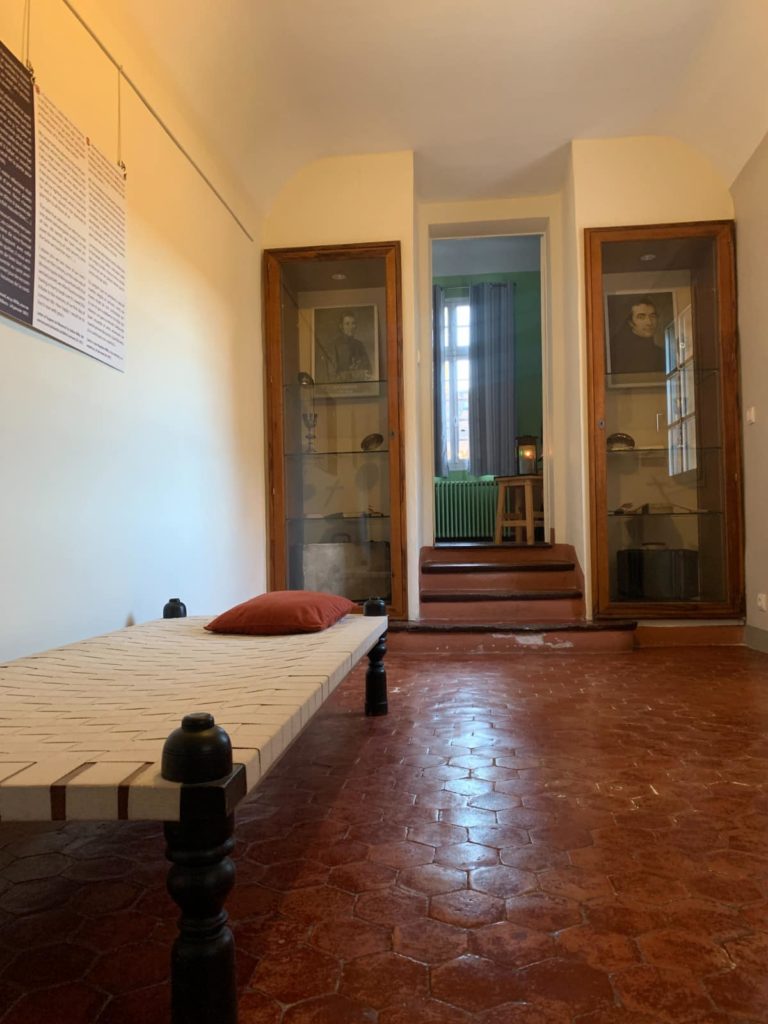
The corridor as it has been reconstructed today
My camp bed was placed in the small passageway which leads to the library: it was then a large room used as a bedroom for Father Tempier and for one other whose name we no longer mention amongst us. It was also our community room.
One lamp was all our lighting and, when it was time for bed, it was placed in the doorway to give light to all three of us. The table that adorned our refectory was one plank laid alongside another, on top of two old barrels.
We have never enjoyed the blessing of such poverty since the time we took the vow. Without question, it was a foreshadowing of the state of perfection that we now live so imperfectly…. I assure you we lost none of our merriment; on the contrary, as this new way of life was in quite striking contrast with that we had just left, we often found ourselves having a hearty laugh over it. I owed this tribute to the memory of our first day of common life. How happy I would be to live it now with you!” (To Father Mille, January 24, 1831, Oblate Writings, 8, p. 11)
With gratitude to the OMIWORLD site
Posted in WRITINGS
2 Comments
TO LIVE IN COMMUNITY THEY HAVE GIVEN UP THE ORDINARY PARISH MINISTRY
Prior to the arrival of the Oblates in Limoges, a contract had been made with the Bishop in which it was agreed that they would be mission preachers in the diocese and that they could be sent “temporarily and by exception into parishes to replace pastors who were ill or absent for a short time.” In the first three months of their presence in Limoges, the Bishop had begun to abuse this exception and use them to minister as solitary parish priests out of community. Eugene protested by clarifying the mission of the Oblates.
I’m experiencing a sorrow that it’s impossible not to confide in you. You know that each one must live one’s own life and follow one’s own vocation. It so happens that the system followed in Limoges deprives our Oblates of what they came to the Congregation for. It is to live in community that they have renounced the ordinary ministry of parishes, and it is above all through the exercises of the missions that they bring souls back to God.
To prove his point, he quotes the Oblate Rule to the Bishop.
Their Rules provide that they live in community, so much so that they prescribe that they always go forth in pairs: Duo saltem ibunt ad missiones [ed a minimum of two are to go on missions]. I understand that at times it is necessary to dispense from this point of the Rule, especially when a missionary is sent to assist a parish priest. It is essential, however, that this be a temporary measure only. You understand, Your Lordship, that there are good reasons for this.
Moreover, there is a point in the Rule that says: Nequamquam licet paroecias regere [ed. it is by no means permitted to care for parishes] Their choice gives them enough to do, so that they can leave to others the care of parishes for which they are not called…
Letter to Bishop Buissas of Limoges, 20 February 1848, EO XIII n 119
REFLECTION
The very first Oblate Rule was clear on two points: “it is by no means permitted to care for parishes” and that community life was an integral part of the missionary lifestyle. Pastoral necessities outside of France led to missionaries ministering on their own especially in areas of first evangelization – a practise causing much anxiety to Eugene.
In these areas of evangelizing and establishing a church community it became necessary for the Oblates to be parish priests as they were the only priests in the area. In many countries, ministering in parishes became the Oblate norm and non-parish ministry the exception. Today our Constitutions and Rules and our General Chapters impel the Oblates and all the members of the Mazenodian Family to return to our charism roots by responding to the evangelizing needs of the most abandoned within the structure of apostolic community not necessarily tied to a parish structure.
“The very charism of the Founders (Evangelii Nuntiandi 11) appears as an “experience of the Spirit,” transmitted to their disciples to be lived, safeguarded, deepened and constantly developed by them, in harmony with the Body of Christ continually in the process of growth. “It is for this reason that the distinctive character of various religious institutes is preserved and fostered by the Church” (The Church document Mutuae Relationes art 11)
PRAY, PRAY OFTEN WITH FERVOR, EVEN BEYOND THAT WHICH IS PRESCRIBED IN OUR RULE
In the previous entry we saw Eugene’s reaction to the misbehaviour of young Fr. Molinari. Now he was given a second chance.
What remains to be done now? Father Magnan. full of charity for you. is agreeable to keep you in his community in the hope of using you somehow, but he counts on your docility to his advice, and I would add on your gratitude, since he cannot render you a greater service than to help you with his advice and to indicate the road you must follow. I agree then to forgive you and to confide you to this good Father, a man of good sense and of good counsel…
Eugene then traced for him the path to take for positive and life-changing growth.
Come back to order, my dear son, imbue yourself with the spirit of your holy state in life; ask God urgently for the gift of piety which is lacking in you. Pietas ad omnis utilis est [Ed ” I Tim 4:8 “devotion is valuable in every respect, since it holds a promise of life both for the present and for the future”);with devotion you will acquire all the rest and your least actions will become meritorious; put great simplicity into your obedience; beware of your ideas; guard yourself from self-complacency which is born of the pride you must protect yourself against; learn how to mortify yourself, even in the smallest things; but especially moderate yourself in the use of liquor.
Pray, pray often with fervor, even beyond that which is prescribed in our Rule. Avail yourself of the privilege of dwelling under the same roof as Our Lord Jesus Christ to visit him often, to adore him, love him and speak with him of your need and ours. Goodbye, I bless you.
Letter to Fr. Jean Baptiste Molinari in Corsica, 10 February 1848, EO X n 965
REFLECTION
” My child, do not despise the Lord’s discipline or be weary of his reproof, for the Lord reproves the one he loves, as a father the son in whom he delights.” Proverbs 3:11-12
YOU RECOGNIZED YOUR WRONGS AND YOU ASKED FORGIVENESS FOR THEM
28 year-old Father Molinari was working in Corsica and his lifestyle left much to be desired. Eugene had put his trust in him and had been disappointed.
My dear Father Molinari, I never expected that you would cause me such bitter grief. I had made myself accountable for you at the Council of the Congregation and its most senior members who, with more than enough reason, wanted you to go through a longer probation. I did this because I relied on your promises and on the assurance that you gave me with the strongest emphasis that never would you cause me to repent the confidence that I was showing you.
Nevertheless, what has happened? For lack of religious spirit. humility, deference toward your superiors, for lack of piety, you have cheated my expectations by not fulfilling any of your duties. From the outset, you have adopted the style of some of those bad Italian religious who are the scandal of the Church who think of nothing but their belly and live without Rule or the spirit of their holy state in life. And so, to my great astonishment, no one has been able to do anything with you anywhere.
His local superior had written of him, “he was smoking, drinking, sometimes venturing certain rather radical statements and sleeping late in the mornings, somewhat of a rebel in regards to regular observance…” Eugene, while recognizing his faults, also did see the good in him.
You recognized your wrongs and you asked forgiveness for them. That is good. Certainly there is no one more disposed in your favor than I, but be fair and judge yourself; declare judgment if it is possible to maintain yourself in that attitude that is beyond all our religious practices, the spirit of our Rules, our usages, our principles, our way of thinking. When you joined us you were told that you would have to fit yourself into our mould; in becoming one of us, you could not be otherwise than we are; that is unquestionable. See what embarrassment you are causing me! and it is through your own grievous fault. It was up to you to do otherwise, and I would have rejoiced over your success, while now I must shudder over the totality of your conduct.
Letter to Fr. Jean Baptiste Molinari in Corsica, 10 February 1848, EO X n 965
REFLECTION
Eugene was prepared to go to great lengths to see the good in his Oblates and to forgive their failings if they acknowledged that they had been wrong and made efforts to change. This attitude is clear in his paternal yet firm letter to this young Oblate.
“Experience results in the most enduring lesson. When one commits a mistake and if he is wise enough to learn his wrong done, goes for corrective measure. All this process from mistake to correction culminates in experience. ” (Anil Sinha)
YOUR WONDERFUL MISSION OF MAKING JESUS CHRIST KNOWN AND EXTENDING HIS KINGDOM AS YOU WALK IN THE FOOTSTEPS OF THE APOSTLES
Writing to the first four Oblate Missionaries in Jaffna, Eugene stressed what the foundation of their mission had to be.
Not being able to write to you individually, I address myself to all of you, my dear sons, who have been called by God to such a wonderful mission. Do honour to your ministry by practising all the religious virtues. Be faithful in observance of your holy Rule, live in the most perfect union, and conduct yourselves always in accord with obedience…
Do not allow yourselves to be weakened by the heat of the climate. God must be served everywhere with fervour. If I could believe that you would degenerate in that land which you are to soak with the sweat of your brows to recall some to their duties, and to bring the light to others who do not know the true God, I would declare you unworthy of your great vocation and I would regret having chosen you in preference to so many others for your wonderful mission of making Jesus Christ known and extending his kingdom as you walk in the footsteps of the Apostles.
But no, you will never cause me that pain. On the contrary, I will have only to congratulate myself on having entrusted to you the glory of God and the honour of our dear Congregation. So I bless you in the name of the Father and of the Son and of the Holy Spirit and place you under the motherly protection of Mary Immaculate.
Letter to Fr Etienne Semeria and the pioneer Oblates in Ceylon, 25 January 1848, EO IV (Ceylon) n 2
REFLECTION
Eugene’s mandate continues today in the Mazenodian Family’s wonderful mission of making Jesus Christ known and extending his kingdom as we walk in the footsteps of the Apostles
“By growing in unity of heart and mind, we bear witness before the world that Jesus lives in our midst and unites us in order to send us out to proclaim God’s reign.” (Constitutions and Rules, C37)
“Whoever wishes to become one of us must have an ardent desire for his own perfection, and be enflamed with love for our Lord Jesus Christ and his Church and a burning zeal for the salvation of souls.” (Eugene de Mazenod 1853)
JOIN US TO LISTEN TO OUR SUPERIOR GENERAL SPEAKING ABOUT OUR MAZENODIAN FAMILY
Save the date and join us for the 2024 Kusenberger Lecture presented by Fr. Luis Ignacio Rois Alonso, O.M.I., the Superior General of the Missionary Oblates of Mary Immaculate.
This lecture will explore the rich legacy of St. Eugene de Mazenod’s life and the evolution of our shared charism. Discover the dynamic movement of the Holy Spirit in our lives and learn how to navigate contemporary challenges with creative fidelity.
Register for this FREE event, in person or online, today! https://bit.ly/4aWasRT
Posted in WRITINGS
Leave a comment