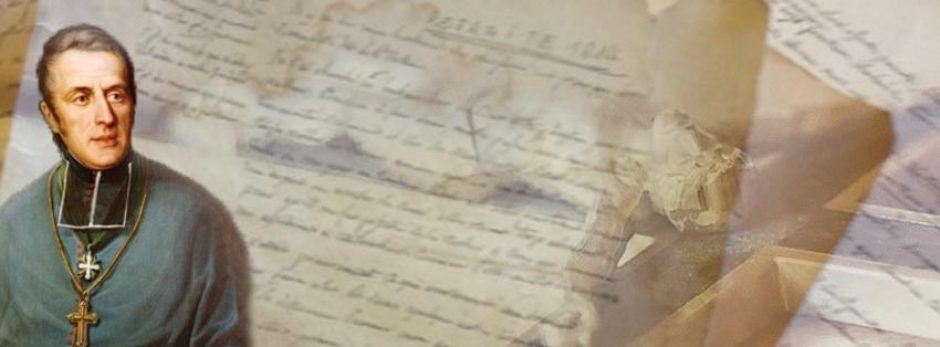
Dear Courtès, I admire always more (that does not mean that I am surprised) your activity and your courage. Your conduct since you have been entrusted with the difficult mission of Limoges is beyond all praise. You have shown what you can be, and I bless the Lord a thousand times that I gave you this trust, to show everybody what are your resources of mind and heart when you apply yourself to the task at hand.
Fr Courtès had been a member of the Founder’s Youth Congregation since 1817 and had been one of the first vocations to become a Missionary of Provence. He was Eugene’s confidant and friend throughout his life. Timid and prone to pessimism, he spent most of his life as the superior of the community in Aix en Provence. He had been chosen to start the first Oblate community in Limoges because it was a challenging foundation with much opposition from the local clergy. Courtès, who had imbibed the spirit of Eugene, was the right person to begin the new community on a sound footing according to our charism.
What a difference in comparison to that sedentary life that was so insufficient for a soul so full of energy like yours! And so I would regret to see you return to that quiet life which neutralizes a great part of the qualities you possess, and that I had wanted many times, but vainly until now, to have you in a situation to deploy them.
It makes me happy to be able to tell you that I approve in every way all that you have done since I gave you the direction of our establishment at Limoges. I only feared at times that you did not give enough care to your health, but the Lord has shown us that he comes to the help of those who have in view only his glory, and the success of the holy ministry entrusted to them. I do not gloss over the difficulties you will have to bring those who will succeed you to your ways of doing things.
May 6.
I am tired out. I do not remember what I wanted to add. Guess who turned me away from finishing my letter yesterday? Your father and your sister came to see me on purpose to tell me their fears for you. I reassured them by showing them your letter.
Letter to Fr Hippolyte Courtès, 5 May 1848, EO X n 975
REFLECTION
“Believe you can and you’re halfway there.” (Theodore Roosevelt)
Within the context of the disorder and fear caused by the 1848 Revolution Eugene wrote in his diary:
Letter from Fr. Courtès. This Father is ever more admirable for action and courage. He returned to Limoges at the time of the rioting in order to reassure the newly arrived Fathers who arrived in the nick of time to help in all these disorders. Fr. Nicolas could not have asked better than to retrace his steps.
Eugene de Mazenod’s Diary, 4 May 1848, EO XXI
REFLECTION
Yvon Beaudoin provides the background to this Oblate foundation in Limoges:
“The year 1847 marked an important stage in the Congregation’s expansion in France. It took root in two dioceses far distant from Provence: Nancy in the northeast and Limoges in the centre. The second of these foundations “was as if directed by Providence Itself,” wrote Father Ortolan, “because no one had thought of them.” On October 3, Bishop de Mazenod received a letter from Bishop Bernard Buissas, Bishop of Limoges from 1844 to 1856, who suggested he establish a house of mission preachers in his episcopal city. Without success, he had already approached several religious congregations. Since he had heard “many good things about the Oblates,” he hastened to ask for a few priests. The very same day, the Founder wrote to Father Courtès to come as soon as possible to Marseilles because he needed him to “answer a letter of great interest. “Already October 7, he sent an answer to Bishop Buissas telling him that “there does, indeed, exist in the Church a small congregation whose main end is to evangelize the poor and to come to the aid of the most abandoned souls.” He told him that he was sending him some priests at the end of the annual retreat at the beginning of November. On October 19, he designated the personnel of the future community: Father Hippolyte Courtès, superior, Fathers Jean Viala and Scipion Chauliac and Brother Jean Bernard Ferrand. On November 17, accompanied by Father Tempier, they took possession of a huge house, recently constructed, surrounded by a garden that was adjacent to the park of the bishop’s house.
…Father Courtès was only sent to Limoges for the foundation and until Father Melchior Burfin would be free after the parish mission season.” (https://www.omiworld.org/lemma/limoges-1847-1904/)
Advice to Father Dassy, Superior of a large Oblate community:
You must make it easy for everyone to carry out their duties, avoid appearing to act like a boss and therefore willingly consult those who have been chosen to be your advisers; you must not fail to do this, especially at the times laid down in the Rule, so that you can never be accused of doing things or letting them go according to your whim.
Letter to Fr Toussaint Dassy in Nancy, France, 7 March 1848, EO X n 970
REFLECTION
The task of a leader is to facilitate the achieving of whatever the group stands for. Consultation and listening form an essential part of the picture.
“People ask the difference between a leader and a boss. The leader leads, and the boss drives.” (Theodore Roosevelt)
Fr. Dassy was named superior of the new community in Nancy. He was a serious scholarly person and was in charge of a house of 20 people, including young priests and many novices. 28 year-old Fr. Santoni was the novice master, and it seems that the young priests had several differences of opinion with Fr Dassy. He had seemingly complained to Eugene.
Not only Father Santoni but all the young Fathers have the right to make observations to you but always with proper respect and reserve; but you yourself have the duty to conform yourself and to require that others conform themselves to what is written. In case of doubt, you should consult me. All this should be done with a view to the greater good, with all the consideration owed mutually by brothers who are moved by the charity of Jesus Christ and are well brought up. Take care, however, that you yourself set an example of the most scrupulous promptness in all that the Rule prescribes, whether for things or for people.
Letter to Fr Toussaint Dassy in Nancy, France, 7 March 1848, EO X n 970
REFLECTION
Eugene’s response was to refer him to the Oblate Constitutions and Rules, which were meant to be used as a guide for community life and mission.
In this time of synodality, it is interesting to see its spirit reflected in Eugene’s words. Authority has a duty to listen to the opinion of others, no matter how hurtful these may be. In these cases they are to be “moved by the charity of Jesus Christ.” It is not meant to be a subjective exercise, but guided by “what is written.” In this case it is the Gospel as it is reflected in the Oblate Rule, approved by the Church as an expression of the Gospel.
Is this not what synodality is: Listen to one another in charity and be guided by the Gospel.
“Consult your friend on all things, especially on those which respect yourself. His counsel may then be useful where your own self-love might impair your judgment.” (Lucius Seneca)
After only seven years of a growing Oblate presence in England, the results were evident and promised well for the future. As shocked as the Congregation had been at the untimely death of Fr Perron, Eugene saw his influence in the closeness of the Oblate community in heaven which interceded for the missionaries.
Our missions in England are so prosperous that had the revolution not occurred, I would have gone to visit them this year. The good Father Perron has welded them together by his holy death.
They are served just now by Frs. Daly, Tamburini, Naughten, Cooke, Noble, Grey, Walsh, Bradshaw and Hickey. You should know several of these good Fathers as well as Bro. Cauvin whom I am sending this very day to America with four others who entered novitiate after your departure.
Letter to Fr Henri Faraud, in Canada, 10 May 1848, EO I n 95
REFLECTION
Eugene’s confidence in God’s providence gave him the courage to dare the seemingly impossible for the “glory of God, the good of the Church, and the salvation of souls”. Eight of the nine Oblates were local vocations.
“Christ wants not nibblers of the possible, but grabbers of the impossible.” (C.T. Studd)
You will not be surprised if I do not make a visit to England as I had planned; but I could not refrain from sending Father Aubert. We have great interests at stake. There is question of accepting a beautiful property for a novitiate, and regulating many other things. He will go to that country at the end of next month, and remain only long enough to establish our houses.
Letter to Fr Ambroise Vincens, 26 April, 1848, EO X n 974
Father Daly, with no consultation, had bought an expensive property in England. He had hoped to collect the money from benefactors and to establish a novitiate to serve the growing number of vocations. This project ended in disaster because to pay the inflated price demanded by the unscrupulous vendor, Fr. Daly was forced to offer the title deeds of Penzance as collateral. After prolonged litigation the decision was given against Fr. Daly and the property of Penzance mission was seized. The Oblates were forced to give up that mission. (See https://www.omiworld.org/lemma/anglo-irish-province-1841-1945/)
REFLECTION
“An optimist is a person who sees a green light everywhere, while a pessimist sees only the red stoplight… the truly wise person is colorblind.” (Albert Schweitzer)
The missionaries were human and, as zealous as they may have been sometimes their human foibles got in the way of their ministry. Father Daly, the founder of the Oblate mission in England had a very poor sense of judgement when it came to finance and acted without consulting people who had experience. Eugene wrote in his diary:
Letter to Fr. Daly. I am astonished at what he permits himself to do without my knowledge. He purchased a house, accepted a new establishment, etc.
Eugene de Mazenod’s Diary, 30 April 1848, EO XXI
Fr. Daly purchased, without permission of the Superior General, an important property in Ashbourne in the county of Derby in the center of England.
REFLECTION
Eugene immediately sent the experienced Fr. Casimir Aubert to England to take the situation in hand.
“Consult your friend on all things, especially on those which respect yourself. His counsel may then be useful where your own self-love might impair your judgment.” (Lucius Annaeus Seneca)
Father Frederic Perron was 35 when he died of typhus, and had spent three years in England. He had worked in Penzance and then as superior of Grace Dieu in Leicestershire, and then was appointed superior of the community in Everingham, Yorkshire. He was an Oblate on whom Eugene had placed his confidence, and whose death was a cruel blow.
Yet Eugene was able to trust in God: “May the Lord be blessed in all things.”
Father Cooke writes me that our late Father Perron regained consciousness a few days ago, and that he never stopped talking about heavenly things right up to his last breath. This is another cruel loss, especially as we need ten more workers in England. May the Lord be blessed in all things. One more of the chosen of our family is in heaven; the assurance that our departed give us of their eternal happiness is truly remarkable. We can rightly apply to ourselves the words of Saint Alphonsus de Liguori who promised heaven to all who die in his Congregation. We have the same reason for confidence because it is perseverance in faithfulness to the commitment made with God, and the saintly death of all our members whom the Lord has called to himself confirming us in this reassurance.
Letter to Fr Ambroise Vincens at N.-D. de L’Osier, France, 27 February 1848, EO X n 969
REFLECTION
The Book of Leviticus 19:1 states, “Be holy as I am holy,” and shows that the way to ensure this is through observance of the God’s Word. Eugene was convinced that every Oblate who lived by the Rule (which is our particular way of living the Word of God) and had been faithful to his oblation would join the Oblate community in heaven.
Religious life is a way of living our baptism as are all ways of life. All who “have been claimed for Christ our Savior” at baptism can have the same confidence: if we are faithful in life, God will be faithful at the time of our death.
Zeal to respond to the cry of the poor and most abandoned by preaching the Gospel needed Missionaries. In England, the sudden death of the 35 year-old Fr Perron led to a gap that had to be filled urgently.
Alas! I hasten to ordain dear Brother Grey because I must immediately send him to England where the death of good Father Perron – which I knew to be imminent but the news of which has reached me since I took up my pen to write you – has made a void which must be filled as soon as possible.
Letter to Fr Ambroise Vincens at N.-D. de L’Osier, France, 27 February 1848, EO X n 969
25 year-old Irish scholastic, John Grey, was ordained to the priesthood two weeks later and received his obedience for Everingham in Yorkshire. Later he was to work in Manchester.
REFLECTION
Responding to the need to evangelize the most abandoned with adequate personnel was a constant challenge for Eugene – as it continues to be today. In recent decades God has led us to understand that it is not only the priests and religious who are the evangelizers, but all the People of God. Each of us is a Gospel-bearer in our everyday life – each is invited to respond quietly and generously in our daily interactions and activities.
“But how are they to call on One in whom they have not believed?[ And how are they to believe in One of whom they have never heard? And how are they to hear without someone to proclaim Him? And how are they to proclaim Him unless they are sent? As it is written, ‘How beautiful are the feet of those who bring good news’!”
Romans 10: 14-15
Fr. Jean-Pierre Bernard, 26 years old, had been ordained in 1847 and left for Canada. Within months of his arrival he succumbed to an epidemic of typhus. Eugene received the news and wrote in his diary:
Our very good, very fervent Fr. Bernard is so ill that he received, that very day, the sacraments. I am truly devastated by this news. Could we not permit ourselves some dedication to God and to the salvation of souls by this fervent missionary, with his good hand, his wonderful voice, his robust health! My God, what a new trial! This dear child, since his ordination to the sub-diaconate, did nothing but grow in virtue. His generosity met every test… He was so happy to sacrifice himself for the salvation of unbelievers!
Eugene’s pain was evident, as was his faith in submitting to God’s will
… All that I fear is that the Lord has found him ripened for heaven and that he is taking this good worker even before he would have been able to carry out everything that his good will was inspiring him to do. This is a major sacrifice which our good God is requiring of me. I am doing everything as though this does not need to be and I am praying with confidence. Who knows if God, in anticipation of these prayers which issue from the bottom of my heart and which my trust in his mercy inspire in me, will not have granted the safeguarding of this precious child? This thought sustains me as I await the first mail from America.
Eugene de Mazenod’s Diary, 6 March 1848, EO XXI
REFLECTION
Everyone’s prayers were answered and he was restored to health and would spend nearly 40 years as a Missionary Oblate in North America, with a 5 year stint in France.
One can imagine the conflicting emotions in Eugene! The missions to the most abandoned in Canada desperately needed good men, and here was the possibility of a talented young man being cut short just when about to begin his ministry. In the midst of his tears Eugene bows to what may be God’s plan while at the same time issuing heart-rending prayers for his healing. I imagine that these were also Mary’s sentiments as she stood at the foot of the Cross.
“To trust God in the light is nothing, but trust him in the dark – that is faith.” (Charles H. Spurgeon)