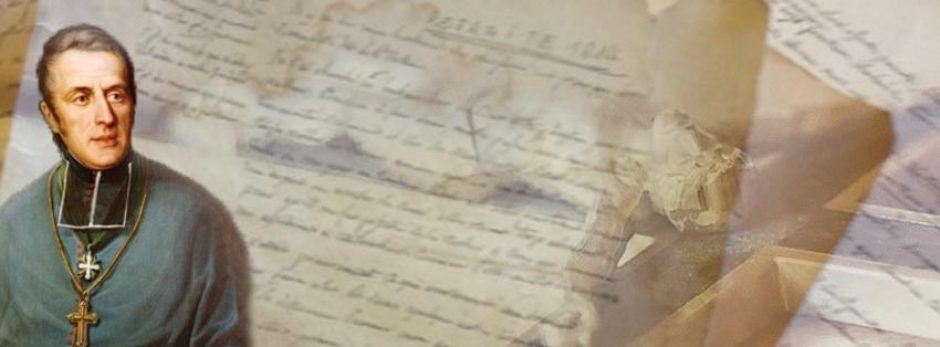
Today I ordained good Father Dorey. On this same day, some 22 years ago, one of our men entered into glory. Father Dorey is worthy to replace him here below.
Letter to Fr. Joseph Arnoux, 20 August 1848, EO X n 985
Eugene never forgot Fr Jacques Marcou. Aged 14 he had been a founding member of Eugene’s youth congregation in Aix. Eugene had watched him grow up and was delighted when Jacques became a Missionary, and a zealous one at that. After three years of priestly ministry he died. Eugene always recalled the day of his death anniversary. Ten years earlier he had reminisced in his diary:
Fr. Marcou still had the strength to come back to Marseilles where I found him on my return from Rome. His condition was desperate; his chest was so affected that there was no hope of recovery. He was convinced, however, that he could still work for the salvation of souls and he was certainly not the one who was least pleased about the success of my journey to Rome where I had just obtained approval for the Congregation of the Missionary Oblates of Mary to be recognized in the Church on an equal footing with other Congregations. Fr. Marcou, although quite weak, wanted to be present at the general assembly which I had called to give an account of my mission and of all the good God had done for us. This good priest could scarcely contain his joy because he always expressed the feelings of his beautiful soul in a lively way. He even came down to the church to renew his vows with all the other members of the new Congregation which had been canonically established. His name is inscribed in the register where we all signed the minutes of this memorable meeting. That was the last important act of this life in which he sealed his consecration to God and the offering of his whole being which he had made throughout many years.
Eugene’s Diary, 20 August 1838, E.O. XIX
REFLECTION
“When someone you love becomes a memory, the memory becomes a treasure.” (Author unknown)
Eugene had ordained Joseph Arnoux to the priesthood in the Marseilles cathedral on 8 April 1848 and sent him to Notre-Dame de Lumières to minister to the pilgrims. During one of his first Masses after ordination he had coughed blood, usually a sign of tuberculosis which had already killed many Oblates. Shrine ministry was demanding, and Eugene worried about this 23 year-old.
I was pleased to learn that you have given yourself courageously to the holy ministry of serving pilgrims; my only fear is that your health may have suffered. Do not forget that your health is fragile and that it has to be treated with caution. So, no matter how large the crowds, never risk staying up the whole night. Go to bed when it is time, and rest as much as you need. By wanting to do too much, you risk pushing yourself to the grave. Do not fear to tell this to the superior who does not know your temperament and who could judge you on appearances only.
I congratulate you on putting forth your first efforts on the occasion of the great feast of our good Mother. You will have gathered your good share of the graces she distributes profusely on all who have recourse to her powerful protection… the dinner bell calls me elsewhere. I leave you then, my dear Father Arnoux, and press you to my heart, which. as you know, loves you tenderly. Do not forget me when you are at the feet of our good Mother at your shrine.
Letter to Fr. Joseph Arnoux at Notre Dame de Lumières, 20 August 1848, EO X n 985
REFLECTION
“The power of youth is the common wealth for the entire world. The faces of young people are the faces of our past, our present and our future. No segment in the society can match with the power, idealism, enthusiasm and courage of the young people.” (Kailash Satyarthi)
The busy Bishop of Marseilles was constantly interrupted and had to struggle to make time to do what he loved the most: communicate with the members of his Oblate family. He was particularly concerned about the welfare of the younger Oblates as they began their ministry.
Father Joseph Arnoux had been ordained four months earlier by Eugene, who fondly recognized his good qualities. He was to prove himself as a dedicated missionary in France, and later in the Anglo Irish Province.
I am grateful to you, my good and dear Father Arnoux, for having excused my silence and for having given me again the consolation of receiving another of your letters before I could answer yours. Overburdened by debts like that I owe you, I closeted myself in today while all the others are at Vespers, and for two hours I have been writing at my ease to the four corners of the globe. I resolved not to postpone yours to another day because you are near and it appears easier to accomplish at such a short distance. Experience proves that I often depend on my good will as an excuse, and that I expose my children who are waiting for an answer to the temptation of accusing me of negligence. You are not capable of such injustice. I must only be more eager to give you evidence of my thanks for your good remembrance and of my tender affection for you.
Letter to Fr. Joseph Arnoux, 20 August 1848, EO X n 985
REFLECTION
Eugene, who considered himself the father of his religious family wrote: “A father’s communication with his many children… that is one of the most agreeable occupations of my life.” Through his letters he expressed what Russell M. Nelson described:
“No, we don’t own our children. Our parental privilege is to love them, to lead them, and to let them go.”
Come and see the place where he lay. Then go quickly and tell his disciples,
‘He has been raised from the dead, and he is going before you to Galilee; there you will see him.’ (Matthew 28: 7)
After journeying with him through the sad event of his Passion, after weeping over the torments that our sins made him endure, how consoling it is to see him rise triumphant over death and hell, and what gratitude must fill our hearts at the thought that this good Master has really willed to make us sharers in his resurrection, destroying the sin that is in us and giving us a new life.
Eugene de Mazenod to his mother, 4 April 1809, EO XIV n 50
OMI Rule of Life, Constitution 8
“We will always be close to the people with whom we work, taking into account their values and aspirations… Awareness of our own shortcomings humbles us, yet God’s power makes us confident as we strive to bring all people – especially the poor – to full consciousness of their dignity as human beings and as sons and daughters of God.”
HOLY SATURDAY: A TIME OF EMPTY WAITING
“That is what Holy Saturday has taught me about being Christian. Between the great dramas of life, there is almost always a time of empty waiting — with nothing to do and no church service to help — a time when it is necessary to come up with your own words and see how they sound with no other sounds to cover them up. If you are willing to rest in this Sabbath, where you cannot see your hand in front of your face and none of your self-protective labors can do you one bit of good, then you may come as close to the Christ as you will ever get — there in that quiet cave where you wait to see how the Maker of All Life will choose to come to you in the dark.” (Barbara Brown Taylor, https://www.huffpost.com/entry/learning-to-wait-in-the-dark_b_5175191)
In the end, though with sadness, I go my way, placing my trust in God alone. Let us love him always more.
Letter to Father Forbin Janson, 12 September 1814
OMI Rule of Life, Constitution 5:
“Wherever we work, our mission is especially to those people whose condition cries out for salvation and for the hope which only Jesus Christ can fully bring. These are the poor with their many faces; we give them our preference.”
In the days when Christ was in the flesh, he offered prayers and supplications with loud cries and tears to the one who was able to save him from death, and he was heard because of his reverence.
Son though he was, he learned obedience from what he suffered;
and when he was made perfect,
he became the source of eternal salvation for all who obey him.
Hebrews 5:7-9
In the incarnation, Jesus became fully human and became one with us in all our experiences. On the cross, he entered into the extreme experience of human hopelessness: the sense of having been abandoned by God.
He became one with us in all those situations where we cry out in darkness and despair: “Where are you God, why are you absent?”
As we embrace Jesus Forsaken on this Good Friday, let us embrace the door that he opened through his suffering and death: his resurrection and ours.
St Eugene knew darkness and seeming-hopelessness many times in his life. Yet he recognized that in these dark moments, his Savior was present, and he attests to this in constantly in his writings. Just one example:
It is true that I have always put all my confidence in the goodness of God.
Letter to Henri Tempier, 16 February 1826, EO VII n 224
OMI Rule of Life, Constitution 4:
“The cross of Jesus Christ is central to our mission… Through the eyes of our crucified Saviour we see the world which he redeemed with his blood, desiring that those in whom he continues to suffer will know also the power of his resurrection (cf. Phil 3: 10).”
Those who eat my flesh and drink my blood have eternal life, and I will raise them up on the last day, for my flesh is true food, and my blood is true drink. Those who eat my flesh and drink my blood abide in me and I in them. Just as the living Father sent me and I live because of the Father, so whoever eats me will live because of me. This is the bread that came down from heaven (John 6: 54-58)
Eugene had made his first communion on Holy Thursday at the College of Nobles in Turin. It was always an important moment for him to recall the joy of this important event. Antoine Ricard, who had been a diocesan seminarian in Marseille, illustrateded this:
One Holy Thursday – as I personally recall – we were in the Cathedral of Marseille. The bishop (Eugene de Mazenod) was officiating with the gentle dignity and recollection that made him renowned among all the bishops, his contemporaries. Unexpectedly we saw him cry and, while trying, he could not conceal it. The seminarians who surrounded the bishop’s throne, struck by the emotion of the Bishop, were moved as they looked at him. He noticed this, and turning to one of them, the author of these lines, whose short-sightedness made his staring more obvious:
“Young man,” he said with that simplicity that made him win hearts, “do not be startled like that – today is the anniversary of my first communion.”
Mgr Antoine RICARD, “Monseigneur de Mazenod, évêque de Marseille, fondateur de la Congrégation des Missionnaires Oblats de Marie Immaculée,” p. 12.
OMI Rule of Life, Constitution 33
“The Eucharist, source and summit of the Church’s life, is at the heart of our life and action… In gratitude for this great Eucharistic gift, we will seek the Lord often in his sacramental presence.”
As we celebrate the institution of the Eucharist at the Last Supper, perhaps we could make this the opportunity to recall our own first communion with joy and thanksgiving.
“My appointed time draws near;
in your house I shall celebrate the Passover with my disciples.”
The disciples then did as Jesus had ordered, and prepared the Passover.
Mt 26: 18-19
St Eugene knew darkness and seeming-hopelessness many times in his life. Yet he recognized that in these dark moments, his Savior was present. It was a Passover invitation and he attests to this in constantly in his writings. Just one of many examples:
Eugene had looked forward to retiring from Marseilles to devote himself more fully to the Oblate Congregation once his 87-year-old uncle retired or died. Unexpectedly, he was appointed to succeed his uncle as Bishop of Marseilles. Unburdening himself to his medical doctor and friend, Eugene revealed his fear about the nature of the responsibility that was now given to him for the rest of his life:
Now here I am, doomed to die in harness and this terrible responsibility that I have always so feared, here it is ready to shatter me…
For myself, I am bewildered when I reflect on it and have to summon up my inexhaustible trust in God’s goodness, in the help of the prayers of the just who still bother themselves about me, in the protection of the saints who have found themselves in the same crisis as myself, to win a little respite.
Eugene’s letter to Doctor M. d’Astros, 16 April 1837, EO XV n 183
OMI Rule of Life, Constitution 32
“It is as missionaries that we worship, in the various ways the Spirit suggests to us. We come before him bearing with us the daily pressures of our anxiety for those to whom he sends us (cf. 2 Cor 11:28). Our life in all its dimensions is a prayer that, in us and through us, God’s kingdom come.”
Peter said to him,
“Master, why can I not follow you now?
I will lay down my life for you.”
Jesus answered, “Will you lay down your life for me?
Amen, amen, I say to you, the cock will not crow before you deny me three times.”
Jn 13:36
I have entirely got over an illness that brought me to death’s door and from which I recovered only through the countless and very fervent prayers that were made for me to the good God in every quarter of the town…
It was at the barracks where some 2000 Austrian prisoners were held that I contracted what they call jail fever. On the morning of St. Joseph’s feast day I was close to the end…
Eugene’s letter to his father, 17 June 1814, E.O. XV n. 126
OMI Rule of Life, Constitution 2:
“We are men “set apart for the Gospel” (Rom 1: 1), men ready to leave everything to be disciples of Jesus. The desire to co-operate with him draws us to know him more deeply, to identify with him, to let him live in us.”
Despite opposition from some in the city, the military authorities and the press, the procession was a great success.
The news of this decision had filled the Catholics with joy and, in spite of the remarks of certain fainthearted persons who foreshadowed trouble, it could have been said that a person could rely more on the tranquility of spirit that I showed than on all these fears, and each one made it a duty to reply to the invitation that I extended to the various confraternities and congregations to unite with me to give glory to our Lord.
A large number of women and young ladies from different parishes of the city, the gentlemen of the association for the accompaniment of Holy Viaticum, the churchwardens, the penitents and the clergy went to the cathedral at the appointed hour and, since the cholera [ed. the deadly epidemic of 1837], never had a procession been so splendid and so touching. It was a concert of praises and of admiration to which the entire populace responded. Everyone competed, in accordance with the beauty of the day, in contributing to the magnificence of the feast and to the public joy.
Now everyone is complimenting me, and I am enjoying a true happiness in seeing how things transpired and with what piety this grand feast was celebrated.
Eugene’s Diary, 15 August 1848, EO XXI
A few days later he wrote to an Oblate:
Here we tried to honor her in the best of way we could. I ordered the statue of Our Lady de la Garde brought down to be part of the procession of the Blessed Sacrament which was very solemnly done on August 15, the Blessed Virgin has thus received her share of homage from the people of my diocese. Everything went very well, and I find that I have all the more to congratulate myself for having resisted all insinuations that wanted to deter me from having this beautiful procession. Nothing like it had been seen since our processions at the time of the cholera: the same eagerness, respect, and even more, universal joy in all the population. This is not the first time that I recognize that there are graces of state.
Letter to Fr. Joseph Arnoux, 20 August 1848, EO X n 985
REFLECTION
“Lourdes, where non-Catholics imagine that we accord Mary undue eminence, is no doubt that place in the world where Christ in the Eucharist is most glorified. It is the only place in the world where, under the veil of the Host, Christ mingles in the midst of so many people and is as closely pressed by them as He was during His mortal life. His mother prays for these bodies and these souls, and Christ cures them. The procession of the Blessed Sacrament in Lourdes starts from the Grotto to show that Jesus was given to us by the Virgin. And she who stood on Golgotha, at the foot of the Cross a condemned Man, stands here by the side of the King of eternal glory.” (Francois Mauriac)