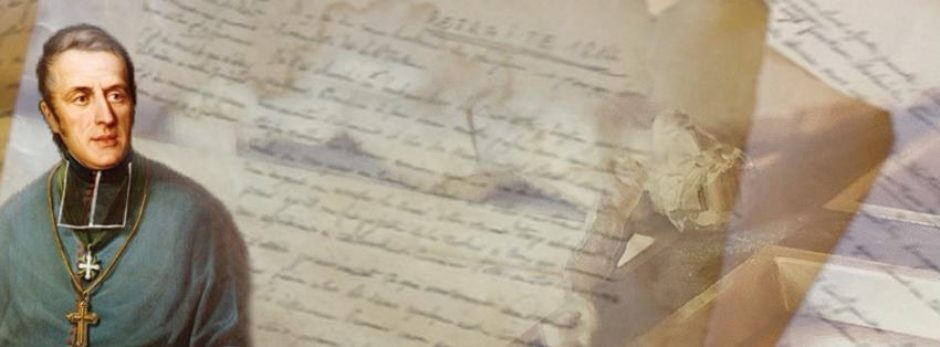
25 JANUARY 1816 – RECALLING OUR FOUNDING STORY

The all-important first day of community life for the Missionaries was obviously a story often repeated in all its details.

Here Eugene is writing to the novices and scholastics who were in Billens, Switzerland, to escape the dangers of the anti-religious persecution by the government of Louis Philippe. He narrates the story of the beginning of their religious family, and draws a conclusion linked with the vow of poverty and the call to simplicity.

 Tomorrow I celebrate the anniversary of the day, sixteen years ago, I left my mother’s house to go and set up house at the Mission. Father Tempier had taken possession of it some days before. Our lodging had none of the splendour of the mansion at Billens, and whatever deprivations you may be subject to, ours were greater still. My camp-bed was placed in the small passageway which leads to the library: it was then a large room used as a bedroom for Father Tempier and for one other whose name we no longer mention amongst us. It was also our community room. One lamp was all our lighting and, when it was time for bed, it was placed in the doorway to give light to all three of us.
 The table that adorned our refectory was one plank laid alongside another, on top of two old barrels. We have never enjoyed the blessing of such poverty since the time we took the vow. Without question, it was a foreshadowing of the state of perfection that we now live so imperfectly. I highlight this wholly voluntary deprivation deliberately (it would have been easy to put a stop to it and to have everything that was needed brought from my mother’s house) so as to draw the lesson that God in his goodness was directing us even then, and really without us having yet given it a thought, towards the evangelical counsels which we were to profess later on. It is through experiencing them that we learnt their value.
 I assure you we lost none of our merriment; on the contrary, as this new way of life was in quite striking contrast with that we had just left, we often found ourselves having a hearty laugh over it. I owed this tribute to the memory of our first day of common life. How happy I would be to live it now with you!

 Letter to Jean-Baptiste Mille and the novices and scholastics,
24 January 1831, O.W. VIII n.383

Posted in WRITINGS | 1 Comment

Mazenodian Family Vocation Congress 2019

Wednesday, January 23, 2019, 7:00pm – 9:00pm (USA central time)

“The Oblate Charism Today: Its Essence and Its Urgency”

The Missionary Oblates of Mary Immaculate were founded to serve the poor. Historically that foundation was also rooted in the Founder’s experience of the Cross, his sense of Mary as the special patroness of the poor, and his knowing that effective compassion and ministry can only come out of community. What does that mean for us today, seeking to live out that charism 200 years later?

Presenter

Ron Rolheiser, OMI is a Roman Catholic priest, member of the Missionary Oblates of Mary Immaculate and president of Oblate School of Theology. Father Ron is a theologian, professor, and award-winning author. Apart from his academic knowledge in systematic theology and philosophy, Father Ron is an internationally renowned speaker and spiritual writer whose books appeal to Christians of all backgrounds and spiritual seekers of all kinds. He writes an award-winning weekly column that is carried in many newspapers around the world. His latest book Wrestling with God: Finding Hope and Meaning in Our Daily Struggles to Be Human was released in May 2018.

The Public lectures may be accessed LIVE, and later uploaded, via the OST Youtube :

channel:https://www.youtube.com/channel/UCeMlmWkrakcrOFHd3NwPcqg

Posted in WRITINGS | Leave a comment

Mazenodian Family Vocation Congress 2019

Mazenodian Family Vocation Congress 2019

Tuesday, January 22, 2019,  7:00pm – 9:00pm (USA central time)

 “For whoever does the will of my Father in heaven is my brother and sister and mother: Toward a Theology of the Oblate Charism, Vocation, and Ministry”

Oblates live at the intersection between two movements of the Spirit that are bearing fruit in the life of the Church since the Second Vatican Council (1962-65).  The council called upon religious orders to renew their spiritual foundations by returning to their founding roots and charisms, while it also called upon all the baptized, lay faithful to claim their true leadership roles and status in the Church and to infuse the secular world with the values of the Gospel.  Oblates live at a paradoxical intersection of these two trends, and yet there is not an adequately developed theology of lay ministry that can be applied directly to the oblate charism in the twenty-first century.  This keynote address will explore the developments of a lay theology of ministry since the Second Vatican Council, and then place those trends into dialogue with the lived experiences of oblates today.  Our goal is to begin to articulate a theology of the oblate charism, vocation, and ministry that can provide some guidance for oblates in our dual commitments to the renewal of religious life and to infusing the seeds of the Gospel in the secular world today.

Presenter

Tom Bushlack, Ph.D., is associate professor of Theology and Ethics and Director of the Ashley-O’Rourke Center for Health Ministry Leadership at Aquinas Institute of Theology (St. Louis, MO).  After briefly considering a monastic vocation with the Benedictine monks at St. John’s Abbey (Collegeville, MN), he became an Oblate of St. Benedict, and is also a Trustee of the Trust for the Meditation Process, and the host of the “Contemplate This!” podcast.  His scholarship explores the intersection between the pursuit of justice in Catholic social thought, contemplative spirituality, and moral formation in the virtues.  He currently lives in St. Louis, MO, with his wife Anna, and their three children. For more information, please visit thomasjbushlack.com.

The Public lectures may be accessed LIVE, and later uploaded, via the OST Youtube :

channel:https://www.youtube.com/channel/UCeMlmWkrakcrOFHd3NwPcqg  

Posted in WRITINGS | 1 Comment

Mazenodian Family Vocation Congress

The Year of Oblate Vocations declared by the General Administration began on December 8, 2017 until January 25, 2019.

In the U.S. Province—the creation of the Mazenodian Family Committee has resulted from  the desire by  the Oblate Provincial Administration not only to promote vocations to the Missionary Oblates but to all the branches of the Mazenodian Family.


The Province will celebrate all these varied vocations at the end of the Year for Oblate Vocations: January 22-25, 2019 at Oblate School of Theology, San Antonio.

Goals of the Vocation Congress

Reflect

Theological reflection on meaning and experience of charismatic families

Celebrate

Value our individual vocations and our diversity in the Mazenodian Charism

Collaborate

Seek ways to work together as members of the Mazenodian family in the mission entrusted to us by Saint Eugene de Mazenod.

Posted in WRITINGS | Leave a comment

PAUSE FOR CHRISTMAS

I wish you a Blessed Christmas and every blessing during 2019.

There will be a pause until the end of January. During our pause I invite you to consult the many reflections on this website which have been published since 2010.

I also invite you to consult the actual writings of St Eugene online.

You can find theses in chronological order at https://www.eugenedemazenod.net/?page_id=2362 

Thanks to the generous work of many, this chronological version is now complete.

On our OMIWORLD site you will also find the volumes in digital form, as they were originally published in book form:  https://www.omiworld.org/our-charism/founder/writings/ 

Posted in WRITINGS | Leave a comment

CELEBRATING THE DELIGHTFUL NIGHT OUR LOVABLE SAVIOR IS BORN IN A STABLE

Eugene was ordained to the priesthood on 21 December 1811 and celebrated his “First Mass” on Christmas Eve. He invited his mother to be united with him in a special way.

Dear mother, be one with me on Christmas Eve, join in the holy mysteries in Aix while I celebrate them for you in Amiens, in the most fervent of; let each of us for our own part speak our minds to our good Master who assuredly will be quite unable to say no on such a wonderful day…

Letter to his mother, 8 December 1811, EO XIV n. 96

After his ordination, the custom was to spend more days in retreat in preparation for celebrating Mass for the first time. On the day of his ordination had written in anticipation:

I leave you now, dear, darling mother. I have three days still to get used to the idea that I am a priest and prepare to celebrate the divine mysteries on the delightful night our lovable Saviour is born in a stable…

Letter to his mother after his priestly ordination, 21 December 1811, EO XIV n.97

How am I preparing to celebrate the delightful night our lovable Savior was born in a stable?

Posted in WRITINGS | 1 Comment

PREPARING FOR CHRISTMAS WITH SAINT EUGENE

One of the privileged moments of prayer for Eugene was to be able to unite himself with those he loved in the presence of God. In our Oblate tradition we have come to know this exercise as “oraison.” As a seminarian in Paris he wrote to his mother one Christmas morning describing how united he had been with her during Midnight Mass, despite the distance that separated them.

Dearest Mother, do you really think that I was not beside you last night? How could I fail, meditating as I was on the holy Mother of God, who had just been filled with consolation on giving the world its Saviour, and at the same time had to experience so vividly the poverty, weakness and misery to which she saw her Divine Master reduced for love of men, how could these tender sentiments fail to draw me close to you?
Indeed yes, darling mother, we spent the night together at the foot of the altar, which for me represented the crib in Bethlehem; together we offered our gifts to our Savior and asked him to come to birth in our hearts and strengthen us in all that is weak, etc.
You know my heart all too well, since it was formed from your own, so you will have a very clear understanding that it is as active and goes through the same feelings as your own.

Letter to his mother, 25 December 1809, EO XIV n 37

Who are the people I want to unite myself with before the crib in Bethlehem this year?

Posted in WRITINGS | 1 Comment

200 YEARS AGO: COMMUNITY PRAYER: THE SOURCE OF ALL MISSIONARY SUCCESS

It seems surprising that as the sixth ministry Eugene puts the community prayer of the Breviary:

All the priests, oblates, and novices are bound to recite the Divine Office in common, according to the rite of the Holy Roman Church, at the hours prescribed by the schedule.

The surprising part is not that the Missionaries must pray regularly, but that this is seen as one of the MINISTRIES of the Missionaries. In other words, the time given to praying the Breviary is as important as any one of the other ministries.

Apart from the personal sanctification that Eugene never stops stressing (“be” in order to “do”), the community prayer is other-centered in that it is a ministry done for the good of the whole Congregation and its mission.

The Institute regards this exercise as the source of all the blessings which must pour out upon all the ministry of the whole Society.

1818 Rule, Part One, Chapter 3, §6 Divine Office

Praying the Divine Office, the Liturgy of the Hours, is an act of the Church and for the good of the whole Church, of which the community of Missionaries is a cell.

Two clarifications on the text:

– One of the ends of the Missionaries was to make up for the disappearance of the Orders, whose foundation was built on singing the Divine Office at various moments of the day – hence this initial insistence. As the Oblates became geographically more widespread and their ministry more varied in small groups or individually – it was the spirit of this part of the Rule that had to be maintained in their individual prayer: praying the Breviary was a ministry for the welfare of the mission of the whole Congregation.

– Eugene used the word “oblates” to denote all those who had professed their first vows and were not yet priests (i.e. scholastics – seminarians). This was 8 years before the Congregation took the official name of “Oblates” for all its members.

The Liturgy of the Hours is the prayer of the Church, the spouse of Christ. In it, we praise the Father for his wonderful works and invoke his blessing on our mission. Each community will ordinarily celebrate part of the Hours in common. Where possible, the faithful will be invited to join us in this public prayer of the Church. CC&RR, Constitution 33

Posted in WRITINGS | 1 Comment

200 YEARS AGO: ALWAYS CLOSE TO THE PEOPLE AROUND THEM – ESPECIALLY IN SICKNESS AND DEATH

The church of the Oblate Mission house in Aix was never a parish. The community was young, dynamic and obviously attracted many people to their services –either in the church or in the various ministries of the Missionaries in the city. Eugene felt a sense of responsibility to these persons, particularly in the case of serious illness and the approach of death.

Art. 1. When those under the care of the missionaries fall sick, we will prepare them for the reception of the last sacraments as soon as possible. Indeed, one should not wait until the benefactors and friends of our Society are in danger of death, before showing them our gratitude and sincere affection in Jesus Christ.

The Missionaries had the responsibility of praying with them and bringing them the sacraments, but it did not end there because they continued being united with them:

We will pray for them many times each day; we will offer the Holy Sacrifice; they will be given a full and complete share in all the good works, prayers, Masses, and penances of the Society. In a word, we should provide all we can for their spiritual and also temporal needs, if it is for the glory of God.

In the case of the dying,

Once the sick under the care of a member of the society have received the last sacraments, their confessor will visit them often, even every day or several times a day, if he judges it to be necessary.

1818 Rule, Part One, Chapter 3, §5 the dying

Posted in WRITINGS | 1 Comment

200 YEARS AGO: PRISONERS – ABANDONED BY SOCIETY AND THE CHURCH

The common theme running through all the descriptions of the ministry of the Missionaries was this infallible rule:

We are never to lose sight of one of the principal ends of our Institute, which is to help the most abandoned souls.

As Eugene unfolds the ministry of the Missionaries in the 1818 Rule, he applies this principle In the fourth category: evangelizing the prisoners :

For this reason, the unfortunate inmates of prisons have a rightful claim upon the charity of the Society.

The response of the Missionaries was

we will try to meet their needs, as far as circumstances permit, by frequently visiting them and by teaching them their religious duties, at least on Sundays, when we can get into these places of detention.

Among this category of abandoned people, the Missionary was to pay special attention the “most abandoned” of this group, those condemned to death – abandoned and shunned by society, and sadly by the Jansenist church too. The Missionary was to follow the example of Jesus and reach out:

In accordance with all the resources of Christian charity we will use every means in our power to assist those who have been condemned to death.

1818 Rule, Part One, Chapter 3, §4. Prisons.

[On the website you can find more information on this in the entries of 5 – 9 July, 2010 https://www.eugenedemazenod.net/?p=100 onwards]

Posted in WRITINGS | 1 Comment