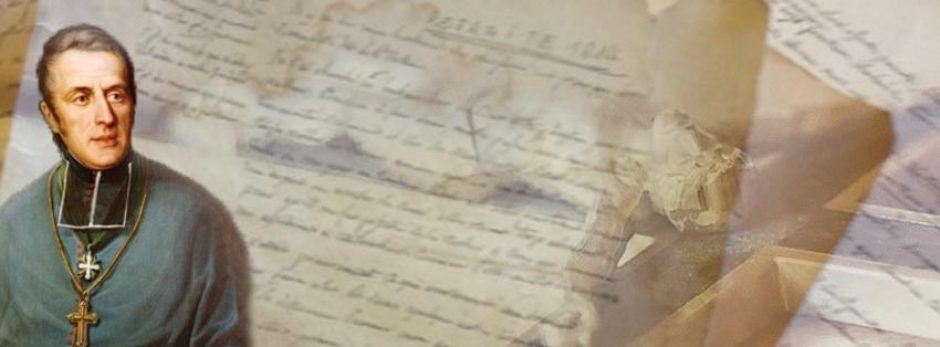
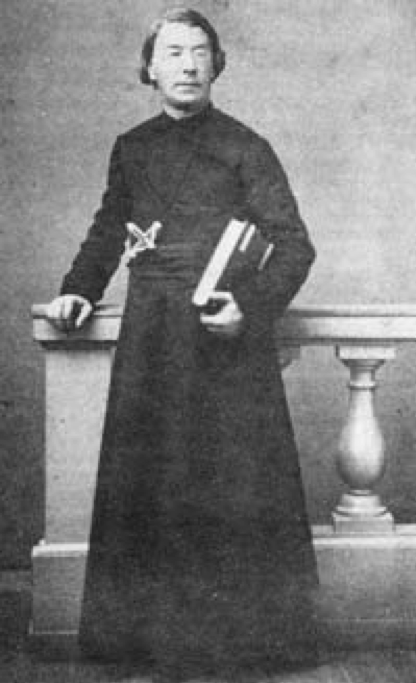
ALEXANDRE DUPUY AND OUR FIFTH OBLATE FOUNDATION

Another of the early Oblates who left an impression on our story. Yvon Beaudoin writes:

Alexandre Dupuy was born in Aix on November 29, 1798. His parents have not been identified. Madame Joannis, Eugene de Mazenod’s grandmother, paid for his upkeep and education until he entered the novitiate of the Missionaries of Provence on October 3, 1816.

His early years were spent in the care of a farmer’s wife on a farm in the demesne of Madame Joannis in the area of Banon near Aix. When he was seven years of age, he was baptized publicly in the Cathedral of St-Sauveur in Aix. His primary studies were made first with Roze-Joannis, the nephew of Madame Joannis, and then with the Frères Gris (Grey Brothers). For his secondary education he went to the minor seminary of Aix. Finally, he followed the formation given to the Oblate novices and scholastics at Aix and at Notre-Dame du Laus. He was ordained on June 16, 1821.

In 1830 he asked to leave the Oblates…  It can be said that his departure was providential for the Congregation. It is thanks to him that the Oblates came to Notre-Dame de l’Osier in 1834, a place where they were still present until recently.

When he left Notre-Dame du Laus, the Abbé Dupuy entered the service of Bishop Philibert de Bruillard of Grenoble. The latter appointed him parish priest of Notre-Dame de l’Osier, also in the hope that he would give new life to the Marian shrine there; it had been abandoned since the French Revolution. In the beginning of 1834 the new parish priest purchased the former Augustinian monastery that was adjacent to the shrine and set about restoring it. Father T. Dassy, who was recovering from a serious illness and needed a change of air, came to spend the summer with him. Father Dassy was a good preacher and easily made contacts with people and he worked so well that he won the Bishop’s confidence and obtained, with the Abbé Dupuy’s consent, that the shrine and the parish of l’Osier be entrusted to the Oblates as early as the end of 1834.

In 1837 the Abbé Dupuy sold his properties at Notre-Dame de l’Osier to the Oblates and then transferred to the service of Bishop de Mazenod, who in that year had become the Bishop of Marseilles
https://www.omiworld.org/lemma/dupuy-alexandre-1798-1880/ 

Posted in WRITINGS | 1 Comment

I DON’T ATTACH AS MUCH VALUE AS YOU TO ALL THE PRAISES AND APPRECIATIONS THAT ARE SHOWERED UPON YOU

We saw in the previous entry what a talented person Fr Dassy was. The result was that in his preaching and missionary work he received high praises, which he obviously enjoyed. Eugene watches over this young Oblate missionary, acknowledging the good, but also wanting him to be focused on what really counts.

My dear friend, it makes me very happy to see the good work you have embarked upon, but I don’t attach as much value as you to all the praises and appreciations that are showered upon you. It doesn’t amount to much in my estimation…

Letter to Fr. Louis Dassy, 25 April 1834, EO VIII n 479

Posted in WRITINGS | 1 Comment

LOUIS TOUSSAINT DASSY, A GIFTED AND COLORFUL OBLATE

From now on we will regularly be coming across names of Oblates who were influential in the life and mission of the Congregation. As we encounter them for the first time, I will write something about them so that “Letter to Fr…..” will make more sense and the addressee is seen as a member of the Mazenodian Family and not just a name. Today I would ;like to introduce you to Fr. Louis Toussaint Dassy.

He was born in Marseilles, and at the age of 20 entered the major seminary, which was under the direction of the Oblates. A year later he joined the Oblates and was ordained in 1831. As a result of the Revolution of July 1830 his first years were spent as a preacher of parish missions in Switzerland.

From 1834 we will be reading about him as he was at the newly-established Shrine of Notre Dame de l’Osier, the fifth house of the Oblates.

Yvon Beaudoinn writes: “He soon began to display the wide range of his talents: ministering to the pilgrims during the summer, preaching parish missions, close collaboration with the superior in the work of repairing the convent and the construction of a lodging house for the pilgrims, the writing of some works on history and archaeology, etc. Intelligent, learned, enterprising, he succeeded in everything he undertook and completed his tasks with dispatch.”

This talented Oblate then worked in various Oblate foundations in France until 1853 when he was appointed to the Calvaire in Marseilles. Beaudoin continues the story:

Founder of the Institute of Young Blind People and of the Congregation of the Sisters of Mary Immaculate (1857)

During his apostolate at Le Calvaire and his preaching at Marseilles, Father Dassy encountered a number of blind people. He stated that he had counted over 200 in the city, many of whom were children. Already in 1853, he wanted to set up an organization to address the needs of these poor wretches. On June 29, 1857, he laid out his plans before Bishop de Mazenod. He requested permission to take up residence in the Oblate community of Notre-Dame de la Garde and to carry out the apostolate to the young blind people which he wanted to establish at the foot of the hill. In a few years, the work flourished; a large institution was built and a religious congregation established…

Indeed, May 17, 1858, Father Dassy, well known through articles in journals and some works on the history of the Church and the religious monuments of Marseilles was elected to the academy of Marseilles. There he took his place beside his older brother, Joseph, a painter and curator of the city’s museum. In 1866, Abbé Dassy was appointed permanent secretary of this academy. In 1886, he received the cross of the Legion of Honour.

Certainly a colorful and gifted man. More details can be found in: https://www.omiworld.org/lemma/dassy-louis-toussaint/

Posted in WRITINGS | 1 Comment

I LOVE MY FRIENDS, SO WORTHY AS THEY ARE OF THAT TITLE

Another glimpse into the heart of the Founder and Superior General. Eugene loves the Oblates and considers them friends – in the same way that he wrote elsewhere that Lazarus was the friend of Jesus

…through all this, although I have a keen desire to be in closer touch with those who have my affectionate love, yet it is such a consoling experience interiorly that I cannot bring myself to lament or regret it; I love my friends, so worthy as they are of that title, for all that they are as well as for all that they achieve; it is a flowing stream that runs in a flood that causes no damage and whose abundant waters can but irrigate and make fertile.

Letter to Henri Tempier, 31 October 1833, EO VIII n 472

Posted in WRITINGS | 1 Comment

FIRM CORRECTION AND LOVING GUIDANCE

Eugene shows the concerns of his fatherly heart: severe when correction was needed, but loving nevertheless. The two young Oblates he writes about had been ordained priests for a couple of months.

Give G[ignoux] a good shaking up, show him no mercy. What a pity that with all that talent he should surrender himself to that useless mysticism that will end up leaving him in a complete fog and deprive him in the meantime of all possibility of doing some good.
Take care not to discourage Marcellin; he mustn’t be made too conscious of his mediocrity, that would quite incapacitate him; he has good qualities, he should be helped to exploit them.

Letter to Henri Tempier, 29 October 1833, EO VIII n 471

Posted in WRITINGS | 1 Comment

CARE FOR THE YOUNGER MEMBERS

We have been following the events around the difficulties between Eugene and the French government, and I have focused only on these for several weeks. While all this was going on, he was always Superior General of the Missionary Oblates. I will now go back chronologically to pick up the narrative on his relations with his Missionary Oblate Family.

During the months that Eugene was in Rome, Father Tempier had been his Vicar in France, handling the day-to-day affairs of the Congregation. Eugene’s correspondence with his Vicar shows his fatherly concern:

… When moving someone you must always ask whether it will result in the dismantling of the work that person is doing. … You could not do better than change Pélissier [ed. who had only been ordained for 6 months), Marseilles does not have much to offer him, but I doubt whether he has the capacity to endure the solitude at Billens; his vocation is too recent to be put to that test…
You did the right thing in giving that angel Aubert a change of air for a while; I do hope that it is only a question of his taking a break which you felt he should have, not of a mandatory rest. I am always anxious about that child, for fear that his health may suffer as a result of all the work he has. …
I am delighted that Vincens is not flagging, a few like him would do wonders for you.

Letter to Henri Tempier, 29 October 1833, EO VIII n 471

Posted in WRITINGS | 1 Comment

A PAINFUL CONCLUSION

The Pope and the authorities at the Vatican were steering a delicate political situation with the French government because they saw the larger picture of maintaining relations between Church and state. In the process they “sacrificed” Eugene, who wrote to the Vatican:

[…] So as not to cause the least distress to the Holy Father, I have instructed my advocate to abandon my action and withdraw my appeal…

Eugene feels misunderstood and abandoned by those in the Church whom he had served so faithfully:

Bishop Capaccini is happily undisturbed in the Quirinal, he pays no heed to the quality and immensity of the sacrifice made by a Bishop who abandons his rights and disarms in the face of an astute and powerful enemy, quite ready to abuse his victory and walk all over me as he likes.

Eugene had always been loyal to the Pope, in the face of fierce opposition as being “ultramontane.” The extent of his sense of abandonment by the Vicar of Christ, leads him to write these bitter words:

Enclosed is a copy of my letter to the Ministry of Worship. In it you will see I leave everything and abandon myself to Divine Providence. I wish I could add “and to the benevolence of the Holy Father”, but I hope for little from that quarter. The Holy Father, if I understand him correctly, has placed no value on either my character or my services, which gave me a right to his protection, nor on the affection accorded me by Leo XII and Pius VIII. If persecution drives me into exile from my country and to withdraw to Rome, I know I may not count on either grace or favour; my reward must come from God.

We touch the fullness of his pain in this letter.

I wish I had a less sensitive heart, I would love less, be less tied up in a host of things which affect me very deeply within and I would be happy.

Letter to Bishop Frezza, Secretary of the Congregation for Extraordinary Affairs at the  Vatican, 28 November 1834, EO XV n 175

Beaudoin concludes the narrative:

“He passes the winter of 1834-1835 at Marseilles, but in the spring he sees that his position is untenable… and leaves for L’Osier and N.-D. du Laus. There he will stay until the end of October.” (EO 8 pages XXV-XXVI)

Posted in WRITINGS | 2 Comments

A YEAR OF ANGUISH

Yvon Beaudoin narrates:

“It is the crucial point in this difficult episode of Bishop de Mazenod’s life. The faithful “Roman” appears abandoned by the Curia, at a time when the police are free to expel him from France whenever they like and so separate him from all his loved ones: his uncle Fortuné, Tempier, the Oblates, etc. With good reason Rey writes that the year 1834 was a year of anguish for the Founder.” (EO 8 pages XXV-XXVI)

We pick up his anguish in this sentence from his letter to the Vatican:

I wish I had a less sensitive heart, I would love less, be less tied up in a host of things which affect me very deeply within and I would be happy.

Letter to Bishop Frezza, Secretary of the Congregation for Extraordinary Affairs at the  Vatican, 28 November 1834, EO XV n 175

Posted in WRITINGS | 1 Comment

A YEAR OF ANGUISH FOR THE FOUNDER

Yvon Beaudoin continues the narrative.

“In consequence Bishop de Mazenod renounces his action and keeps as much as possible out of the public eye. Even so he does preside at some religious ceremonies in Marseilles and conducts some pastoral visitations in the diocese of Avignon. Even this is too much.

Paris is kept informed of everything and the Government takes the steps necessary to force him into leaving the country, striking out his name from the electoral list, as an alien. The Bishop of Icosia comes to know of this step at the beginning of September 1834, and, without delay, he lodges afresh appeal against this decision; at the same time he informs the French bishops of the persecution he is suffering. He also writes to Rome to explain the reason for his re-opening the case notwithstanding the representations previously made to him.

Bishop Capaccini immediately replies, in the name of the Pope, that he must again renounce his action. The prelate’s letter even contains some expressions that would lead one to think that the Pope is not pleased.”

Yvon Beaudoin EO 8 pages XXV-XXVI

Eugene wrote to the Pope through his Cardinal Secretary of State:

However since His Holiness does not wish me to make use of the supportive declarations of the Bishops, I renounce it. And furthermore: the pain with which the Holy Father views the continuation of the process brought against me and the desire I have to abstain from anything that could displease him, determine me to desist from my appeal, come of it whatever God wills; all the lawyers I have consulted guaranteed me a successful outcome; by my desisting, I am submitting to an iniquitous judgment rendered against me and to the baneful consequences it may have, but neither the advantages promised me, nor the drawbacks I have to fear could make me hesitate when it is a question of the will or even of a mere desire of the Head of the Church. I will inform the French Minister without delay of my desisting and then he will no longer have any pretext for evading the appeals of Your Court. It remains only for me to entrust myself to the benevolence of the Holy Father into whose hands alone I place my interest and my honour.

Letter to Cardinal Thomas Bernetti, Secretary of State, 19 November 1834, EO XV n 174

Posted in WRITINGS | 1 Comment

I WOULD HAVE THE APPEARANCE OF HAVING BEEN SENT AWAY AS A PENANCE BY THE POPE

As we reflect on this period of conflict that Eugene was living, let us remember the personal suffering he was undergoing. Persecuted by the government, removed as Vicar General to his Uncle Bishop Fortuné in Marseilles, and not experiencing any support from the Pope who was in an awkward situation trying to bring maintain political expediency with the government for the sake of the welfare of the Church in France. In the center of all this was the suffering of a person.

The French government had engineered a situation where they were attempting to pressurize the Pope to take action against Eugene, whom they wanted sent away from France. Eugene ‘s message to the Pope was:

But this does not go so far as agreeing to leave France… It is also to do oneself too much violence to condemn oneself, for the satisfaction of a government, to a perpetual exile.

If Eugene did not leave France then the authorities pressurized the Pope to remove him from Marseilles. Eugene’s response:

Likewise I am not decided to go and stay outside Marseilles… really it would be incomprehensible why I would go to live in another town; it would give rise to the worst impression: I would have the appearance of having been sent away as a penance by the Pope, while in reality I would be being persecuted by the government, which would seem not to have anything to do with it, and which would exploit the Sovereign Pontiff to punish me for not being to its liking.

The heart of the matter was:

The truth is I am by no means hostile to the government; I am doing nothing against it, although it might well be true that it does not fill me with enthusiasm. It is because I stay clear of politics and am unassailable on that point that the intervention of the Sovereign Pontiff is sought. I hope that this odious tactic will not succeed and that I will remain at my post.

Letter to Baron D Papassian in Rome, 14 May 1834, EO XV n 173

Posted in WRITINGS | 1 Comment