IT SEEMED TO ME THAT I COULD SAY LIKE OUR DIVINE MASTER THAT A POWER HAD GONE OUT FROM ME AND I KNEW IT

This Holy Saturday ordination brings me back the memory of the first I had the happiness of doing on the same day in 1833.

In the previous journal entry, Eugene had described the priestly ordination of Charles Bellon, and now he reminisced about the first priestly ordination he had ever performed as a newly-ordained bishop. It is a powerful revelation as to what went on in Eugene as he became God’s instrument of communicating the gift of the priesthood in an ordination. He exclaims: “This miracle is worked in every ordination I perform.”

Can I recall without emotion that the first fruit of my fecundity was the precious Father Casimir Aubert, the first on whom I imposed hands. No one could guess what transpired in my soul when in profound recollection I invoked the sovereign priest Jesus Christ with all the power with which I was invested to bring about this great miracle, and lifted up my hands over the dear head of my well-beloved son and passed on to him a share of that abundance of grace and power of which I had myself received the plenitude some months before.
It seemed to me that together with the Holy Spirit who came down on him and with the power of the Most High who was about to overshadow him, – for one may apply to this divine operation that transforms in a way the soul of the new priest as it makes it fruitful, the words of the angel to the Mother of God, – it seemed to me, I say, that my own spirit communicated itself to him, that my heart expanded in the outpouring of a charity, a supernatural love that produced in its turn something more than human.
It seemed to me that I could say like our divine Master that a power had gone out from me and I knew it. At all events I was in a transport with that very real and wholly-of-God power that I was passing on with force and efficacy and that I could say as it were went out from me, since it was in me radically through the character I possessed, all unworthy though I may be.
This miracle is worked in every ordination I perform and I experience it to a greater or lesser extent according to the quality of those on whom I impose hands, for I confess that paternal love is at work in the very midst of all these marvels, especially when I see my children disposed as I desire. Thanks be to God, it is what I believe I have perceived in the majority of those I have ordained up to now.

Eugene de Mazenod’s Diary, 25 March 1837, EO XVIII

Beautiful words that remind us that the priesthood is not a career but a God-given responsibility.
Posted in WRITINGS | 1 Comment

THE HAPPINESS OF MY TWO-FOLD PATERNITY

Eugene wrote in his personal journal:

Holy Saturday: Ordination of our worthy Brother Bellon…
Our hopes could not be higher for this well-beloved child, who not only has never earned the least reproach since he entered the Congregation, but has constantly given to all his confreres, both during his novitiate, and during his period as an oblate [ed. scholastic], the example of the most exact regularity, fidelity to the rule, and sustained fervour.
We were together as a family in the chapel of the bishop’s house, where I carried out the ordination, and the feelings that inspired this meeting of brothers echoed the happiness of my two-fold paternity brought me at this indescribable moment when by the communication of the gift of God and the power of the Holy Spirit the bishop gives birth to the priest.

Eugene de Mazenod’s Diary, 25 March 1837, EO XVIII

The father of the Oblates rejoices that as a bishop he is able to be the instrument (“father”) of the candidate on whom he conferred priestly ordination.

For further details about the missionary life of Father Charles Bellon see https://www.omiworld.org/lemma/bellon-charles-barthelemy/

Posted in WRITINGS | 1 Comment

THEIR SOULS ARE NOT WORTH MORE OR LESS THAN THOSE OF THE LEAST PEASANTS, IF WE CONSIDER THEM IN TERMS OF THE PRICE THE LORD HAS PAID FOR THEM

The approach of the Oblates was always to be close to the people, especially the poorest and most abandoned. In Provence these were the people who did not understand much French, so the Oblates preached in the Provencal language. Father Honorat had been intidiated by some of the wealthier parishioners, and broke this rule. Eugene wrote in his diary:

Letter from Father Honorat from the Maussane mission. It is beginning under auspices as promising as those of Fontvieille. Attendance at the exercises is such that the church is too small although they have made provision for letting in at least 200 people more than usually entered previously. Father Honorat tells me that the parish priest was highly delighted that our Fathers give the instructions in Provençal, although with his consent and to yield to the desire of five or six bourgeois who demand some conferences in French, he has allowed himself be persuaded to preach in the evening alternatively in the two languages.
I could not sufficiently reprimand this weakness; I never agreed to it, when I gave missions, to satisfy that stupid vanity of a number of bourgeois whom you find in every village you evangelise. It is tantamount to sacrificing the instruction that would attract the people through sermons in the language they speak. It is acknowledged that they are unable to follow reasoning made in French. The poor people hear just words that do not tie up with any of ideas when one preaches in French. It is something beyond doubt, it has been tried, and it is to go directly against the end of our institute to imitate the example of only too many priests who have delusions about this.

Eugene de Mazenod’s Diary, 26 February 1837, EO XVIII

To Father Honorat he wrote:

I worry little about the infinitely small number of bourgeois people who have not yet shown any sign of good will. The majority of them, if not all, will surrender like the others. In any case, their souls are not worth more or less than those of the least peasants, if we consider them in terms of the price the Lord has paid for them.
 Thus it is foolish to be more concerned about these gentlemen than about the other good people of the area.

Letter to Jean Baptiste Honorat, 28 February 1837, EO IX n 606

Posted in WRITINGS | 1 Comment

WE ARE THE MINISTERS OF HIS MERCY, AND SO LET US ALWAYS HAVE THE TENDERNESS OF A FATHER TOWARDS ALL

Sometimes when we encounter opposition, and even hostility, in our living and expressing Gospel values, we are tempted to respond negatively. Eugene counteracts this here:

We are the ministers of his mercy, and so let us always have the tenderness of a father towards all; let us easily forget the insults that are sometimes committed against us in the exercise of our ministry as the good Lord wishes to forget the offences continually being committed against him. The father of the prodigal son was not content with putting the best robe on him and having a ring put on his finger, he had the fatted calf killed as well.
In the same way, we must not only reconcile sinners, but in the view of all the graces granted to them during the mission, of the guarantees their fidelity gives to respond thereto and of the efforts they have had to make for all this, we admit them to the Eucharist, we give them the bread of life so that they can advance in this new path which they are to follow…

Letter to Bruno Guigues, 20 February 1837, EO IX n 605


Posted in WRITINGS | 1 Comment

REMEMBER THAT YOU ARE SENT TO SINNERS, AND YOU MUST EXPECT RESISTANCE FROM THE DEVIL

Yesterday we read Eugene’s reaction in his personal journal to the incident where Father Guigues had received opposition from some young people. Today we read Eugene’s response to him which reasserts the pastoral attitude which he expected all the members of his religious family to have.

I have just received your letter of the 15th and I am leaving aside everything to reply to it. May God save you, my dear friend, from refusing Communion to those, who, being guilty of the mischief which you mention to me, have been repentant. You yourself admit that they were only carried along by their exuberance and not at all by hostile intention. Oh! you are sent by God to forgive greater sins than theirs and even greater scandals than the one they may have given by their thoughtlessness. Once they had been reconciled, it was your duty to admit them to the Holy Table…
Remember that you are sent to sinners, and even to hardened sinners. You must expect resistance from the devil; he will not easily let go of his prey. This resistance manifests itself now in one way, and now in another. Jesus Christ is always the victor, “Christus vincit.” He demands sacrifices, “Christus imperat.” He establishes his reign in souls, “Christus regnat.” This is all that we desire, this is the result of and compensation for our labours.

Letter to Bruno Guigues, 20 February 1837, EO IX n 605

Posted in WRITINGS | 1 Comment

SINNERS SHOULD BE WELCOMED WITH THE MOST MOVING KINDNESS

Letter from Father Guigues. The Theys mission that he is currently giving, with his colleagues from the house of N. D. de l’Osier, is going wonderfully. The missionaries are in the confessional from morning to evening.

They have it is true had the disagreeable experience of seeing some very badly disposed bourgeois families indulging in giving scandal, creating a kind of provocative uproar, but public indignation and the missionaries’ silence soon settled that, … and several of the youth who had let themselves be influenced presented themselves for confession.
On this point, Father Guigues asks me if it would not be proper to refuse outright giving communion to these young people whom he admits were seduced into going to that unseemly event and had no hostile design.
… May God grant that this unhappy idea, due to inexperience, won’t have led the missionaries to receive these sinners coldly, when they should be welcomed with the most moving kindness, first to console them in doing something which is always difficult to nature, and also to enable them to encourage others who still hesitate.

Eugene de Mazenod’s Diary, 19 February 1837, EO XVIII

Posted in WRITINGS | 1 Comment

REMEMBER to take some time to unite yourself with the Family of St Eugene de Mazenod today in the practice of oraison


https://www.omiusa.org/index.php/2019/11/01/31015/

Posted in WRITINGS | Leave a comment

ORAISON: PRAYING WITH THE MAZENODIAN FAMILY

“In the prolonged silent prayer we make each day, we let ourselves be molded by the Lord, and find in him the inspiration of our conduct” (OMI Rule of Life, 33).

The practice of Oraison was an important part of St. Eugene’s daily prayer during which he entered into communion with the members of his missionary family. While they were all in France it was easy for them to gather in prayer at approximately the same time. When Oblate missionaries started to be sent to different continents it was no longer possible to pray at the same time, yet each day there was a time when they stopped and prayed in union with one another – even though not at the same time.

This is a practice that Eugene wanted the members of his religious family to maintain.

This is why you are invited to take part in this practice of Oraison on Sunday, November 17, 2019 at any time of your choice, as we remember the feast of the Spanish Oblate Martyrs later this month.

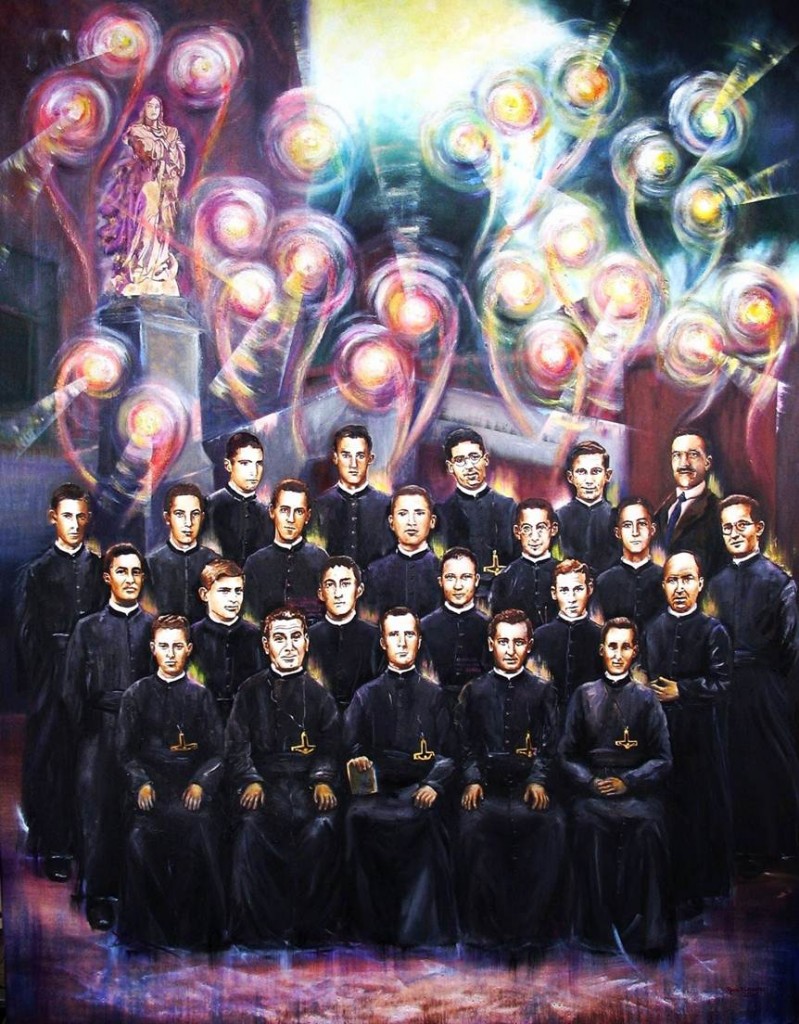
“The three-year period from 1936 until 1939 was a time of bloody martyrdom for the Church in Spain. During this religious persecution, there were thousands of people who suffered violent death. Within this general climate of hatred and antireligious fanaticism, one may justly place the martyrdom of 22 Oblates: priests, brothers and scholastics from Pozuelo de Alarcón (Madrid). On July 22, 1936, a large contingent of armed militia attacked the Oblate house. The Oblates were made prisoners in their own house. On the 24th, at about three in the morning, the first seven were executed. On November 7, two more were and on November 28, the remaining thirteen. (Excerpt from Oblate Prayer Book (pgs. 148-149)

John 15: 13-14

No one has greater love than this, to lay down one’s life for one’s friends. You are my friends if you do what I command you.

Excerpt from the Deposition of Father Felipe Diez Rodriguez

From the first moment we were detained, in each one of us, there was a presentiment that we would be assassinated because of our status as religious.

Yet, within us, all that transcended was the spirit of forgiveness on the one hand, and on the other, the desire to offer our lives for the Church, for the peace of Spain, and those whom we thought were going to shoot us.

The only motive that guided us was supernatural, since humanly we were to lose everything. We knew that if we were killed, it would be because of hatred for the Christian faith…

As for the place of martyrdom, the first seven of Pozuelo, I have already stated that we do not know where they were killed; of the others, we know they were murdered in Paracuellos de Jarama. At the time of their death, I heard that there was someone, who by their description matched that of Father Esteban, who asked permission to give absolution to the companions. And whose last words were: “We know that we are murdered because we are priests and religious. We forgive you. Long live Christ the King!”

St. Eugene de Mazenod

“Final perseverance, and even martyrdom or at least death while tending victims of the plague, or any other kind of death for God’s glory or the salvation of souls. “

(One of the intentions for which he offered his first Mass, E.O. XIV n.100)


For further reading, we recommend this material on the OMIWORLD website:

https://www.omiworld.org/wp-content/uploads/09-The-Oblate-Spanish-Martyrs-1.pdf

and

https://www.omiworld.org/our-charism/our-saints/oblate-causes/blessed-22-oblate-martyrs-of-spain/short-story-of-the-martyrdom/?fbclid=IwAR1Vny5uEfhTj1-nsivki1IPxomj9uqa7i_rRIHosU6QDB-SFJbZm85vaEo

Posted in WRITINGS | 1 Comment

IT WAS FROM THE FOOT OF THE ALTAR THAT THEY WERE GOING OUT FOR FRESH CONQUESTS

Anniversary of the approval of the institute by the Holy See… The second renewal prescribed by the Chapter was carried out immediately afterwards, in my presence, by all the priests and oblates [ed. Eugene always referred ot the scholastics as “oblates”]. The novices were present at the ceremony…. Once one has made one’s renewal kneeling down before the exposed Blessed Sacrament with candle in hand, one remains standing in a circle around the altar.

Since our approbation by the Pope, on February 17 1826, it has always been customary for Oblates to renew their vows on that day

The ceremony this morning was not only imposing, as it always is, but moving, I would add again “as it always is”. This was the mutually shared feeling when we met together in the community room.

It was to Jesus the Savior that the Missionaries, his co-operators, came to offer thanksgiving for the success of their missions and to ask for blessings on the ones they were about to undertake.

What was special and I could not help remarking on it in the few words I usually deliver on days like this, was that it was from the foot of the altar that they were going out for fresh conquests, those same men who had come to lay there their acts of thanksgiving for the wonderful successes of the missions they had just accomplished. What blessings in fact had they gathered in the missions, which have just finished in Fontvieille and Entraigues! The Lord will accompany his envoys to Maussane and Mane, and he will bless their labours as he has always blessed all those we have undertaken in his name.

Eugene de Mazenod’s Diary, 17 February 1837, EO XVIII

We too are invited each day to bring our daily successes to the Savior and to renew our trust in his presence to accompany us in our difficult moments.

Posted in WRITINGS | 1 Comment

ORPHANS WELCOMED WITH CHARITY AND TRUST IN DIVINE PROVIDENCE

At the end of each day, Eugene would write his personal journal and record some of the events of the day and his personal reactions. Today he gives thanks for the project of the orphanage which he and his uncle had established for the children left without families because of the recent cholera epidemics.

Although I am still not fully recovered, I could not refuse the appeals made to me to go and bless the temporary chapel and house for the cholera orphans. The liturgy went very well. After the blessing of the chapel and before beginning the Holy Sacrifice, I was content to address a few words to the large congregation to excuse myself for not having the strength to speak. These few words were accepted with a kind of gratitude precisely because of the efforts I had to make to express what I was feeling.
It was marvellous actually to find oneself in this fine building, put up within ten months since we came and blessed the first stone on the rocky slope. The work had been begun under the auspices of the chief pastor, to offer support to a dozen poor little orphans, and now I saw eighty of them in front of me, and in a few days another twenty are going to be welcomed with the same charity, and the same trust in divine Providence! After Mass, we went in procession all around the house to bless it.

Eugene de Mazenod’s Diary, 12 February 1837, EO XVIII

Eugene’s time in Marseilles would be marked by countless activities like this one as he tried to respond to the needs of the most abandoned.

Posted in WRITINGS | 1 Comment