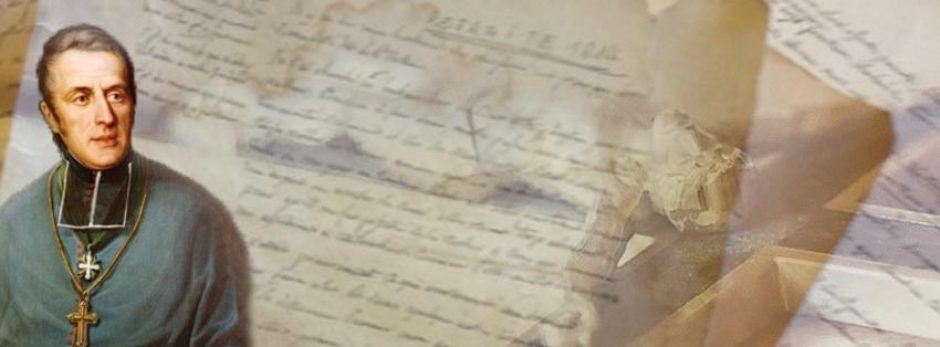
I DO NOT WANT TO BECOME THE PASTOR OF MARSEILLES, NEVER EVER

Three weeks earlier, Eugene’s despondency and suffering as the result of the harsh treatment he had received from the local authorities and from some of the priests of Marseilles (which we saw in earlier entries) had led him to this outburst.

As to my position concerning Marseilles, it has been made absolutely clear, my ties were broken by my resignation and the appointment to the office of vicar general of my successor.
I’m not the pastor of the people of Marseilles, and I don’t ever want to be; what does their opinion matter to me? People’s injustice has taught me to scorn infamous judgments that come down always on the side of lies rather than truth.
Regarding Marseilles, I gave them all for twelve years; sacrifices of all kinds; complete devotedness, with no return on the part of the townsfolk except the basest ingratitude. I made up my mind long ago, that after the death of my much loved and venerable uncle, I’d keep my independence and free myself of all the cares that have taken their toll of me during all the years I was everyone’s lackey, even my bitter enemies’.
I do not want to become the pastor of Marseilles, never with a capital N.

Letter to Henri Tempier, 31 July 1835, EO VIII n 528

Now, just a few weeks later, they were pressurizing him to change his mind and accept a diocese!
Posted in WRITINGS | 1 Comment

MY CAREER IS OVER; I HAVE NEITHER THE STRENGTH NOR THE FLEXIBILITY TO EMBARK ON ANOTHER

Recoiling from the suggestion that he accept to be bishop of a diocese, Eugene appeals to two arguments: he no longer has the energy to administer a diocese, and that he has the responsibility of Superior General of the Oblates.

Clearly your friendship is leading you astray in your hope of making peace all round through the use of a method that would be disastrous for me. My career is over; I have neither the strength nor the flexibility to embark on another where it wouldn’t be long before I were submerged in every kind of sorrow, compensated by precious few consolations.
All my reflections lead me to the conclusion that I cannot in conscience accept a diocese if one were offered me. What a following I would have gathered if I offered the least hint to the contrary! This conviction is so rooted in me that nothing short of a formal command from the Head of the Church would suffice to overcome my justifiable distaste, and then I would be condemned to a most unhappy life, and one which would certainly be cut short on account of the continual violence that I would have to do to myself. To this repugnance are added reasons of conscience which ought to distance me from any diocese, which would necessarily entail a double responsibility for me.

Letter to Henri Tempier, 23 August 1835, EO VIII n 536

Posted in WRITINGS | 1 Comment

I’M UNABLE TO COMPROMISE WITH ERROR, LIES AND IMPIETY

In 1832 Eugene had been appointed Titular Bishop of Icosia, without a connection to an actual diocese. Now, in order for his episcopal status to be recognized by the government, he was expected to be linked to an actual diocese in France.

In his letter dated August 17 to Father Tempier, Father Guibert said that he had made the proposal to the Minister that the government name the Bishop of Icosia coadjutor to his uncle or even to the first vacant diocese; this would oblige him to take the oath and to prove to the Government and to the King that he was not hostile to them. (cf REY, I. 645)

Eugene’s response was a categorical refusal.

My dear friend, what have you done? What is this abyss you wish to hurl me into? I have reached harbour, and do you want to expose my frail craft once again to tempest and reef, which it would be impossible for me to avoid? No, no, no! I’ve learnt by experience. I am not up to achieving any good in that elevated position in this day and age…
One would almost say that Providence made a mistake over the century in having me born in this one, with the dispositions and, if you like, the qualities that were needed to do great things two hundred years ago. I’m unable to compromise with error, lies and impiety. I’m a man of dedication; but the frankness of my character and my uprightness in all that I undertake hinder me from clouding the issue, as you have to do to succeed when one has to deal with people who don’t have a sincere desire for what is good, and apply themselves to it only because it’s politically correct.

Letter to Henri Tempier, 23 August 1835, EO VIII n 536

Posted in WRITINGS | 1 Comment

MONTHLY ORAISON WITH THE MAZENODIAN FAMILY

Sunday, September 15, 2019 any time between 12 AM – 11:30 PM

“In the prolonged silent prayer we make each day, we let ourselves be moulded by the Lord, and find in him the inspiration of our conduct” (OMI Rule of Life, 33). The practice of Oraison was an important part of St. Eugene’s daily prayer during which he entered into communion with the members of his missionary family.

You are invited to take part in this practice of Oraison. Sunday, September 15th, is the memorial of Our Lady of Sorrows and the anniversary of the beatification of Blessed Joseph Gerard, OMI. With Mary contemplating Jesus Christ crucified and with Bl. Joseph Gerard who dedicated his life to preaching Him, you are invited to set apart some time this day to enter into prayerful communion with the whole Mazenodian Family.

Just choose a time for personal prayer wherever you like, in unity with all the members of the Mazenodian Family

Please feel free to let us know (https://www.facebook.com/events/364263131171686/) that you will be joining in prayer and share with others who would be interested.

Posted in WRITINGS | 3 Comments

I WANT TO PRESERVE MY DIGNITY, EVEN IF I AM THE VICTIM OF INJUSTICE AND CALUMNY

Now that the door had been opened, Father Guibert wrote about the next step to be taken. (All the interactions were done by letter because Guibert was in Paris, Eugene was at ND du Laus and Henri Tempier was in Marseilles.)

The Bishop of Marseilles and the Bishop of Icosia will write letters to the king, calculated to remove any suspicion of hostility. The Bishop of Icosia, moreover, will assure the king that the charge of his being an enemy of the government was a calumny, that when he accepted the titular bishopric, if he had thought that this would pain his majesty, he would have refused; that, moreover, if there was anything irregular in that, he begs his majesty, by his sovereign will, to kindly remedy it.

Hippolyte Guibert to Bishops Fortuné and Eugene, 17 August 1835 quoted in Leflon II p 498

Eugene was not happy at having to overlook the harsh treatment he had received from the government and to pretend that it had all been his fault.

My dear Tempier, you saw in my last letter that I agree with what Guibert sends you without raising any doubts that he has been able to prepare the way and that the King showed himself to be very disposed.
As to the letter you advise me to write, I don’t think it opportune at this moment, for it would be difficult to do it without humiliating oneself. When I have received justice, if they decide to do so, then will be the time to say thank you; but now, when I am still liable to be rejected, I put too much at risk. That Minister has taught me to fear those kinds of set-backs; I still remember the insolent reply he gave to my generous overtures; so I am not going to write. I want at least to preserve my dignity, even if I am the victim of injustice and calumny.

Letter to Henri Tempier, 21 August 1835, EO VIII n 535

Tempier’s replied, not hiding his exasperation:

Oh, how tedious it all is when we apply the zeal and activity that we have put into this affair! This lack of appreciation takes away half of my strength and courage and I admit that if my motives for acting were not as strong as they are and if the person in whose favor we are so concerned were not so close to me and dear to my heart, I would take it much, much easier. . .

Letter of Henri Tempier to Eugene de Mazenod, 23 August 1835, EO2 Tempier n 82


Posted in WRITINGS | 1 Comment

PLEADING FOR EUGENE WITH THE FRENCH KING AND QUEEN

Father Hippolyte Guibert had gone to Paris to fund-raise for the seminary in Corsica and to plead the cause of Eugene with King Louis Philippe. On 11 August 1835 he wrote to Father Tempier to report on his visit with the King. Guibert wrote:

I then told him that when passing through Marseilles, I had seen the venerable bishop who had ordained me and, knowing that I was coming to the capital, the venerable old man told me the grief he was suffering in the closing hours of his life, because of his nephew’s predicament and because of the calumnies of which he was the victim.

After the Ajaccio superior finished his vindication of the Bishop of Icosia, Louis Philippe answered:

that he was very glad to hear what I had just told him and that he hoped he had been mistaken; that, regardless of what had happened, he was still willing to forget everything. Once this first point was won, Guibert pushed on by recalling ‘the disastrous decree which had taken away French citizenship from a man like the Bishop of Icosia who is French to the very depths of his soul.’ The king then said to me: ‘Do you realize that he accepted a titular bishopric without my permission?’ ‘Yes, I know that, Sire, but I assure Your Majesty that it was done in good faith and in ignorance of the decree, and not from any motive.’

‘Very well! I take your word for that,’ replied the king. ‘For the rest, I would want nothing better than to withdraw that decree; however, the matter must be handled according to the usual procedure. Louis Philippe concluded by declaring that he would look ‘very favor­ ably upon any steps taken to restore harmony. Religion will gain by it.’ Quoted in Leflon II p. 494-495

A week later, Father Guibert had an audience with the Queen, reported in Leflon II p. 496:

On August 17, the queen to whom “the king had spoken regarding Guibert’s two requests,” in her turn, granted the superior of Ajaccio an audience. Marie- Amelie made quick dispatch of the first matter by promising “to provide for our chapel,” and then immediately took up the matter of the Bishop of Icosia. Guibert then offered his vindication, emphasized the worth of the prelate, “a man of great ability,” and requested the mediation of the queen, who proved “kind and understanding beyond all words.”

The path to reconciliation had been successfully begun.

Posted in WRITINGS | 1 Comment

ISN’T IT MY DUTY TO SAFEGUARD MYSELF AGAINST THE POSSIBILITY OF A STILL MORE FIERCE PERSECUTION?

We have been following the difficulties experienced by Eugene on many fronts. Finally, in August 1835, some hope appeared of resolving the conflict between the French government and Eugene over the issue of his having been appointed Bishop of Icosia by the Pope without having received government approval. Consequently, he had been deprived of his rights as a citizen and was in danger of being expelled from France at any moment.

The opening came from two events. The first was that Father Guibert had gone to Paris on business for the seminary he was responsible for in Corsica. Guibert was a friend of the Queen and thus had access to the King to be able to plead Eugene’s case.

The second opening came from an assassination attempt on King Louis Philippe on 28 July. There were many victims, but the King was unharmed. For the first time since the 1830 anti-religious government had taken power, the Minister of Worship approached the Bishops in the King’s name to ask that prayers be ordered in all churches for the victims and that a Te Deum be sung in thanksgiving for the safe deliverance of the royal family. This was the first time in 5 years that there were signs of a decrease of hostilities.

Eugene saw the possibility of reconciliation with this change of attitude.

My dear friend, reflecting on your letter of yesterday, it has to be acknowledged that it is through orders from higher up that these overtures have been made. In the light of this it has to be presumed that there is an intention to bring about a reconciliation, and that one could count on finding attitudes of goodwill, at least in these first moments.

Eugene sees this as an opportunity to approach the King to bring an end to his painful situation:

And so I think it would be to the point for my uncle to write in his own hand to the King, to put an end to the persecution that is weighing upon me. … I think that there would be good reason for us to reproach ourselves if we did not try in this way to bring about a cessation of this state of unjust oppression. If we don’t succeed, it will be a set-back, but we will have done what prudence and wisdom suggest. Not that I can promise myself in consequence that I shall be left in peace. I would not ask for more than to lead the life that I have been leading these last two months, during which I compete in exactitude of performance at all the exercises of our communities with the least of the novices. But isn’t it my duty to safeguard myself against the possibility of a still more fierce persecution?

Letter to Henri Tempier, 17 August 1835, EO VIII n 534

Posted in WRITINGS | 1 Comment

HE IS ON FIRE TO WORK FOR THE SALVATION OF SOULS

The 28 year-old Jean Joseph-Marie Lagier had been a diocesan priest for 5 years and, meeting the Oblates at Notre Dame de l’Osier, discerned an Oblate vocation. At the end of his novitiate year he was preparing himself to make his life-time oblation. Eugene wrote about his with joy.

Speaking of Father Lagier, I can tell you that I have never seen anyone prepare himself for a holy event of oblation as he did. And in consequence what fruits won’t he derive from it? Father Lagier can’t contain himself for jubilation. He told us, he who has always been so fervent both at the seminary and in the parish, that he has never known such peace and happiness, that he was overflowing with gladness and along with these outpourings from his noble soul he brings a firm resolution to do all for the glory of God, the service of the Church and of the Society, in whatever work obedience assigns him.
He is on fire to work for the salvation of souls, but he waits without anxiety for his superiors to choose the ministry in which they wish to employ him. To sum it all up in a few words, a more perfect subject couldn’t be found.

Letter to Henri Tempier, 16 August 1835, EO VIII n 533

Jean Lagier was to continue living in this spirit for the rest of his life, and sharing it with others mostly as a formator, professor and seminary rector. (See https://www.omiworld.org/lemma/lagier-jean-joseph-marie/ )


Posted in WRITINGS | 1 Comment

FAR FROM YOU I AM MISSING SOMETHING THAT IS ESSENTIAL TO MY EXISTENCE. I AM ONLY HALF-ALIVE

I am not happy with my position. Need I say it?

Exiled from Marseilles diocese, having been deprived of his French citizenship, constantly maligned in the anti-religious newspapers and political circles, and now far away from the people he loved who were being threatened by the cholera epidemic, to say that he was not happy with his position is rather an understatement!

The few lines that follow in this letter are a powerful insight into the person of Eugene. At this moment of difficulty he confides in Henri Tempier, from whom he is geographically separated. “Separated from you, I am missing something that is essential to my existence. I am only half-alive.”

Let us recall that Henri Tempier had been the first companion of Eugene at the foundation of the Missionaries in 1816. He was the one who had immediately understood God’s plan in the charism given to Eugene, and together they worked at bringing the Oblates to the same understanding. On Holy Thursday 1816 they had made a vow of obedience to God and to one another to discern and do the will of God. They were each other’s spiritual directors and confessors. They were indeed “two souls united” in God, in the Oblate vocation and mission, and in the administration of the Diocese of Marseilles.

Personality-wise, they were very different. Eugene was the impulsive charismatic visionary with a heart as large as the world. Henri was quiet, reserved, practical, and always deferential to Eugene’s position as Superior General. These two opposites needed each other, and Eugene could never have achieved what he did without the constant support and advice of Henri.

Although you are often quite moody, and one can’t ever share with you the pleasure of throwing reserve to the winds, of those uninhibited exchanges that are true joy for two souls as united as we are, and although without it being really your fault, I know, but due to your personality, you are always deferring to me, even so I am unable to live without you.
When I’m – I won’t say separated from you, this often happens we are under the same roof – far from you, I am missing something that is essential to my existence. I am only half-alive and very sad.

Letter to Henri Tempier, 1 August 1835, EO VIII n 530

This rare insight into Eugene’s heart makes us understand why he was always inspired by the relationship between Jesus and his friend Lazarus, and held Jesus and his beloved disciples as the model for Oblate life.

Posted in WRITINGS | 1 Comment

I DON’T CARE IN THE SLIGHTEST FOR PEOPLE’S OPINION

In the midst of the published criticisms against him Eugene shares with Henri Tempier:

I don’t get too upset at everything the culprits are staging against me; I would sometimes be tempted to shield myself even from the tiresomeness of having to know what they are plotting against me, taking no more part in human affairs.

For himself, Eugene did not care about these attacks on his person, but they were linked with his office as a bishop and with the whole diocesan administration, and so he felt that a response had to be made.

However, I realize that it isn’t the moment to deliver the sanctity of my episcopal character and the honour of my ministry to the calumny of men who are out to condemn in my person the whole of the administration and the diocesan bishop himself.
It seems to me that my uncle ought to make a public protest … But as always I leave my opinion to another’s judgment and remain passive, with no anxiety and with no great effort. So you can go ahead freely; whether a strong stand is taken or nothing at all is done is a matter of indifference to me, for I don’t care in the slightest for people’s opinion.

Letter to Henri Tempier, 13&14 July 1835, EO VIII n 522

Having officially left the diocese, the decision as to whether to respond or not was left to others – and Eugene was at peace with this, yet humanly it did weigh on him as he confided to his long-time friend, Forbin Janson.

As for myself, I am so weary of my fellow men that all my efforts go to arranging a place of solitary retirement, there to devote all my time to the business of my own salvation in the peace of a regular life divided between prayer and things I choose to do, no longer at the beck and call of all the people whose superior one is and who in actual fact are in a very real sense our masters.

Letter to Charles de Forbin Janson, 16 July 1835 EO XV n 178

Posted in WRITINGS | 1 Comment