THROUGH BAPTISM I BELONG TO GOD AND TO A LIVING COMMUNITY, DESPITE GEOGRAPHICAL DISTANCING

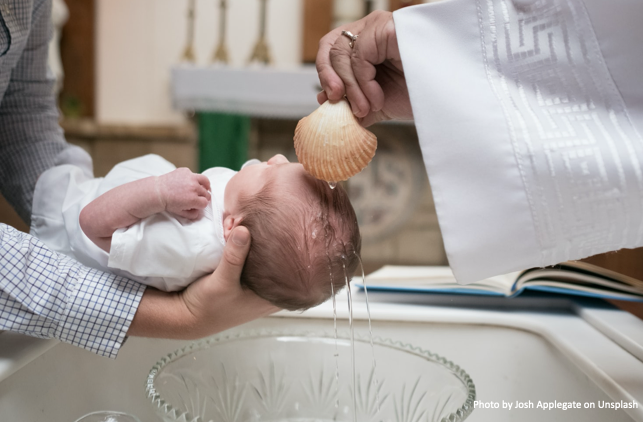
“I tell you most solemnly, unless someone is born through water and the Spirit, they cannot enter the kingdom of God.” (John 3:5

Today’s Gospel reading is John 3:1-8.  The Kingdom of God is not a place but a state of relationship, with God and with the community of believers, that is entered into through baptism. It is our stepping into eternal life already here and it will be fulfilled in eternity.

However isolated we may be, we are never alone: we are in relationship with God and with one another despite geographical distancing.

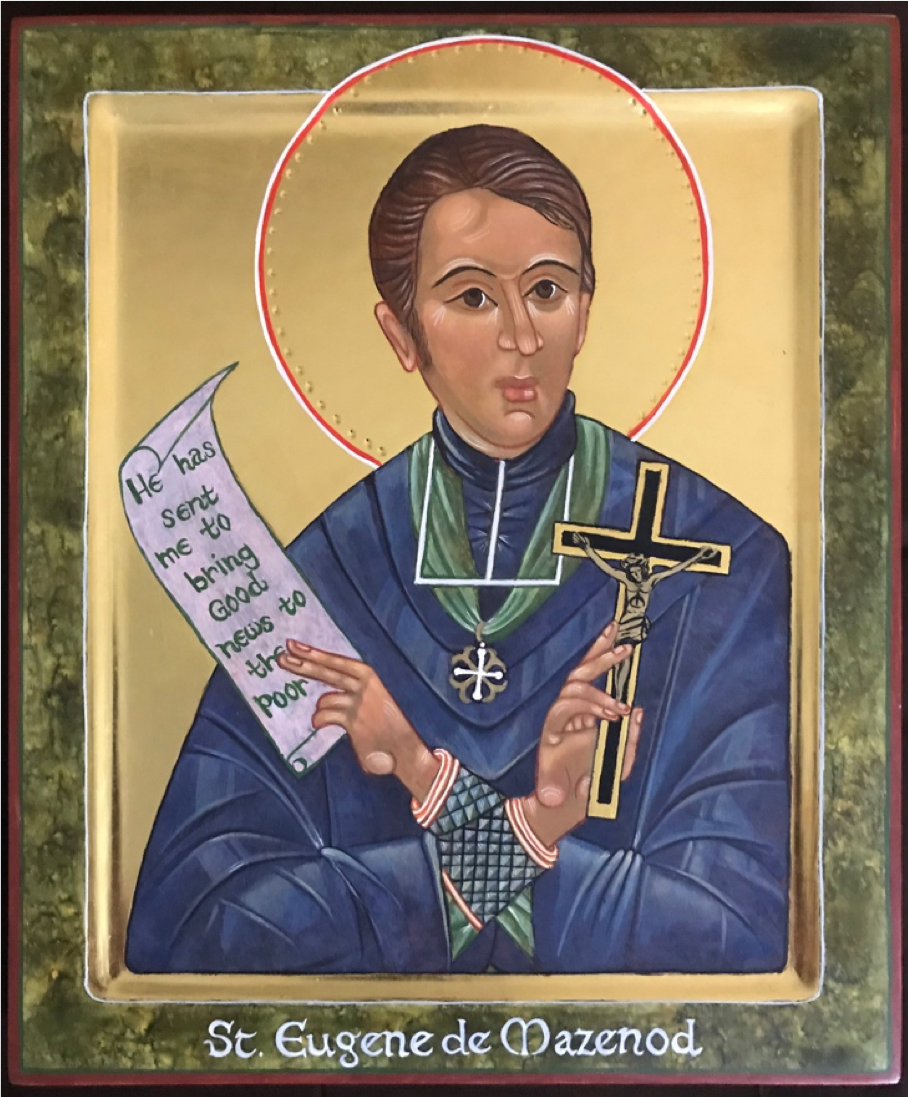
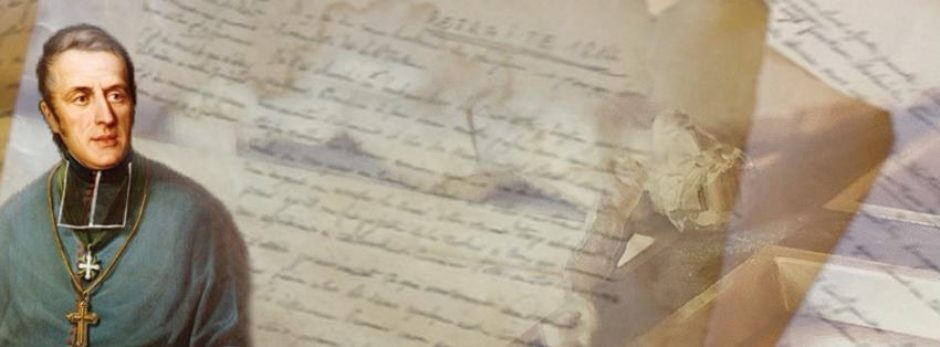
For St Eugene, the most important day of his life was his baptism. He gratefully and solemnly recalled its anniversary every year.
The anniversary of my baptism. Before leaving St-Martin to go to Marseilles, I said, at the Mass, with a profound sense of gratitude, repentance and confidence, joined to what I dare to believe, sincere good will, these beautiful prayers from the Vienna missal:

Blessed may you be Lord, you who in your great mercy have given us new birth to a living hope of an incorruptible inheritance, grant us always to desire, as new-born infants, pure rational milk so that through it we may advance to salvation. (Cf. IP 1,34 and 2,2), God, thanks to your inestimable love, we are called to be your children and such we are (Cf.: 1 In. 3, 1), grant that, through the power of this sacrifice, we, who have received the Spirit of adoption as children in baptism, may obtain the promised blessing as our inheritance.

Lord, this faith, that you have given us at our baptism, we now renew at your altar, renouncing Satan and choosing to fulfill the law of Christ; grant that we, who have received a pledge of the eternal life promised to us, may gain continual growth in the sinless life to which we have dedicated ourselves.

Eugene de Mazenod’s Diary, 2 August 1837, EO XVIII

Let us make this prayer our own today, remembering how at baptism, the Sign of the Cross was traced on our foreheads and we were claimed for Christ our Savior


Posted in WRITINGS | 1 Comment

ORAISON: PRAYING WITH THE MAZENODIAN FAMILY ON APRIL 19

“In the prolonged silent prayer we make each day, we let ourselves be molded by the Lord, and find in him the inspiration of our conduct” (OMI Rule of Life, 33).

The practice of Oraison was an important part of St. Eugene’s daily prayer during which he entered into communion with the members of his missionary family. While they were all in France it was easy for them to gather in prayer at approximately the same time. When Oblate missionaries started to be sent to different  continents it was no longer possible to pray at the same time, yet each day there was a time when they stopped and prayed in union with one another – even though not at the same time.

This is a practice that Eugene wanted the members of his religious family to maintain. This is why you are invited to take part in this practice of Oraison on Sunday, April 19, 2020, as we remember the hope of Easter Resurrection.

http://fabiociardi.blogspot.com/

From a letter of St Eugene to his mother:

After journeying with him through the sad event of his Passion, after weeping over the torments that our sins made him endure, how consoling it is to see him rise triumphant over death and hell, and what gratitude must fill our hearts at the thought that this good Master has really willed to make us sharers in his resurrection, destroying the sin that is in us and giving us a new life. (April 4, 1809)

1 Peter 1:3-9:

Blessed be the God and Father of our Lord Jesus Christ, who in his great mercy gave us a new birth to a living hope through the resurrection of Jesus Christ from the dead, to an inheritance that is imperishable, undefiled, and unfading, kept in heaven for you who by the power of God are safeguarded through faith, to a salvation that is ready to be revealed in the final time.

Posted in WRITINGS | 2 Comments

DURING OUR SOCIAL DISTANCING, SILENT LISTENING FLOWS FROM AND LEADS TO A DEEP LOVE

The disciple Jesus loved said to Peter, ‘It is the Lord.’ At these words ‘It is the Lord’, Simon Peter, who had practically nothing on, wrapped his cloak round him and jumped into the water. The other disciples came on in the boat, towing the net and the fish. (John 21: 7-8)

In John 21:1-14, the disciples had returned to their normal occupation of fishing and the Risen Jesus appeared to them in the midst their everyday activity. They did not recognize him at first, but it was love that opened their eyes.

St Eugene had always loved the Risen Jesus present in his Word. In 1837, before becoming Bishop of Marseilles, he looked back on 55 years of lovingly listening to the Word of God:

I give you thanks, O Lord, for having made shine forth this light from the sacred deposit of your Holy Scriptures. As you show me the way I should follow, and give me the desire to follow it, you will also give me the powerful help of your grace.

René Motte OMI, who made a study of the role of Scripture in the life of St Eugene gives us some practical advice on how we can develop the same attitude as the disciples at the time of Jesus and disciple Eugene. Circumstances today make it more possible for all of us to spend time with the Word of God in this loving attitude:

Silence is necessary, silence to listen to Jesus Christ who speaks in the Bible. Silent listening is generous, since it flows from a deep love. That is what the Oblates [ed. and all members of the Mazenodian family] are called upon to experience “in joy”, says the Founder. They are happy to be in intimate union with Christ, enjoying his word. Thus the mouth will speak from the abundance of the heart (see Matthew 12:34). Consequently, the reading of Scripture is not limited to study; it must be seen in the context of an encounter with Christ. It is thus a listening to his word received as a personal message.

“Sacred Scripture” in Dictionary of Oblate Values: https://www.omiworld.org/lemma/sacred-scripture/

Posted in WRITINGS | 1 Comment

EASTER: THE INVITATION TO DEVELOP A LISTENING HEART

They were still talking about all this when Jesus himself stood among them and said to them, ‘Peace be with you!’   … He then opened their minds to understand the scriptures, and he said to them, ‘So you see how it is written that the Christ would suffer and on the third day rise from the dead, and that, in his name, repentance for the forgiveness of sins would be preached to all the nations, beginning from Jerusalem. You are witnesses to this.’ (Luke 24:35-48)

Handed on to his Apostles by Jesus, this word has lost none of its power in the course of the ages. We have experienced the fact that because it issued from the mouth of him who is himself eternal life, it is always spirit and life.”

Eugene de Mazenod, Pastoral Letter 1844

Today we can understand in a deeper way the experience of the disciples locked in the upper room because they were afraid. The risen Jesus appeared to them and opened their minds to his presence in the Scriptures. Let us invite the Risen Jesus to penetrate the walls of our “upper room” today and give him time to open our minds to understand how present he is whenever we read the Word of God.

Our OMI Rule of Life, totally impregnated by the spirit of St Eugene can be applied to every disciple today:

The Word of God nourishes our spiritual life and apostolate. We will not only study it diligently but also develop a listening heart, so that we may come to a deeper knowledge of the Saviour whom we love and wish to reveal to the world. This immersion in God’s Word will enable us to understand better the events of history in the light of faith. (OMI Constitutions and Rules, C.33)

Posted in WRITINGS | 1 Comment

IN ISOLATION WITH THE WORD OF GOD – MAY OUR HEARTS BURN WITHIN US

Did not our hearts burn within us as he talked to us on the road and explained the scriptures to us? (Luke 24,32)

The downcast disciples returning to Emmaus had lost all sense of purpose. The one they had pinned their hopes on had been put to death, and all that he stood for had disappeared. No more dreams or inspiring ideals… it was time to return home and shut themselves in.

Luke 24:13-35 narrates how they became aware that a “stranger” was walking with them and entered into their experience and opened their eyes.

Here we understand the meaning of Easter: the realization that Jesus Christ is alive and enters into the reality of our lives. Easter is the opening of our eyes and hearts and lives to his presence.

Unable to attend services in church, we are invited to spend time at home with Scripture. Like the disciples let us let him explain his Word to us and set our hearts on fire in our everyday existence.

Saint Eugene’s life was dedicated to explaining the Good News of salvation to those who were most in need. He and his missionaries wanted the hearts of all those who listened to burn within them. The invitation he wrote in the Rule of 1818 continues today:

Our one and only aim should be to instruct people…
not only to break the bread of the Word for them but to chew it for them as well;
in a word, to ensure that when our discourses are over,
they are not tempted to heap foolish praise on what they have not understood,
but, instead, that they go back home edified, touched, instructed, able to repeat in their own family circle what they have learned from our mouth.

At times we feel like those disciples who wanted to shut themselves into their own isolation in Emmaus. Let’s open our eyes to recognize the presence of the Risen Jesus alongside us.  Let us spend some time with his Gospel. As we break the bread of the Word, he helps us to chew it – and our hearts will burn within us.

Posted in WRITINGS | 1 Comment

IN ISOLATION LET US MAKE IT POSSIBLE TO PROCLAIM “I HAVE SEEN THE RISEN LORD”

“Mary Magdalene went to the disciples with the news: ‘I have seen the Lord!’ And she told them that he had said these things to her.” John 20,18

Mary Magdalene was the first to recognize that Jesus was risen and she rushed to tell the disciples who were fearfully isolated in the upper room. “I have seen the Lord!” she proclaimed. Initially incredulous, they too began to experience that Jesus was alive.

As a result of the French Revolution the people of the countryside of France were locked in their ignorance of their faith. Eugene de Mazenod had recognized the presence of the Risen Jesus in his life, and he dedicated his life to proclaiming “I have seen the Lord!” to those who were the most needy of coming to know the Risen Lord.

Inviting others to enter into his life of proclamation, he founded the Missionary Oblates, and insisted that their time be divided between “seeing the Lord” in prayer, reading and reflection and the proclamation, “I have seen the Lord!” whom they had encountered in this way:

The Missionaries will divide their group in such a way that while some strive in community to acquire the virtues and knowledge proper to a good missionary, others are travelling in the rural areas proclaiming the Word of God.
 When their apostolic journeys are over, they will return to the community to rest from their labours by exercising a ministry that is less demanding, and to prepare themselves through meditation and study for a more fruitful ministry when next called upon to undertake new work.

Request to the Capitular Vicars of Aix, 25 January 1816, EO XIII n.2

In these days when so many of us are in isolation, let us use this time in a similar way so that each day we too can proclaim “I have seen the Lord! He is risen and alive for me!”

Posted in WRITINGS | 1 Comment

DURING OUR ISOLATION, OUR RISEN LORD INVITES US TO A SPIRIT OF RECOLLECTION

“Do not be afraid; go and tell my brothers that they must leave for Galilee; they will see me there.” (Matthew 28, 10)

Photo by Sammy Chandio on Unsplash

The Risen Jesus tells the disciples to go back to Galilee: “They will see me there.” Galilee is where it all began for the disciples, it was the place where they met Jesus, and he entered into their lives.

Today, the Risen Lord tells each of us: “Go back to Galilee – go back to that time when you realized that I was present in your life.”

During this time of isolation, the Risen Jesus is inviting us to enter into the Galilee of our hearts and lives.

Saint Eugene frequently did this, and he called it recollection. He wanted all those who followed his way of discipleship to do the same, as he wrote in his Rule of 1818:

The whole life of the members of our Society ought to be a life of continual recollection (Art. 1).

To attain this, they will first of all make every effort to walk always in the presence of God, and frequently try to utter short but fervent  spontaneous prayers. (Art.2,)

Eugene and Jesus shared a deep bond of friendship – and a friend always wants to be in the presence of a loved one. His days are filled with moments of recollection – of short bursts of prayer and expressions of love.

During this Easter spent isolation and this is what Eugene invites us to do in a special way during these difficult days.


Posted in WRITINGS | 1 Comment

EASTER: TO RECOGNIZE AND ANNOUNCE THE POWER OF HIS RESURRECTION

Through the eyes of our crucified Saviour we see the world which he redeemed with his blood, desiring that those in whom he continues to suffer will know also the power of his resurrection (cf. Phil 3: 10).

OMI Constitutions and Rules, Constitution 4

Icon written by Lauretta Agolli for the US Mazenodian Family

After journeying with him through the sad event of his Passion, after weeping over the torments that our sins made him endure, how consoling it is to see him rise triumphant over death and hell, and what gratitude must fill our hearts at the thought that this good Master has really willed to make us sharers in his resurrection, destroying the sin that is in us and giving us a new life.

Eugene de Mazenod  to his mother, 4 April 1809, EO XIV n 50

“We announce the liberating presence of Jesus Christ and the new world born in his resurrection”

OMI Constitutions and Rules, Constitution 4

Posted in WRITINGS | 1 Comment

HOLY SATURDAY: WE FEEL CLOSE TO HER WHO IS THE MOTHER OF MERCY

In her, we recognize the model of the Church’s faith and of our own.


We shall always look on her as our mother.

In the joys and sorrows of our missionary life, we feel close to her who is the Mother of Mercy.

OMI Rule of Life,  CC&RR Constitution 10

Posted in WRITINGS | 1 Comment

GOOD FRIDAY: “MY GOD, MY GOD, WHY HAVE YOU FORSAKEN ME?”

What was the moment when Jesus suffered the most and when he showed his greatest love for us?

It was when, hanging on the cross, he cried out: “My God, my God, why have you forsaken me?”

In the incarnation, Jesus became fully human and became one with us in all our experiences. On the cross, he entered into the extreme experience of human hopelessness: the sense of having been abandoned by God.

He became one with us in all those situations where we cry out in darkness and despair: “Where are you God, why are you absent?”

As we embrace Jesus Forsaken on this Good Friday, let us embrace the door that he opened through his suffering and death: his resurrection and ours.

As I read St. Eugene’s writings, I constantly hear echoes of his Good Friday experience of his fragility and his awareness of God’s healing love. It was a conviction that never left him and that was at the basis of all his ministry: to lead others to his same experience. St Eugene knew darkness and seeming-hopelessness many times in his life. Yet he recognized that in these dark moments, his Savior was present, and he attests to this in constantly in his writings. Just one example:

In the end, though with sadness, I go my way, placing my trust in God alone. Let us love him always more.

Letter to Father Forbin Janson, 12 September 1814

He encouraged others to do the same. In particular today I recall his words to Father Jacques Jourdan, aged 25, and the first Oblate to die. He was suffering from deep depression and darkness:

Courage, my dear friend. Very great saints have been tried like you, but they became saints in spite of these circumstances because they did not cease to obey; courage, once more, my dear friend, we are all down on the floor praying for you so that you will bear this hard trial like a valiant soldier of Jesus Christ. This so amiable Master, our model, did not yield to despair in the garden of Olives; into what an agony he was plunged nevertheless! Hold on to him and fear nothing, drink the cup of his bitterness since he allows to let you share in his passion, but do not doubt that he will soon fill you with his sweetest joys. Until then you must keep your peace and obey…
At the moment of communion, tell him lovingly about all your sorrows: “O Lord I am oppressed be my security!” [Is. 38, 14].Embrace his feet in spirit, protest that you will never separate yourself from him, that you wish to love him for ever, then take him into your heart and be not troubled about anything.

Letter to Jacques Antoine Jourdan, 30 March 1823

Victor Frankl, a survivor of the second world war concentration camps attests to this when he wrote:

“We who lived in concentration camps can remember the men who walked through the huts comforting others, giving away their last piece of bread. They may have been few in number, but they offer sufficient proof that everything can be taken from a man but one thing: the last of the human freedoms — to choose one’s attitude in any given set of circumstances, to choose one’s own way.”

St. Eugene teaches us the choice of the attitude of recognizing Jesus in his forsakenness on the Cross in every moment of the darkness we experience in this present crisis.

Posted in WRITINGS | 1 Comment