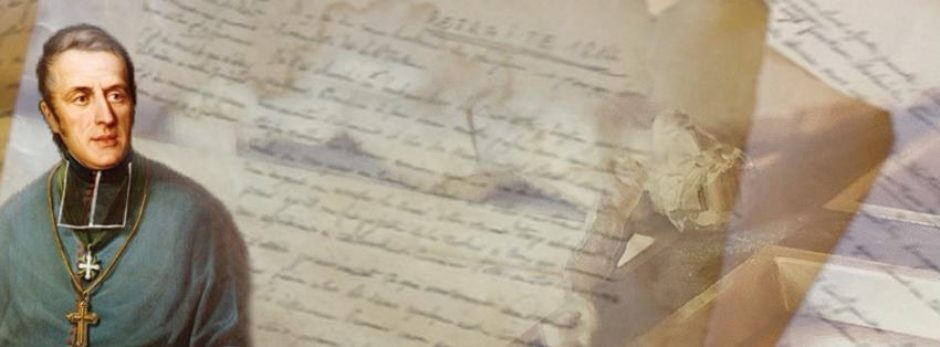
I HAVE ALWAYS BEEN A MAN OF DESIRES AND SOME OF THEM HAVE BEEN HEARD AND FULFILLED

During his lifetime, St Eugene was portrayed as having a zealous missionary heart as large as the world.

I am not a prophet, yet I have always been a man of desires and some of them have been heard and fulfilled. May those I address to God for you, my dear children, draw upon you every heavenly blessing and fill your souls with graces and consolations.

Now the Oblates, on their way to Canada, were putting this dream into practice. Eugene’s fatherly heart responded with affection.

You are the object of my most tender solicitude, you are constantly in my mind; my heart could not love you more considering the fidelity of your response to your vocation and especially the zeal with which you have undertaken the beautiful mission which has been awarded to you, for you know that others among your brothers wished to be a part of it. So be it, you represent them all and the Congregation will felicitate herself for having confided this work to you.

Adieu, my dear children,

I wish you once more a good voyage and bestow on you my paternal benediction permanently as I pour out my heart to you.

Letter to the first Oblates leaving for Canada, 9 October 1841, EO I n 9

Posted in WRITINGS | 1 Comment

THE MORE YOU ARE HOLY, EXEMPLARY, REGULAR, THE MORE GOOD WILL FLOURISH

St Francis of Assisi had instructed his friars to preach with words only when necessary. In other words, it was the exemplary quality of their lives that was meant to make the biggest impact on people. This too was the principle of Eugene: let your actions speak louder than your words.

Anyway you realize that the reputation and the fame of the Congregation are in your hands. The more you are holy, exemplary, regular, the more that good will flourish.

You are expected to make it grow in vast regions for Montreal is perhaps only the gateway leading the family to the conquest of souls in several countries.

When you have reached the scene, you will sound out the terrain. The first thing is to get properly settled where we are called. If God blesses us, then we will see…

 May the aroma of your virtues attract Canadian clergy to you, whether from Montreal or Quebec, no matter, or rather, may Quebec also furnish her contingent and thus attract you into this diocese. But I anticipate the future by that thought.

Letter to the first Oblates leaving for Canada, 9 October 1841, EO I n 9

Posted in WRITINGS | 1 Comment

I ENJOY CONVERSING WITH YOU ABOUT WHAT WE HOLD IN COMMON.

The six missionaries who were on their way to establish the first Oblate mission in Canada were human and certainly not perfect. Eugene, as the father of this family, was aware of this and gives them advice on how to live as a united religious family.

Be of one mind; put up with each other. Even though something be not to your liking, take care not to grumble. Communicate the observations that you believe useful, but mildly, not contentiously or bitterly. If they are not adopted, keep your peace and do not swerve from obedience.

Never make personal remarks, never be touchy, let there be candour, frankness, simplicity, mildness and especially charity, “everything done in love”.

In case of need, communicate with me confidentially but only after ruminating the matter at the foot of the crucifix, without prejudice, without exaggeration.

We are all members of one body, let each strive by every means and by making sacrifices, if he must, for the well-being of this body and the growth of all its potential.

I do not know why I remind you of these things. I am quite aware of the fine spirit which animates you. It is just that I enjoy conversing with you about what we hold in common.

Letter to the first Oblates leaving for Canada, 9 October 1841, EO I n 9

Good human and fatherly advice that calls us to a reflection on our own relationships today.

“See how these Christians love one another and are even ready to die for one another.” Tertullian in the 2nd century.

Posted in WRITINGS | 1 Comment

SONS OF MINE JOURNEYING TOWARDS THIS BEAUTIFUL MISSION WHICH REACHES OUT ITS ARMS TO YOU

St. Eugene writes to the first-ever group of who leave France to establish our first foreign mission “sons of mine who journey towards this beautiful mission which reaches out its arms to you.”

He warns the six Oblates about the importance of the impression they will make on their arrival. Their success in preaching the Gospel depends on it.

Be mindful on arriving that all eyes will be upon you and that you will be judged first by appearances. It is difficult to overcome first impressions.

Let people see in you men marching to the conquest of souls, whose integrity can be counted upon for the edification of the clergy and of the people of this vast diocese and of all these lands.

The key to their success was to be found in modelling their lives according to the Oblate Rule, which summed up how to live the spirituality and mission of the Oblates.

Once you are settled, promptly follow the guidance of our Rule. Let it not be said that the Sulpicians and the Jesuits [ed. the two major groups in Eastern Canada at that time] are better at this than you.

Letter to the first Oblates leaving for Canada, 9 October 1841, EO I n 9


Posted in WRITINGS | 1 Comment

PERSUADE THE PARTIES TO ACCEPT THE DECISIONS YOU GIVE AS MOTIVATED BY A SPIRIT OF IMPARTIALITY

Bishop Eugene de Mazenod, committed to be in Marseilles, nevertheless took great interest in the missionary work of each of his Oblate sons.

Continue this vocation with trust and courage, you see how the good Lord guides your steps and helps you.

Then he referred to the reconciliation ministry that the Oblates were doing in Corsica between the violently opposed factions. It was not sufficient to bring about reconciliation in words and emotions. It was necessary to provide each party with the opportunity to express their disputes (usually over property and power) and then to work together to a mutually agreed solution. The Oblates became neutral mediators to arbitrate a permanent settlement.

I certainly approve that you agree to be the arbitrators of the disputes that maintain discord between families. To this end, however, you need to acquire some knowledge of the laws that govern the subject. You will have to read the civil code because you have to be careful not to risk taking decisions that may be in conflict with the law. Equity does not always suffice.

You must act with much prudence in all the cases and persuade the parties as far as possible to accept willingly the decisions you give as motivated by a spirit of the most perfect impartiality.

Letter to Fr. Etienne Semeria, 10 November 1841, EO IX n 748

Eugene’s sentiments echoed those of Jesus, who  sent his disciples on difficult missions with these words: “See, I am sending you out like sheep into the midst of wolves; so be wise as serpents and innocent as doves.” (Matthew 10:16)

Posted in WRITINGS | 1 Comment

SURROUNDED BY ALL THESE BLOODTHIRSTY MEN WHO BECOME LIKE LAMBS AT YOUR CALL, THE DAGGERS FALLING FROM THEIR HANDS

Eugene de Mazenod was Superior General of the Oblates, while at the same time being Bishop of Marseilles. He thus had the overall responsibility for the missionary work of the Oblates and took a direct interest in all that they were doing. He rejoiced in their successes.

My dear Father Semeria, every time I receive your letter, I must begin with fervent thanks to God for all that he deigns to do through your ministry.

The Oblates had been on the island of Corsica for six years, in charge of the major seminary and preaching village missions. The island, at that time, was known for violent family feuds and bloodshed. They had just finished a mission in the town of Zicavo where they had managed to be peacemakers among the warring factions.

Zicavo CC BY-SA 3.0

This time I admit that we must even redouble our gratitude for the marvels of this beautiful mission of Zicavo: we have to shed tears of joy.

From here. I see you surrounded by all these bloodthirsty men who become like lambs at your call, the daggers falling from their hands: they forgive and embrace each other. Oh how beautiful this is! And this moving response: now that their arms, loaded as they were to kill their enemies, now that these latter no longer existed. it was only right that they be shot off in your honour. Yes, that is superb!

Letter to Fr. Etienne Semeria, 16 October 1841, EO IX n 741

Eugene’s joy is that of Jesus who had used the missionaries as His ministers of making God known and bringing about God’s reconciliation.

“At that time Jesus said, I thank you, Father, Lord of heaven and earth, because you have hidden these things from the wise and the intelligent and have revealed them to infants; yes, Father, for such was your gracious will. All things have been handed over to me by my Father; and no one knows the Son except the Father, and no one knows the Father except the Son and anyone to whom the Son chooses to reveal him.” (Matthew 11:25-29)

Posted in WRITINGS | 1 Comment

THE HAPPINESS OF FINDING MYSELF WITH PERSONS SO BELOVED

On a rare break with his mother and his sister’s family, Eugene described his impressions in glowing terms. The family gathering was to be the last with his nephew, Louis, who was terminally ill. Two of Louis’ sisters had died in their teens, and now he faced death at the age of 26. Only two of his siblings were to survive: Eugène and Césarie.

The Boisgelin Family chateau at St Martin de Pallières, Provence

We had community life at the chateau. It was inspiring to see around me so many Christian souls who joined the most amiable qualities to the charm of virtue.

Our good octogenarian mother, model of patriarchal customs, so exact in all her religious duties, reciting with my sister her daily Office with an admirable devotion and recollection; my sister, true angel of piety, a strong woman tested in the crucible of suffering and bearing with heroiccourage, which does not exclude deep feeling, the cruel loss of her children so worthy of our most bitter regrets.

My brother-in-law, is the most honorable man I know, who lacking only in what the Lord has granted through the prayers of his virtuous wife andall of ours, that is, practices the religion he had always honored with deepest respect.

What shall I say of my nephew Louis so holy, so spiritual, so accomplished and his brother Eugene who charmed everyone and has proven to all that the praise of Fr. Pillon, rector of the college of Brugelette, was rightly deserved.

As for Césarie, all who know her will agree with me when I say that she is as lovable as she is good, that her mind, her heart and her character make her a perfect subject.

The happiness of finding myself with persons so beloved was troubled and mingled with bitterness when considering the suffering of our poor Louis….

Eugene de Mazenod’s Diary, 16 September 1841, EO XX

Posted in WRITINGS | 1 Comment

THE HAPPINESS I FEEL WHEN I DISTRIBUTE THE BODY OF JESUS CHRIST TO ALL MY FAMILY

Eugene’s nephew, Louis Boisgelin, was studying to be a Jesuit priest and had fallen gravely ill. He would be the third of Eugene’s sister’s children to die young.

Louis had been sent home to rest for a while, and Eugene joined them for an 8-day break.

I cannot express the happiness I feel when I distribute the body of Jesus Christ to all my family. This is something divine; I always have difficulty holding back my tears, my heart is so full.

Eugene de Mazenod’s Diary, 14 September 1841, EO XX

Posted in WRITINGS | 1 Comment

WE GROW OLDER ONE DAY AT A TIME, BUT THEN COMES THE ANNIVERSARY THAT REMINDS YOU THAT YOU ARE OLDER BY A YEAR

Eugene’s musings about his 60th birthday and age need no commentary today.

August 1: Nothing special today except that I finish my 59th year. This is how we approach the end almost without even noticing it. We grow older one day at a time, but then comes the anniversary that reminds you that you are older by a year, and each year the number grows and eventually surprises you because in this rapid progression nothing seemed changed, neither in the strength of the body nor in the mind.

If the mirror had been consulted, it could have called one’s attention to the irreparable ravages of the years, but I use this piece of furniture only to hastily get rid of an unwelcome beard; besides, the mirror shows you nearly as you were the day before and who is going to reflect on the more orless beauty, more or less freshness of one’s face. And so I fall into the sixties. It would almost be better not to know it, because it seems that is the end of life, and then where to find the courage to do something? It takes an effort of the will, powerfully stimulated by the grace of God.

Eugene de Mazenod’s Diary, 1 August 1841, EO XX

Posted in WRITINGS | 1 Comment

IT IS PROVIDENCE WHICH ARRANGES MATTERS WITHOUT OUR HAVING THE LEAST HINT IN THE WORLD.

Hippolyte Guibert had been 14 years old and living near from the Missionaries of Provence when they were founded in 1816 in Aix. For seven years he observed their zeal and finally, at the age of 21, he felt called by God to join them. In 1823 he made his perpetual oblation.

Guibert was a highly talented person, but always remained humble. Eugene recognized his qualities and gave him several positions of leadership, notably superior of the community in Laus and then as rector of the major seminary in Corsica.

The French Church and the Government also noticed his qualities and in 1841 appointed this 39-year-old Oblate as Bishop of the city of Viviers. (He was later to become Archbishop of Paris and the first OMI Cardinal – but that story is for later)

The government wants to appoint Fr. Guibert a bishop. I’m not surprised.

Eugene de Mazenod’s Diary, 20 July 1841, EO XX

The Oblates in France had already been depleted by the six missionaries sent to Canada, and now one of the most gifted Oblates was also being removed from the work-force. Eugene confided to Father Courtès:

To complicate further our quandary, look how our Father Guibert has just been taken away. There is no denying the advantages of this nomination in several respects but it overwhelms me in the present situation. I would willingly have seen him named to Gap two years ago — the reason is obvious — but at Viviers, and at this time, I am stunned.  However, I could not oppose the plans of Providence. It is Providence which arranges matters without our having the least hint in the world. It will come to our help.

Letter to Hippolyte Courtès, 11 August 1841, EO I n 3

Posted in WRITINGS | 1 Comment