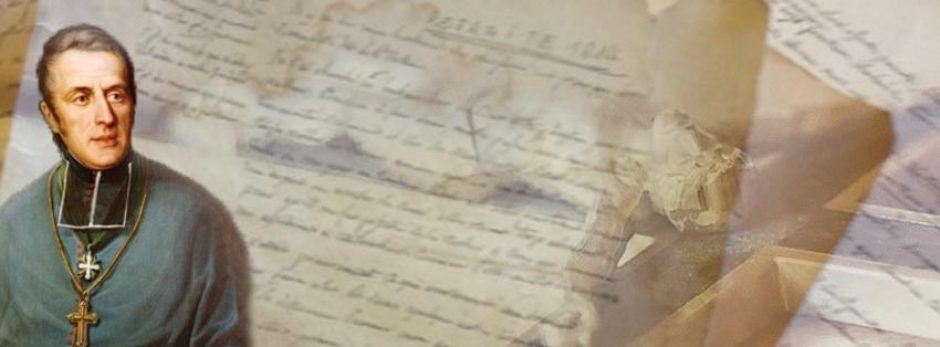
THE LOSS OF THIS HOLY MAN HAS DEEPLY AFFECTED MY HEART. ONE CANNOT REPLACE SUCH FRIENDS!

On February 12, 1840, the 91-year-old retired Bishop Fortuné de Mazenod became seriously ill. His nephew Eugene did not leave his bedside until his death on 22 February.

He later wrote that he mourned

the untimely death of my dear uncle. All has been written and printed about this blessed death, I do not have the courage to add anything, but the loss of this holy man has deeply affected my heart. One cannot replace such friends!

Eugene de Mazenod’s Diary, April 1840, EO XX

Eugene was deeply affected because he had had a deep friendship with his father’s brother. He was associated with his uncle during his childhood in Aix. Then they were together during part of the years of exile in Venice, Naples and Palermo. After Eugene’s return to France, Fortuné and Eugene lived under the same roof from 1817 to 1841 and worked together. It is thus easy to understand his grief

My thoughts go to the tomb where I just placed the precious remains of my venerable uncle. Yet a few years and I will go down into the same crypt to be placed beside him and our ashes will await there together for the great day of the glorious resurrection, as it is written on the stone which will cover both of us: Hic jacent, etc., expectantes beatam spem et adventum gloriae Magni Dei [ed. “Here lie, etc…. who await the blessed hope and the coming of the glory of our Great God.” -Titus 2:13]

Eugene de Mazenod’s Diary, April 1840, EO XX

For further details on Fortuné, see the article in the Historical Dictionary https://www.omiworld.org/lemma/mazenod-bishop-fortune-de/

Posted in WRITINGS | 1 Comment

ALL OUR ACTIONS CAN BE ACCEPTABLE TO GOD WHEN WE OFFER THEM TO HIM.

In France it is customary that people wish each other for the New Year – whereas in several other countries this is done for Christmas. For the Bishop this meant hours of meeting people formally to exchange greetings and good wishes.

Eugene found these moments heavy, but saw them as an important part of his role in the city. He survived them by trying to live them in the presence of God.

January 1:

And then began the grand general reception. It lasted all day. I had to repeatedly raise my heart to God to offer him the wearisome duty of my position. As annoying as it is, there is a good side to be considered. It is a tribute to the head of religion in the diocese. A lot of people meet him. We exchange a few kind words.

Eugene de Mazenod’s Diary, 1 January December 1840, EO XX

The visits were so numerous that a second day had to be set aside to continue the process.

January 4: A day of visits like yesterday. All our actions can be acceptable to God when we offer them to him. It is out of duty that I do thisdrudgery. Besides, some good comes from this meeting of the pastor with his flock.

Eugene de Mazenod’s Diary, 4 January December 1840, EO XX

A good attitude for us to cultivate when we have to face the dull routine of some of our daily occupations.

Posted in WRITINGS | 1 Comment

A HOSPICE FOR BEGGARS

Another example, from Eugene’s diary, of his being constantly aware of the needs of the most abandoned in his diocese, and taking practical steps to respond:

I went to get the Prefect in my carriage to show him the second monastery of the Visitation that we would like to sell for a hospice for beggars. My goal was accomplished; the prefect was delighted with the locale and he finds it fitting for the purpose in question.

Eugene de Mazenod’s Diary, 23 December 1839, EO XX

His 24 years as Bishop of Marseilles were marked by his Oblate outreach in practical ways of bringing the Gospel to the most abandoned.

Posted in WRITINGS | 1 Comment

THE PAINSTAKING CARE I GIVE TO THE YOUNG PRISONERS THROUGH THOSE WHO LOOK AFTER THEM

Nine months after the diary entry we reflected on yesterday, Eugene wrote about the success of the penitentiary for juvenile delinquents. The Brothers of St Peter in Chains cared for these abandoned youth between the ages of 10 and 18.

I went to administer the sacrament of confirmation to a young person who was dying in the house for juvenile prisoners. There are already 45 children in this house between the ages of 10 and 18. It is painful to see this early degradation; we expect much from the painstaking care that Igive these poor youth through Fr. Fissiaux and Fr. Margaillan, his assistant. Already some of these children are showing the good effects of the religious instruction they receive.

Eugene de Mazenod’s Diary, 9 February 1840, EO XX

Eugene felt personally responsible for their welfare and supported those who dedicated themselves to their care.

Posted in WRITINGS | 1 Comment

BROTHERS WHO SERVE THE YOUTH IN PRISON

Missionary Oblate, Eugene de Mazenod, dedicated his life to bringing the Gospel to those who were most in need. During his years as Bishop of Marseilles he preached the Good News of salvation through his closeness to the most abandoned spiritually and materially. He did this by empowering people in his diocese to dedicate themselves to serving particular needy groups.

In today’s diary entry we see him focusing on the youth, on the most abandoned among the young men: the young delinquents and prisoners. Together with one of his diocesan priests, they started an industrial school for young prisoners.

May 21: Before my Mass in my chapel I gave the religious habit to three Brothers who are destined to serve the prisoners. They are the core of the association that we intend to create. I put them under the direction of Fr. Fissiaux, giving them the name of the Brothers of Saint Peter in Chains

Eugene de Mazenod’s Diary, 21 May 1839, EO XX

To achieve this, a religious congregation was founded in the city, known as the Brothers of Saint Peter in Chains. They dedicated themselves to running industrial and agricultural penitentiaries, thus ensuring that the young prisoners would have a profession that would make a valuable contribution to society once they were released from prison.

Their mission continues today. In 2018 some of the Spanish members of this Congregation and their associates were beatified as martyrs.

Posted in WRITINGS | 1 Comment

JOIN US TO LEARN MORE ABOUT SAINT EUGENE DE MAZENOD


Visit http://tiny.cc/eugene101 for more information


Posted in WRITINGS | 1 Comment

PRAY WITH THE MAZENODIAN FAMILY ON SUNDAY 18 OCTOBER

Invitation to our monthly oraison with the Mazenodian Family.

More info at https://tiny.cc/oraison


Posted in WRITINGS | Leave a comment

JESUS PRESENT, TANGIBLE, AND IN A WAY VISIBLE, ELECTRIFIED THE HEART

One of the major achievements that Bishop Eugene de Mazenod was remembered for during his many years in Marseilles was his promotion of works to look after the material and spiritual needs of the most abandoned. Throughout his Diary we find references of his inspiring and supporting groups of people to respond.

One of these was the Providence House for girls orphaned by the cholera epidemics of 1834 – 1835. Four years after the foundation he wrote in his diary:

January 14. Mass in the chapel of the home for Poor Girls. Many ladies attended. I received more than 50 of them. The association now numbers 475 women… It’s a miracle.

Eugene de Mazenod’s Diary, 14 January 1839, EO XX

and:

January 20: Mass at home for Poor Girls. It was at the end of a retreat that Fr. Deplace had given to the ladies of this work who attended it very assiduously. It was really a superb celebration. It was nice to see more than 300 ladies gathered in the chapel where the Blessed Sacrament was enthroned amidst about 200 candles, with the bishop coming to offer the Holy Sacrifice on this altar of lights from which shone even more abundant graces than lights.

150 poor young girls together with those who served as their mothers came to nourish themselves on the same heavenly food. This was something that touched the depth of one’s soul.

Also the beautiful Mass of the Holy Name of Jesus, the beautiful words of the Introit, etc. addressed to Jesus present, tangible, and in a way visible, electrified the heart. I was moved to tears by the deep emotion which I felt.

Eugene de Mazenod’s Diary, 20 January 1839, EO XX

An Association of 475 women looked after 150 orphans. Most through material and financial support and others through the physical and spiritual care of the orphans in the Providence House. Jesus was indeed tangible and visible in this work.

See: https://www.eugenedemazenod.net/?p=4119


Posted in WRITINGS | 1 Comment

I LET YOU KNOW THESE THINGS SO THAT YOU CAN SPEAK CONFIDENTLY TO GOD ABOUT THEM

In the previous entry, Eugene had asked for prayers at the Marian Shrine of Osier regarding the difficulties that the Oblates were going through. He continues to storm heaven by asking the contemplative sisters to pray for him.

I thank you, Good Mother, for your attention. I profit from the occasion you provide me to beg you to enjoin your community to recommend especially to God the Congregation of our Missionaries which is suffering a cruel persecution in the diocese of Gap…

We lack men, it is impossible to fulfill all the ministries that the Congregation wants to do. The death of the holy Father Albini has completely undone the missions in Corsica…

In short, a time of trial; we need the help of your prayers to repel the evil one to whom God has allowed some power to sow darnel in the field and to devastate the inheritance of the Father of the family.

I let you know these things so that you can speak confidently to God about them. I unite myself in advance with your prayers and bless you as well as your whole community.

+ C.J. Eugene, Bishop of Marseilles.

Letter to Mother Abbess of the St Clare convent, 23 November 1839, EO XIII n 97

Posted in WRITINGS | 1 Comment

NEVER BEFORE HAS THE CONGREGATION EXPERIENCED A SIMILAR STORM

Writing to Father Guigues, who was at the Marian Shrine of N.D. de L’Osier, Eugene commends the Congregation’s difficulties to Mary’s intercession.

Pray to the Blessed Virgin that she comes to our assistance, never before has the Congregation experienced a similar storm. Death, apostasy, dreadful persecution from those whose duty it is to protect her. Are these sufficient reasons to cry out to God?

Letter to Bruno Guigues, 4 November 1839, EO IX n 704

Death: Eugene was mourning the death of two Oblates. Fr Albini to whom he had been very close for the past 16 years, and the 22 year-old scholastic brother Morandini.

Apostasy: Fr Jerome Gignoux had left the Congregation and was stirring up violent opposition against the Oblates outside.

Dreadful persecution: at the Shrine of Notre Dame du Laus (which we had served from 1818) the new Bishop and the priests of the Diocese were agitating to remove the Oblates from the highly successful Shrine ministry so that they could take it over themselves.

Yet, in the midst of all this, Eugene kept his eyes on God for strength.


Posted in WRITINGS | 1 Comment