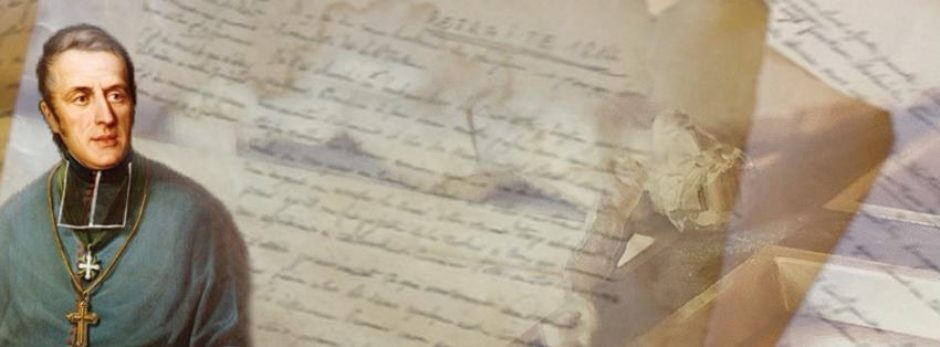
Every six years the Missionary Oblates gather for an important meeting, called a General Chapter. Here, representatives from each province come together to review the state of the Congregation and to evaluate its responses to the needs of the world at that particular time. It is the highest decision-making Oblate gathering and ensures faithfulness to our God-given charism and spirit.
Rey, the Founder’s biographer, describes this gathering which took place in July 1843 in Marseilles.
In May he had already sent the official letter of convocation of the General Chapter for July 10. This was the seventh that the Congregation was to hold. On the 11th and 12th of the same month, he made the canonical visit to the Calvaire community as a kind of preparation for the general meeting of his children. He was fully satisfied and his desire increased to see the Superiors and delegates of all the houses assembled around him…
On July 10, the members of the Chapter met at the Major Seminary, 22 in number. After the Mass celebrated by the Superior General, they went to the chant of the “Come Holy Spirit” in the assembly hall, and there, taking his place at the stand prepared in the center of the auditorium, the Founder addressed his children.
But,” say the Acts of the Chapter, “no sooner had the Superior General said a few words to thank heaven for the memorable things accomplished since the last Chapter in the bosom of the congregation than he was suddenly overwhelmed by one of those tender and lively emotions that he could not hide. His spirit, he said, had descended into his heart. The emotion was shared by the whole assembly and each one tried to express the most filial and caring affection towards a beloved father. Guibert’s elevation to the episcopate and the founding of the missions in Canada and the British Isles, he exclaimed:
“These are the wonders of Providence upon us and an ever more pressing reason to thank the Lord who has given us such a vocation and to accomplish even more faithfully the apostolic virtues that this vocation demands of us.”
REY II p 161 – 162
Pertinent advice for all of us who are tempted not to read the signs that God sends us regarding the responsibility of self-care.
I have learned with extreme pleasure by your letter that you have recovered from your illness; but it is with some anxiety that I learn you are planning to give several retreats in a row. We must never wish to do more or otherwise than the good Lord indicates. In this matter, I would wish you to take the advice of your admonitor in all simplicity in order to avoid responsibility before God and the Congregation of unpleasant consequences which might result to your health, so precious to all of us.
Letter to Father Eugene Guigues (at at N.-D. de L’Osier, France). 6 July 1843
Continuing his letter to the Society of the Propagation of the Faith, Eugene boasts about the Oblate achievements in England and Wales and their hopes for the conversion of many to Catholicism. The vocabulary is of that time – bear in mind that in the 19th century Catholics held that outside of the Catholic Church there was no salvation, so it was imperative to focus on the conversion of people in a predominantly Anglican country.
This same Congregation has also opened a house in the county of Cornwall in England. This house begins with the founded hope of being a powerful means for the conversion of the Protestant population of the county. Everything already bodes for the best and a number of conversions have in a certain way inaugurated a work which from its very birth has encountered a nearly general sympathy in the country. The Church of the Missionaries constructed in Penzance is spacious but it has not been paid for entirely. In this sense, nothing can be requested from the Protestants who nonetheless enjoy coming to attend the services of the Catholic Church and listening to the instructions delivered by our men. This initial success has given rise to the upcoming establishment of a new foundation in Wales in keeping with the wishes of the Apostolic Vicar of that district. There are hopes for joyful fruits of salvation in England.
I also felt it necessary to consent to the opening of another house in Cork in Ireland. Besides the fact that our missionaries, who have already tested their mettle in that country, will be very useful assistants to the local clergy since their own spirit makes them particularly suitable for a ministry which furthers the action of the Irish clergy, it is necessary for our men to recruit workers from among this clergy for Upper Canada where English is spoken and for the English missions. Candidates for this will not be lacking and they will be able to fulfil their vocation perfectly if we receive them young enough to form them properly in the religious education of a good novitiate.
The activities abroad, however, are too vast for our Congregation to be able to suffice with its resources alone. The Congregation needs the assistance of the Missionary Society of the Propagation of the Faith, and I request that aid with all the more confidence since what we have done has assumed today sufficient importance and extent for us not to be disregarded in the distribution of funds destined for the foreign missions. I hope that as of this year you will be so obliging as to grant us the aid which will allow us to accomplish what the Lord has permitted us to begin with the visible effect of His blessing.
Letter to the Society of the Propagation of the Faith, 15 June 1843, EO V n 82
Then the personal touch was added here as well to arouse the generosity of the benefactors.:
There is another missionary of the same Congregation of the Oblates of the Immaculate Conception who will come to visit you. He too will have wonders to tell you about his mission in Ireland and in the county of Cornwall in England. … He is one of the most distinguished men who has already earned the esteem and trust of all the bishops of Ireland and England with whom he has been in contact. These bishops place upon him and his companions all their hopes for the conversion of the heretics in the county of Cornwall and the principality of Wales. His name is Fr. Aubert.
He has already opened a church in Penzance where for the last 300 years no one has ever seen a single external rite of our holy religion. Ten abjurations have been the prelude to what grace will bring about in these areas. However, he will need the assistance of your Council. I hope you will be good enough to promote the cause of these poor heretics who await only the moment of grace to return to the fold. Fr. Aubert’s community now consists of three priests and four novices. He is coming to France to ask me for more men whom he needs in order to include the provinces ready to receive him and thereby respond to the pressing requests from the bishops who have placed their hope in him. Fr. Aubert will be able to give you a better explanation of his position and the state of affairs. I think you will consider his a just case to benefit from the aid of the Missionary Society.
Letter to the Society of the Propagation of the Faith, 3 June 1843, EO V n 81
Establishing Oblate missions outside of France required personnel and funds. The Society for the Propagation of the Faith was generous in giving financial assistance. In order to receive a grant each year, Eugene had to write to them to give a report on the Oblate missionary situation. He obviously stressed all the achievements so as to entice the benefactors to be generous.
Today these letters give us a glimpse of some aspects of the missions that are not always recorded in Eugene’s diary. Even better, when possible, a personal visit by an Oblate to the Propagation offices made a huge difference in the willingness to give a grant.
Dear Sirs,
The Congregation of the Missionary Oblates of Mary Immaculate, of which I am the Superior General, after evangelizing for a number of years after its approbation by the Holy See a large number of dioceses in southern France has undertaken to open foundations abroad. Around two years ago a number of its members left for Canada. There are now seven priests and six lay brothers[1] and in the novitiate they have received young ecclesiastics who wish to join their ministry. The good they have wrought in the diocese of Montreal as well as the surrounding dioceses has been the cause of great wonderment in those areas. While His Excellency the Bishop of Montreal encourages their effort in favor of his sheep among whom they are established, the other bishops also ask them to open houses in their dioceses. They are especially prompted to this effect by the prelates of Upper Canada. Their increase in this country, however, depends very much on the resources to be placed at their disposal.
Letter to the Society of the Propagation of the Faith, 15 June 1843, EO V n 82
Then, to add a personal touch, he wrote:
Divine Providence places me in a position to be grateful for the kindness granted to our missionaries by the Propagation of the Faith…
I assume that you will soon see one of our missionaries from Canada. He will tell you about all the wonders brought about by their ministry. They have already brought back a large number of heretics and the one whom I expect coming to Europe for a few months single-handedly confuted 5 or 6 ministers in a public debate they had had the temerity to promote…
P.S. I forgot to tell you that the two missionaries who were to leave for Canada were held up at the time of embarkation due to illness. They will leave with the person I am waiting for and who should go back in August.
Letter to the Society of the Propagation of the Faith, 3 June 1843, EO V n 81
Father Telmon had come to France to attend the General Chapter in Marseilles and to bring back to Canada three reinforcements for the Oblate mission: Fr. Allard and two deacons: J.-N.Laverlochère and Aug. Alexandre Brunet.
One of Eugene’s greatest joys was to receive news from his Oblates about themselves and their missionary work. The length of time that letters from Canada took was a source of frustration for him, thus making it a special occasion when a letter did arrive.
Since my last letters, my very dear Father Honorat, I have received in the same mail yours of April 14 and that of Father Telmon of the 5th of the same month. This is too much enjoyment in one day… You would not believe what I went through with his letter.
I who am so avid for every detail about your community, your persons and your activities, am obliged to keep my eagerness bottled up and champ at the bit while reading two dull pages only on the subject of the Sisters of Jesus and Mary. I writhed as I watched the paper being consumed without anything said about you. For the love of God, play no more tricks like this on me. Ten lines suffice for anything not related to you.
Letter to Jean Baptiste Honorat, 31 May 1843, EO I n 19
Letters at that time were usually made up of one sheet of paper folded into four pages, with the last half being left for the address to be written on before it was sealed. There was no envelope. This explains Eugene’s frustration when useless things filled up the pages instead of news – added to which was the high cost of the paper and the postage for each sheet.
Young Father Lucien Lagier was 27 years old when he arrived in Canada. He was impressionable and had been unduly influenced by the negativity of Fr. Baudrand. Now that the latter had been removed, Lagier was able to come to terms with his shortcomings and mistakes.
Eugene wrote to Father Honorat, his superior in Canada:
In thus agreeing amongst yourselves, in esteeming each other, in loving one another as you ought, you will inevitably lead the young Father Lagier, who needs it, in the right direction with this good example. Father Telmon can be very useful to him in correcting his compositions which the latter should submit to him with simplicity and gratitude for to give him this family training is to render him great service. I have always thought that this youngster would not be so unruly as he has been in his letters and presumably as he has shown himself in conversation, had he not before his eyes the aberrations of Father Baudrand.
Neglect nothing to put him back on the right path but, to the efforts he makes to renew himself in the spirit of his vocation, let him join a serious application to study. Persuade him that it is not given to everyone to have the talent of Father Telmon and that so far from being humiliated in following his advice, he should count himself fortunate to have so close to him in the family a brother who shares his knowledge with him and who helps him to develop.
Letter to Jean Baptiste Honorat, 31 May 1843, EO I n 19
The caring approach succeeded, and Father Lagier became an accomplished and successful preacher in Canada and in the United States. He certainly managed to rediscover the “spirit of his vocation.”
An important method of maintaining the Congregation faithful to its charism and spirit was by the regular correspondence between Eugene and the local community superiors. This was especially the case with Father Honorat, the Canadian mission superior, and father Aubert in England, who regularly reported on the community life and missionary activities of the Oblates. After their initial interpersonal setbacks a level of community harmony had been reestablished in Canada. Eugene rejoiced.
I hasten to finish so that my letter may leave today, otherwise I will miss the sailing from Liverpool. Adieu then, but let me say before ending how happy I am with the harmony that reigns amongst you. To think of this consoles and helps me bear your absence. Live always thus. Speak to one another with open hearts without fear of displeasure. When you are of one heart, you always take everything in your stride. Adieu.
Letter to Jean Baptiste Honorat, 27 April 1843, EO I n 17
A month later:
It would be difficult for you to imagine the joy which I experienced on your confiding to me that perfect harmony reigns amongst you. In thus agreeing amongst yourselves, in esteeming each other, in loving one another as you ought, you will inevitably lead the young Father Lagier, who needs it, in the right direction with this good example.
Letter to Jean Baptiste Honorat, 31 May 1843, EO I n 19
How much our broken world needs us to take this seriously today!
Eugene as Bishop of the second-largest city of France and Superior General of a growing missionary Congregation, had very little time for himself. These two extracts give an example.
I let myself go, my dear Father Honorat, and wrote an interminable letter to our good Father Telmon. He addressed to me one so amiable in regard to his sentiments and so interesting that I was bound I would not spare myself in responding to all he had communicated. I locked myself in and, deaf to thirty-six thousand double knocks at my door, I pursued this task as if I were alone in the world.
Letter to Jean Baptiste Honorat, 27 April 1843, EO I n 17
To the Bishop of Montreal:
Having wished to give myself time to reply in detail to the kind and touching letter that you have had the kindness to write me, I have found myself obliged to wait until today when, in order to escape from the incessant and daily disturbances at Marseilles, I have come to take refuge in the country. I have been telling myself: as soon as I shall have an hour to myself, I shall devote it to my venerable friend whose excellent letter is ever under my eyes, but this hour of liberty, experience proves, I shall never have in the midst of my immense population as long as I do not change my system. I know it, my door is open too wide and I am too much at the disposition of everyone, whether it be the sick who must be reassured or the religious ceremonies become so numerous in my episcopal city. I say this, Monseigneur, to explain the delay for which my heart has reproached me many times although it is excused of necessity by my rather unique position. At least I feel relieved today in my solitude, as I take up my pen to converse with you. Half a league away from the city, I promise myself that no one will disturb me.
Letter to Ignace Bourget, Bishop of Montreal, 30 May 1843. EO I n 18
Closeness to his people, in Marseilles and in the Oblates, was always paramount for him – a characteristic he has left to his Mazenodian family until today.
Eugene finished quoting the Bishop of Montreal’s letter to him about the Oblates:
“As for the rest, what I have to say to you about it, Bishop, is by no means to complain about it, but solely to bring you up to date about what is happening here.”
Then he refers to that special grace of state which Eugene had as Superior General :
“Because, having the fullness of heavenly gifts necessary for the government of this congregation, you have the grace of state to give spirit and life to each and to all these members. It is with this perspective that I believe it necessary to ask you to insist, in the recommendations that you give to them…”
Then follows a list of recommendations, which he ends with
“Again, if I make these revelations to you, it is only to put you in a state of better exercising over your infants of Canada this efficacious action whose virtue will always be perceived beyond the seas.”
Eugene’s comment:
What an admirable letter! However helpful it may be for me, it fills my soul with the most lively sentiments of gratitude for this holy prelate who went out of his way to write to me.
The Bishop of Montreal’s letter to Eugene, that we have been studying in these entries, pointed out some of the faults of the Oblates that needed attention. The way in which he did this was a lesson in itself. Eugene commented:
What moderation, what gentleness, what charity! With so many topics of dissatisfaction, to not utter a complaint; to even accentuate the works and the virtues of those who show themselves to be so imperfect, so much beneath their holy mission, as he does in the first part of his letter which I have not copied. But also what a lesson in the recommendations that he suggests making to them!
When it came to some of the mistakes, Eugene was disconsolate because he feared that his dreams for the religious life and missIonary success of his sons would be compromised and only lead to failure.
Not one word is false. It’s the undiluted truth. It’s the faithful mirror of a too incontestable reality. I am brokenhearted about it. Here they are convicted of having conducted themselves poorly in everything. Not a single exception to well-merited reproaches. They have all contributed their share to discrediting and compromising themselves as well as the Congregation, about which they give such a poor impression in the new world.
Eugene de Mazenod’s Diary, 20 March 1843, EO XXI
His “nightmare” never materialized and the missionaries produced admirable fruits.
What does stand out for me is how Bishop Bourget was able to see the good in every person and their possibilities – and never allowed their faults to eclipse their goodness. Eugene recognized this when he responded to his letter:
What a letter is this to which I am to respond! I bow to the heart which dictated it. No, Monseigneur, I shall never be able to express to you how much it has moved my sensibility or excited my admiration and gratitude. Let me pour out my heart with such simplicity and frankness as can banish all flattery; in each line I admire the generosity of the bishop, the goodness of a father, the trust of a friend. I would wish that those who are the object thereof might always have under their eyes this admirable letter, just as I keep it etched in my soul…
I am happy over the good they are doing in your diocese and the tribute you kindly give them fills me with joy, but this is not enough, I intend that they give you no anxiety or worry and I dare say it will be so.
Letter to Ignace Bourget, Bishop of Montreal, 30 May 1843. EO I n 18
Father Telmon was a man of zeal for the Gospel with a capital “Z” – but until he came to Canada his experience had been of France and he did not understand the protestant churches. Bishop Bourget continues to narrate to Eugene:
“Fr. Telmon, with his passionate manner, reacted unsuitably several times with the best intentions in the world. He unfortunately consented to engage in a public debate with some Protestant ministers. Although he would have floored and beaten them on an even playing field, and there would have resulted a great good therefrom, nevertheless, from other aspects, this debate had some regrettable consequences and there especially resulted therefrom a public impression that he had not been victorious in this battle. The reason for this is that his enemies had the effrontery to sing a victory song and that a good number of Catholics, who were present, did not have sufficient instruction to discern the solidity of his arguments and the futility of those of his adversaries which are always very hollow for people who are not accustomed to controversy.
In the 19th century the Oblates (and the Church in general) were not familiar with the concept of ecumenism and were motivated by the doctrine of “outside of the Church there is no salvation.”
On another occasion, he burned some Bibles and Protestant books, without taking sufficient precaution to conceal his action. As well, it became an affair of state to the point that the periodicals of the United States and of Canada, which are committed to publishing people’s mistakes, seized upon it and tried to establish a spirit against the Catholic missionaries who have, they say, committed the awful sacrilege of profaning the Holy Bible. If this good Father were to consult, a little more, people experienced with the country, he would not expose the faith to being thus compromised and would not put the bishops in a very great predicament.
Eugene de Mazenod’s Diary, 20 March 1843, EO XXI
The ecumenical movement entered into Church thinking and practice only in the 20th century, so let us not be too harsh in judging people who acted according to the mentality of their time. Despite all his faults, Pierre Telmon was an amazing missionary who brought many to know Jesus Christ in France, Canada, Eastern USA and Texas – as we shall see later.