BEING CLOSE TO THE PEOPLE BECAUSE EACH ONE HAS THE RIGHT TO BE LISTENED TO BY THEIR PASTOR (Constitution 8)
We will always be close to the people with whom we work, taking into account their values and aspirations.
Constitution 8
One of Eugene’s earliest biographers, Rey (I, p 38), shows how Eugene remained faithful to this program of being available to all in his diocese. Each morning, for four hours, he was in his office to receive whoever came. Because Marseille was a crossroad of all people and all types of misery, it was clear that all these presented themselves and received a welcome, without having to make an appointment or having to state their names. Within a few weeks of starting this practice, Eugene was led to note :
Audiences swamp me!” and “Who will be the most indiscreet in asking me for exorbitant help. Five persons drained me with their requests this morning. Mr. Fabre, magistrate and municipal councilor… had the patience to wait more than one and a half hours for his turn to enter my place. This perseverance gained him a very polite reception.”
Later in the year he reflected on one of these mornings in his Diary:
If mornings such as this one has been, and indeed many others too, were to occur too often, I feel that I would not be able to continue. It is not merely a question of giving money, but to be faced with unfortunate people and to realize that, even doing the impossible, I am not able to meet their needs, is more than I can cope with. A widow
whose husband has died in Cayenne and who hasn’t a penny either to live or to return to her country. A young man, of Belgian nationality, coming out of hospital where he spent all his money and who is now
worn out by his illness and by frustration, has only the 10 Francs given him by his consul to get him back to Belgium. An old lady, the sister of a priest of the diocese who died a long time ago, who has all
her belongings in the pawn shop and who has not the wherewith to go to her son who would at least give her a bowl of soup to prevent her dying of hunger.
Diary, 3 September 1838, EO XIX
Reflecting on these and countless other moments of being close to his people he concluded:
These audiences every day take all of my time. Nevertheless, they are necessary. It is the duty of a bishop to make himself available to all his flock. I have the satisfaction of seeing everybody satisfied with the way they have been received when they leave. I must give advice and help, each one has the right to be listened to by their pastor.
Diary, 8 September 1838, EO XIX
This entry was posted in
WRITINGS. Bookmark the
permalink.
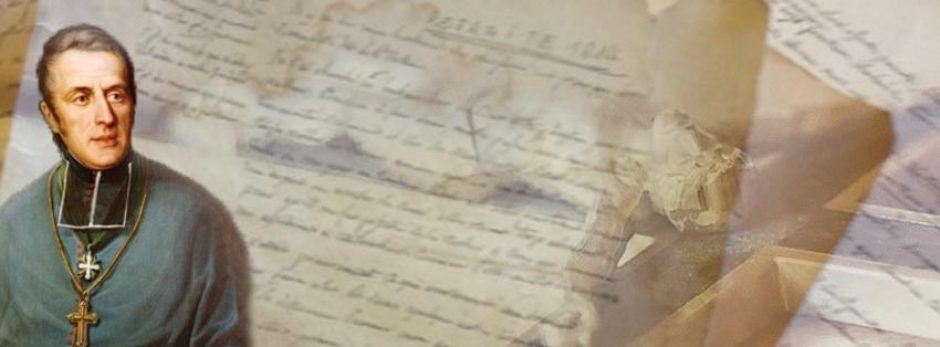
Eugene is the man who a year earlier in his retreat leading up to his installation as Bishop of Marseilles wrote that he had not wanted a flock. I think of Catherine De Hueck Doherty, Foundress of Madonna House here in Canada and who told her priests to “open their hearts and allow the world to trample through” those same hearts. Hers was a begging community made up of lay men and women and priests who served the poor.
Eugene with a heart as big as the world began with priests in France and who shared his charism with priests and brothers, and now with his sons and daughters (the many people who are members of what the Church calls the laity) who have felt the call that he first recognized within himself. The Oblate Charismatic Family made up of religious and lay people who have made their Oblation to God, the Church and indeed the Oblate Family.
Rule 37a inspires and speaks to us: “Lay people […] share in the charism in a spirit of communion and reciprocity amongst themselves and with the Oblates. Blessed Josef Gerard OMI said: “We must love them, love them in spite of everything, love them always.”
Together we share in the charism in a spirit of communion and reciprocity amongst ourselves and with the Oblates. (ref. R 37 a) Today is Thanksgiving Day in Canada: a day to pause and thank God for all that we are given – without looking at boundaries or status. I am so grateful to all of you who have taken the time to show me how to open my heart so that the poor of this world might trample through it and that we are all a part of each others’ hearts.