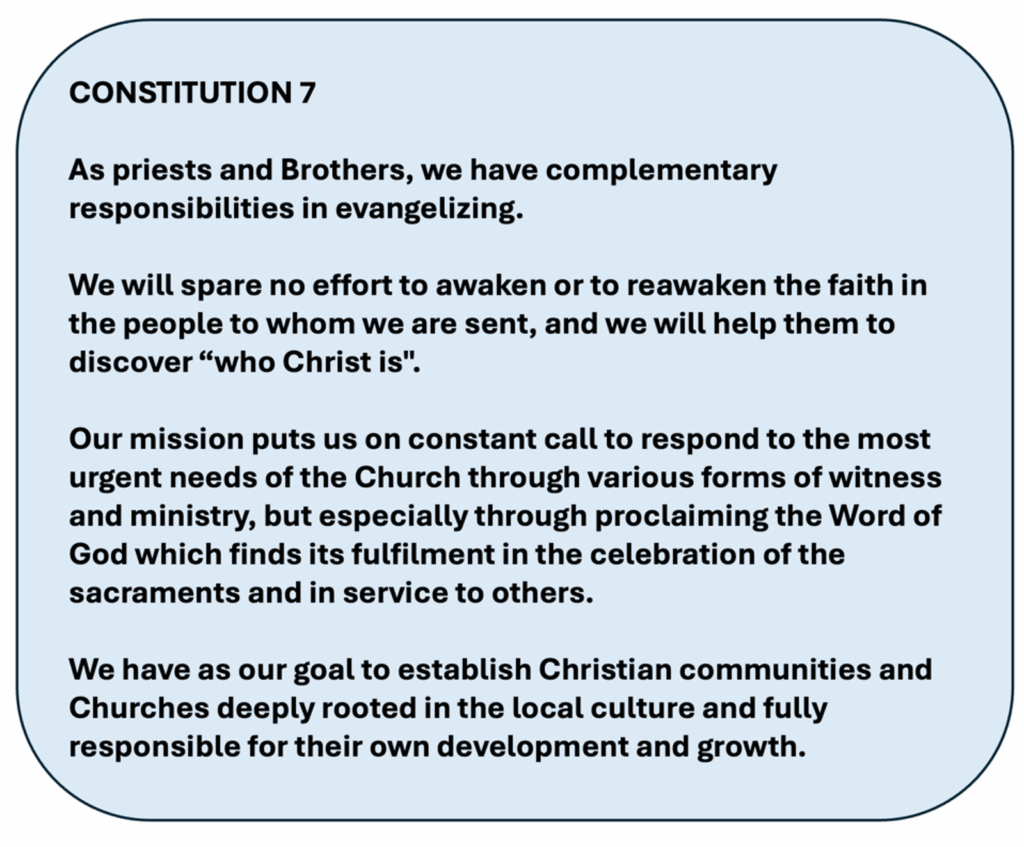
Our mission puts us on constant call to respond to the most urgent needs of the Church through various forms of witness and ministry.
(Constitution 7)
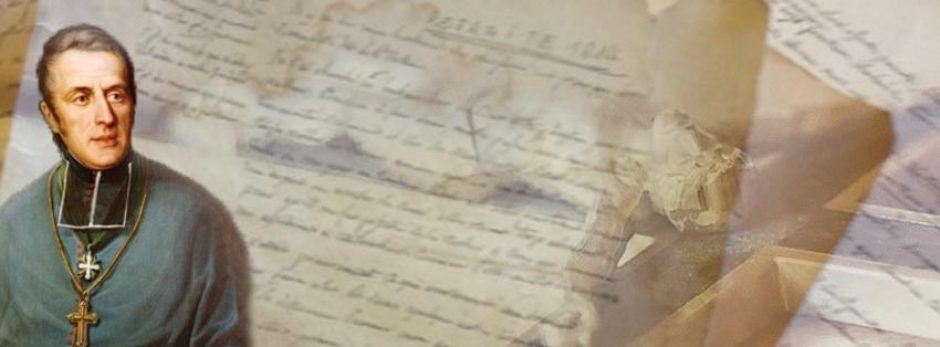
This phrase certainly mirrors the spirit of Eugene and the first Missionaries! In their parish missions they used every possible form of ceremony, symbolic gestures and ministry to communicate their message and respond to the needs of the people. As Bishop of Marseilles, Eugene had the same approach in responding to the most urgent needs of the members of the local church and beyond. Apart from pastoral letters, sermons and personal contacts, he responded by enlisting as many people as possible in the charitable responses of the diocese. He wrote:
Admire how these charities are multiplying. How many new institutions have an objective that was previously unknown!
Childhood, old age, the sick, the poor, the worker bent from morning to night under the weight of the workday and the heat, the innocent in peril, the disgusting and remorse-ridden vice, the young prisoner already initiated into the habits that make criminals, the serious offender hardened in crime, the rich man himself often so helpless before God on his deathbed:
charity embraces everything; and when there are new needs, it invents new responses when necessary:
spiritual help, bodily help, bread for the soul, bread for the body; instructions for ignorance; advice, guidance, support for weakness; a sanctuary for virtue or for penance; pious sentiments, sweet consolations, supernatural strength for the dying;
all types of good works are lavished in the name of Jesus Christ.
Pastoral letter of Bishop de Mazenod to the Diocese of Marseilles for Lent 1847
There is a vary large sculpture in the downtown area of Montreal which portrays a group of people witnessing a great event, “un grand spectacle” or a great light in the night sky. I was first introduced to this some years back during a retreat which spoke to me in a very deep way. It depicted how people either responded or reacted to what they were witnessing.
And while St. Eugene first began with Priests and Brothers, he never closed the doors on anyone rich or poor. It is easy to recognize that he was a man of his times as we read notes from his 1847 Lenten Pastoral Letter to the members of his Marseilles Dioceses.
Now in this 21st Century we recognize how in the Church many of us from all around the world are called to be “lay oblates” and how we “have complementary responsibilities in evangelizing.” Our own vows and commitments lived out in service to God and our Church puts us on call to “respond to the most urgent needs of the through various forms of witness and ministry.” (ref. C7)
Will we be like the people in the sculpture responding to life, to the charism of the Oblate Congregation or will we turn our backs on light and love and the Charism shared with us (“Give us a portion of your Spirit…” by Sandra Prayer) The Oblates do share with us their spirit, they offer us formation and sharing of experiences so that we too become called and sent to our own parishes, towns and cities across the world It is in this way that we become like seeds that are planted deep within us with our baptisms so as to grow and become the fruit of our living.