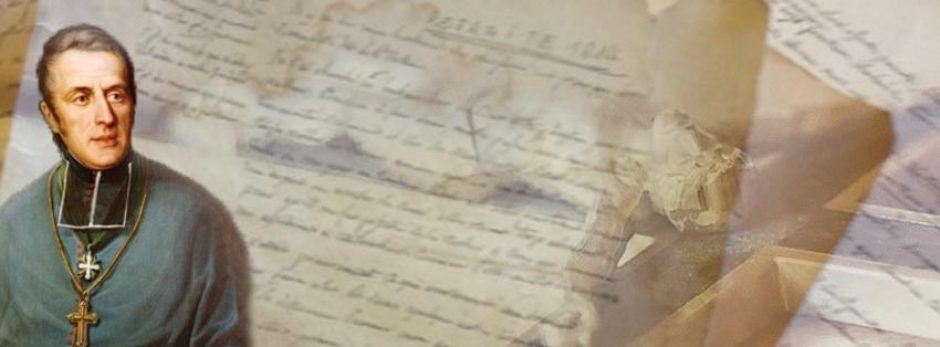
With deepest sorrow I inform you of the death of our good and saintly Father Mie.
Letter to Jean Baptiste Mille, 11 March 1841, EO IX n 726
With these words Eugene announced the death of one of his first companions, with whom he had founded the Oblates in 1816. Pierre Mie and Henri Tempier were the only two of the original founding figures to have persevered as Oblates. For this reason, I will dedicate several reflections to this man.
Born in 1768, he was 21 years old when the Revolution broke out in France and he had almost completed his theological studies for the priesthood at the seminary in Aix. He interrupted his studies so as not to have to make the oath of allegiance to the Revolutionary government. He worked as a teacher and helped the priests who had remained loyal to the Church and had to minister in secret in the villages. Six years later, when the persecution of the clergy had become more violent, and there was a desperate need for priestly ministry, he was ordained in secret.
His first years of priesthood were in the village of La Fare where he worked as a tailor’s apprentice during the day, and did priestly ministry in secret during the night. Jeancard describes this:
Mye returned to La Fare, where he secretly exercised the holy ministry. To hide his true apostolic mission, he pretended to be the apprentice of a local tailor. During the day, he appeared to be busy in the store of the tailor, a good Catholic, who knew the secret of his so-called apprentice’s situation, and at night he carried out his priestly duties. It may well be that he did not apply himself very much to learning his trade as a tailor; he made no progress in this art, for which he had not the slightest aptitude. People who did not know what he really was were surprised that he always did the same thing without succeeding. He did not worry about it and suffered, without saying a word, the reproaches that one of his relatives made on his incapacity apprentice – he did not know that his nephew had other things to do than making clothes,.
However, he was known in the area as a priest. This did not produce any compromising effect; the hostility had calmed down, and the one who had not ceased to be called Father Mye seemed to them rather to be a priest than a tailor of clothes.
“Notice sur le révérend père Mie”, in Missions, 5 (1866), p 435
Mie must have been a man of unusual courage and strength, a man who knew who he was in the eyes of God and who did whatever was necessary in order to live out the call he received from God. Even if that meant taking on the mantle of an apprentice tailor. It sounds as if he was quiet and unassuming and I find myself likening him to Henri Tempier in some ways. Hidden brilliance.
I think of the prayer that has become a part of my breathing as I asked God to “make me little, to make me ordinary, to make me hidden; to make me a light for my neighbours feet”. I smile as I think about it. And I think that is how Fr. Mie and many of his brothers may have out their lives.
I am tempted to think of the many Oblates whose names are well known and set as an example to us; but there are I imagine many more who were and are like Fr. Mie with hidden and quiet strengths and courage. There is a glimpse of beautiful perseverance about him and them.
Eugene chose Mie quite specifically, this man who was older than him and not the kind of preacher that he was looking for; the word tender comes to mind and I do not know why.
He made his oblation November 1st 1818 – a member of the founding community. I stop and look at the members of the Mazenodian Family today that have met – members which can be found all around the world. Many of them ordinary in the sense that live as they have been called, sharing in the Mazenodian charism, the Mazenodian spirit. Living their lives in the unassuming manner that is born in the ordinary of our day-to-day lives; transforming that ordinary to the extraordinary that we see we look through the eyes of our crucified Saviour.
These are the men and women who have become our models, our hero’s; that is such a consolation in light of the challenges we are faced with in today’s world.